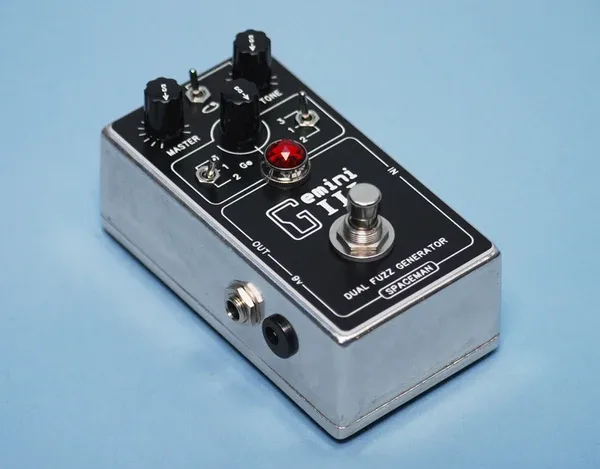


The Spaceman Gemini III is a Dual Fuzz Generator: a discrete transistor fuzz pedal from Spaceman Effects that puts two different fuzz circuits in parallel, one vintage germanium and the other modern silicon, and blends them together with a single Ge/Si knob for a layered fuzz tone1. The germanium side uses vintage 1970s new-old-stock AC128 transistors, which Spaceman prizes for their classic fuzz tone, while the silicon side supplies the harder, more modern voice1.
It was built in small numbers and is long gone from production. Spaceman itself describes the Gemini III as "infamous and now unobtanium"2, and on the used market it trades far above its original price3.
Germanium and silicon fuzz in parallel
Most fuzz pedals commit to one transistor type. Germanium fuzzes tend toward warmer, looser, vintage voices; silicon fuzzes toward tighter, brighter, more aggressive ones. The Gemini III's trick is running one of each at the same time and letting you mix them. Spaceman says the two vastly different fuzzes are blended via the Ge/Si knob, and that the result covers a wide range of usable fuzz territory, from lower-gain classic tones to heavy high-gain, scooped-mid sounds1.
Premier Guitar's reviewer found that range genuine rather than marketing:
"But it is positively packed with fuzz voices generated by parallel germanium and silicon circuits"4
The same review mapped the two sides to recognizable styles. At lower gain settings the germanium side is great for mid-'60s garage-punk tones, while cranked germanium suits the Brit '67-'70 sounds of Beck-Ola, Led Zeppelin I, or Donovan's "Hurdy Gurdy Man"4. Blending in more silicon and rolling off the tone control for a mid scoop moves into Iommi territory and stoner zones, with chords retaining remarkable note-to-note clarity4. The reviewer also found that aggressive use of the filter control can produce a synthy trace of octave suited to Cream-era Clapton runs and horn-like stabs in heavy funk jams4.
Spaceman recommends the pedal for bass as well, saying there is plenty of low frequency response on hand to make for an equally awesome bass fuzz1.
The controls
The Gemini III keeps its control set compact, with shared tone and master knobs and toggle switches for shaping each fuzz circuit1.
| Control | What it does |
|---|---|
| Ge/Si knob | Blends the germanium and silicon fuzzes together for a layered fuzz tone1 |
| Tone control | Affects each fuzz independently yet at the same time; 12:00 gives a balanced full-range fuzz, clockwise scoops the mids, counterclockwise smooths the highs1 |
| Master knob | Controls the output of the final mix, with enough gain on tap to cause what Spaceman calls a supernova1 |
| Gain toggles (each fuzz) | A choice of three gain settings via toggle switch on each side1 |
| Filter sweep toggle | A 2-position switch that alters the direction of the filter sweep in germanium mode4 |
The shared tone control is the unusual part. Because it shapes both circuits at once but independently, one knob can scoop the mids out of the silicon side while smoothing the germanium side, which is how the Premier Guitar reviewer reached the heavier scooped settings14.
Power and connections
The Gemini III runs on 9V DC and uses true-bypass switching, which Spaceman describes as via the heaviest-duty mechanical footswitch available1. Input resistance is 4.7 Meg Ohm1. Bypass current draw is listed at 1.8 mA in one maker listing1; another maker listing gives 7 mA1.
The Gemini III is discontinued and was made in very small numbers, so any unit you encounter today is a secondhand sale. Spaceman's transferable three year warranty and lifetime discount repair plan applied when the pedal was new1.
History and versions
The release date is reported two ways: Guitar Pedal X dates the Gemini III to May 20113, while Spaceman's own Gemini IV page calls it circa 20122. Only 160 of the original Gemini III were made3. Each pedal is numbered on the nameplate to show its limited availability, and each is also signed and numbered on the inside1. Everything was hand-soldered and handmade in Portland, Oregon1.
Spaceman produced the Gemini III in several enclosure finishes: Silver, Copper, Blue, Black and White1. The Blue variant was itself a small run; Guitar Pedal X describes one example with serial number 08/15, the 8th of 153.
The pedal sits in a USA-cast aluminum enclosure with an engraved vinyl faceplate and custom engraved knobs1.
What it is worth today
The Gemini III originally sold for $3593, with Spaceman's own listing showing a range of $349.00 to $389.00 across editions1. On the used market, Guitar Pedal X reported in 2025 that examples typically fetch around or just over $1,000, and that pristine examples have fetched over $2,0003.
What replaced it
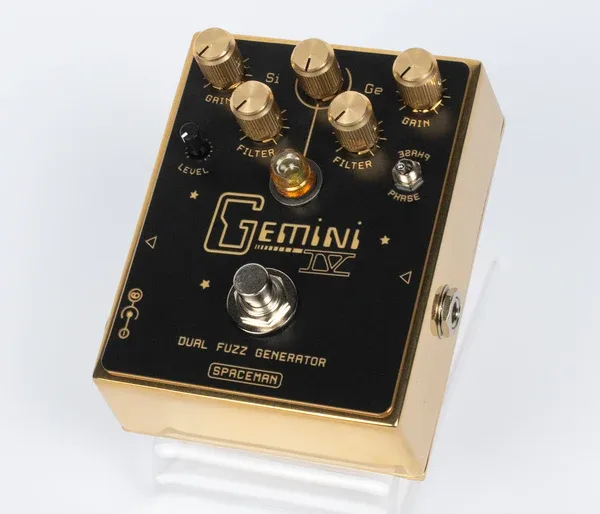
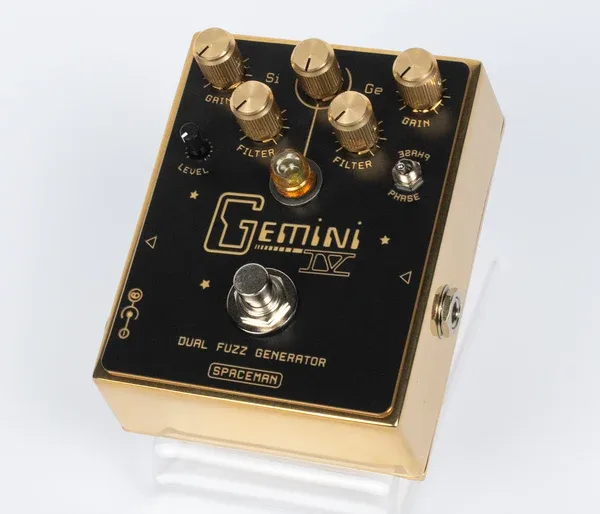
Spaceman redesigned and expanded the concept as the Gemini IV Dual Fuzz Generator, described by Delicious Audio as a redesigned evolution of the Gemini III with independent Filter and Gain controls, a Si/Ge blend knob and a Phase toggle5. Spaceman's Gemini IV page presents it as based on the infamous and now unobtanium Gemini III2.
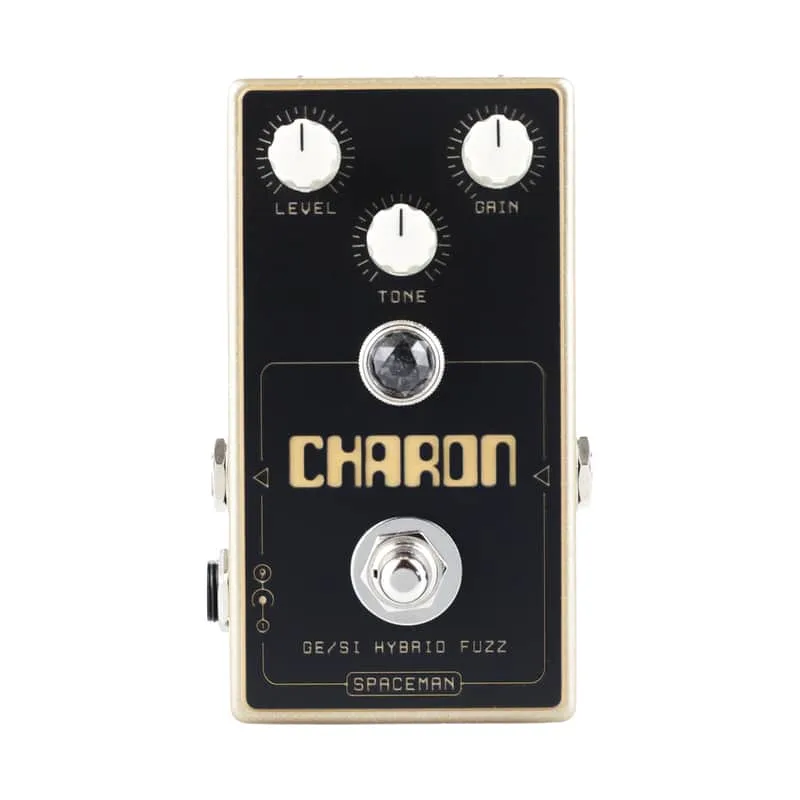
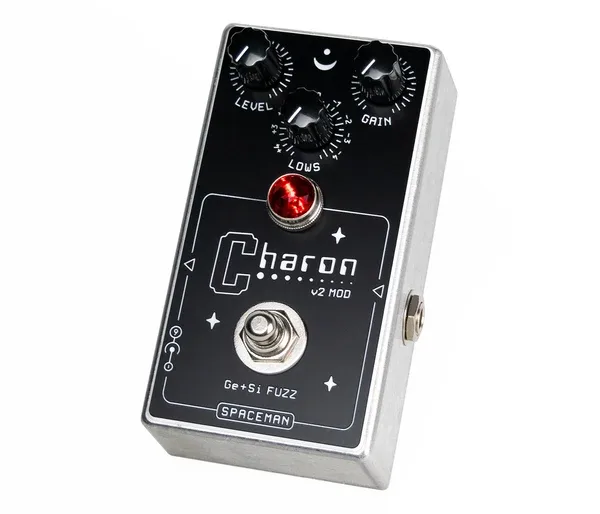
The Gemini III's influence also reached other builders. Coriolis Effects has produced compact takes on the circuit, including a second edition with fully variable gain controls where the original had three switchable gain settings per side3.
Videos
SpacemanEffects
docSanchezFX
ElevationBoutiques
Sources (5)
- Gemini III: Dual Fuzz Generator, Spaceman Effects
- Gemini IV: Dual Fuzz Generator, Spaceman Effects
- Guitar Pedal X, Guitar Pedal X, 2025-10-06
- Spaceman Gemini III Dual Fuzz Generator Pedal Review, Premier Guitar, 2012-01-10
- Spaceman FX Gemini IV Dual Fuzz Generator, Delicious Audio, 2021-12-17