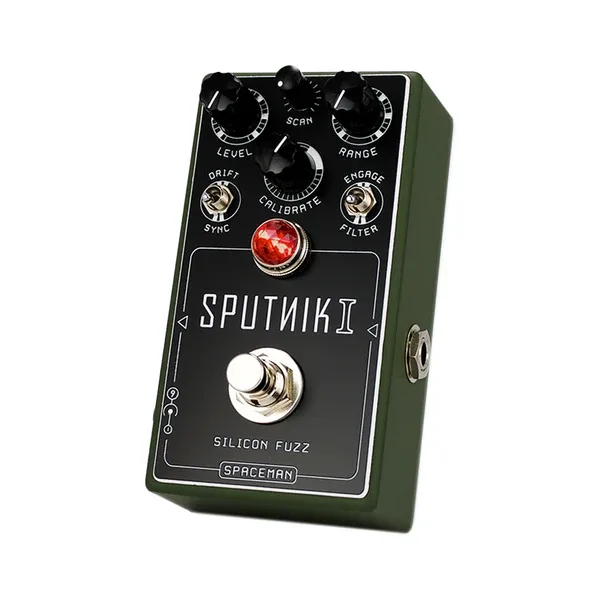

The Spaceman Sputnik I: Silicon Fuzz is a compact fuzz pedal from Spaceman Effects, a Portland, Oregon builder. It carries the original Sputnik v1 circuit, but with a twist: instead of germanium, it runs on NOS silicon transistors. Spaceman describes the result as "an uncommonly wide orbit of fuzz tones; from smooth and vintage to splatty, sputtery, and completely off-the-rails"1.
The pedal is a discrete, analog circuit using only through-hole components, with true-bypass switching via a soft-click footswitch. It is completely soldered and wired by hand in Portland, Oregon, and carries a limited lifetime warranty1. It was released in October 2025 at $299, with a limited Olive Drab Cyrillic Edition at $35921. The maker's page currently lists it as sold out1.
The controls: Range, Calibrate, Fuzz, Filter, Sync/Drift and Scan
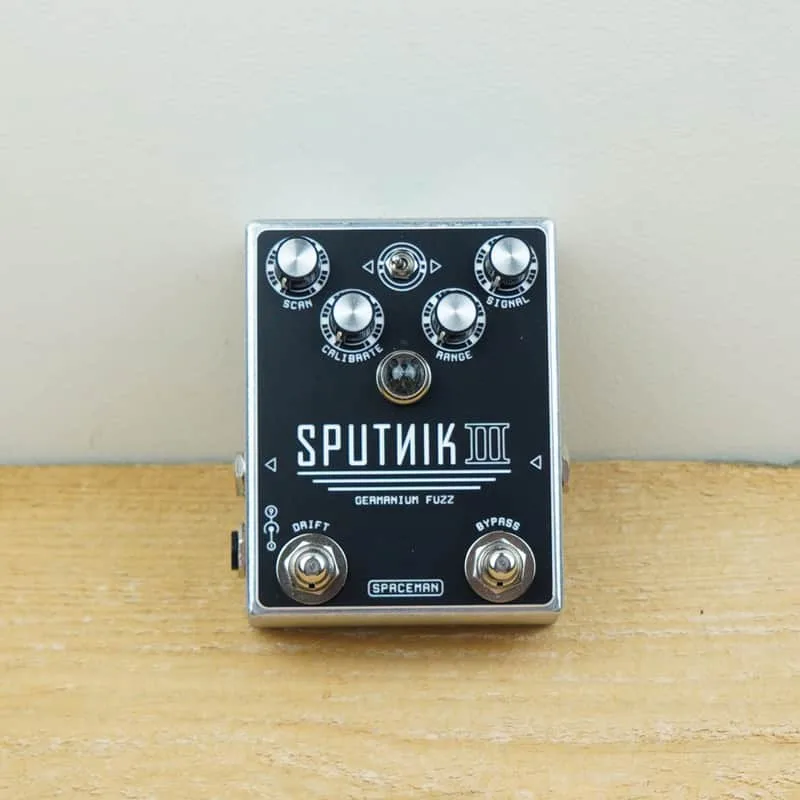
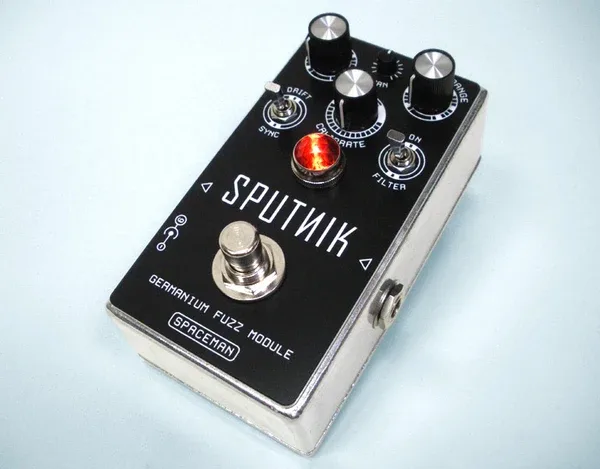
The Sputnik I Silicon Fuzz keeps the control set of the germanium original. Guitar Pedal X's Stefan Karlsson maps the panel as Signal (volume), Scan (scramble/corruption), Range (fuzz gain), Drift/Sync (engage scan), Calibrate (tone), and a Filter engage switch3. The maker describes what each does:
| Control | What it does |
|---|---|
| Range | Spans everything from light overdrive to thick, sustained fuzz1 |
| Calibrate | Shapes your tone in dynamic interaction with Range, unlocking an even broader spectrum of sounds1 |
| Fuzz | Turn up to boost your tubes for dynamic, amp-like overdrive with a clear chimey tone1 |
| Filter switch | Engages a second tone circuit, instantly doubling your tonal palette1 |
| Sync/Drift toggle | Switch to Drift Mode, and Sputnik transforms1 |
| Mini Scan | Adds another layer of precision, making every parameter highly interactive in Drift Mode, including your instrument's own controls1 |
The Filter switch is worth a note for players comparing voices: with Filter engaged you get a brighter and more searing tonality, as the core EQ gets a bass cut and mids scoop4. The Scan control itself is the updated version taken from the Spaceman Sputnik IIb1, which Karlsson calls "a refined Scan mode - per the Sputnik IIb"4.
Drift mode
Drift Mode is where the Sputnik I stops behaving like a conventional fuzz. Switching the Sync/Drift toggle, in the maker's words, transforms the pedal, "unleashing synth-like tones, oscillation, pseudo-octaves, 8-bit artifacts, and more"1. In this mode every parameter becomes highly interactive, including your guitar's own volume and tone controls, and the mini Scan control adds further precision. Spaceman's framing is simple: "Go subtle or go extreme - you can shape it, tame it, or let it run wild"1.
Power and connections
The pedal runs on a 9V DC supply, negative center, through a 2.1mm jack, or on a 9V battery1. Current draw is modest: 4.85 mA in bypass and 5.7 mA engaged1, light enough that battery power is practical.
For external control there is an expression input: a 0-5V DC TRS jack, protected against over and reverse voltage1. Input resistance is 1 megohm1.
The maker's product page lists two specification sets for size and weight: one at 2.60 by 4.73 by 2.17 inches and 10.5 ounces, and a second, unlabeled set at 3.9 by 4.7 by 2.3 inches and 14.8 ounces, with current draws of 14 mA bypass and 18 mA engaged. The page does not say which edition each set belongs to1.
From the germanium Sputnik I to the silicon edition
The original Spaceman Sputnik I first came out in 20135. The silicon edition, released in October 2025, is a variant of that circuit with the same controls; as Karlsson put it, "All the controls are the same as before - it just the type of transistors that has changed here"3. The maker describes it as featuring the original v1 circuit, powered by NOS silicon transistors1.
The circuit itself is built from silicon transistors and a JFET. Karlsson's review identifies six silicon transistors and a BA17 JFET, using 2N3904, 2N4125 and 2N70004; another account of the same review counts seven transistors instead.
One design change matters to players comparing the two: the Sputnik I has no input transformer, which the maker says makes it more lively while providing a wider frequency range1.
How it differs from the germanium original
Guitar Pedal X reviewed the silicon edition as "an updated and upscaled version of the Sputnik I Germanium Fuzz"4. The differences the press found:
- Character: "a little more aggressive" than the original Sputnik I2
- Output: more volume, gain and range than the germanium edition4
- Trade-off: it does not quite have the germanium version's same harmonic grit3
- Circuit: no input transformer, for a livelier feel and wider frequency range1
Karlsson, who has owned a germanium Sputnik I since picking up a pristine Red Cyrillic version in 2018 and calls it his favorite American fuzz since then5, summed up the comparison: "Near enough every bit as good as the original Germanium variant. This one doesn't quite have that same harmonic grit"3.
First Editions: Olive Drab, White, Black and Blue
The silicon Sputnik I shipped in four signed and numbered First Editions: Olive Drab, White, Black, and Blue1. The White, Drab Olive and Black Editions were available for preorder on the Spaceman Effects Webstore, while the ultra-limited Blue Edition was only available through Spaceman dealers12.
The limited-batch Olive Drab Edition has a Cyrillic engraved faceplate, custom knobs, and a smooth glass indicator jewel1; Karlsson also notes it has unique knobs and a smooth lens cap2. It went for $359 and is long since sold out4. A Blue Dealer edition completed the 2025 quartet4.
What reviewers said
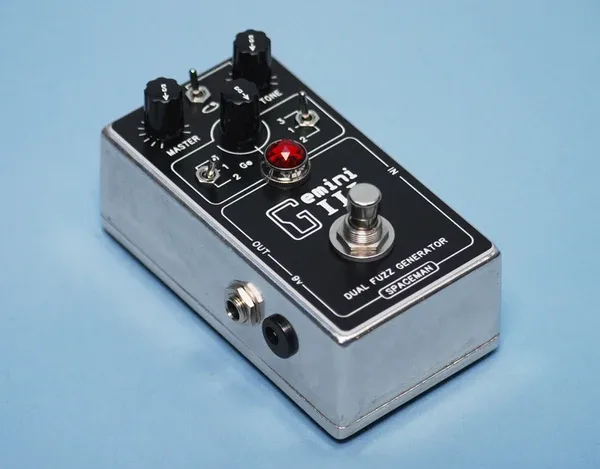
Guitar Pedal X's Stefan Karlsson reviewed the pedal in November 2025 and found it "retains the original Germanium Edition's singing, searing tonality, with more volume, gain and range"4. When the variant was announced, he called it "a total no-brainer shoe-in for me"2. At the end of 2025 it took a Silver award in Guitar Pedal X's best new fuzz pedals of the year, where Karlsson also noted that "The Spaceman Quartet of Gemini III and Sputnik I pairs was also a major fuzz event of the year for me!", pairing it with the Spaceman Gemini III3.
"Near enough every bit as good as the original Germanium variant. This one doesn't quite have that same harmonic grit"
Who uses the Sputnik I
The best-documented player is Stefan Karlsson of Guitar Pedal X, who bought a pristine Red Cyrillic germanium version in 2018 and calls it his favorite American fuzz since then5. In his earlier saturation guide he described the germanium Sputnik I as "Germanium singing but quirky", noting it is based on the Fuzz Face circuit6.
Videos
SpiralCasterPlaysPedals
Questions
What is Drift mode on the Spaceman Sputnik I?
Drift mode is the Sync/Drift toggle's wild side. Switching to it transforms the pedal, unleashing synth-like tones, oscillation, pseudo-octaves and 8-bit artifacts. Parameters become highly interactive, including your instrument's own volume and tone controls, and the mini Scan control adds another layer of precision. You can shape it, tame it, or let it run wild.
Can the Sputnik I Silicon Fuzz run on a battery?
Yes. Spaceman specifies that the pedal can be powered by a 9V battery or an external power supply, with the external option being 9V DC, negative center, via a 2.1mm jack. Current draw is low, at 4.85 mA in bypass and 5.7 mA engaged, so a battery is a practical option.
What transistors are in the Sputnik I Silicon Fuzz?
The maker describes the circuit as powered by NOS silicon transistors. A Guitar Pedal X review identifies six silicon transistors and a BA17 JFET, using 2N3904, 2N4125 and 2N7000, though another account of the same review counts seven transistors.
How is the silicon Sputnik I different from the germanium one?
The controls are the same as the original germanium Sputnik I; only the transistor type changed. The silicon version is described as a little more aggressive, with more volume, gain and range, though reviewers note it lacks the germanium edition's distinctive harmonic grit. It also drops the input transformer, making it more lively with a wider frequency range.
Where is the Spaceman Sputnik I made?
It is completely soldered and wired by hand at Spaceman Effects in Portland, Oregon. The pedal sits in a cast-aluminum enclosure with an engraved vinyl faceplate, a large indicator jewel, and a hand-hammered number badge riveted to the back, and it carries a limited lifetime warranty.
Sources (6)
- Sputnik I: Silicon Fuzz, Spaceman Effects
- Guitar Pedal X, Guitar Pedal X, 2025-10-09
- Guitar Pedal X, Guitar Pedal X, 2025-12-08
- Guitar Pedal X, Guitar Pedal X, 2025-11-24
- Guitar Pedal X, Guitar Pedal X, 2024-11-15
- Guitar Pedal X, Guitar Pedal X, 2018-09-11