

The Strymon DIG is a dual digital delay pedal from Strymon: two simultaneous, integrated delay lines in one compact, pedalboard-friendly box, voiced on the rack-mount digital delays of the 1980s1. Strymon describes it as unearthing "the true soul of digital delay and doubles it," with two synchronized delay lines, selectable subdivisions and three delay voicings that let you dial in rhythmic patterns quickly23.
The idea behind the pedal is a tribute to a specific era. Rack-mount digital delays of the '80s ushered in a new era of audio effects, and the DIG brings those conversion methods to a pedal, from dazzling '80s echoes to pristine modern delay tones31. Delicious Audio calls it "an homage to the digital rack delays of the '80s"4. The original DIG is discontinued; the second generation, the DIG V2, was released in 2022 and is in stock142.
Two delays, three voicings
The DIG runs two delay lines at once. Delay 1 is the master: its Time knob sets the delay time from 20ms to 1.6s, or 40ms to 3.2s with the Half Note subdivision, and it acts as the master time control for both delays1. Delay 2 is a rhythmic sub-delay whose Time 2 knob sets the subdivision relationship between the two, so a single tap tempo setting produces two interlocking rhythms21.
The Type knob chooses between three delay conversion voicings, each modeled on a different era of digital technology21:
| Voicing | What it is | How Strymon describes the sound |
|---|---|---|
| ADM | Early '80s adaptive delta modulation, a one bit, high sample rate technique from telecommunications voice coding | Snappy, percussive, wide-band delay that adds character when input dynamics increase21 |
| 12 bit | Mid '80s 12-bit, 32kHz PCM conversion using monolithic IC chips developed in the late '70s | Slightly darker and warmer delays with a dimensional sense21 |
| 24/96 | Modern 24-bit, 96kHz conversion | Clean, high-resolution, high-bandwidth delay with uncolored, artifact-free repeats21 |
Premier Guitar's reviewer found the 12-bit mode especially characterful, noting that "repeats are grainier, warm, almost analog- or plate-like, thanks to the 12-bit voicing (state of the art in the early '80s)"5.
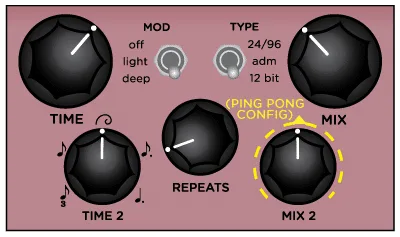
Other sound-shaping controls include a Mod knob with three levels of delay line modulation (Off, Light, Deep), a Tone knob that sets the feedback filter response (left for high cut, right for low cut, flat at 12 o'clock), and independent Mix knobs for each delay, with 3 o'clock giving a 50/50 mix2. The V2 also adds a Free Mode secondary function that disables time sync and subdivisions between the two delays, giving the Time 2 knob the full 20ms to 1.6s range as an independent free-running delay24.
Series, parallel and ping pong routing
The two delays can be combined in three configurations, accessed by holding the TAP and BYPASS footswitches and turning the Mix 2 knob67:
- Series (knob at 9:00): Delay 2, the rhythmic sub-delay, feeds Delay 1. Strymon's technical analysis describes this as equivalent to two single delay pedals in succession, with a mono input feeding both left and right channels8.
- Ping Pong (knob at 12:00): still a series connection, but the repeats bounce between the left and right outputs in stereo. With a mono output signal it behaves the same as Series. In stereo, each delay acts as a ping-pong delay, and they interact when both Mix knobs are turned up8. A November 2023 firmware update changed the V2's Ping Pong mode so it functions like the V1 pedal9.
- Parallel (knob at 3:00): the delays are independent and run at the same time without interacting. In stereo, Delay 1 outputs to the left channel and Delay 2 to the right; if the right output is unused, the wet signal sums to mono so both delays are heard from the left output8.
The Golden Ratio setting
One subdivision unique to the DIG is the Golden Ratio tap division, which Strymon says is not available on the TimeLine and "provides delays that will never step on the repeats for ambient sounds with long trails"10. Premier Guitar's reviewer put it more vividly: the setting "generates echoes that decay in a logarithmic spiral," creating very spacious reverberation5. In a Strymon demo video, Ethan Tufts combined the Golden Ratio subdivision with a very high Repeats setting and a Dotted Eighth subdivision, giving the delay "a distinctly reverb-like quality"6.
Controls, bypass and secondary functions
The front panel keeps things simple: Time, Repeats, Tone, Mod, Type and Mix for Delay 1, plus Time 2 and Mix 2 for Delay 2, and TAP and On/Off footswitches21. The TAP footswitch sets the master delay time, with its LED flashing red at the tempo, and holding it engages Circular Repeats, which infinitely repeat the delays without increasing in volume or dynamics for as long as TAP is held26.
Several secondary functions live behind the knobs, accessed by holding both footswitches8:
- Delay 1 Subdivision (Time knob): changes the default tap subdivision, from Dotted Eighth fully counterclockwise, Quarter note at noon, to Half note fully clockwise.
- Delay 2 Repeats (Repeats knob): independently controls Delay 2's repeats; fully clockwise is the default Track Repeats setting where both delays' repeats are tied together.
- Kill Dry (Time knob at power up): kills the dry signal, useful in routing such as a parallel effects loop.
Bypass is selectable. From the factory the DIG is set to true bypass, an electromechanical relay switched connection that leaves the signal 100 percent untouched when the pedal is off; it can be set to buffered bypass, which preserves high frequency response through long pedal chains and cable runs211. Connecting a cable into the right output jack automatically sets the bypass mode to buffered bypass11. Trails work only in buffered bypass: the wet signal's decay naturally fades out after the pedal is bypassed, enabled by holding the BYPASS footswitch while connecting power8.
The input stage is a high impedance, ultra-low noise discrete Class A JFET preamp, and an input level mode adds 10dB of headroom for line level sources such as keyboards, synthesizers, basses with active pickups and effects loops212.
Power and connections
The DIG V2 runs on a 9V DC center negative supply rated 300mA minimum, and the supply is not included2. The original DIG drew 250mA minimum and shipped with its power supply included1. There is no battery option13. The V2's ARM processor has more power and consumes less energy than previous iterations, according to Premier Guitar's news coverage14.
- Input: single TRS jack, high impedance Class A JFET, with a rear panel switch for mono or stereo input type; output is stereo in both cases.
- Outputs: low impedance independent TS stereo outputs; use Out L for mono.
- EXP/MIDI jack: multifunction jack for a TRS expression pedal (continuous control over the knobs), an external tap switch, a Favorite switch, or MIDI.
- USB-C: computer connection for controlling via MIDI and firmware updates.
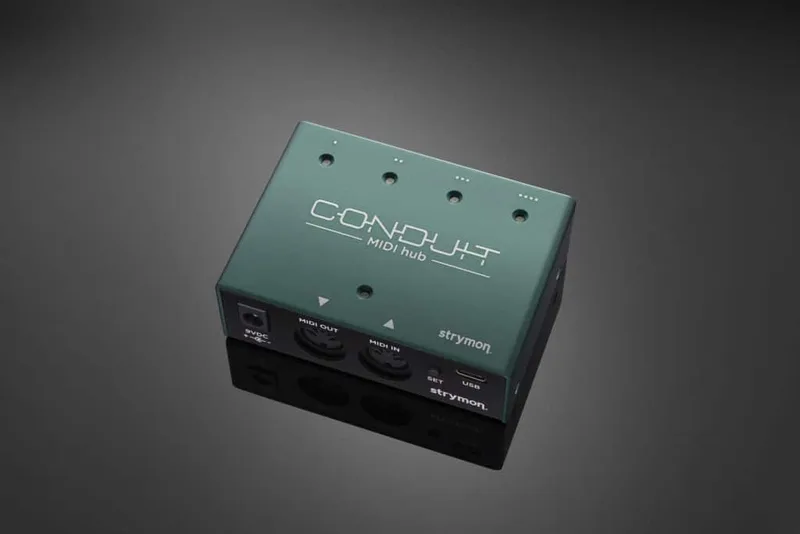
The EXP/MIDI jack has four modes, selected by holding the TAP footswitch while powering up: Expression Pedal (green, the default), Favorite (amber, recalling a Favorite setting with a Strymon MiniSwitch), Tap (red, setting master delay time with a MiniSwitch), and MIDI (blue, selecting three presets with a Strymon MultiSwitch Plus)16. Full MIDI functionality is also available by sending MIDI Program Change messages via a 1/4 inch TRS MIDI connection using a Strymon Conduit or MIDI EXP cable, or via USB from a host device1510. In MIDI mode, 300 preset locations are available, and the currently loaded settings can be saved to any of them at any time1724.
Firmware updates are done by downloading Strymon's Update software, connecting the powered pedal to a computer with a USB-C cable, and clicking Check for Updates, then Install Update18. The current V2 firmware release is REV v1.26, released November 202419.
History and versions
Strymon announced the DIG as part of a line of six new pedals, and the original pedal is now discontinued, with Strymon's brochure page carrying a discontinued product note120. The DIG is also available as a plugin, bringing the rack delay sounds to a DAW3.
The second generation arrived in 2022. Delicious Audio reports that "V2, released in 2022, adds a Tone knob and several upgrades to the circuit"4. Strymon says the V2 "keeps the same distinctive rack-mount digital delay tones from our original and adds significant new features," including the new ARM processor, a TRS MIDI jack for bidirectional MIDI communication with MIDI clock sync, full stereo inputs and outputs with a rear panel Mono/Stereo switch, and onboard storage for up to 300 presets1420. The updated pedals became available directly from Strymon and a select group of dealers worldwide14.
If you own an original DIG, the V2 features cannot be added to it. Strymon states the electronic and mechanical designs are different and the hardware is not interchangeable21.
A Midnight Edition of the DIG was also produced as a limited finish22.
What reviewers said
Premier Guitar's reviewer concluded that although the DIG delivers the best of '80s rack-unit sounds and functionality, "it feels as timeless and potent as any echo unit out there" when used judiciously5. MusicRadar's Trevor Curwen rated its build quality, features and value for money as fantastic, with none to avoid, calling it a wise investment for spacey ambient sounds23. Guitar.com's Richard Purvis noted the included 9V power supply and the absence of battery power in the original review13.
Videos
ProGuitarShopDemos
Pete Thorn
Sweetwater
News
Questions
Is the Strymon DIG discontinued?
The original DIG is discontinued, and Strymon states it is not possible to add the V2 features to older pedals because the electronic and mechanical designs are different. The second generation DIG V2, released in 2022, is currently in stock and available directly from Strymon and a select group of dealers worldwide.
Does the Strymon DIG run on a battery?
No. The DIG has no battery power and runs from a 9V DC center negative supply. The original DIG shipped with a power supply included and drew 250mA minimum. The DIG V2 requires a supply rated 300mA minimum, and the power supply is not included.
What is the Golden Ratio setting on the DIG?
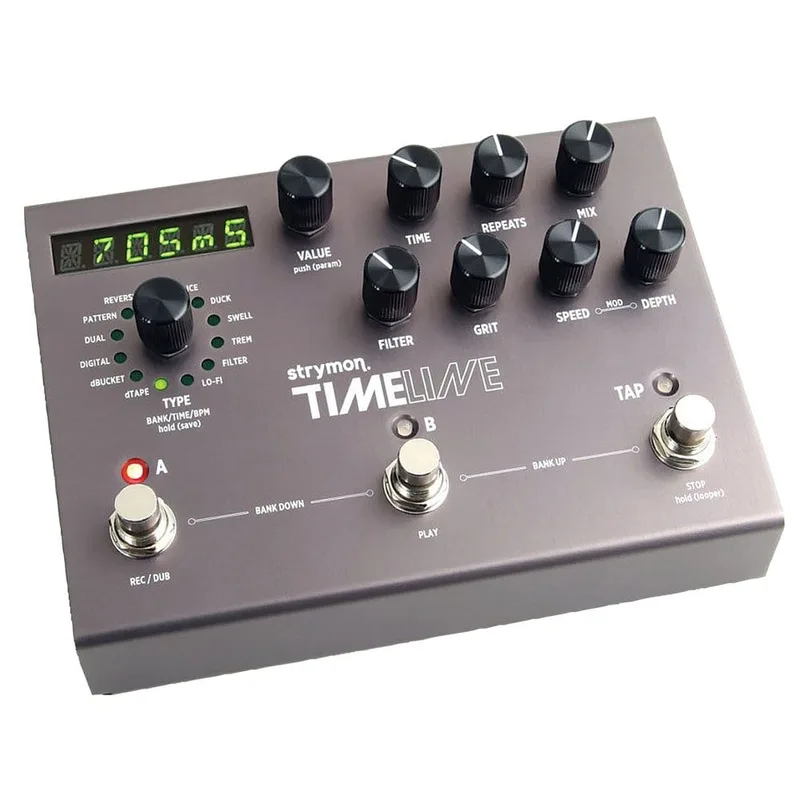
Golden Ratio is a tap division not available on the Strymon TimeLine. Strymon says it provides delays that will never step on the repeats, useful for ambient sounds with long trails. Premier Guitar's reviewer described it as generating echoes that decay in a logarithmic spiral, creating very spacious reverberation.
Does the DIG have trails?
Yes, when set to buffered bypass. In that mode the wet signal's decay naturally fades out after the pedal is bypassed. Trails are enabled by holding the BYPASS footswitch while connecting power. In the default true bypass setting the signal path is fully disconnected instead.
How many presets can the DIG store over MIDI?
The DIG V2 offers 300 MIDI preset locations for loading and saving settings, with full MIDI implementation through the EXP/MIDI jack or a USB-C connection. Delay time can be synchronized via MIDI Clock Sync, and the sync setting is saved per preset.
Is the Strymon DIG v2 stereo?
Yes. The DIG V2 has full stereo input and output capabilities, with a single TRS input jack and low impedance dual TS output jacks. A rear panel switch selects mono or stereo input type, and in both cases the output is stereo.
Sources (23)
- DIG Brochure, Strymon, 2023-12-05
- DIG V2 Dual Digital Delay, Strymon (www.strymon.net), 2026-08-12
- DIG Family Page, Strymon (www.strymon.net), 2026-10-06
- Strymon Dig V2 Digital Delay, Delicious Audio, 2025-07-06
- Quick Hit: Strymon Dig Dual Digital Delay Review, Premier Guitar, 2016-05-15
- Deconstructing the DIG Dual Delay video song, Strymon, 2015-11-03
- DIG Digital Delay Technology White Paper, Strymon, 2015-05-19
- Secondary Functions: DIG Dual Digital Delay, Strymon, 2021-07-09
- New Firmware Is Here!, Strymon, 2023-11-10
- What is the difference between DIG and Timeline's Dual Delay?, Strymon
- How do I change the bypass mode on DIG?, Strymon
- How do I set the Input Level on DIG?, Strymon, 2026
- Strymon DIG Dual Digital Delay review, Guitar.com, 2015-07-08
- Strymon Announces Updated Line of Six Popular Pedals, Premier Guitar, 2022-06-28
- How do I control DIG with MIDI?, Strymon, 2022-06-28
- How do I configure the EXP/MIDI jack on DIG?, Strymon
- How do I save presets in MIDI mode with DIG?, www.strymon.net, 2022-06-28
- How can I update the firmware on DIG v2?, Strymon, 2026-07-09
- DIG v2 Firmware Revision Release Notes, Strymon, 2023
- Strymon Announces Line of Six New Pedals, Recording Magazine, 2022-06-28
- Can I send in my old pedal to get the V2 features added?, Strymon
- Back in black: Strymon offers Midnight Edition finish on its TimeLine, Mobius, DIG, and BlueSky pedals, Guitar World, 2022-03-04
- Strymon DIG review, MusicRadar, 2015-10-12