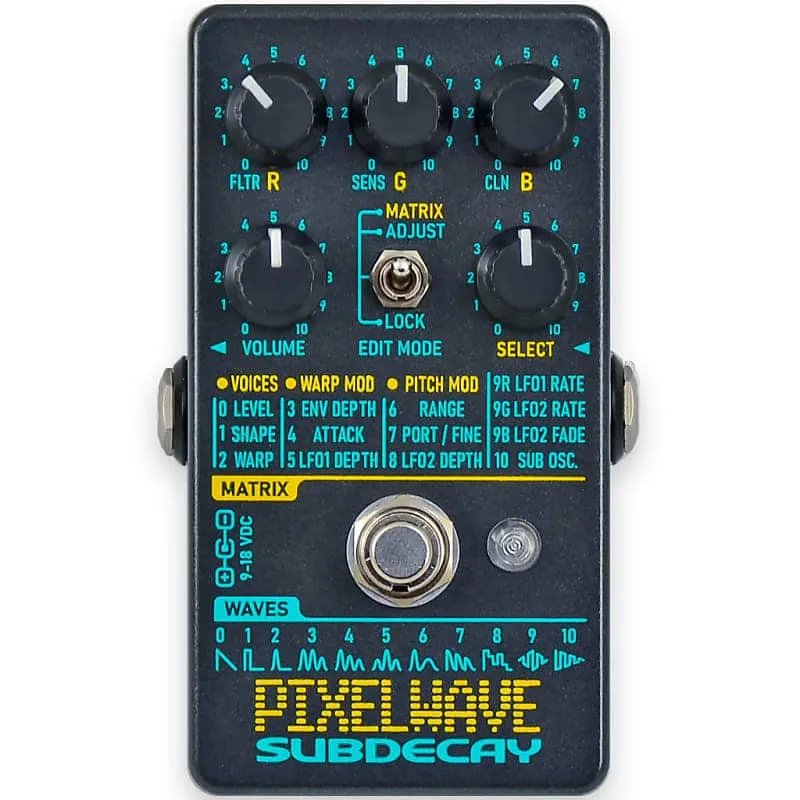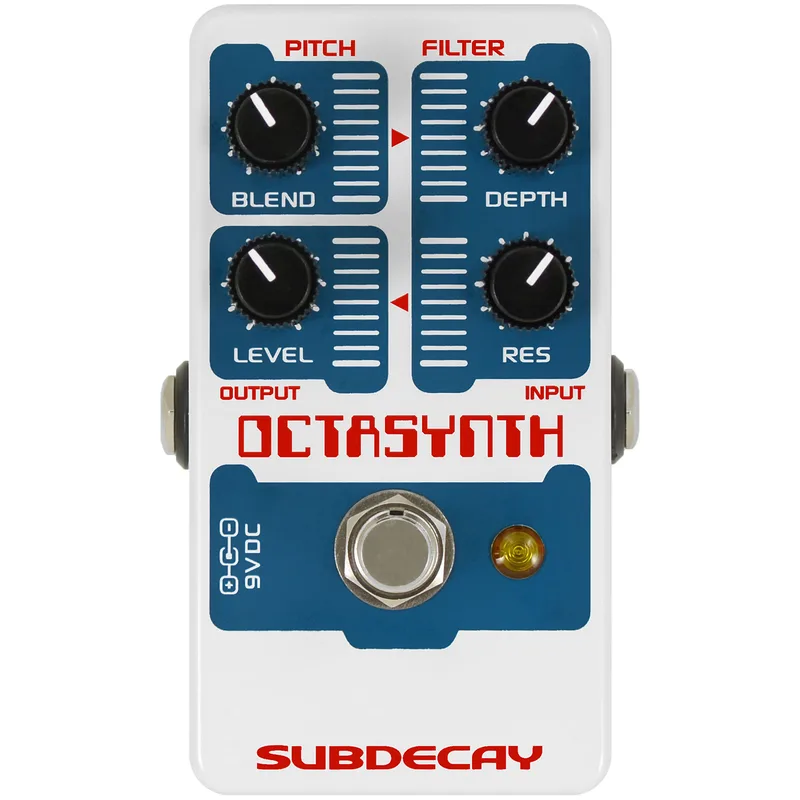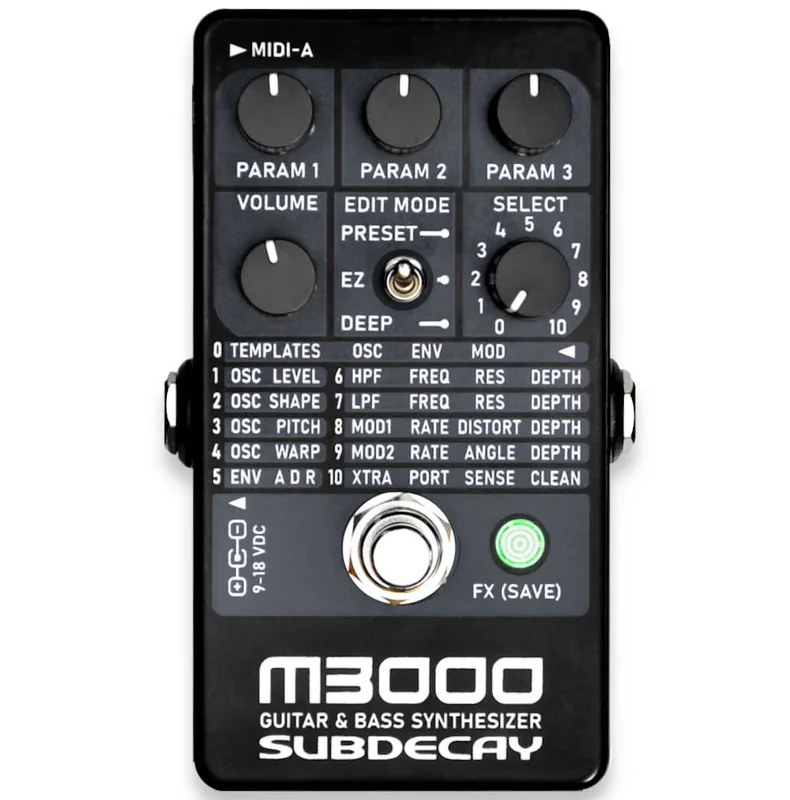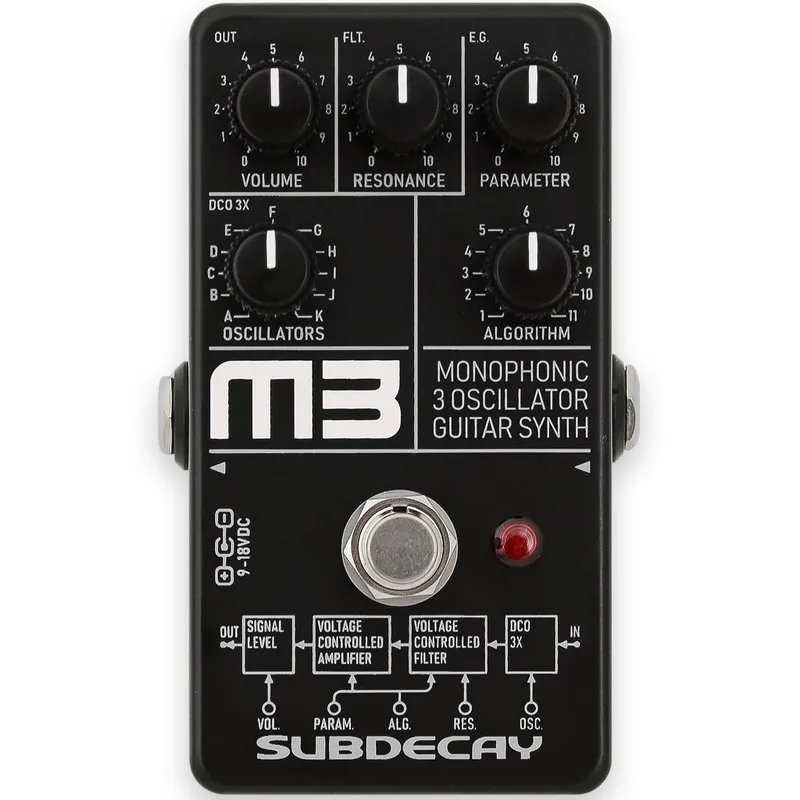


The Subdecay M3 is a digital guitar synthesizer pedal released in 2019 by Subdecay, designed to bring the sounds of 70s monophonic synthesizers to a pedalboard without the modular complications12. Instead of the dual oscillators used in many synth pedals, it employs three digitally controlled oscillators for what RockBoard's PedalPedia describes as fat synth sounds that never go out of tune1. It sits in the company's line of synth pedals alongside the Subdecay PixelWave and the earlier SubDecay Octasynth.
Designer Brian Marshall has said the goal was for the pedal to sound like an actual synthesizer rather than a fuzzy filter3. The M3 is currently listed as out of stock on Subdecay's product page, and the company has since released the M3000 Guitar and Bass Synthesizer as its follow-up42.
A three-oscillator guitar synth
The M3's voice comes from three digitally controlled oscillators rather than the two found in many competing synth pedals. Because the oscillators are digitally controlled, they track each other exactly and never drift out of tune with one another1. RockBoard's PedalPedia says the design is based on the Korg MS-20, bringing the sounds of 70s monophonic synthesizers to the pedal format1.
In a self-interview published on Subdecay's site, Brian Marshall explained the circuit's lineage in more detail3:
"While the filter design is reminiscent of the MS-20's famous low-pass filter, the oscillators are more akin to Roland's DCOs from the Juno synthesizers5."
He described the M3 as conceived as the offspring of the Korg MS20, and said the frequency detector from an octave divider experiment became part of the M3, though the triggered oscillator from that experiment did not3. The filter itself is a low-pass design in the spirit of the MS-20's famous filter, while the oscillators behave more like the digitally controlled oscillators Roland used in its Juno synthesizers5.
The development took years. Marshall began work after a 2017 back injury, and it took time to fine-tune the design and months to write the code before release3.
The controls and oscillator settings
The M3 keeps its control surface simple: a handful of knobs that cover oscillator selection, filter resonance, output level, and an algorithm system that handles everything else4.
| Control | What it does |
|---|---|
| Oscillators | Sets between 11 different oscillator selections4 |
| Parameter | Varies depending on the algorithm setting4 |
| Resonance | Controls the resonance of the filter4 |
| Algorithms | Controls everything else: filter and amp envelopes, LFOs, portamento and pitch follow for the filter4 |
| Volume | Output level4 |
Oscillator presets
The Oscillators knob offers eleven presets4. A few examples from Subdecay's own descriptions:
- G, Fifth: Two oscillators track the input pitch with one oscillator offset by a 5th, for that classic 5th synth sound4
- H, Major Triad: More of an ode to 90s electronic music than the 70s4
- J: Two square waves and an upper octave 5th, a common way synthesizers attempted to capture bell and chime timbres, or even electric piano4
- K, Stacked Squares: All three oscillators run square waves in unison, which Subdecay calls perfect for synth leads4
Algorithms
The Algorithms knob has eleven settings that shape the sound by controlling the filter, two envelope generators, LFOs, portamento and more1. Two examples:
- Algorithm 3, portamento: Parameter controls filter offset, and the oscillators glide smoothly from note to note4
- Algorithm 6, Decay/sustain 2: Similar to algorithm 5, but slower and brighter4
Tracking, bass and power
Subdecay is direct about the M3's tracking: it is optimized for guitar. Some users have found success using it with bass, but the company describes it as primarily designed with guitar in mind5. Bass players comparing synth pedals may want to look at the M3000, which Subdecay positions as a guitar and bass synthesizer2.
Power comes from a 9V DC center negative supply drawing 60mA1, a standard pedalboard arrangement.
The M3 carries a list price of $199.002. It offers eleven oscillator presets, and was designed by Brian Marshall, who founded Subdecay in 200443.
Videos
Subdecay
Subdecay
Subdecay
Questions
Is the Subdecay M3 analog or digital?
The M3 is a digital pedal. Its three oscillators are digitally controlled, which is what lets them stay perfectly in tune with each other, and its filter design is reminiscent of the low-pass filter on a Korg MS-20.
Does the Subdecay M3 work with bass?
Subdecay says the M3 is optimized for tracking with guitar. Some users have found success using it with bass, but the company describes it as primarily designed with guitar in mind. Bass players may want to look at the M3000, which is a guitar and bass synthesizer.
Is the Subdecay M3 discontinued?
The M3 is listed as out of stock on Subdecay's product page, and the company has since released the M3000 Guitar and Bass Synthesizer as its follow-up. The M3 appears to have been superseded rather than restocked.
How much current does the Subdecay M3 draw?
The M3 draws 60mA. It runs on 9V DC with a center negative plug, so it needs a standard pedalboard power supply rather than a battery.
What replaced the Subdecay M3?
The M3000 Guitar and Bass Synthesizer, released in 2025 at $229.00, is Subdecay's follow-up to 2019's M3. It offers enhanced tracking and is designed for both guitar and bass.
Sources (5)
- M3 by Subdecay, RockBoard PedalPedia, 2026
- M3000 Guitar and Bass Synthesizer, Subdecay, 2025-12-26
- Brian Marshall interviews himself on the making of the M3 guitar synth., subdecay.com, 2023-11-15
- M3 3 oscillator monophonic guitar synthesizer, Subdecay, 2025-12-26
- Which Synth Pedal is for Me?, Subdecay, 2024-08-15