

The SubDecay Octasynth is an analog octave synthesizer pedal made by Subdecay, hand built in Oregon. It takes a single note from your guitar, converts it into three square-wave octave voices, and runs those through a resonant low-pass filter, which is the same basic recipe as many classic analog synths: raw waveforms plus a resonant filter1. Subdecay describes the result plainly: "An analog synth pedal that actually sounds like… A SYNTH."1
It is a monophonic pedal, so it tracks one note at a time rather than chords1. Subdecay calls it their simplest synth pedal, a set-and-forget box with four knobs2. The Octasynth first appeared in a limited three-knob release around 2007; the production model officially launched in 2011 and has remained unchanged since2.
How it works
The Octasynth has two stages. The first is an octave generator that converts your guitar into three square waves, one octave down, two octaves down, and one octave up from the input. Those octaves then run through a second stage, a resonant low-pass filter1. Subdecay's framing of the design is that most analog synth tones players know come down to exactly this combination:
"90% of the analog synth tones you are familiar with are just this, Raw waveforms and resonant filters1."
Subdecay product page1
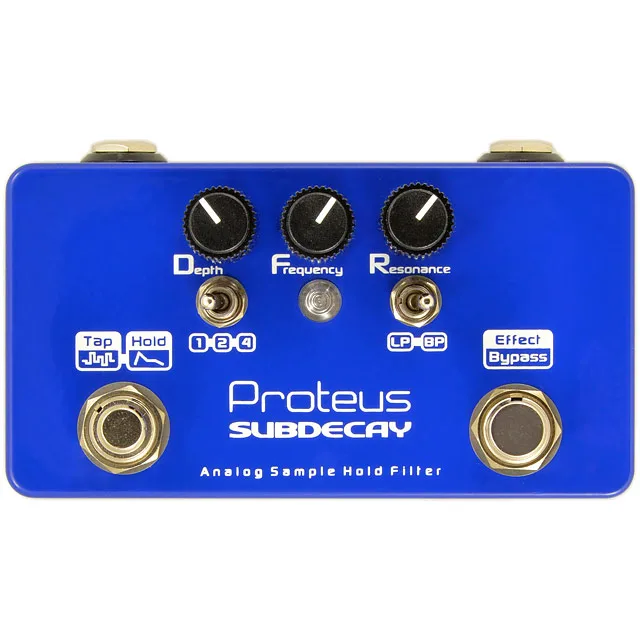
The filter shares some common DNA with the filter in Subdecay's Proteus, according to Brian Marshall, the maker's designer5. Getting there took time: Subdecay says the effect was designed and redesigned more than a dozen times over six years, dating back to the early days of the company1.
The controls
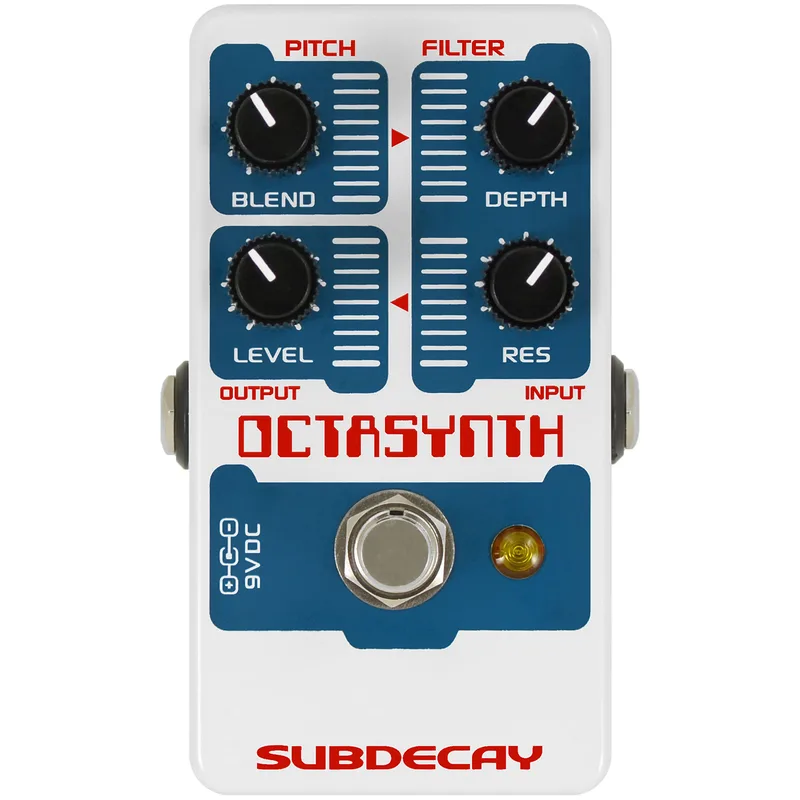
The production Octasynth has four knobs, and each maps directly onto the two stages1:
| Control | What it does |
|---|---|
| Blend | Mixes the three octave voices. Full left is two octaves down, full right is one octave, center is a mix of all three1 |
| Depth | Sets the range of the filter. Each note pushes the filter cutoff higher as you turn it right; all the way down there is no sound at all1 |
| Res | Resonance/feedback for the filter. Turned right, the cutoff is intensified; all the way right the filter approaches near oscillation1 |
| Level | Total output volume1 |
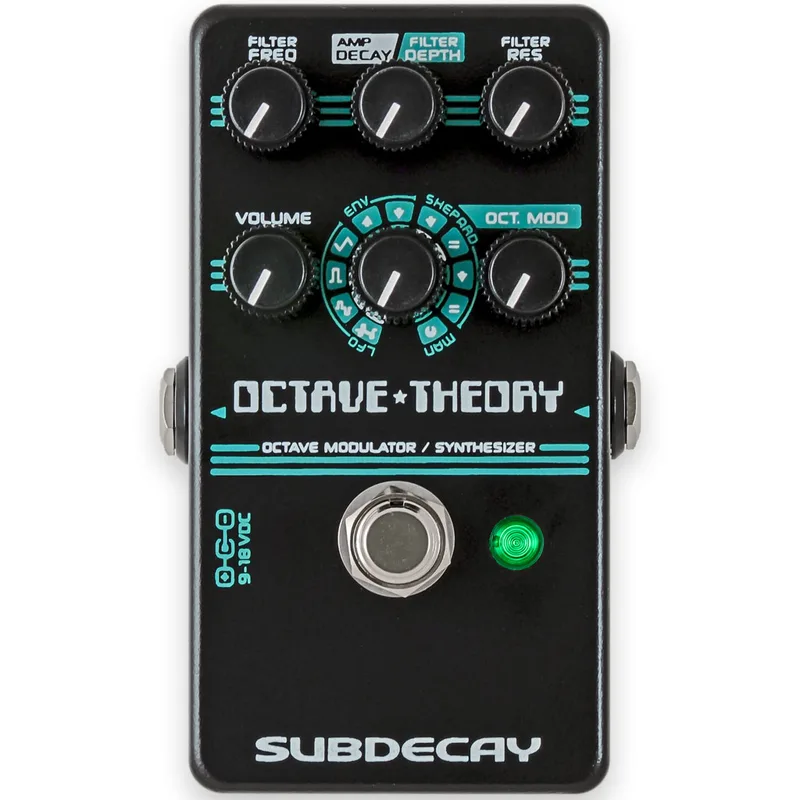
Because Depth makes each note push the filter cutoff, the pedal responds to dynamics and pitch: higher notes open the filter further, which is what gives filter-based synth pedals their vocal, squelchy character. The Blend control is a simple three-way mix rather than a full level control for each voice; Subdecay notes that on the later Octave Theory, this was one of the things they moved beyond, since "the Octasynth's blend control which only allowed for one or two octaves down"6.
Tracking: guitar, bass, and pickups
Subdecay's own guidance is that the Octasynth "tracks exceptionally well on guitars, with the neck pickup providing the best results"2. On bass, the picture is more mixed. The pedal was designed with guitar in mind, and its ability to produce a full two octaves down can be too much for a bass's lower registers. Tracking on bass may not be great below the 5th fret, but generally performs well above the 7th fret, and the middle of the fretboard can create great bass-synth tones1. Subdecay's buying guide adds that on bass it "generally performs well above the 7th fret"2.
A Premier Guitar reviewer tested it with a Gibson SG's neck pickup, tone control rolled back, into a vintage Fender Super Bassman dialed for a throaty clean tone, and found that setup "produced a much more controlled response from the unit"7. The same reviewer found the pedal approachable for players with no synth background, calling it "very simple to operate"7.
Power and connections
The Octasynth runs on a 9V battery or a regulated 9VDC to 12VDC adapter with a negative center, through a 2.1mm barrel plug1. Current draw is less than 10mA1, which is light enough that it fits easily on most pedalboard power supplies. Input impedance is 500K, and output impedance varies depending on the Level setting1.
If you power the Octasynth from a daisy-chain supply, all other pedals on that chain must be negative ground, per Subdecay1.
Versions and b-stock
The limited three-knob version from around 2007 predates the production model; everything since the 2011 launch has used the same four-knob layout2. Subdecay has also sold b-stock units at $99.00, described as fully functional blemished items that may include paint scratches, silkscreen errors, or older style graphics, with the standard three-year warranty, though blemished pedal sales are final4.
Where it sits among synth pedals
Within synth pedals generally, the Octasynth sits on the analog side of the family: Subdecay describes it as an analog synth pedal and octave generator built around a resonant low pass filter1. Reviewers found it approachable on that count, with one noting that "it's very simple to operate" for guitarists7. Within Subdecay's own line, it is the long-running option, in production and unchanged since its 2011 launch2.
Videos
Subdecay
Prymaxe
Dennis Kayzer
Questions
Does the SubDecay Octasynth work on bass?
It was designed with guitar in mind, and its two-octaves-down voice can be too much for a bass's lower register. Subdecay says tracking on bass may not be great below the 5th fret but generally performs well above the 7th fret, and the middle of the fretboard can produce great bass-synth tones.
Can the Octasynth run on a battery?
Yes. The pedal runs on a 9 volt battery or a regulated 9VDC to 12VDC adapter with a negative center, using a 2.1mm barrel plug. Current draw is less than 10mA, so it is easy on a power supply.
Is the SubDecay Octasynth true bypass?
Yes. Subdecay specifies true bypass switching using 3PDT switches, so the pedal's circuit is out of the signal path when it is disengaged.
Which pickup tracks best with the Octasynth?
Subdecay says the Octasynth tracks exceptionally well on guitars, with the neck pickup providing the best results. A Premier Guitar reviewer similarly used a Gibson SG's neck pickup with the tone rolled back for a more controlled response.
Is the Octasynth polyphonic?
No. The Octasynth is monophonic, so it tracks one note at a time. Chords will not translate, and it is best played with single-note lines.
Sources (7)
- Octasynth, Subdecay, 2018-05-02
- Which Synth Pedal is for Me?, Subdecay, 2024-08-15
- Quasar Phaser mk5, Subdecay, 2026-10-15
- Octasynth, Subdecay, 2021-02-24
- Brian Marshall interviews himself on the making of the M3 guitar synth., subdecay.com, 2023-11-15
- Octave Theory, Subdecay, 2020-07-03
- Subdecay Octasynth Pedal Review, Premier Guitar, 2011-10-18