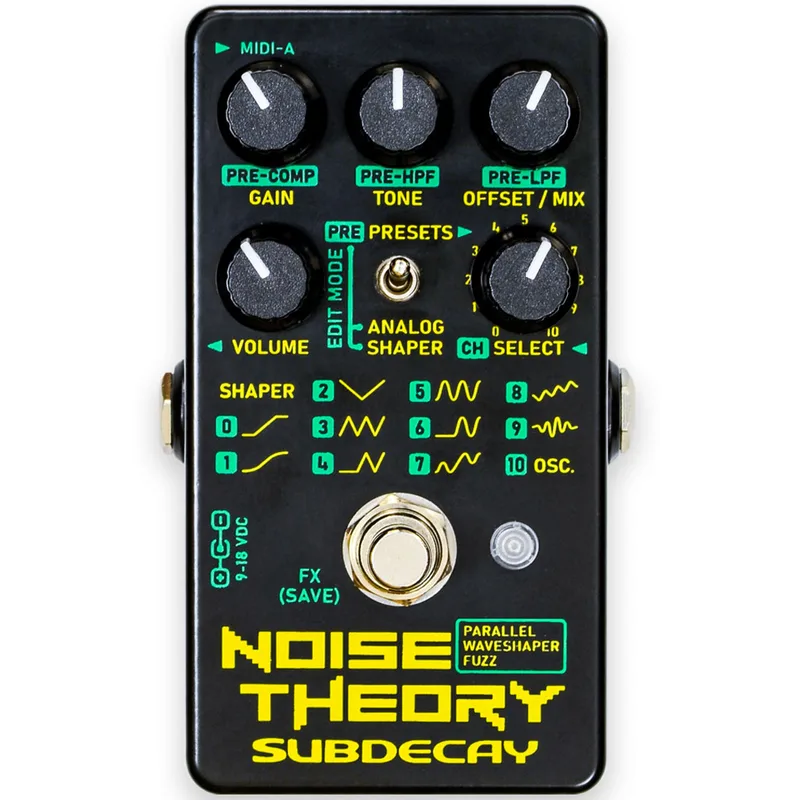


The Subdecay Noise Theory is a fuzz pedal from Subdecay that does something most fuzz pedals do not: it runs two fuzz circuits at once. Delicious Audio's Paolo De Gregorio describes it as combining "an analog and a digital fuzz circuit placed in parallel," so an analog voiced fuzz sits alongside a digital side1. It ships from 22nd February 20242.
The digital side is where the Noise Theory gets unusual. Instead of one fuzz voice, it offers 11 selectable algorithms that reshape the waveform in different ways, from square wave clipping to wave folders that fold the signal back on itself. Delicious Audio's Griffin Jennings describes the pedal as "a dual fuzz that blends an analog and a digital fuzz, employing radical-sounding Wave Folding and Wave Shaping circuits" through those 10 algorithms on the digital side34. There is also a synthesizer mode: Subdecay's product page says it "will get analog like, similar to old Casio CZ synthesizers, but it really shines with dirty in your face fuzzy tones," drawing on 1980s phase distortion synthesis5. In Subdecay's own buying guide, Brian Marshall adds that "The Noise Theory Fuzz even has a built in MIDI synthesizer if you are into that sort of thing"6.
Where it came from
The controls and edit modes
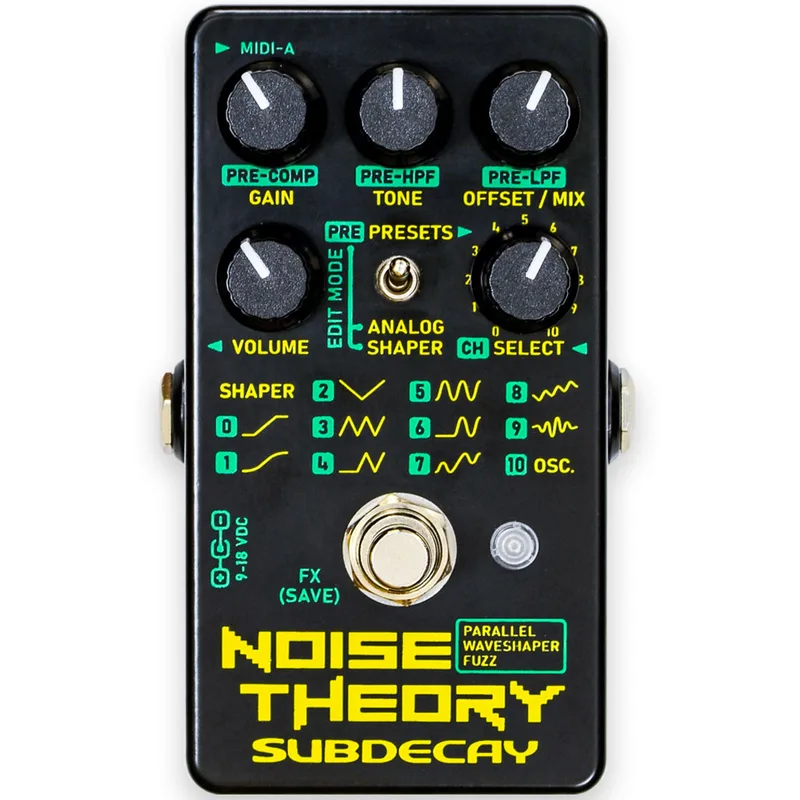
The face of the pedal carries five knobs plus two selectors. Guitar Pedal X's control listing runs: GAIN / Pre-Comp, TONE / Pre-HPF, OFFSET (Bias), MIX / Pre-LPF, VOLUME, an EDIT MODE switch with PRE, ANALOG and Shaper positions, and a FUZZ TYPE selector numbered 1 to 11, with holding the footswitch used to save a preset4. Subdecay's manual explains the GAIN knob in shaper mode as controlling "the overall gain of the waveshaper fuzz"9.
| Control | Function |
|---|---|
| GAIN | Overall gain of the waveshaper fuzz9 |
| TONE | Pre-HPF (high-pass filter before the shaper)4 |
| OFFSET | Bias control4 |
| MIX | Pre-LPF (low-pass filter before the shaper)4 |
| VOLUME | Output level4 |
| EDIT MODE | PRE / ANALOG / Shaper edit modes4 |
| FUZZ TYPE | Selects the shaping algorithm, 1 to 112 |
The knobs pull double duty depending on the edit mode, which is why Guitar Pedal X lists each with a slash: in the Shaper edit mode, the controls become Gain, Tone, Offset (Bias), Volume and Fuzz Type8. Beyond the panel, the pedal goes deep: Delicious Audio notes that "Its 30+ parameters can be controlled via Midi and edited in depth via a free app"3, and Subdecay's manual highlights "multiple fuzz types, MIDI control, parallel" signal routing among the options that set it apart from a typical fuzz9. For players already using MIDI on a board, the MIDI pedals page covers how this kind of control fits in.
The 11 fuzz types
The Fuzz Type selector is the heart of the digital side. Guitar Pedal X's January 2025 review lists the full set of algorithms in Shaper mode8:
- 0. Square Fuzz
- 1. Sine Clipper
- 2. Full Wave Rectifier
- 3. Wave Folder
- 4. Single Sided Wave Folder
- 5. Sine Wave Folder
- 6. Single Sided Sine Wave Folder
- 7. Zero Limited Wave Folder
- 8. Harmonic Ripple Wave Folder
- 9. Wave Smasher
- 10. Oscillator Fuzz
A wave folder works differently from a clipping fuzz: as the signal grows, the waveform is folded back on itself rather than flattened at the top, which generates harmonics in a different way. Subdecay's product page describes Fuzz 5, the Sine Wave Folder, as "Similar to Fuzz 3, but based on sine waves"5. Guitar Pedal X's February 2024 news piece also lists a Chorus & Flange setting within the Fuzz Type range2, and the flanger and chorus pages cover those effect types in their own right.
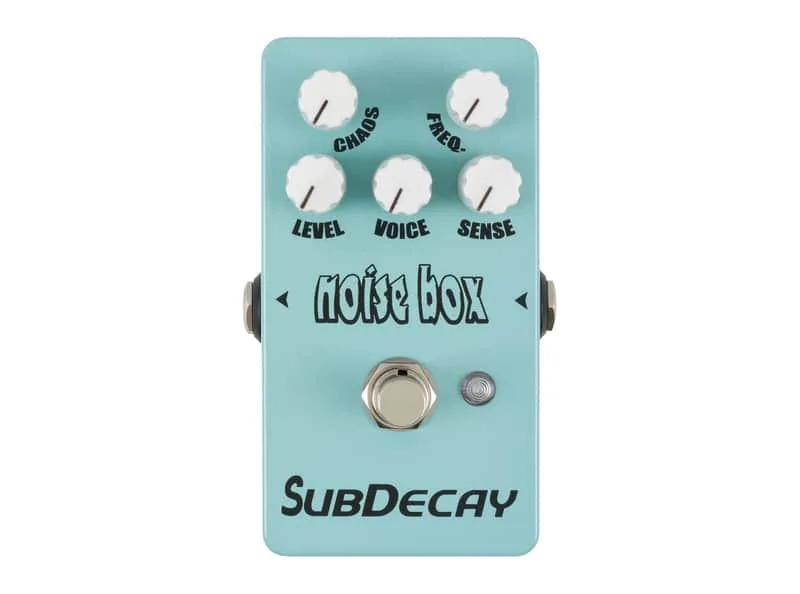
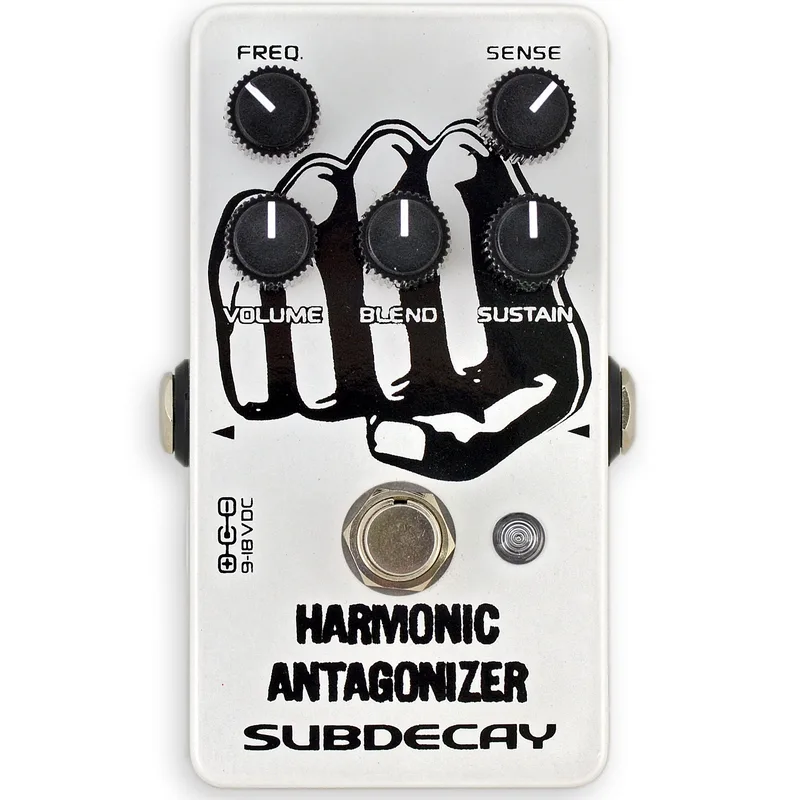
The Noise Theory sits in a small family of unusual Subdecay fuzz designs. The company's earlier Noise Box took a different approach to fuzz and oscillation, and the Harmonic Antagonizer pairs fuzz with an oscillator. If the synth side of the Noise Theory is what interests you, Subdecay's own guide to synth pedals places it among the company's options6.
What reviewers said
Coverage has been consistent on the pedal's unusual placement. Guitar Pedal X's Stefan Karlsson wrote that "This is very much a Multi-Fuzz unit which folds in digital waveforms in parallel to an Analog voiced fuzz"2. Delicious Audio placed it in its roundup of unusual fuzz pedals, with Griffin Jennings describing the dual analog and digital blend and the wave folding and wave shaping circuits3. Neither of those pieces is a verdict from a reviewer's own board: Karlsson noted in December 2024 that he was still awaiting a Subdecay restock, expected early the next year4.
Videos
Subdecay
Pedal Experiments
Tri Pedal Reviews
Questions
What is a wave folder fuzz?
A wave folder takes your guitar's waveform and folds it back on itself as the signal gets bigger, which creates harmonics in a different way from clipping. On the Noise Theory, Wave Folder is Fuzz Type 3, and Subdecay builds several variations on the idea, including single sided versions, a sine wave folder and a harmonic ripple wave folder, all selectable from the Fuzz Type control.
Is the Subdecay Noise Theory analog or digital?
It is both. Guitar Pedal X describes it as a hybrid analog and digital multi-fuzz, and Delicious Audio's Paolo De Gregorio explains that it combines an analog and a digital fuzz circuit placed in parallel. The analog side carries the traditional fuzz voicing while the digital side handles the wave folding and wave shaping algorithms.
How much does the Subdecay Noise Theory cost?
Subdecay lists the Noise Theory at $199.00 USD on its product page as of September 2026. Guitar Pedal X reported the same $199 price in its December 2024 roundup, and noted that as of February 2024 the UK price was £199.
What does the Fuzz Type selector do on the Noise Theory?
The Fuzz Type control selects which of the 11 shaping algorithms the digital side uses, numbered 0 through 10. The list runs from Square Fuzz and Sine Clipper through Full Wave Rectifier, the Wave Folder family, Wave Smasher and Oscillator Fuzz. Guitar Pedal X also notes a Chorus & Flange setting in the Fuzz Type range.
Does the Noise Theory have a built-in synthesizer?
Yes. Subdecay's Brian Marshall writes in the company's synth pedal buying guide that the Noise Theory Fuzz has a built-in MIDI synthesizer. Subdecay's product page describes the synth mode as combining 1980s phase distortion synthesis with the pedal's wave shaping fuzz, in a style similar to old Casio CZ synthesizers.
Sources (9)
- New Pedal: Subdecay Noise Theory Fuzz, Delicious Audio, 2024-05-01
- Guitar Pedal X, Guitar Pedal X, 2024-02-21
- The Best Crazy, Weird, And Unusual Fuzz Pedals In 2024, Delicious Audio, 2024-10-24
- Guitar Pedal X, Guitar Pedal X, 2024-12-18
- Noise Theory, Subdecay, 2026-06-19
- Which Synth Pedal is for Me?, Subdecay, 2024-08-15
- TremCoder 2, Subdecay, 2026-09-18
- Guitar Pedal X, Guitar Pedal X, 2025-01-17
- Noise Theory, Subdecay, 2024-04-01