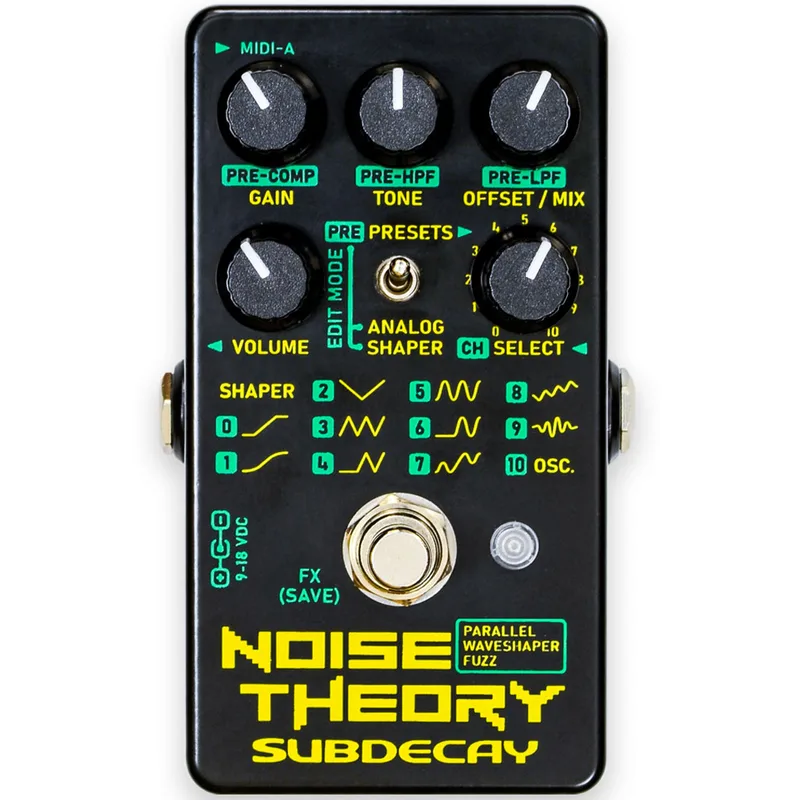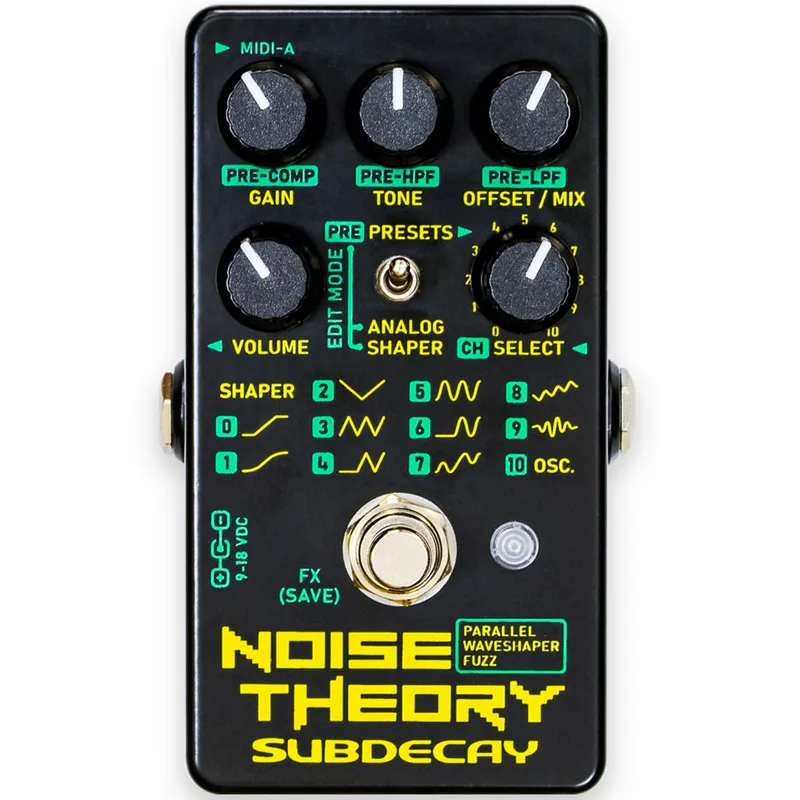


The Subdecay Noise Theory is a fuzz pedal that runs two fuzz circuits at once: an analog voiced fuzz and a digital fuzz built on wave folding and wave shaping, blended together in parallel. Subdecay gives it 11 fuzz types, five knobs, a three-way edit mode switch, MIDI control and savable presets, which puts it closer to a compact multi-fuzz unit than a one-trick stompbox1. Delicious Audio's Paolo De Gregorio described the core idea plainly: "the noise theory combines an analog and a digital fuzz circuit placed in parallel"2.
What it does to your sound
Because the analog and digital sides run in parallel, the mix knob decides how much of each circuit you hear. The digital side works by folding and shaping the waveform of the signal, and the 11 modes cover what Guitar Pedal X's Stefan Karlsson called "both classic and more experimental sounds", with different texture at the start and end of the gain sweep1. Subdecay's own page notes that the synthesizer mode will get "analog like, similar to old Casio CZ synthesizers, but it really shines with dirty in your face fuzzy tones"4, a reference to 1980s phase distortion synthesis.
Delicious Audio's buying guide sums up the design as "a dual fuzz that blends an analog and a digital fuzz, employing radical-sounding Wave Folding and Wave Shaping circuits" across 10 algorithms6. Subdecay's manual puts it in context: "The Noise Theory offers more options than your typical fuzz pedal, including multiple fuzz types, MIDI control, parallel" signal routing and more3.
The 11 fuzz types
The mode selector runs 0 to 10, and each number is a different way of mangling the waveform17:
| # | Fuzz type |
|---|---|
| 0 | Square Fuzz |
| 1 | Sine Clipper |
| 2 | Full Wave Rectifier |
| 3 | Wave Folder |
| 4 | Single Sided Wave Folder |
| 5 | Sine Wave Folder |
| 6 | Single Sided Sine Wave Folder |
| 7 | Zero Limited Wave Folder |
| 8 | Harmonic Ripple Wave Folder |
| 9 | Wave Smasher |
| 10 | Oscillator Fuzz |
Subdecay's product page explains the family relationships: Fuzz 5 is "Similar to Fuzz 3, but based on sine waves"4, and the single sided variants follow the same pattern against modes 3 and 4.
Controls, editing and presets
The five knobs each carry a second function depending on where the three-way edit mode switch is set, which is how a compact pedal reaches this many parameters18:
| Knob | Pre edit mode | Analog edit | Shaper edit |
|---|---|---|---|
| GAIN | Pre-Comp | Gain | Gain |
| TONE | Pre-HPF | Tone | Tone |
| OFFSET | Bias | Offset (Bias) | Offset (Bias) |
| MIX | Pre-LPF | Mix | Mix |
| VOLUME | Volume | Volume | Volume |
The manual describes PRE-COMP as controlling "pre-fuzz compression"3, and Delicious Audio notes that the hardware knobs cover "Tone, Compression, HPF and LPF and preset navigation"6. The edit switch positions are PRE, ANALOG and Shaper, and the mode selector doubles as the fuzz type and chorus-and-flange control in editing8.
Saving is done from the footswitch: hold it to save a preset for the current mode, and press again to exit the edit modes. The LED flashes while you are in an edit mode and again when a new preset has been saved1. Subdecay lists 11 savable presets in total, one per mode4.
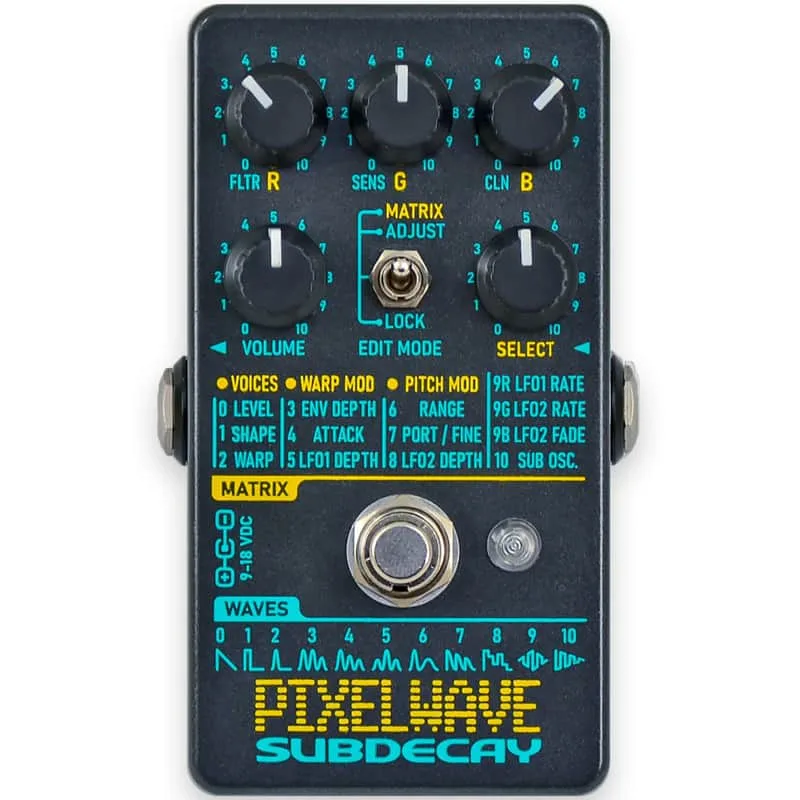
The Noise Theory shares its layout, an 11 position mode selector, five knobs and a three-way toggle, with Subdecay's PixelWave Phase Distortion Synth, so the two pedals work the same way if you move between them1.
MIDI and the synth side
Alongside the fuzz algorithms, the pedal carries a built-in MIDI synthesizer. Subdecay's Brian Marshall put it this way in the company's synth pedal guide: "The Noise Theory Fuzz even has a built in MIDI synthesizer if you are into that sort of thing"5. For players already running MIDI on a board, that makes the Noise Theory a candidate among both fuzz and synth pedals, and the manual's MIDI implementation data was included in the printable PDF guide Subdecay published in April 20243.
Price and availability
The pedal ships from 22 February 2024, at a list price of $199 USD1. Subdecay's announcement gave the price as "$199 and equivalent" in other markets, so the UK figure follows the dollar price rather than being set separately1.
What reviewers said
Karlsson's launch coverage described the pedal's range: "You get 11 different voicings out of this pedal - covering both classic and more experimental sounds"1. That breadth of voicings, with different texture at the start and end of the gain sweep, is the picture the announcement gives of what the pedal offers1.
Videos
Subdecay
Subdecay
Pedal Experiments
Questions
How many fuzz modes does the Subdecay Noise Theory have?
The Noise Theory has 11 mode settings, numbered 0 to 10. They run from a Square Fuzz and Sine Clipper through several wave folder types, including single sided and sine wave variants, a Zero Limited Wave Folder, a Harmonic Ripple Wave Folder, a Wave Smasher and an Oscillator Fuzz. Each mode can hold its own saved preset.
Can you save presets on the Noise Theory?
Yes. Subdecay lists 11 savable presets, one for each of the 11 modes. You save a setting for the current mode by press-holding the footswitch, and the LED flashes to confirm when a preset has been saved. Pressing the footswitch again exits the edit modes.
Is the Noise Theory analog or digital?
Both. It places an analog voiced fuzz circuit and a digital fuzz circuit in parallel, and the mix knob blends between them. The digital side uses wave folding and wave shaping algorithms, and the pedal also carries a built-in MIDI synthesizer.
How much does the Subdecay Noise Theory cost?
Guitar Pedal X listed the Noise Theory at $199 in the United States, with an equivalent price of £199 in the UK when it launched in February 2024. By January 2025 it was available direct from Subdecay for $199 and from Joe's Pedals in the UK for £195.
Is the Noise Theory the same layout as the PixelWave?
It shares the same format as Subdecay's PixelWave Phase Distortion Synth: an 11 position mode selector running 0 to 10, five knobs and a three-way edit mode switch. The circuit inside is a fuzz rather than a synth, though the Noise Theory does include a MIDI synthesizer mode.
Sources (8)
- Guitar Pedal X, Guitar Pedal X, 2024-02-21
- New Pedal: Subdecay Noise Theory Fuzz, Delicious Audio, 2024-05-01
- Noise Theory, Subdecay, 2024-04-01
- Noise Theory, Subdecay, 2026-06-19
- Which Synth Pedal is for Me?, Subdecay, 2024-08-15
- The Best Crazy, Weird, And Unusual Fuzz Pedals In 2024, Delicious Audio, 2024-10-24
- Guitar Pedal X, Guitar Pedal X, 2025-01-17
- Guitar Pedal X, Guitar Pedal X, 2024-12-18