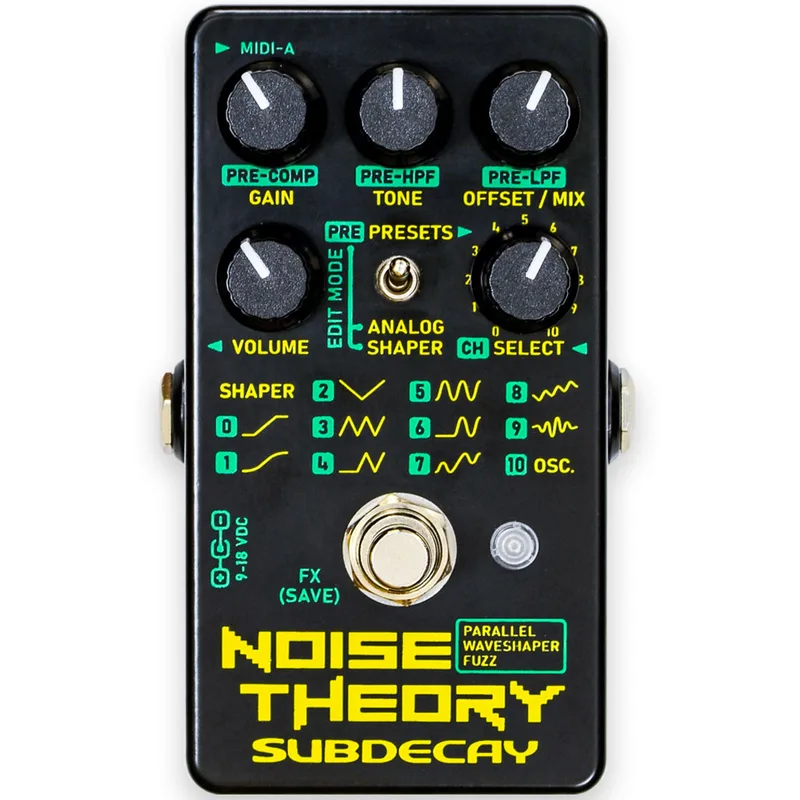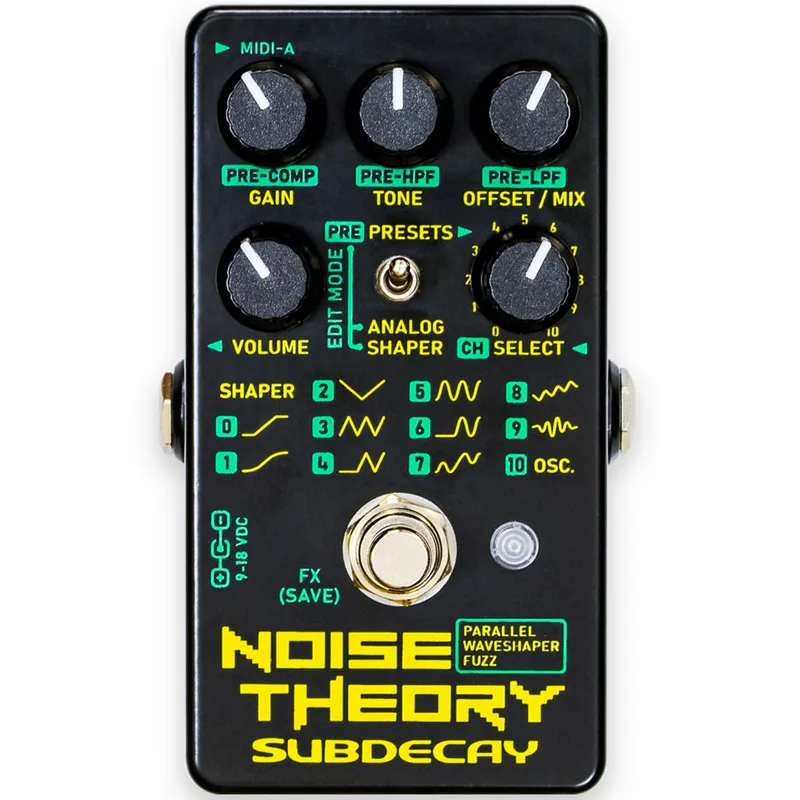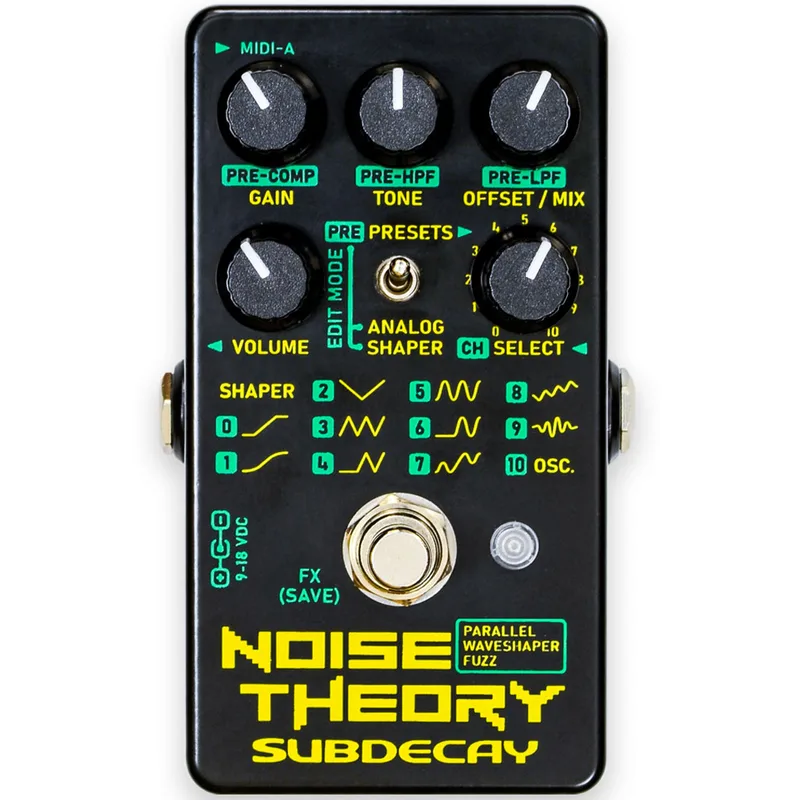


The Subdecay Noise Theory is a hybrid multi-fuzz pedal that blends an analog-voiced fuzz with a digital fuzz running in parallel, using wave folding and wave shaping circuits borrowed from synthesizer design. Where a classic fuzz pedal clips your signal, the Noise Theory reshapes it: wave folding folds the tops of the waveform back into the waveform, generating higher harmonics and, at extremes, harsh white-noise textures1. Subdecay describes the pedal as "Unconfined by 60's and 70s tradition, it embraces synth technology like wave folding and wave shaping distortions."2
The pedal carries a list price of $199.00 direct from Subdecay3.
Fuzz types and chorus/flange settings
The digital side of the pedal offers 11 fuzz types, selected with the Fuzz Type control. Guitar Pedal X's review lists them as follows1:
| Fuzz Type | Name |
|---|---|
| 0 | Square Fuzz |
| 1 | Sine Clipper |
| 2 | Full Wave Rectifier |
| 3 | Wave Folder |
| 4 | Single Sided Wave Folder |
| 5 | Sine Wave Folder |
| 6 | Single Sided Sine Wave Folder |
| 7 | Zero Limited Wave Folder |
| 8 | Harmonic Ripple Wave Folder |
| 9 | Wave Smasher |
| 10 | Oscillator Fuzz |
Fuzz Type 0, Square Fuzz, is the most conventional of the set: Subdecay says it "amplifies the signal until it reaches its limits, resulting in squared-off peaks and valleys," which is close to how a traditional fuzz circuit behaves2. The rest of the range moves into wave folding and wave shaping territory, with names like Harmonic Ripple Wave Folder and Wave Smasher pointing at textures a standard fuzz pedal does not produce.
Beyond the fuzz types, the pedal includes a chorus and flange option with its own settings. Guitar Pedal X's review describes it as 0 for off, with settings 1 to 10 covering different chorus and flange sounds: 1 and 5 are higher-level oscillation with a rotary sort of character, 2 to 4 are flangers (4 being a jet flange), and the remainder are mostly different styles of chorus1. That puts modulation duties normally handled by a separate chorus or flanger pedal inside the same box.
Presets and MIDI control
The Noise Theory stores 11 savable presets, numbered 0 to 10, selectable from the pedal's own controls21. Editing is split across modes, and Guitar Pedal X's review breaks the control set down like this1:
| Mode | Controls |
|---|---|
| Pre (non-edit) | Compression, HPF, Volume, Select Presets 0-10 |
| Edit analog | Gain, Tone, Mix, Volume |
| Edit shaper | Gain, Tone, Offset (Bias), Volume, Fuzz Type |
In Shaper mode, the third top dial becomes a secondary bias control, which the review notes can introduce a secondary octave of sorts into the output1. The Gain control in shaper edit mode "Controls the overall gain of the waveshaper fuzz," per the maker's user guide6.
MIDI is where the pedal opens up. Its 30-plus parameters can be controlled via MIDI and edited in depth through a free app5, and in the pedal's synthesizer mode all parameters are controllable via MIDI in real time1. Subdecay's own buying guide notes that "The Noise Theory Fuzz even has a built in MIDI synthesizer if you are into that sort of thing," which places it among the more unusual synth pedals on the market7.
The MIDI input uses a 1/8" TRS type A MIDI connector, and the adapter is not included. If your MIDI controller outputs on a 5-pin DIN jack, you will need a TRS adapter cable before you can hook it up6.
What wave folding fuzz sounds like
Because the analog and digital fuzz circuits run in parallel, the Noise Theory is not a single fuzz voice but a blend: the analog side holds the familiar fuzz character while the digital side folds waveforms on top of it. Guitar Pedal X called it "very much a Multi-Fuzz unit which folds in digital waveforms in parallel to an Analog voiced fuzz"4. Delicious Audio's roundup of unusual fuzz pedals describes it as "A dual fuzz that blends an analog and a digital fuzz, employing radical-sounding Wave Folding and Wave Shaping circuits on the digital side, through 10 different algorithms"5.
For a player used to silicon or germanium fuzz circuits, the wave folder types behave differently: instead of clipping the signal flat, they turn the peaks back on themselves, which stacks harmonics in ways that can get noisy and metallic at extreme settings1.
What reviewers said
Guitar Pedal X's review was positive about the sound but critical of the interface. On the downside, the reviewer wrote that "Secondary functions and the flashing Edit LED make operation clunky," adding that the reviewer is rarely a fan of multiple secondary and tertiary functions on the same controls1. The hardware knobs cover Tone, Compression, HPF and LPF plus preset navigation, with the deeper editing pushed to the app and MIDI5.
"Wavefolding folds waveform tops back into the waveform, generating higher harmonics and, at extremes, harsh white-noise textures."
Videos
Subdecay
Subdecay
Subdecay
News
Questions
How many presets does the Subdecay Noise Theory have?
It has 11 savable presets, numbered 0 to 10. Preset selection is handled from the pedal's controls, so you can move between stored sounds without touching MIDI or an app.
What kind of MIDI connector does the Noise Theory use?
It uses a 1/8 inch TRS type A MIDI connector on its MIDI input. Subdecay notes that you may need an adapter, and one is not included with the pedal. The default MIDI channel is channel 1.
What is wave folding fuzz?
Wave folding folds the tops of a waveform back into the waveform itself. That generates higher harmonics, and at extreme settings it produces harsh white-noise textures. It is a technique borrowed from synthesizer design rather than traditional guitar fuzz circuits.
Is the Subdecay Noise Theory analog or digital?
It is a hybrid. An analog-voiced fuzz runs in parallel with a digital side that uses wave folding and wave shaping circuits, with multiple algorithms selectable as fuzz types.
Is there an app for the Subdecay Noise Theory?
Yes. Its 30-plus parameters can be edited in depth via a free app, and all parameters are controllable over MIDI in real time, including in the pedal's synthesizer mode.
Sources (7)
- Guitar Pedal X, Guitar Pedal X, 2025-01-17
- Noise Theory, Subdecay, 2026-06-19
- TremCoder 2, Subdecay, 2026-09-18
- Guitar Pedal X, Guitar Pedal X, 2024-02-21
- The Best Crazy, Weird, And Unusual Fuzz Pedals In 2024, Delicious Audio, 2024-10-24
- Noise Theory, Subdecay, 2024-04-01
- Which Synth Pedal is for Me?, Subdecay, 2024-08-15