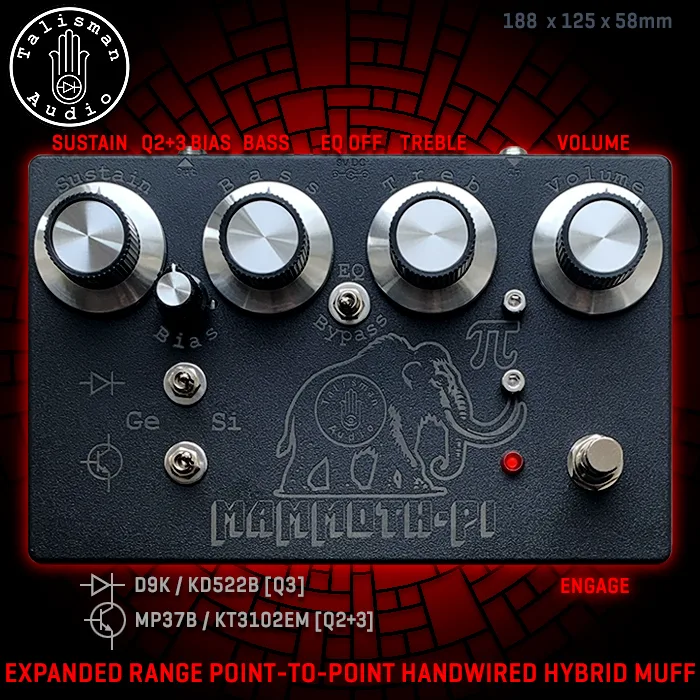


The Talisman Audio Mammoth Pi is a fuzz pedal built as a point-to-point Big Muff variant: the circuit is hand-wired without a printed circuit board, and it is based on the Big Muff Pi design rather than copying it outright. Guitar Pedal X's Stefan Karlsson, who reviewed it in October 2026, calls it "a very unique one-of-a-kind take on the Big Muff Pi"1.
What sets it apart from a stock Big Muff is how much of the circuit you can reconfigure. The transistors can be silicon or germanium, the clipping diodes are switchable between the two, and the familiar Big Muff tone stack has been split into separate passive Bass and Treble controls with a switch to defeat the EQ entirely1.
A point-to-point Big Muff variant with switchable diodes
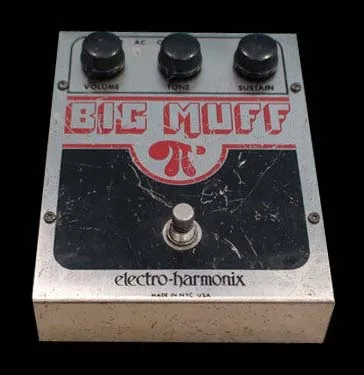
The Big Muff Pi circuit it builds on is a four-stage transistor amplifier with two diode clipping sections in a row, and its signature sound comes from those clipping stages combined with its tone control, as documented in Kit Rae's technical analysis of the circuit2. The Mammoth Pi keeps that general architecture but changes the recipe: it uses a TL072CP dual op-amp alongside either silicon KT3102EM or germanium MP37B transistors, and the Q3 clipping diodes are switchable between silicon KD522B and germanium D9K types in an asymmetrical arrangement. The Q2 diodes are fixed KD522B types1.
That gives you several distinct fuzz voices in one pedal, and the combinations matter. Karlsson found the silicon diodes with germanium transistors to be the standout1:
"The Si Diodes + Ge Transistors combination is spectacular."
He also noted that the all-germanium combination has a volume drop, which is worth knowing before you settle on a setting1.
The build itself is part of the appeal. Karlsson's view of point-to-point construction in general:
"These point-to-point circuits always have an extra rawness, and extra output quality to them"1
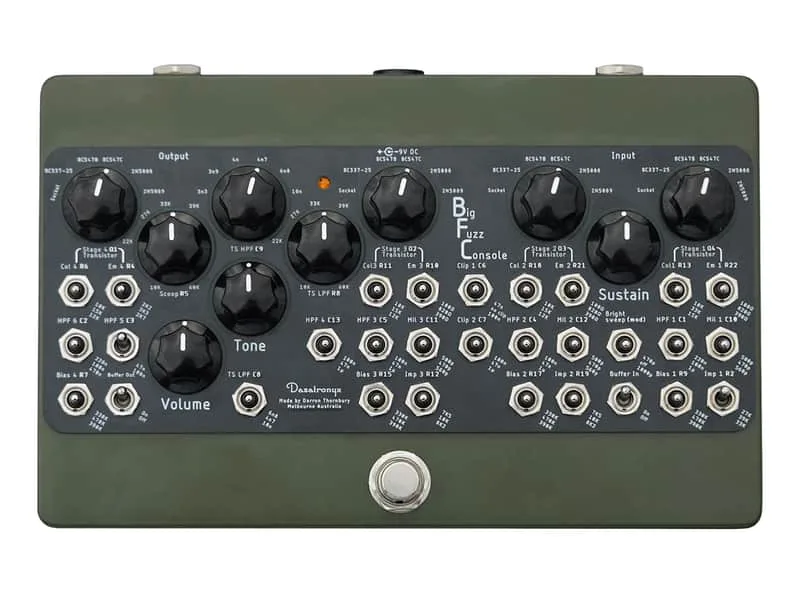
The pedal uses the exact same enclosure as the Dazatronyx Big Fuzz Console1.
The controls
| Control | What it does |
|---|---|
| Sustain | Sets the fuzz/compression amount |
| Bias | Targets the Q2 and Q3 transistors |
| Bass | Passive bass EQ control |
| Treble | Passive treble EQ control |
| EQ On / Bypass | Tone defeat switch for the EQ section |
| Volume | Output level |
The EQ section is the biggest departure from a standard Big Muff. Instead of the single Tone knob of the original tone stack, the Mammoth Pi splits it into separate passive Bass and Treble controls, and the EQ On / Bypass switch lets you defeat the whole EQ section1.
Karlsson preferred the pedal with the EQ bypassed:
"I actually prefer it too on EQ / Tone Bypass - as you get more Low-End in the Output Profile, more gain, and more volume"1
His one suggested change was to put the EQ bypass on a second footswitch for easier on-the-fly switching, and he also wanted a third "no diode" clipping option1.
How it compares to other Big Muff variants
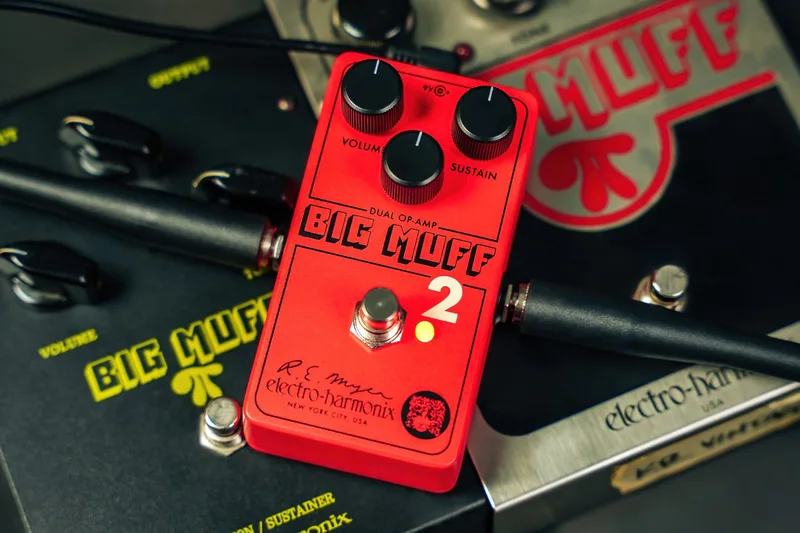
Compared with the current Electro-Harmonix lineup, the Mammoth Pi takes a different approach to variation. The Electro-Harmonix Deluxe Big Muff Pi covers the classic Triangle, Ram's Head and Sovtek voicings plus Fuzz Face and Tone Bender style tones in one digital-modeling pedal, as Kit Rae documented3. The Op-Amp Big Muff Pi recreates the vintage op-amp circuit, and the Deluxe Dual Op-Amp Big Muff Pi 2 adds footswitchable mids. The Mammoth Pi instead varies its sound through hand-wired, physically switchable components: transistors, diodes and a bias control, in a point-to-point build1.
Availability and price
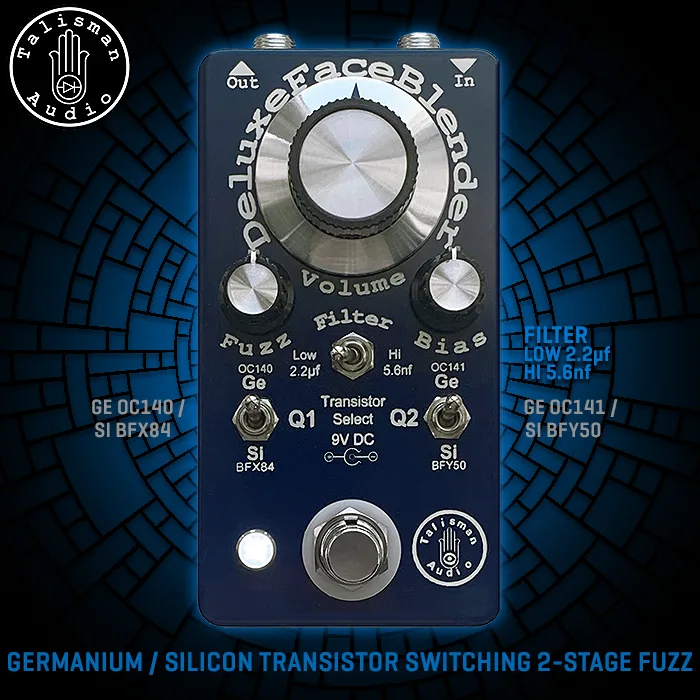
The Mammoth Pi goes for £450 GBP, a price Karlsson called exceptional value for this particular build1. It is built to order by Tom at Talisman Audio, who has other daily duties, so output is limited to a few days per week1. Talisman Audio also makes the Deluxe Face Blender and the GP7 fuzzes.
Karlsson's overall verdict:
"This Mammoth Pi is an all-round extraordinary pedal - a bona fide masterpiece for sure"1
Videos
TalismanAudio
TalismanAudio
Sources (3)
- Guitar Pedal X, Guitar Pedal X, 2026-10-07
- BIG MUFF TRANSISTORS AND OTHER COMPONENTS, Kit Rae (kitrae.net), 2012-07
- The Big Muff History of All Versions 3, Kit Rae (kitrae.net), 2017-09