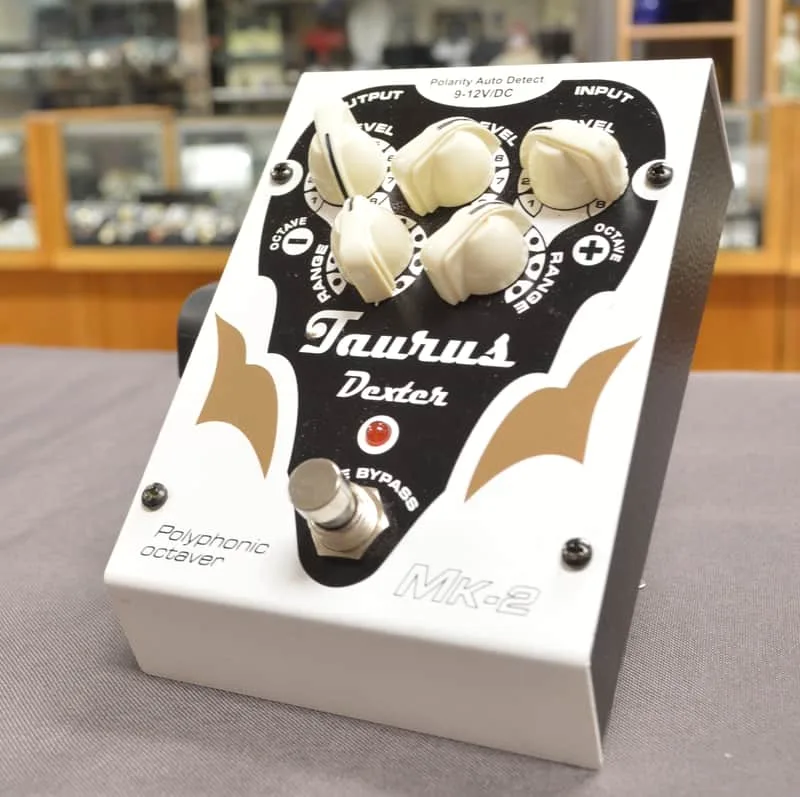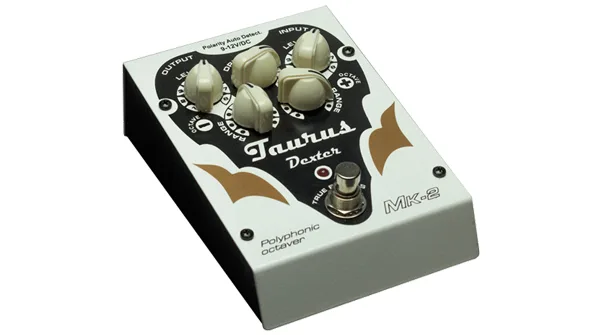


The Taurus Dexter is a polyphonic octave pedal from Taurus Amplification, part of the company's Silver line of boutique effect pedals. It tracks the notes you play and adds a generated tone one octave above and one octave below them, so a single guitar or bass line can come out as a three-voice stack1. Where most octave pedals of the older analog style track only single notes, the Dexter's digital tracking is built to follow chords, which is what "polyphonic" means here.
The pedal sits in a 5" x 5.5" bent-steel chassis, with the input, output and power jacks on the top edge rather than the sides12. A true-bypass footswitch turns the effect on and lights two backlit red "eyes" on the face of the pedal so you can see at a glance when it is working1. Taurus released the original Dexter in early 2014, and a redesigned, smaller Taurus Dexter Mk-2 followed in 201523.
How it works and what it does to your sound
Inside the bent-steel box is a 24-bit DSP processor that tracks incoming audio and generates the octave voices1. Because the tracking is digital, the pedal can follow more than one note at a time, so chords and double-stops keep their shape instead of collapsing into glitching artifacts the way a monophonic analog octaver would.
You can use one octave voice or both at once, and the Mk-2 version extends this further, letting the octaves be used separately, mixed together, or mixed with the original notes23. That makes the pedal usable as a subtle thickener, with a quiet octave-down under your clean notes, or as a full octave stack with both voices at full level.
Premier Guitar's reviewer found the generated voices convincing rather than synthetic, describing the octave-up voice as sounding like an actual string rather than a thin, reedy digital copy, and the octave-down voice as tuned to perfection with a focus on the lower midrange rather than deep subs1.
The controls
The front panel is built around paired controls for each octave voice, plus one master control1:
| Control | What it does |
|---|---|
| Level (per octave) | Sets the volume of that octave voice1 |
| Range (per octave) | Limits the frequencies processed by that octave generator, setting the note range it tracks1 |
| Out level | Controls the overall output volume1 |
The range controls are the heart of the pedal. Premier Guitar called them "Dexter's secret weapons," because they let you predetermine the note range each voice tracks, which trims out unwanted tones at the edges of your instrument's range1. The Mk-2 press release describes the same pair of potentiometers per octave as controlling octave level and bandwidth to eliminate unwanted tones3.
"Dexter's secret weapons are his range controls, which limit the frequencies processed by the octave generators."
Power and pedalboard fit
The original Dexter's power jack sits on the top of the pedal alongside the Input and Output jacks, which keeps the sides clear for tight pedalboard placement2. Premier Guitar's reviewer flagged the pedal's power arrangement as a real consideration when assimilating it into an existing board1. The Mk-2 series addressed this directly, adding polarity auto detection, which solves the issues that come with using various types of power supplies3.
If you are powering the original Dexter from a shared supply, check its polarity requirement before plugging it in alongside your other pedals. The Mk-2 version removes this problem with its automatic polarity detection3.
The reviewer also noted that the dry signal cannot be muted, so the original note is always present in the output alongside the octaves1.
What reviewers said
The Dexter was reviewed warmly in the press. Guitar World's Billy Voight, reviewing the newly released pedal in February 2014 at a US street price of $319, found it "easy to get along with"2. Premier Guitar's reviewer, writing in the magazine's State of the Stomp column, was more effusive:
"I'm incredibly impressed by the tone of this machine."
The same reviewer called the Dexter "one of the best sounding and tracking poly-octaves available" and urged readers to give it a test run before settling on better-known alternatives1. The criticisms were minor: the power supply polarity, the unmuteable dry signal, and a few small hiccups, none of which touched the core tracking and tone1.
Videos
Premier Guitar
BassTheWorld.com
Darek Wawrzyniak (Darius Wave)
Questions
Is the Taurus Dexter analog or digital?
It is digital. The pedal houses a 24-bit DSP processor that tracks incoming audio and generates the octave voices, which is what allows it to track chords and multiple notes at once rather than single lines only.
Is the Taurus Dexter true bypass?
Yes. A true-bypass footswitch activates the effect, and when it is on, two backlit red eyes light up to show that the pedal is engaged.
What power supply does the Taurus Dexter need?
The original Dexter runs on a 12-volt, tip-positive power supply, which Premier Guitar's reviewer noted can make pedalboard integration difficult. The later Mk-2 version accepts 9 to 12V and adds polarity auto detection.
Can you mute the dry signal on the Taurus Dexter?
No. Premier Guitar's reviewer counted the inability to mute the dry signal among the pedal's minor hiccups, so the original note always stays in the mix alongside the octave voices.
Can the Taurus Dexter play both octaves at once?
Yes. You can use one octave voice or both at once, and the Mk-2 version lets the octaves be used separately, mixed together, or mixed with the original notes.
How much does the Taurus Dexter cost?
Guitar World listed a US street price of $319 in its February 2014 review of the pedal. That figure dates from the original release and may not reflect current pricing.
Sources (3)
- State of the Stomp: Dexter the Polyphonic Monster, Premier Guitar, 2013-12-17
- Review: Taurus Dexter Polyphonic Octaver Pedal, Guitar World, 2014-02-06
- Taurus Dexter Mk-2 Polyphonic Octaver for Bass and Guitar, Guitar Interactive Magazine, 2015-03-05