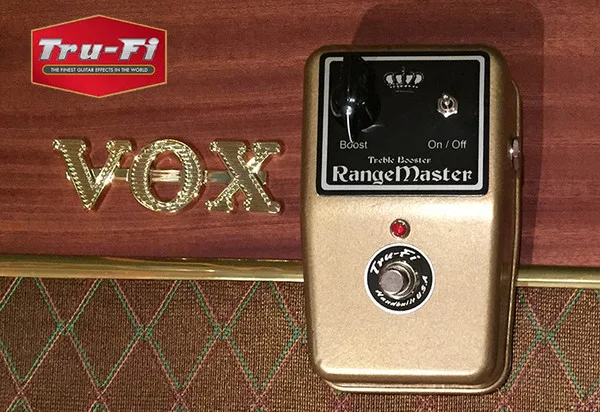
The Tru-Fi Treble Boost Rangemaster is a boost pedal built in the image of the Dallas Rangemaster, the 1960s treble booster that shaped the sound of British rock guitar. Tru-Fi describes it as a pedal that "takes a mild overdriven tube guitar amp and push's it into outer space for the classic Crunch Rock sound," and names Brian May of Queen, Sabbath and Deep Purple as players associated with that Rangemaster approach12. The pedal is built with real OC44 Mullard Black Glass transistors, the germanium part at the heart of the original circuit1.
What it does to your sound
A treble booster sits between the guitar and the amp and does two things at once. The British Pedal Company, describing the original Dallas unit, puts it plainly: "Its function was two-fold: to increase the signal strength of the guitar going into the amplifier, and to increase tones"3. In practice that means the pedal pushes more signal, weighted toward the top end, into an already working tube amp, and the amp's own overdrive does the rest. That is the classic use: a cranked amp on the edge of breakup, treble boost in front, and the sound turns into sustained crunch. MusicRadar's Trevor Curwen called the Rangemaster treble boost "one favourite" for giving an amp extra lift, from a time before dedicated stompbox boosts were common4.
Controls
The front panel carries a switch and a knob, and the switch is where the Tru-Fi departs from the original1:
| Control | What it does |
|---|---|
| ON/Off switch | Labeled like the original, but really a tri-mode frequency selector: up is full sound, middle is treble sound, down is bass enhanced1 |
| Boost knob | Sets the amount of boost; Tru-Fi calls it very responsive1 |
Tru-Fi's own verdict on the layout: "Every position on the switch is incredibly usable and the boost knob is very responsive."1
On the original Dallas unit, the switch really was a simple ON/OFF sliding switch, with a potentiometer to adjust the volume2. The tri-mode frequency selection on the Tru-Fi echoes a well-known Rangemaster modification: GuitarPCB's circuit analysis describes an output cap mod using an ON-OFF-ON switch to change between 1nF, 10nF (the standard value) and 1uF, which shifts the frequency character of the boost2. The Tru-Fi builds that idea in from the factory.
The circuit it comes from
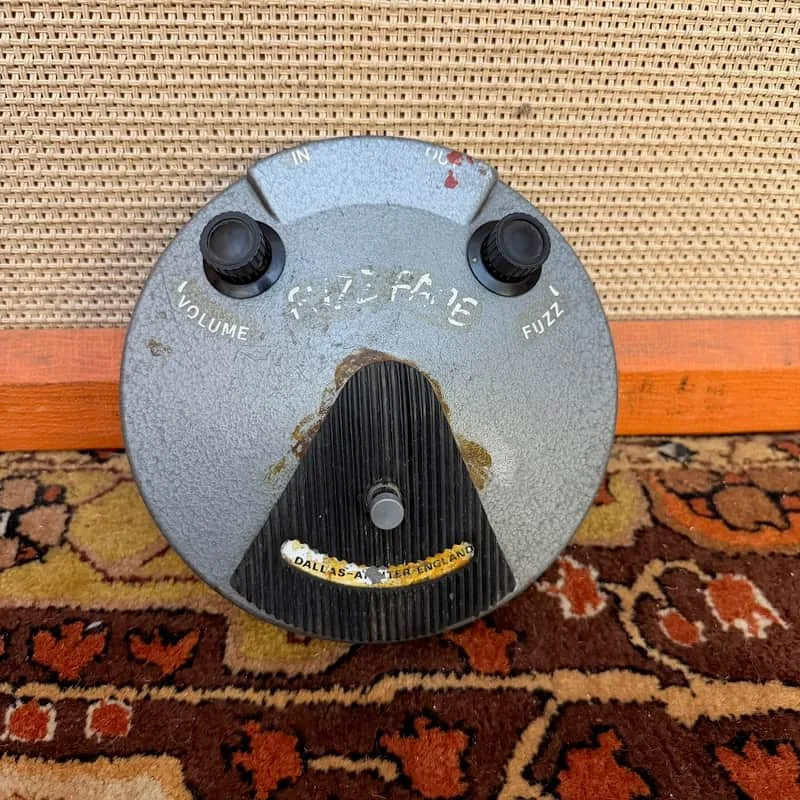
The Dallas Rangemaster Treble Booster is, in GuitarPCB's words, "beautifully simple, a single stage Common Emitter PNP amplifier"2. Their analysis puts its voltage gain at 80, equal to 38dB2. It was designed with the parts available in the 1960s, including carbon comp resistors and Mullard germanium transistors2. Vintage Guitar magazine reports that most Rangemasters carried a Mullard OC44 or an NTK275, the transistor also used in the original Dallas Arbiter Fuzz Face, although some boards used a Mullard OC715. The Tru-Fi's choice of real OC44 Mullard Black Glass transistors follows the most common original specification15.
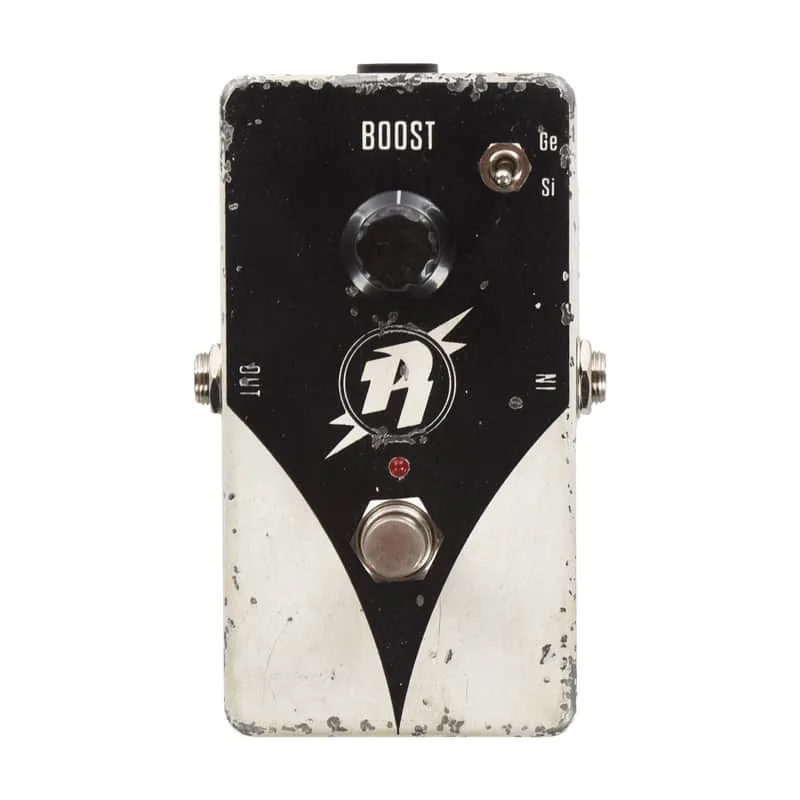
The original was made by Dallas, and the circuit's association with JMI lives on: TONEHOME lists a JMI Rangemaster Treble Booster re-issue, hand-built in England, limited to 100 units and powered by NOS OC44 transistors, dated England 20126. The circuit has been copied and varied many times since, and germanium Rangemaster-style boosts remain a recognized category among boost pedals.
Germanium-based Rangemaster-style pedals follow a 1960s design. The Tru-Fi runs on 9V power2; as with any germanium pedal, power arrangements matter on a shared board, so it is worth planning its spot on the power supply accordingly.
Questions
What transistors does the Tru-Fi Treble Boost Rangemaster use?
Tru-Fi builds the pedal with real OC44 Mullard Black Glass transistors, the germanium part associated with the original Dallas Rangemaster. Vintage Guitar magazine reports that most original Rangemasters carried a Mullard OC44 or an NTK275, with some boards using a Mullard OC71, so the Tru-Fi follows the most common original specification.
What does the ON/Off switch do on the Tru-Fi Rangemaster?
The panel switch is labelled ON/Off like the original Rangemaster, but on the Tru-Fi it is really a tri-mode frequency selector. Up gives the full sound, the middle position gives a treble sound, and down gives a bass-enhanced sound. Tru-Fi says every position on the switch is incredibly usable and that the boost knob is very responsive.
What is a Rangemaster treble booster?
The Dallas Rangemaster was a treble booster pre-amplifier made in the 1960s. The British Pedal Company describes its function as two-fold: to increase the signal strength of the guitar going into the amplifier, and to increase treble tones. Players pushed mild overdriven tube amps into heavier crunch with it, and the circuit has been widely copied ever since.
What voltage does the Tru-Fi Treble Boost Rangemaster run on?
The Tru-Fi Treble Boost Rangemaster runs on 9V power, according to the maker's product page.
Sources (6)
- Tru-Fi Treble Boost Rangemaster Guitar Pedal, tru-fi.com
- Dallas Rangemaster Treble Booster Analysis, GuitarPCB
- Dallas Rangemaster History, British Pedal Company
- Dunlop Echoplex Preamp review, MusicRadar, 2018-08-24
- The Dallas Rangemaster, Vintage Guitar magazine, 2015-01-26
- TONEHOME, TONEHOME