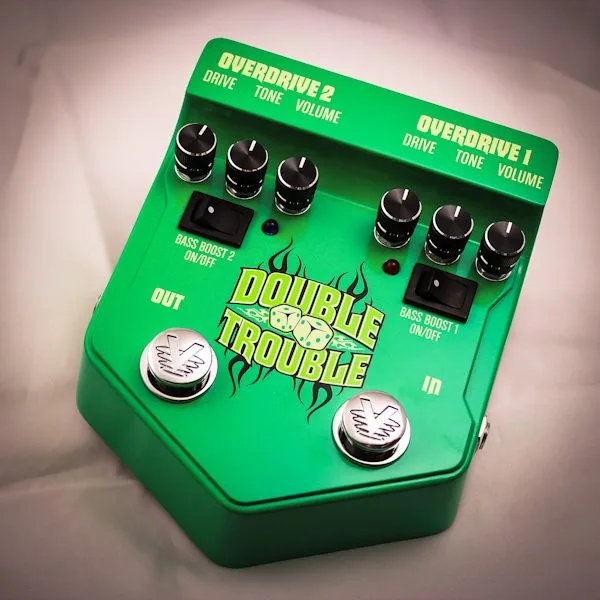
The Truetone V2 Double Trouble is a dual overdrive pedal: two complete overdrive circuits in one box, each with its own footswitch and its own full set of controls. Truetone describes the idea simply as "double the overdrive, double the options," and the layout backs that up: you can switch between two distinct sounds, layer them for more saturation, or use one channel as a clean boost ahead of the other1.
The pedal is no longer in current production. It is listed in the Truetone Archive, which the company presents as "A Legacy of Tone"1. The original version was made under the Visual Sound name, and MusicRadar's review of that pedal closed with the advice "Don't overlook Visual Sound in your search for ultimate tone"2.
Two independent channels
Each channel carries independent Drive, Tone, and Volume controls, and each has its own footswitch, so both sounds are set and switched on their own terms1. In practice that means the two sides can be tuned for entirely different jobs: one as a low-gain push and the other as a hotter voice, or one set near unity as a boost feeding the second channel for more saturation1.
| Control | What it does |
|---|---|
| Drive (per channel) | Sets the amount of overdrive on that channel1 |
| Tone (per channel) | Shapes the voice of that channel1 |
| Volume (per channel) | Sets the level of that channel1 |
| Footswitch (per channel) | Turns that channel on and off independently1 |
Power and noise reduction
The pedal runs on 9VDC with a center pin negative connector, the standard polarity for guitar pedals, and draws 21 to 24mA1. At that draw it sits comfortably within the range of a typical pedalboard power supply output.
The V2 Series includes an integrated noise reduction system that activates automatically when the signal is absent. There is no dedicated control for it; it works on its own1.
Background: Visual Sound becomes Truetone
The Truetone V2 Double Trouble carries two independent overdrive channels, each with its own footswitch and a full set of controls, so you can switch between two distinct sounds, layer them for more saturation, or use one as a clean boost ahead of the other1. The pedal measures 5" × 6" (126 × 153mm)1.
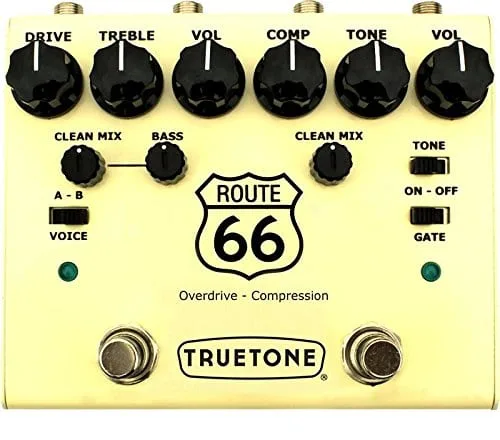
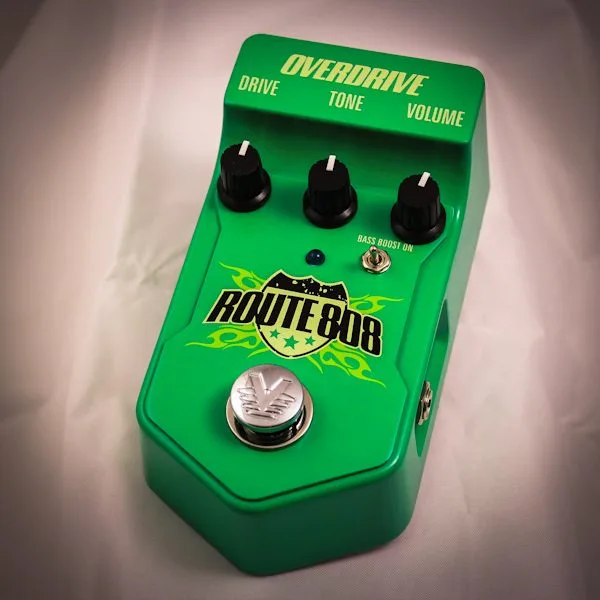
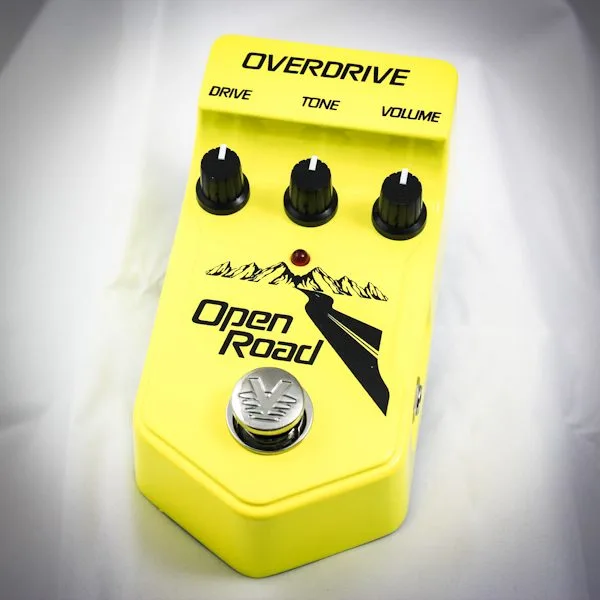
Truetone's dual-pedal line continued alongside the Double Trouble with models like the V2 Route 66 and V2 Route 808, and the single-channel V2 Open Road came from the same V2 Series era.
Questions
Can you stack the two channels of the Truetone V2 Double Trouble?
Yes. The pedal has two independent overdrive channels, each with its own footswitch and full set of controls. Truetone describes the options as switching between two distinct sounds, layering them for more saturation, or using one channel as a clean boost ahead of the other.
How much current does the V2 Double Trouble draw?
Truetone lists the current draw at 21 to 24mA. That is modest by pedal standards, so most standard 9V power supplies can handle it, though the pedal has no battery option mentioned on the maker's page.
What power supply does the Double Trouble use?
The V2 Double Trouble runs on 9VDC with a center pin negative connector, the same polarity as nearly all modern guitar pedals. Truetone lists this on the product page.
What is the noise reduction in the V2 Series?
The V2 Series includes an integrated noise reduction system that activates automatically when the signal is absent. Truetone lists this as a feature of the V2 Double Trouble, so it works in the background without a dedicated control.
Is the Truetone V2 Double Trouble still made?
No. The pedal is archived and appears in the Truetone Archive, which the company describes as 'A Legacy of Tone'. It is no longer part of the current lineup.
Did Visual Sound become Truetone?
Yes. Visual Sound changed its company name to Truetone in 2015. Founder Bob Weil announced the rebrand after 20 years, citing the Truetone trademark, the Truetone.com domain, and the name's history in 1920s radio.
Sources (2)
- V2 Double Trouble, Truetone, 2026
- Visual Sound Double Trouble review, MusicRadar, 2008-05-23