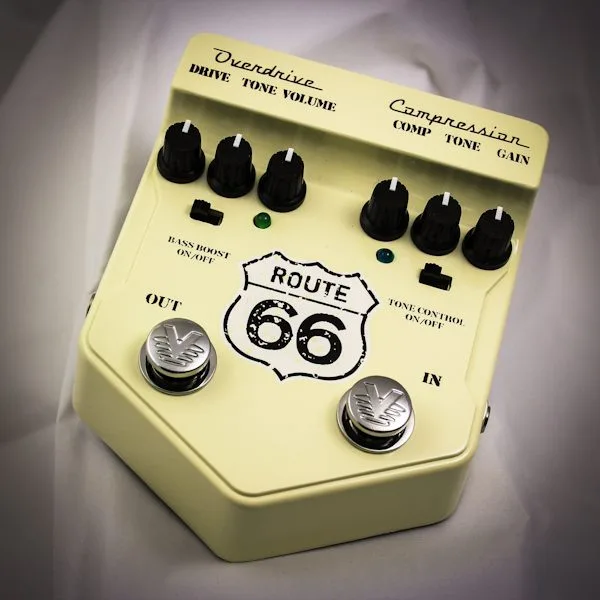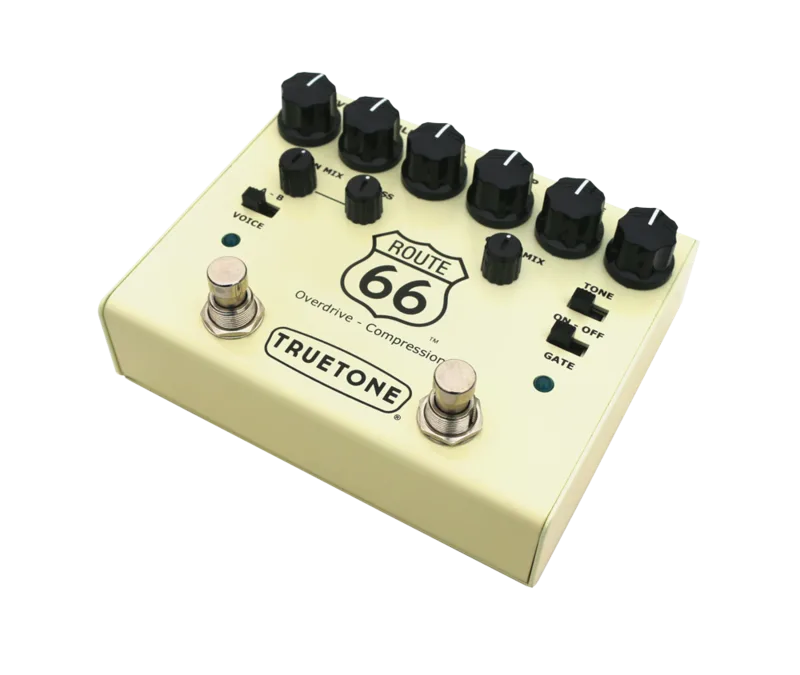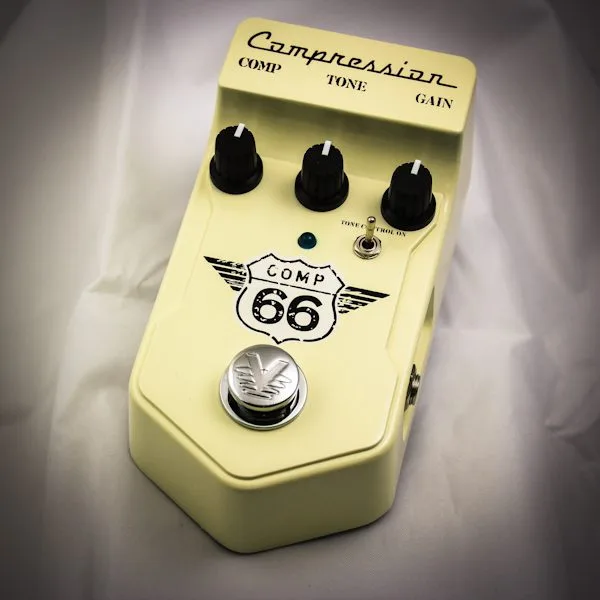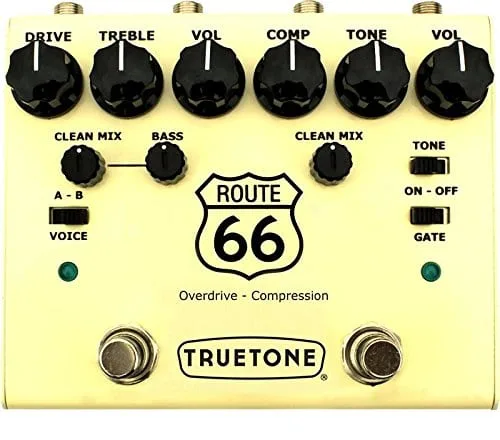


The Truetone Route 66 is a dual-channel pedal that puts a compressor and an overdrive in one enclosure, each with its own footswitch. Truetone says that when it first paired compression with overdrive in 1999, nobody else was doing it, and the pairing has been refined through several generations since1. The overdrive side is described by the maker as covering everything from mild boost to cranked amp sounds, while the compressor is one players often leave on as a permanent tone enhancer2.
The pedal was introduced in 1999 under the Visual Sound brand3, and the company now sells it as Truetone. Two generations matter to a buyer today: the V2 Route 66, now in the maker's archive, and the current V3 Route 66.
Compressor and overdrive in one box
The core idea of the Route 66 is that the two effects are independent circuits with their own footswitches, so a player can run the compressor alone, the overdrive alone, or both stacked. Premier Guitar's reviewers called it "a true two-in-one" thanks to the separate inputs and outputs for each effect, which also let the two channels sit in different places in a signal chain4.
On the sound, Truetone describes the V3's compression as ranging from smooth and connected to tight and punchy, with an overdrive that responds like a well-cranked amp1. The V3 adds Clean Mix controls to both channels, which the maker says lets the natural dynamics of the guitar cut through, and the effect order can be reversed with a patch cable for different creative approaches1. The V3's footswitches are rated for 10 million actuations with gold-plated relay contacts1.
What each side offers, by version:
| Feature | V2 Route 66 | V3 Route 66 |
|---|---|---|
| Channels | Independent compressor + overdrive, separate footswitches2 | Dual channel, separate inputs and outputs per channel1 |
| Clean mix | Clean mix mini knob on the overdrive side4 | Clean Mix controls on both channels1 |
| Noise reduction | V2 Series integrated noise reduction on both channels2 | Not stated |
| Effect order | Fixed | Reversible with a patch cable1 |
| Dimensions | 5" x 6" (126 x 153mm)2 | 5.11" x 4.45" x 2.05" (130 x 113 x 52mm)1 |
Noise reduction on both channels
Both channels of the V2 Route 66 include the V2 Series integrated noise reduction system. Truetone says the circuit is channel-independent and activates automatically, so it engages on its own when the signal is absent rather than needing a knob or switch2. On the earlier Visual Sound version reviewed by Premier Guitar, the compressor side had acquired a mix control and a switchable noise gate4.
What reviewers said
Premier Guitar's roundup reviewers found the Route 66 "pairs a potent overdrive with a great-sounding compressor," and were specific about the compressor's character4:
"The Route 66 isn't a completely transparent compressor, think of an old Ross or MXR Dyna Comp, but it can achieve subtlety"
In other words, it sits in the vintage squeezebox camp rather than the transparent camp, but the mix knob lets a player dial in a lighter touch. The same review noted two mini knobs on the overdrive side controlling clean mix and bass4.
Versions and editions
The Route 66's family tree runs from 1999 to the present:
- Original Route 66 (1999): introduced by Visual Sound3
- V1 and V2: pentagonal enclosures, shaped like home plate5
- V3 Route 66 American Overdrive: announced by Visual Sound in November 2014 as a dual pedal with separate compressor and overdrive circuits, with revamped circuitry compared with the original65
- Truetone V2 and V3 Route 66: the same designs carried under the Truetone name after the company rebranded; a retailer listing of a rebranded Truetone model notes that all specifications remain unchanged from the Visual Sound version1
The V3 announcement added a 2-position voice switch on the overdrive side, varying the tone between bright and open or more saturated, and highlighted the compressor's clean mix knob for "huge clean sustained tones that haven't lost their attack"6. Delicious Audio's review of the V3 noted that users can stack and combine the two sides for a variety of compressed overdriven tones5.
The V2 Route 66 now sits in Truetone's archive alongside the rest of the V2 Series, so it is no longer part of the current lineup2.
Power and bypass
The V2 Route 66 runs on 9V DC with a center pin negative, drawing 15 to 24mA2. The V3 draws 44mA max1. Neither figure is demanding: both are well within what a typical isolated power supply supplies per output.
The V3's bypass is a per-channel choice between true bypass and buffered bypass using Truetone's Pure Tone circuit1. That flexibility matters on a large board, where a player might want one channel buffered to drive long cable runs and the other true bypass.
Related Truetone pedals
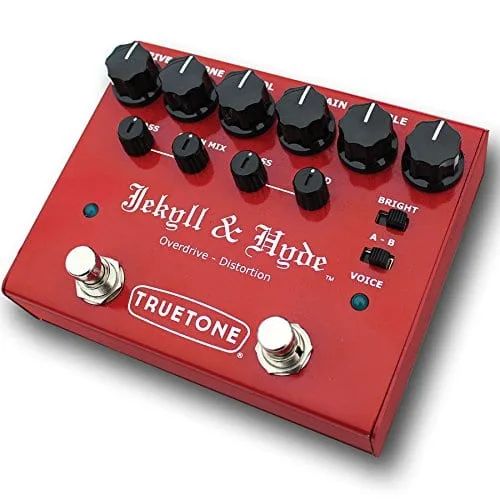
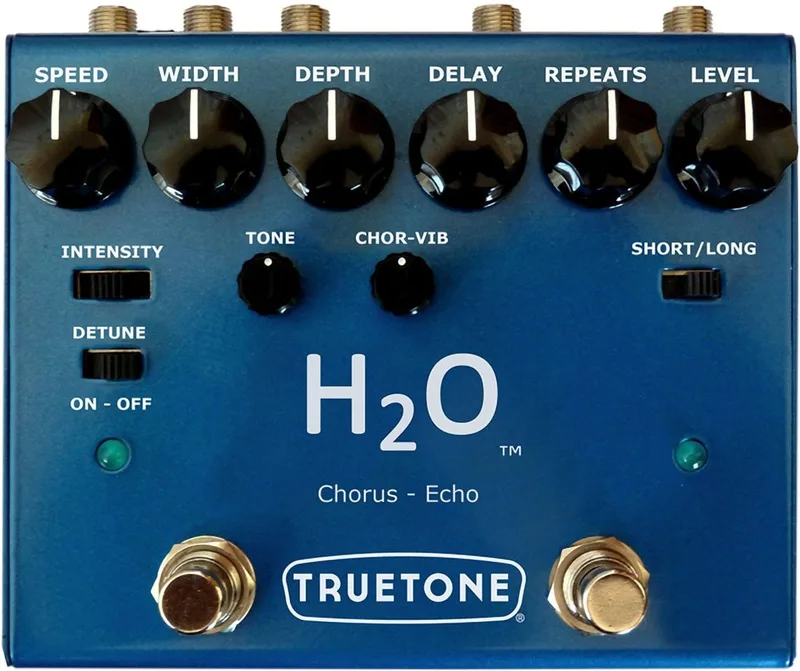
The V3 generation of the overdrive-plus-compressor design continues as the Visual Sound V3 Route 66 American Overdrive, with separate inputs and outputs per channel and an effect order that can be reversed with a patch cable6. Players comparing dual-channel Truetone pedals will also find the V3 Jekyll & Hyde, a dual overdrive drawing 49mA max, and the V3 H2O, a chorus and delay drawing 56mA max, in the same series78.
Videos
Premier Guitar
Truetone
Truetone
Questions
What power supply does the Truetone V2 Route 66 need?
The V2 Route 66 runs on 9V DC with a center pin negative, the same standard arrangement as most modern pedals. It draws between 15 and 24mA, which is low enough that it places very little demand on a typical pedalboard power supply.
Does the Route 66 work with bass?
Yes. Truetone says the V2 compressor responds equally well to guitar and bass, and the V3 page lists the pedal as compatible with guitar, bass, keyboards, and acoustic-electric instruments. Bass players can use the compressor side alone or stack it with the overdrive.
Can the compressor and overdrive be used separately on the V2 Route 66?
Yes. The V2 Route 66 has independent compressor and overdrive channels with separate footswitches, so each effect can be switched on and off on its own. The two can also be stacked for compressed overdriven tones.
How much current does the Truetone V2 Route 66 draw?
Truetone lists the V2 Route 66's current draw as 15 to 24mA. The V3 Route 66 draws more, at 44mA maximum, but both figures are modest by the standards of modern dual-effect pedals.
Was Truetone once called Visual Sound?
Yes. The Route 66 was originally released in 1999 under the Visual Sound brand, and the V3 series was announced under that name in 2014. The company later became Truetone, with one retailer noting that a rebranded model kept all its specifications unchanged.
Is the Truetone V3 Route 66 true bypass?
It can be. The V3 Route 66 offers true bypass or buffered bypass using Truetone's Pure Tone circuit, and the choice is selectable per channel. That means a player can run one channel true bypass and the other buffered.
Sources (8)
- V3 Route 66, Truetone, 2026
- V2 Route 66, Truetone, 2026
- Visual Sound V2 Comp 66 Pedal Review, Premier Guitar, 2008-10-15
- Overdrive Overload: 6-Pedal Review Roundup, Premier Guitar, 2015-05-13
- New Pedals: Visual Sound V3 Route 66 American Overdrive + Compressor, Delicious Audio, 2015-01-16
- Visual Sound Launches V3 Route 66 American Overdrive, Premier Guitar, 2014-11-21
- V3 Jekyll & Hyde, Truetone, 2026
- V3 H2O | Truetone Archive, Truetone, 2026