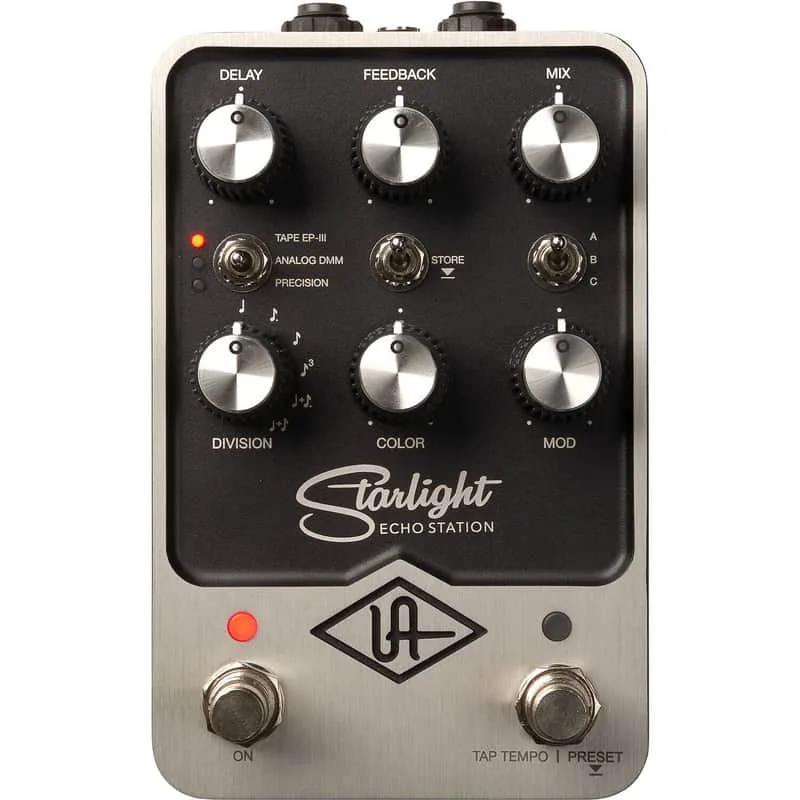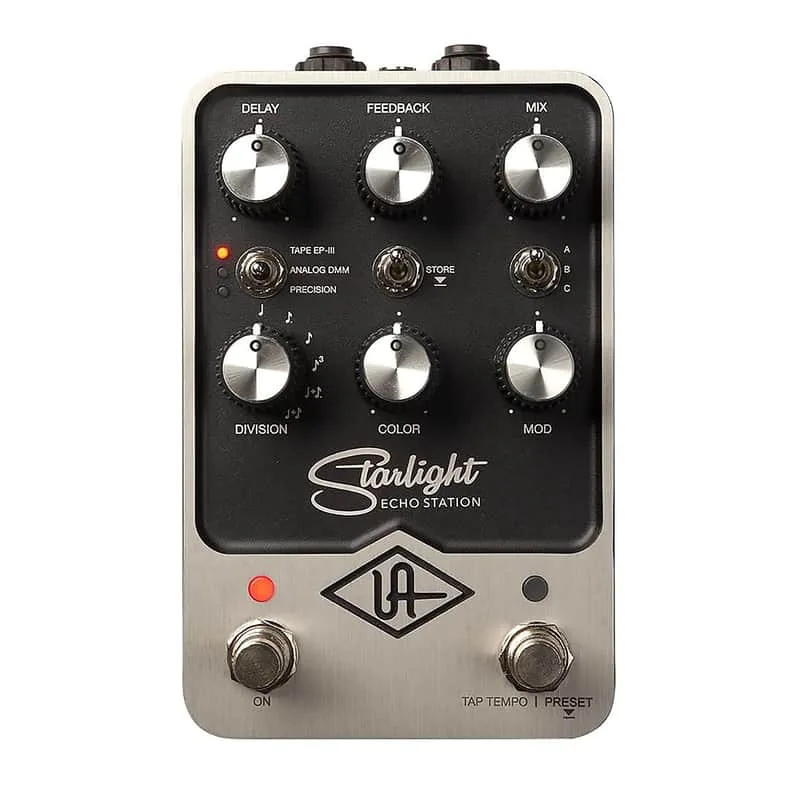


The Universal Audio Starlight Echo Station is a delay pedal from Universal Audio that puts three delay types in one unit: a tape echo, a bucket-brigade analog delay, and a digital delay1. It is a DSP pedal, part of the first wave of UAFX stompboxes that Universal Audio shipped in 2021 alongside the Golden Reverberator and Astra Modulation Machine2. Each mode is a detailed emulation of a specific vintage unit rather than a generic delay, which is the pedal's main selling point.
The three modes are Tape EP-III, Analog DMM, and Precision3. Tape EP-III models the Echoplex EP-3 tape delay unit, Analog DMM models the Electro-Harmonix Deluxe Memory Man analog delay pedal with its bucket-brigade delay chip, and Precision is a studio-grade digital delay with modulation options24. A fourth model, the Cooper Time Cube, was offered as a download with lower-fi charm and three filter options5.
Tape, bucket-brigade and digital delay in one pedal
The three modes cover the main families of delay in one enclosure. Tape EP-III emulates a classic tape-based delay, with three variations described by Guitar World's reviewer as "pristine, old tape or a bit knackered", plus adjustable wow and flutter5. Universal Audio frames the tape mode as a soup-to-nuts model of vintage early-'70s tape echo units, and lets you choose between New, Used, and Worn tape machines for different repeat color and texture1. Premier Guitar's reviewer noted that the brightest, cleanest A variation is based on the EP-4, the "studio" Echoplex that added a compressor and bass and treble controls to the signal path4.
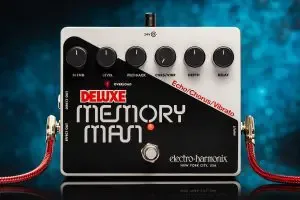
Analog DMM mimics the Deluxe Memory Man, the classic bucket-brigade pedal4. Universal Audio says it captures the best characteristics of multiple handpicked vintage units from the late-'70s and early-'80s1. MusicRadar's review details the A/B/C variations: for the Analog DMM you can choose chorus, modulation off, or vibrato, like the Electro-Harmonix original, while the EP-III offers a choice of tape ages2.
Precision handles digital delay chores with options for added flanger or chorus5. Universal Audio describes it as delivering pristine repeats with hi-fi studio-grade flange and chorusing textures and ping-ponging repeats1.
| Mode | Based on | A/B/C variations |
|---|---|---|
| Tape EP-III | Echoplex EP-3 tape delay2 | Tape ages: Minty Clean, Used Warm, Dark Worn2 |
| Analog DMM | Deluxe Memory Man bucket-brigade delay24 | Chorus, modulation off, or vibrato2 |
| Precision | Studio-grade digital delay1 | Flanger or chorus options5 |
The controls and footswitches
The control set is straightforward. Guitar World lists the controls as Delay, Feedback, Mix, Division, Color, Mod, plus an Effect Type switch, a Store switch, a Mode switch (A/B/C), and a Pair switch5. Gearnews' reviewer called the Delay, Feedback and Mix knobs "all self-explanatory"3.
There are two footswitches: one turns the effect on and off, and one loads the preset, which also doubles as tap tempo3. Because the preset footswitch is shared with tap tempo, you have to hold it down to store a sound6. Guitar World describes the preset system simply: "You have a single preset per pedal; just dial in your sound, flick the Store switch and you're done."5
One detail worth knowing: the last two settings on the Division switch send different delay times to the left and right outputs, which is how the pedal sets up ping-pong repeats in stereo6.
The Color control shapes the character of the repeats. Guitar.com's reviewer found it lets you "push the input gain for uncannily accurate messiness or keep things more clean and hiss-free than an analogue original could ever manage."6
Deeper editing happens in the UAFX Control app, which connects by hardwired USB or Bluetooth and lets you customize, save, and manage effects1. Bypass mode, true relay or buffered with trails, is also switched in the app1.
Power and connections
The pedal needs an isolated 9V DC supply, center negative, with a 400 mA minimum1. Guitar World's spec box confirms 400 mA at 9V DC with the adapter not supplied5. That draw is well above what a typical 100 mA output delivers, so it needs a dedicated high-current output.
Connections are two 1/4" unbalanced inputs and two outputs, with the second jack of each pair used for stereo1. The pedal runs stereo or dual mono, with analog dry-through in all modes except preamp coloration, giving 0 ms dry latency from input to output1. A USB Type-C port handles registration and firmware updates via computer1, and the rear panel USB-to-MIDI connection receives preset changes and BPM clock sync from a MIDI rig1. Bluetooth v5 is built in for app control1.
| Specification | Value |
|---|---|
| Input impedance | 500 kilohms (mono in), 1 megohm (stereo in)1 |
| Output impedance | 500 ohms1 |
| Frequency response | 20 Hz to 20 kHz, ±1 dB1 |
| Maximum input level | 12.2 dBu1 |
| Maximum output level | 12.1 dBu1 |
| Dimensions (with knobs) | 2.56" H x 3.62" W x 5.55" D1 |
| Weight (unboxed) | 1.24 lbs1 |
The 400 mA draw means no battery operation and no sharing a daisy-chain output with other pedals. Use an isolated 9V DC supply rated for the full current.
Modeled on the Echoplex EP-3 and the Deluxe Memory Man
The two analog-flavored modes are the heart of the pedal. MusicRadar's review identifies the sources directly: the Tape EP-III is modeled on the Echoplex EP-3 tape delay unit, and the Analog DMM on the Memory Man Deluxe analog delay pedal2. Premier Guitar's reviewer explained that the Analog DMM "mimics Electro-Harmonix's Deluxe Memory Man with its bucket-brigade delay chip."4
The emulations are detailed enough that reviewers singled them out. Guitar.com's Richard Purvis wrote of the Memory Man model426:
"The gently degrading repeats and dreamy modulation are so bang-on it's almost funny"6
MusicRadar's Rob Laing was similarly positive about the Analog DMM, calling it "up there with the very best of the vintage Deluxe Memory Man-inspired stompboxes", with a little more high frequency on tap that he felt would come good in a band mix2.
What reviewers said
Reviews were broadly positive, with some reservations about functionality. Guitar.com gave the pedal 8/10, summing it up as "A multi-mode delay with limited functionality but utterly addictive faux-analogue sounds."6 Premier Guitar's reviewer found that the Starlight "convincingly conjures tape and bucket-brigade delays in all their anarchic glory", and said a "Goldilocks" interface offered lots of tonal options without excessive complexity; that reviewer would consider buying it even if it only included the Echoplex or Memory Man simulations4.
Gearnews' reviewer, testing the pedal at launch, started with the Tape EP-III mode and found it a very good-sounding tape delay37. MusicRadar's best-delay-pedals guide praised the build quality, noting simply that "UA makes super high spec stuff"7.
On Universal Audio's own product page, the pedal carries a customer aggregate of 4.3 out of 5 stars based on 18 reviews, with 78% saying they would recommend it1.
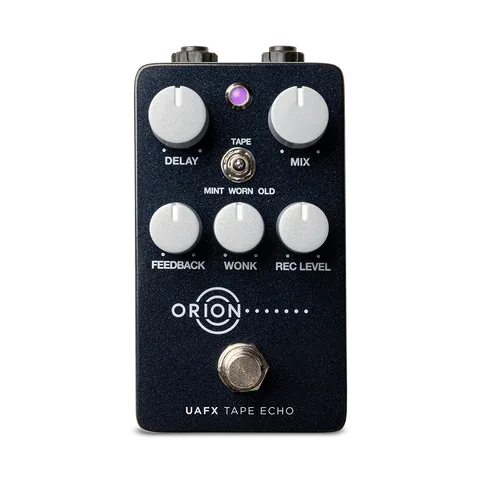
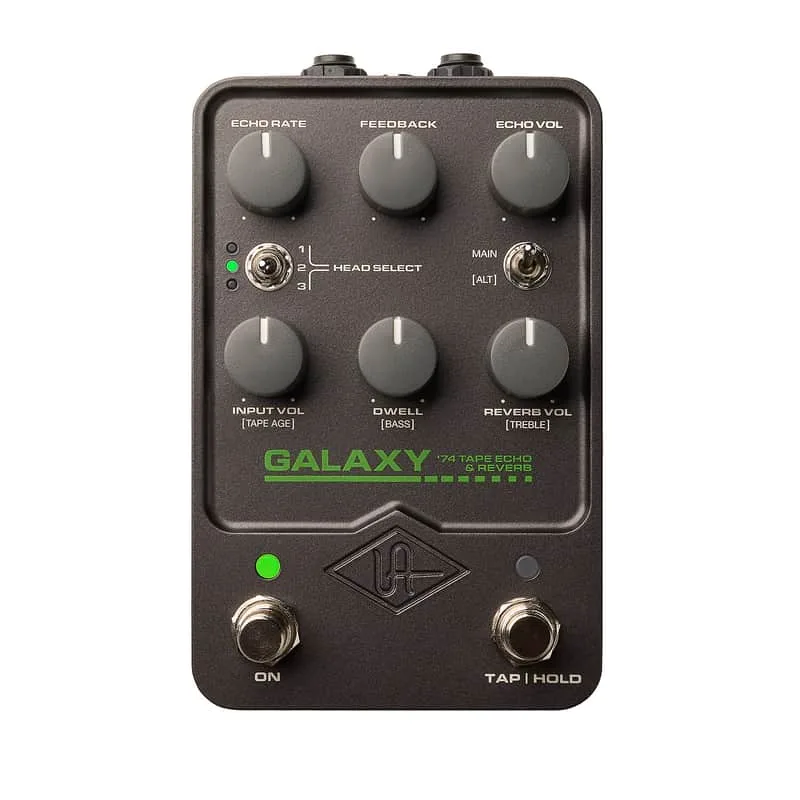
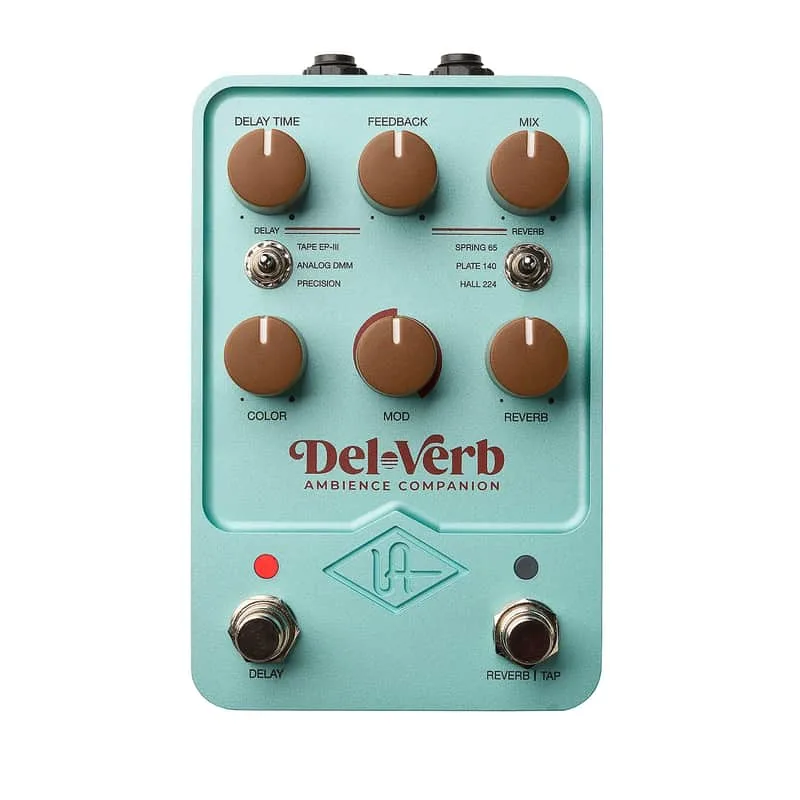
The single-preset design and the shared preset/tap footswitch were the most common criticisms, with Guitar.com noting the hold-to-store workaround6. For players who want the tape mode alone in a smaller, cheaper pedal, Universal Audio later brought the Starlight's EP-III algorithm to the compact Orion Tape Echo, and the company's delay lineup also includes the Galaxy '74 Tape Echo & Reverb and the Del-Verb Ambience Companion.
Videos
Sweetwater
Universal Audio
Universal Audio
News
Questions
Does the Starlight Echo Station work in stereo?
Yes. It runs in stereo or dual mono, with two 1/4 inch unbalanced inputs and two outputs, the second jack on each used for stereo connections. The last two settings on the Division switch send different delay times to the left and right outputs, which gives you ping-pong style repeats.
Is the Universal Audio Starlight true bypass?
It can be. Bypass is switchable between true bypass via mechanical relays and buffered bypass with trails, and the choice is made in the UAFX Control app. The dry signal passes through analog circuitry in all modes except preamp coloration, with 0 ms dry latency from input to output.
Can the Starlight Echo Station sync to MIDI clock?
Yes, over USB. The rear panel USB connection works as a USB-to-MIDI interface, so the pedal can receive preset changes and BPM clock sync from a programmable MIDI rig. The same USB-C port handles registration and firmware updates from a computer.
How many presets does the Starlight Echo Station hold?
One. You dial in a sound, flick the Store switch, and that becomes the preset. The left footswitch calls up your Live sound, the right footswitch calls up the stored preset, and the right footswitch also doubles as tap tempo, so you hold it down to save.
What power supply does the UAFX Starlight need?
An isolated 9V DC supply, center negative, delivering at least 400 mA. The adapter is not supplied. That current draw rules out a battery and means you should not share a daisy chain with other pedals; use an isolated output rated for the full 400 mA.
Sources (7)
- Starlight Echo Station Pedal, Universal Audio
- Universal Audio UAFX Golden Reverberator, Starlight Echo Station and Astra Modulation Machine review, MusicRadar, 2021-12-26
- Review: UAFX Golden Reverberator, Starlight Echo Station and Astra Modulation Machine, gearnews.com, 2021-04-04
- Universal Audio Starlight Echo Station Review, Premier Guitar, 2021-09-07
- Universal Audio Starlight Echo Station review, Guitar World, 2021-09-16
- The Big Review: Will Universal Audio’s entry into the guitar pedal market send boutique brands scurrying for cover?, Guitar.com, 2021-05-13
- Best delay pedals: add extra dimension to your tone, MusicRadar, 2022-05-17