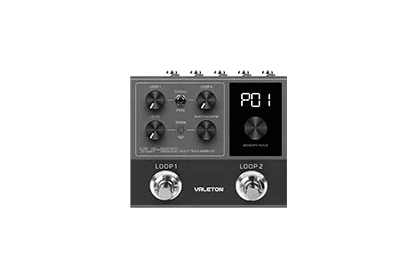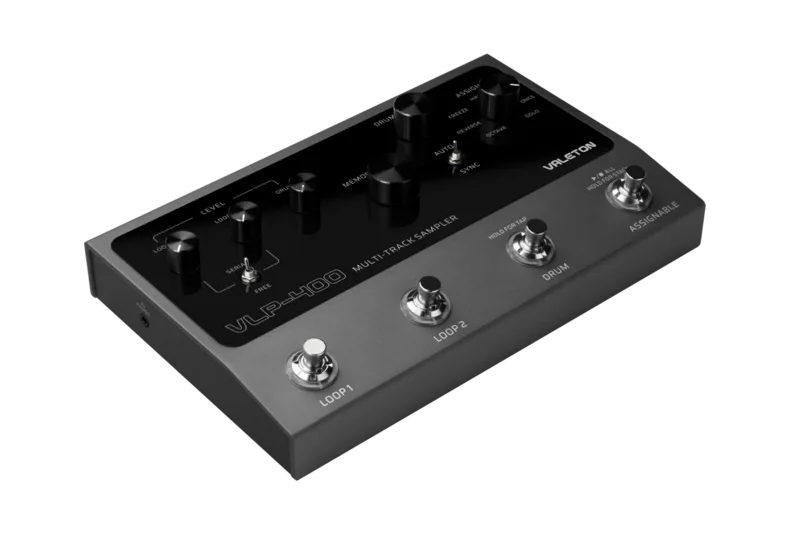


The Valeton VLP-400 is a dual looper pedal with a built-in drum machine. It carries two independent loops, LOOP 1 and LOOP 2, each with its own footswitch control for recording and playback, and the two loops can run one after the other or side by side depending on the mode you choose. Around the looping sits a drum machine with 100 patterns, including a metronome, and a combo input that takes either an instrument or a dynamic microphone1.
Loop modes and recording
The VLP-400's two collaboration modes, SERIAL and FREE, decide how LOOP 1 and LOOP 2 relate to each other. Valeton describes the idea as letting you "effortlessly play two loops in parallel or switch between them"1.
SERIAL mode chains the loops. If LOOP 1 is active, you can record a new track on LOOP 2, and it automatically starts recording after LOOP 1's playback ends. When both LOOP 1 and LOOP 2 contain music segments, the footswitch controls seamless switching between them1.
FREE mode runs the loops together. LOOP 1 and LOOP 2 can play simultaneously, and their recording durations do not affect each other, so the pedal operates as two fully functional independent loopers3. On the smaller VLP-200, Delicious Audio's Paolo De Gregorio described Free Mode as letting "you play the two loops simultaneously, facilitating more complex layering"4, and the same two-mode design carries over to the VLP-400.
Recordings are saved as WAV files at 32-bit float, 48 kHz. The pedal stores up to 99 projects, each holding up to 6 minutes of stereo recording, for a total recording time of 12 hours1. That is a step up from the Valeton VLP-200, which stores a maximum of 99 projects and about 7 hours of recording3, recorded at 24-bit/48 kHz according to Delicious Audio4.
Effects and control
The VLP-400 adds assignable controls over the VLP-200: Valeton states that "Compared to the VLP-200, the VLP-400 introduces ASSIGN knobs and ASSIGNABLE footswitches"1. The footswitch offers independent control of recording and playback for both LOOP 1 and LOOP 21.
Onboard loop effects are part of the package. gearnews.com's George Loveridge wrote that "With just a few spins, seven effects can be activated," naming Octave, Reverse, Freeze, Half, Fade and Solo2, while Valeton's own page lists the set as OCTAVE, REVERSE, FREEZE, HALF, FADE, ONCE and SOLO2. Both describe seven effects; the two lists differ on the seventh.
The drum machine's recording and AD/DA conversion use 32-bit float technology, which George Loveridge of gearnews.com wrote "ensures high-quality audio"2. The pedal's own audio quality is specified at 32-bit, 48kHz1.
Inputs, outputs and MIDI
The input side is a combo jack that accepts musical instruments or dynamic microphones without extra adapters, and the output signal adjusts automatically depending on what is connected1. For quiet practice, Valeton notes you can "Plug in your headphones via the 3.5mm output and enjoy a silent, creative experience"1.
MIDI is handled by a standard 5-pin interface with two behaviors:
- With no MIDI IN signal, the VLP-400 acts as the master clock and sends out the BPM to sync with other gear.
- With MIDI IN active, it receives and forwards the MIDI signal1.
A USB 2.0 Type-C interface rounds out the connections1.
Availability and price
gearnews.com reported the VLP-400 available to order at Thomann on 28 April 20252. The US list price was reported as $159.00 USD at that date2. The European pricing in the same report does not agree with itself: the article gives €199 / £175 in one place and £145.00 / 169.00€ in another, so both figures are shown here as reported2.
Videos
Andertons Music Co
Valeton
Valeton
News
Questions
What power supply does the Valeton VLP-400 need?
The VLP-400 runs on a DC 9V supply rated at 500mA, according to Valeton's product page. There is no battery option mentioned, so a dedicated 9V adapter is required. Because of the 500mA draw, a low-current daisy-chain output may not be enough; a pedalboard power supply output rated for at least 500mA at 9V is the safe choice.
How long can the VLP-400 record?
Valeton lists total recording time of 12 hours across up to 99 projects, with each project holding up to 6 minutes of stereo recording in WAV format at 32-bit float, 48 kHz. For comparison, the smaller VLP-200 stores about 7 hours of audio at 24-bit/48 kHz.
Does the VLP-400 have MIDI?
Yes. It has a standard 5-pin MIDI interface. When there is no MIDI IN signal, the VLP-400 acts as the master clock and sends out the BPM to sync other gear. When a MIDI IN signal is present, it receives and forwards the MIDI signal.
Can I plug a microphone into the VLP-400?
Yes. The VLP-400 has a combo input that accepts musical instruments or dynamic microphones without extra adapters, and the output signal adjusts automatically depending on what is connected. There is also a 3.5mm headphone output for silent monitoring.
What is the difference between SERIAL and FREE mode?
In SERIAL mode, the two loops play one after the other: if LOOP 1 is active, you can record a new track on LOOP 2 and it starts automatically after LOOP 1 playback ends, and when both loops contain segments the footswitch switches between them seamlessly. In FREE mode, LOOP 1 and LOOP 2 play simultaneously with independent recording durations, working as two fully independent loopers for more complex layering.
How is the VLP-400 related to the VLP-200?
The VLP-400 is Valeton's larger take on the same dual-looper concept. According to Valeton, compared to the VLP-200 it introduces ASSIGN knobs and ASSIGNABLE footswitches. It also records at 32-bit float, 48 kHz with 12 hours of total storage, where the VLP-200 records up to about 7 hours at 24-bit/48 kHz.
Sources (4)
- VLP-400 - VALETON, Valeton, 2026-10-14
- Valeton VLP-400: Parallel Looper with Independent Control, gearnews.com, 2025-04-28
- VLP-200 - VALETON, Valeton, 2026-07-23
- New Pedal: Valeton VLP-200 Multi-Track Sampler, Delicious Audio, 2024-09-04