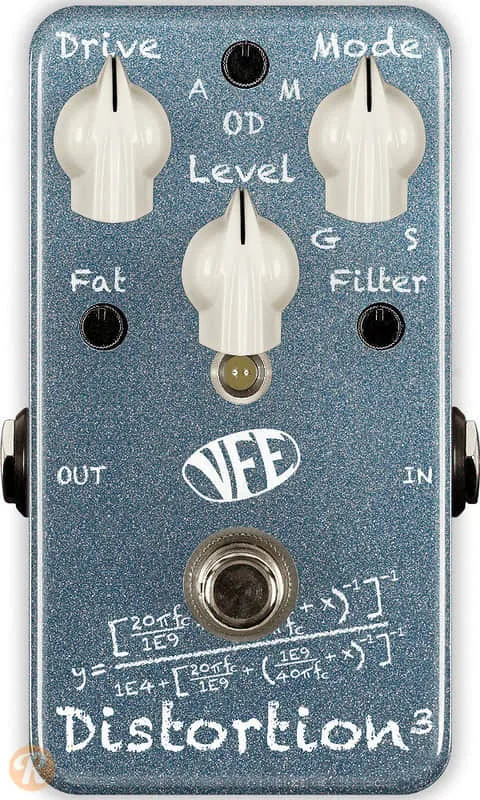

The VFE Distortion3 is a compact distortion pedal that packs three gain stages into one box. The maker's documentation describes it plainly: "The DISTORTION dirt box gives you 3 pedals in one box: boost, overdrive, and distortion," and says it "goes from transparent boost to crunchy overdrive to full-on distortion box with ease"1. It is built around an LM741 op-amp and a BS170 mosfet, and the maker suggests that fans of the ProCo Rat will feel at home: "If you are a fan of the Rat, then you will like the Distortion3. It is rude and unapologetic in all the right ways"1.
Status and availability
The Distortion3 is no longer in production. The maker's documentation describes the PCBs as "the actual boards used to build the recently discontinued line of VFE pedals," now offered for DIY use1.
Because the pedal is discontinued, used-market and DIY routes are the ways to one. The maker's documentation notes that some component values changed over the VFE product cycles, so builders should use the values on the project image rather than the PCB silk-screen1.
The controls
The Distortion3's layout is built around two variable HCC (hard clipping configuration) controls in separate parts of the circuit, plus two EQ-style controls to shape the tone1. Each gain control sweeps through different clipping characters as you turn it.
| Control | What it does |
|---|---|
| DRIVE | Sets the gain of the circuit. With 15dB more gain on tap than the previous version, the maker calls the drive more than ample. |
| SOFT | Sets the compression and character of the softer, overdrive gain section. Counterclockwise gives asymmetrical silicon clipping, clockwise gives sweet and smooth mosfet drive, and 12:00 is clean boost. |
| HARD | Uses the variable HCC circuitry to change from saturated germanium distortion (counterclockwise), to crunchy silicon overdrive (clockwise), to clean boost at 12:00. |
| FILTER | Pull back to cut the treble and smooth out the grit generated by the gain sections. Crank it up for a transparent top end and a crisp, biting edge. |
| LEVEL | Sets the output volume. The EQ and amount of compression greatly affect the overall volume, so this control lets you match unity or push the amp for extra saturation. |
A tonal switch adds lo or hi-fi options on top of the FILTER control2.
The circuits it is modeled on
The Distortion3's clipping options are drawn from a small family of classic pedals. Delicious Audio's review, by Paolo De Gregorio and Ed Gross, explains the lineage: "This pedal simulates the MXR Distortion+ made famous by Randie Rhoads as well as the DOD 250 and MXR MicroAmp." Those three share the same basic circuit, and the Distortion3 lets the player choose the clipping device for each2:
- Germanium (Dist+) mode: germanium diode clipping simulating the MXR Distortion+2
- Silicon (DOD250) mode: silicon diode clipping simulating the DOD 2502
- Diode Lift (MicroAmp) mode: lifts the diodes out of the signal path, simulating the MXR MicroAmp2
The diode count behind those modes comes from the maker's documentation: five 1N914 silicon diodes and two 1N34A germanium diodes1.
What reviewers said
Delicious Audio's reviewers came away thinking of the Distortion3 less as a standalone drive and more as a stacking tool. In their words2:
The Distortion3's Diode Lift mode simulates the MXR MicroAmp2. The pedal was built on the same PCBs used for the recently discontinued line of VFE pedals, and the maker notes that the boards are provided for DIY use1.
They noted that the germanium boost added a layer of nastiness to single coils fed through an already overdriven rig, stacking with other pedals2.
Power
The maker notes that the effect does not use a split-rail power supply1, so it is intended to run from a standard center-negative pedalboard supply rather than a split-rail unit.
Videos
JetCityMusic
Questions
Is the VFE Distortion3 still being made?
No. The Distortion3 belongs to the recently discontinued line of VFE pedals, and the maker's documentation describes the PCBs as the actual boards used to build that line, now offered for DIY use. VFE Pedals has also stated it will close down at the end of 2026, while continuing repair service for out-of-warranty products indefinitely.
What diodes does the VFE Distortion3 use?
The maker's documentation lists five 1N914 silicon diodes and two 1N34A germanium diodes. The two types are what let the pedal switch between silicon and germanium clipping characters, covering the sounds of the DOD 250 and the MXR Distortion+ respectively.
How much current does the VFE Distortion3 draw?
The maker's documentation lists the current draw at 10mA, powered from a 9.42vDC One-Spot style supply. The pedal does not use a split-rail power supply.
Is the VFE Distortion3 like a Rat?
The maker's own documentation draws the comparison: if you are a fan of the Rat, then you will like the Distortion3, which it describes as rude and unapologetic in all the right ways. Reviewers placed its circuits closer to the MXR Distortion+, DOD 250 and MXR MicroAmp family.
Which pedals does the VFE Distortion3 simulate?
The Distortion3 simulates the MXR Distortion+, the DOD 250 and the MXR MicroAmp, three pedals that share the same basic circuit. A switch lets the user toggle between germanium diode clipping for the Distortion+ sound, silicon diode clipping for the DOD 250, and a diode lift mode for the MicroAmp.
Sources (2)
- Microsoft Word, madbeanpedals.com, 2019
- Pedal Review: VFE Distortion3, Delicious Audio, 2012-08-02