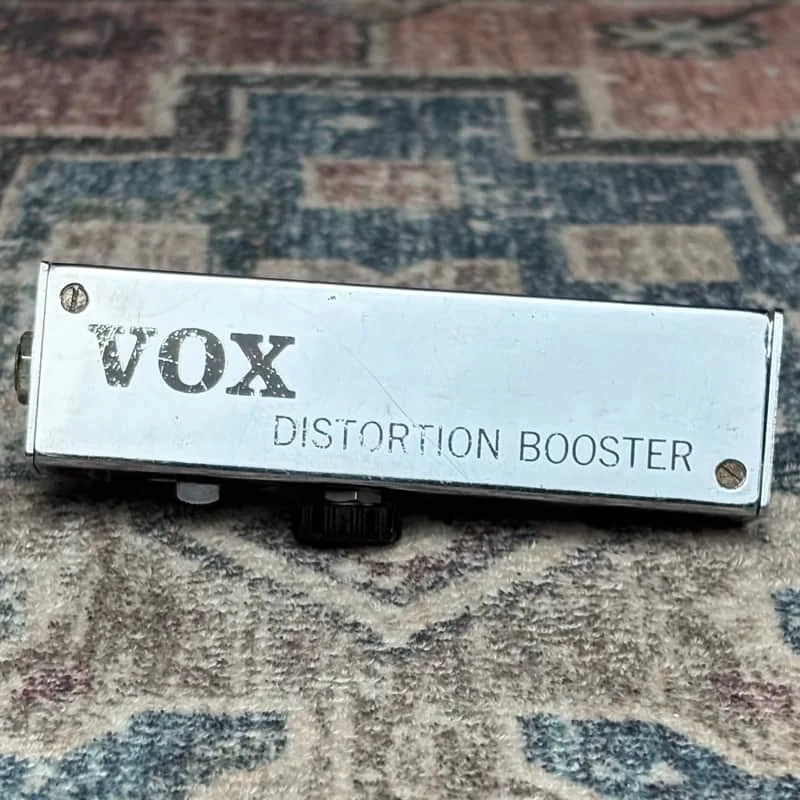
The Vox Distortion Booster V2 is a rare British fuzz unit from the 1960s, a variant of the Fuzz Face circuit that Vox originally sold as one of its plug-in Booster boxes. The original was designed in 1965 and built by Jennings Musical Instruments (JMI) in the UK, and the V2 is the second version of that circuit1. For players, it sits in the same family as other fuzzes: it is a two-transistor distortion design, and the closest modern relatives are covered on our Fuzz Pedals and Distortion Pedals pages.
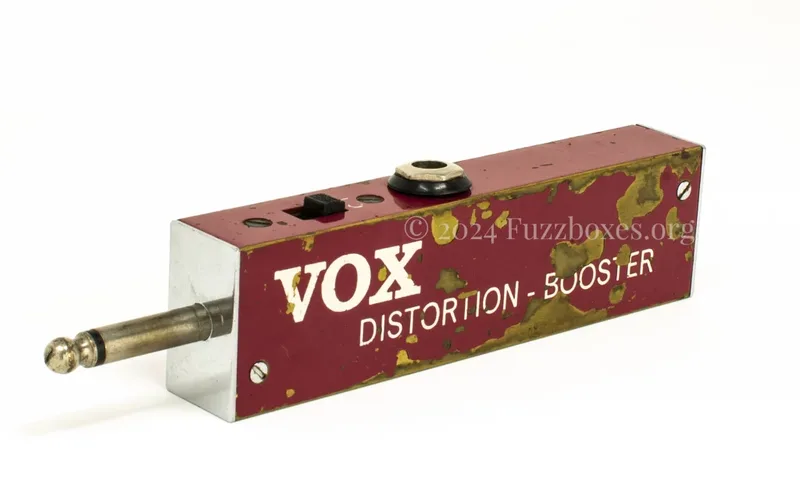
The original JMI Distortion Booster
JMI's Booster range was a set of four "plug-in" units: the chrome Treble Booster, the black Bass Booster, the blue Mic Booster and the famous red Distortion Booster. Rather than sitting on the floor connected by a cable, these were intended to be plugged directly into the amplifier's input1.
The set of four was demonstrated at the British Musical Instrument Industries Trade Fair in August 1965. According to Fuzzboxes.org, there was reportedly a delay in production specific to the Distortion Booster, so it is unclear when the red model actually reached the market1. Guitar Player's history of rare British fuzz boxes notes that the earliest models known are based on the Maestro Fuzz-Tone but use two transistors rather than three3.
Two practical quirks of the early British models are worth knowing:
- The same switch that toggled the effect in and out was also used to disconnect the battery, which caused a loud pop when engaged1.
- The red JMI Distortion Boosters were likely discontinued around the time of JMI's dissolution in 19681.
The V2 circuit and what builders found
Like the V8161, the V2 is a Fuzz Face variant, and the unit is described as similarly rare2. Because originals are scarce, the circuit lives on largely through DIY reproduction: a vero/stripboard and tagboard layout was posted on the Guitar FX Layouts blog in January 20182.
Builders who have worked from that layout report the following:
- A verified build by TJM found it "is not too far from a typical silicon Fuzz Face, although it could benefit from a trimmer to set the Q2 collector voltage" for sound and biasing2.
- In that build, the best transistor set was a 2N2369 with hFe 80 for Q1 and a 2N2222A with hFe 140 as Q2, within normal Fuzz Face ranges2.
- Another builder, SV112, first tried a pair of 2N2222As but found "it sounded kind of weak and would cut the sound when the guitar signal got too low"; a pair of 2N3904s improved it2.
- For a brighter sound, the suggested modification is to lower the 100n capacitor connecting to Volume 3 to a much lower value, such as 12n2.
A shrieking sound at maximum distortion is likely oscillation. The suggested fix is a 47R or 100R resistor in series with the Distortion 1 wire. One builder cured it by adding a bias pot on Q2 and small capacitors on the base and collector of both transistors2.
Where it sits in Vox's distortion line
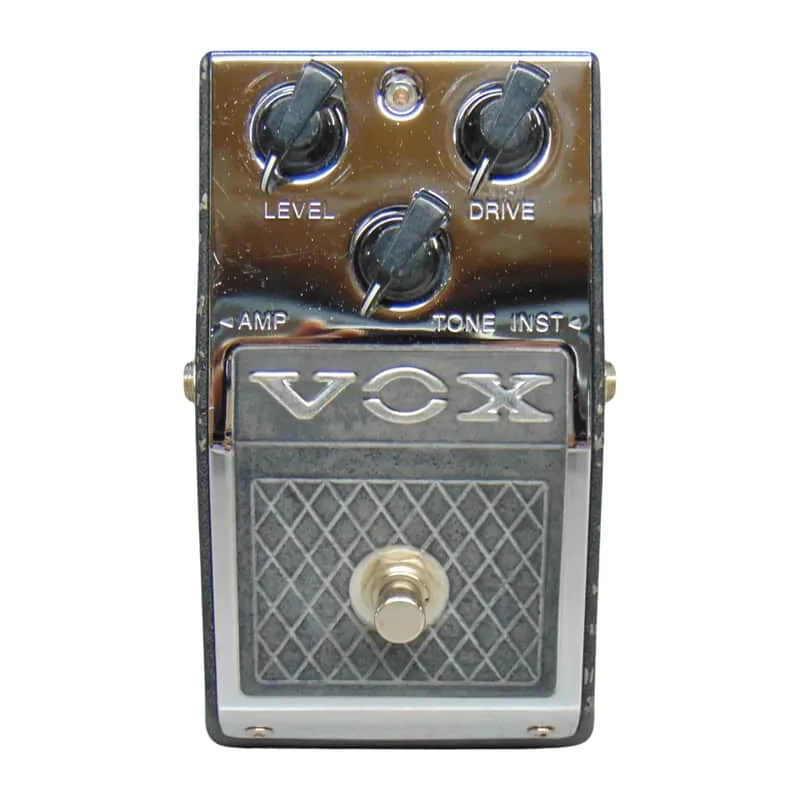
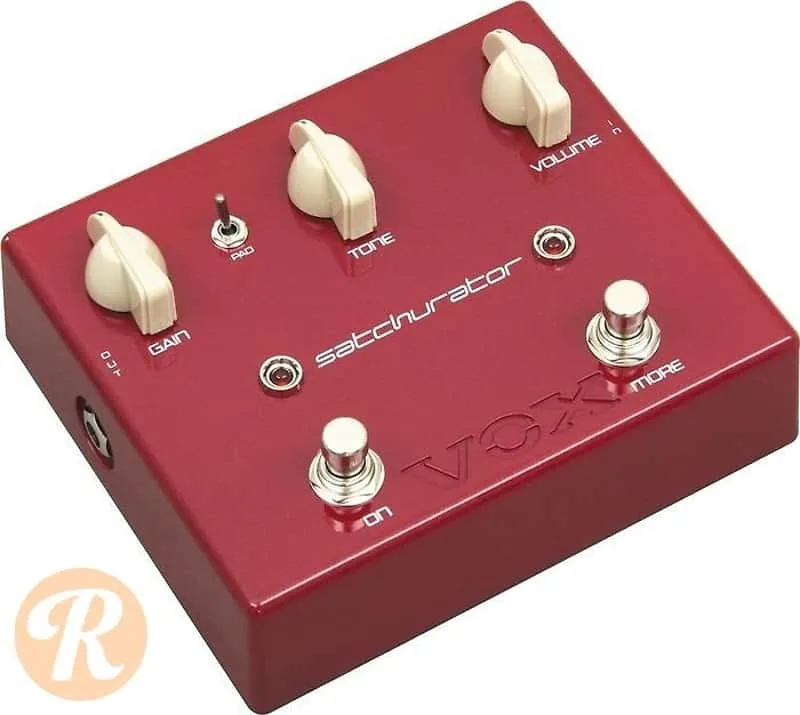
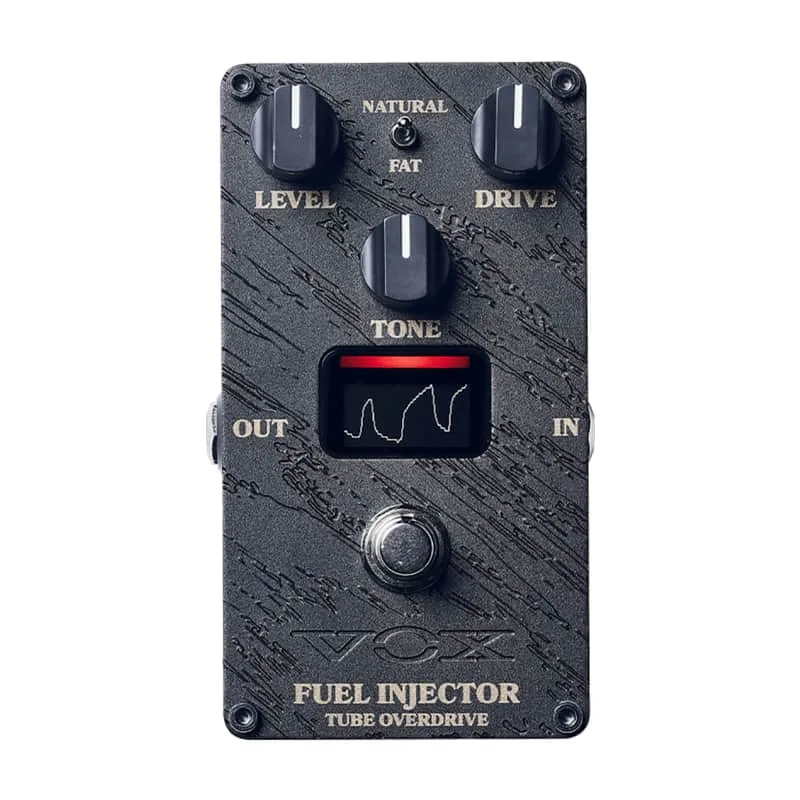
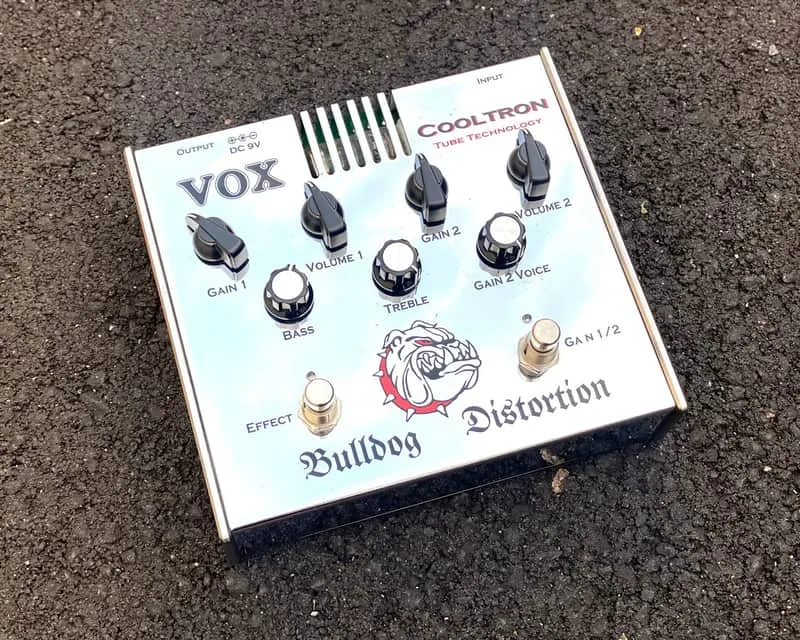
Vox has returned to the distortion pedal many times since the JMI era, from the Vox V830 Distortion Booster and the Vox Deluxe Distortion Booster v8161 to the Vox Satchurator and the Nutube-based Vox Valvenergy Fuel Injector. An overview of the brand's current and past designs is on the Vox page. The V2 itself, though, belongs to the earliest chapter: a two-transistor fuzz from 1965 that never had a long production run21.
Questions
Who made the original Vox Distortion Booster?
The original Vox Distortion Booster was designed in 1965 and initially built by Jennings Musical Instruments (JMI) in the UK. It was one of a set of four plug-in Booster units JMI demonstrated at the British Musical Instrument Industries Trade Fair in August 1965, alongside the Treble Booster, Bass Booster and Mic Booster.
What other units were in the JMI Booster set?
The JMI set comprised four plug-in Booster units: the chrome Treble Booster, the black Bass Booster, the blue Mic Booster and the red Distortion Booster. All were intended to be plugged directly into the amplifier's input rather than connected by a cable like a modern pedal.
When was the Vox Distortion Booster discontinued?
The red-coloured JMI Vox Distortion Boosters were likely discontinued around the time of JMI's dissolution in 1968. Production of the Distortion Booster was reportedly delayed relative to the other boosters in the set, so its exact market arrival is unclear.
Why does a Vox Distortion Booster clone shriek at maximum distortion?
On the Guitar FX Layouts build thread, the shrieking at maximum distortion was identified as likely oscillation. A suggested fix is placing a 47R or 100R resistor in series with the Distortion 1 wire. One builder also cured oscillation by adding a bias pot on Q2 and small capacitors on the base and collector of both transistors.
Sources (3)
- Vox Distortion Booster • Fuzzboxes, Fuzzboxes.org, 2021-05-14
- Guitar FX Layouts: Vox Distortion Booster V2, Guitar FX Layouts (tagboardeffects.blogspot.com), 2018-01-01
- Five Rare British Vintage Fuzzboxes (That Aren't Tone Benders or Fuzz Faces!), GuitarPlayer, 2021-08-31