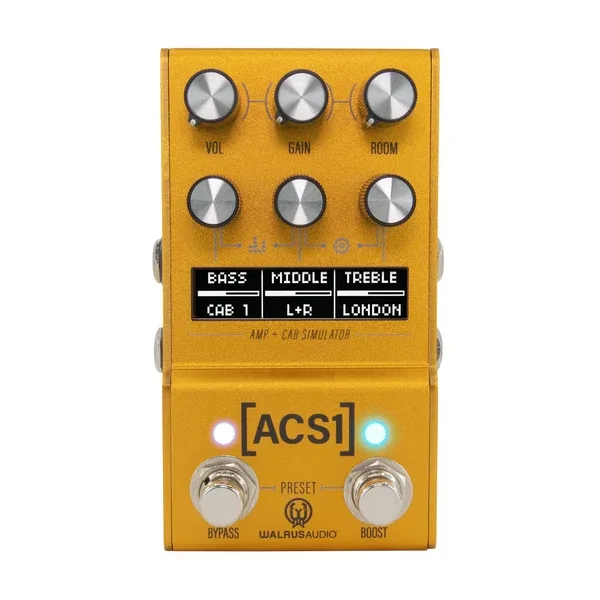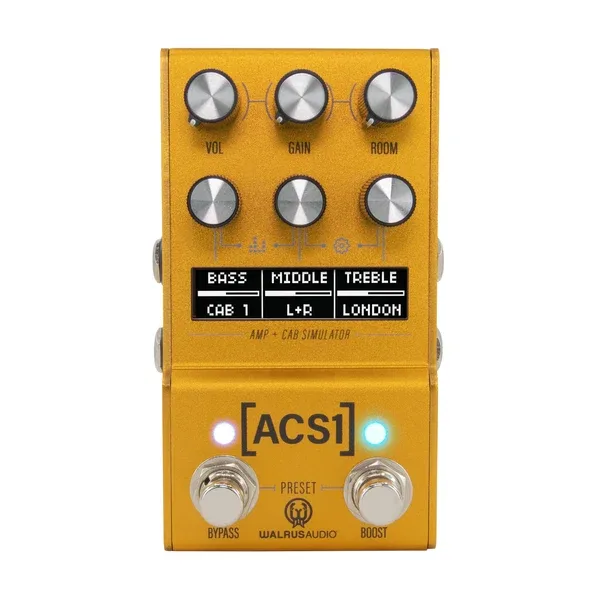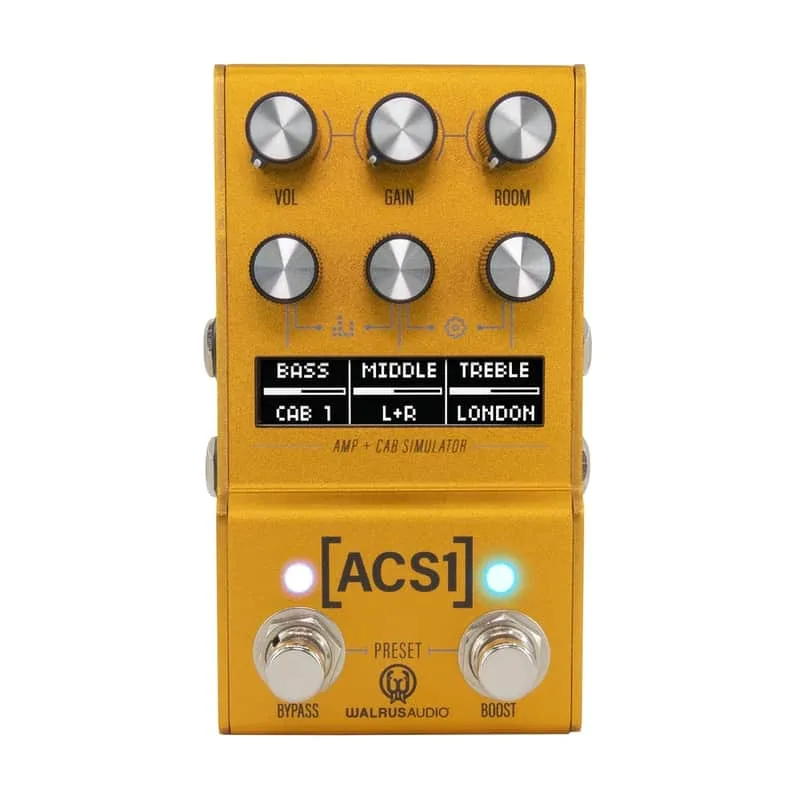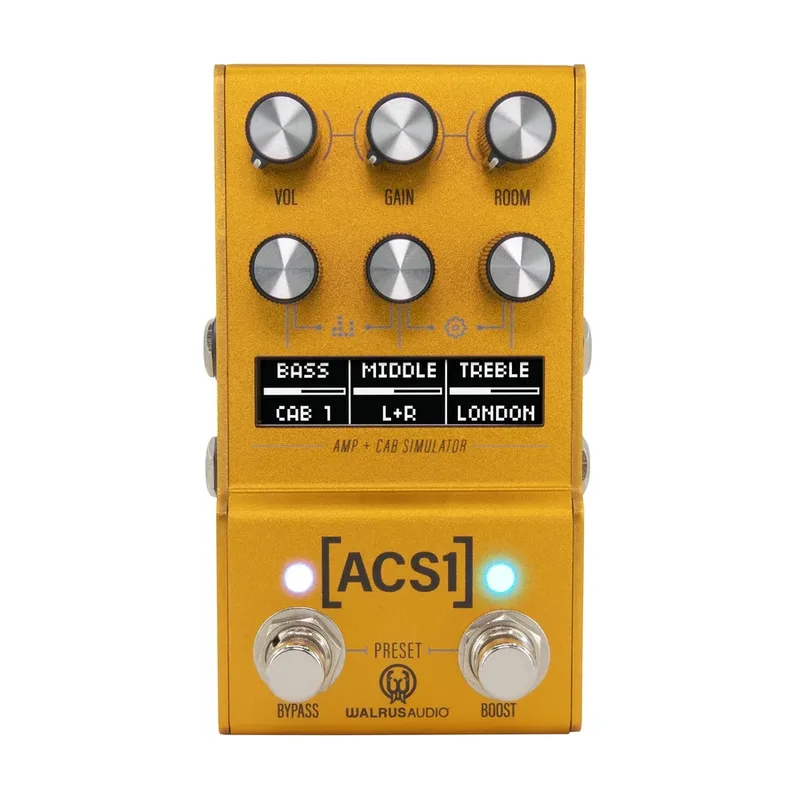


The Walrus Audio ACS1 MkII is an amplifier and speaker cabinet simulator pedal: a digital box that replaces an amp and cab on a pedalboard, feeding a PA, an interface or a pair of headphones. Walrus Audio describes it as "an amplifier and speaker cab simulator delivering the sound and feel of world-class amplifiers"123. It is the second version of the ACS1, part of the Walrus Audio Mako Series, and it holds six amp models and twelve cabinet IRs (impulse responses, the recorded snapshots of a speaker cabinet used to simulate it digitally)4.
What it does: digital amp models with IR cabinets
The ACS1 MkII carries six amplifier models. The three carried over from the original ACS1 emulate the Fender Deluxe Reverb, Marshall Bluesbreaker and Vox AC30; the MkII adds three high-gain models inspired by the Mesa Boogie Dual Rectifier, Orange Rockerverb and Peavey 5150, the last emulating that amp's red channel3. Premier Guitar reported that the three new models were "all inspired by high-gain amps for heavy-style players"9.
Each amp pairs with any of the twelve cabinet IRs, and the cab slots can take user-loaded IRs managed over USB10411. The signal path is digital, with 24-bit 48kHz A/D and D/A converters and 32-bit floating point processing12. There is also onboard reverb in three types, Room, Hall and Spring, set from the Room knob12.
Volume and Gain interact the way they do on a real amp: raising the gain also raises the overall output level, so balancing the two is part of dialing in a sound3.
The controls and footswitches
The MkII replaces the original's toggle switches with an OLED menu screen, and the bottom three dials double as push controls for navigating it8. Guitar World's reviewer called the screen "a massive difference between this new version and the previous MK1"8.
| Control | What it does |
|---|---|
| Volume | Master output level; interacts with Gain as on an amp3 |
| Gain | Amp drive level; raising it also raises output volume3 |
| Room | Reverb level, choosing between Room, Hall and Spring types128 |
| Left encoder | Bass, adjustable per channel (L, R, or L+R)2 |
| Middle encoder | Mids, adjustable per channel2 |
| Right encoder | Treble, adjustable per channel2 |
| Noise gate | New program control on the MkII, set through the menu9 |
There are two footswitches. One engages and bypasses the pedal; the other is a Boost switch that calls up a second, user-defined volume and gain setting1314. The pedal cycles through its three onboard presets, shown as red, green and blue, from a footswitch2.
Power and connections
Power requirements are 9V DC at 300 mA minimum2. The original ACS1 used a 9V DC center-negative supply with the same 300 mA minimum, and the supply is not included1413.
At 300 mA minimum, the ACS1 MkII draws more current than most analog drives or boosts, so it needs its own tap on a power supply or a dedicated adapter rather than sharing a low-current output.
Connections are left and right inputs, left and right outputs, a headphone output, USB-C, and MIDI in and thru8. The headphone output is a mini-jack7. With MIDI connected, up to 128 presets can be saved and recalled4.
The stereo routing is flexible. The two outputs can be configured in Stereo, with the same amp and cab on both sides, or in Dual mode, with a different amp and cab simulation on each channel3. The stereo inputs also allow two guitars to be plugged in at once, each running through its own independent amp and cab5.
How the MkII differs from the original ACS1
The original Mako Series ACS1 predates the MkII by a full generation, and the biggest change between the two is on the surface: the MkII replaces the original's toggle switches with an OLED menu screen, a difference one reviewer called "a massive difference between this new version and the previous MK1"810. Under the hood, the MkII also expands the amp modeling from the original's selection to six amp model emulations in total, adding the Mesa Boogie Dual Rectifier, Orange Rockerverb and Peavey 5150 (emulating the amp's red channel) alongside the Fender Deluxe Reverb, Marshall Bluesbreaker and Vox AC303.
The MkII, announced in September 2024, changes most of that:
- Three new high-gain amp models added to the original three, for six total9
- Twelve cab IRs, up from six, with custom IR upload4
- An OLED menu screen replacing toggle switches, with push functions on the bottom three dials8
- A noise gate added as a program control915
- An extra Boost footswitch for a second volume and gain setting3
- A mini-jack headphone output7
- Increased headroom and a lower noise floor, as Guitar World's reviewer reported8
What reviewers said
Guitar.com's review of the MkII centered on how it moves the pedal on from the original, with the reviewer highlighting the OLED menu screen and the secondary push controls on the bottom three dials as the headline changes over the Mk18. The same review noted that the London model "doesn't have the same level of gain as other Marshall-in-a-box type overdrives," and listed cheaper and more versatile options being available among its reasons to avoid, placing the pedal at the more premium end of the spectrum8.
Guitar World's 2026 review praised the OLED screen and the quieter, higher-headroom design, but flagged two drawbacks: the London model "doesn't have the same level of gain as other Marshall-in-a-box type overdrives," and the pedal "sits at the more premium end of the spectrum" on price, with cheaper and more versatile options available8.
"Now, a massive difference between this new version and the previous MK1 is the inclusion of an OLED screen."
Videos
walrusaudioeffects
walrusaudioeffects
The Studio Rats
Questions
Does the ACS1 MkII have a noise gate?
Yes. The MkII adds a noise gate as one of its new program controls, alongside the other changes Walrus Audio made for the second generation of the Mako Series. It is adjusted through the pedal's OLED menu system rather than a dedicated knob.
What amp models are in the Walrus ACS1 MkII?
Six in total. The three original models are based on the Fender Deluxe Reverb, Marshall Bluesbreaker and Vox AC30. The MkII adds three high-gain models inspired by the Mesa Boogie Dual Rectifier, Orange Rockerverb and Peavey 5150, the last emulating that amp's red channel.
Can the ACS1 MkII run two different amps in stereo?
Yes. The pedal has stereo inputs and outputs, and the two outputs can be set either to Stereo, with the same amp and cab on both sides, or to Dual mode, with a different amp and cab simulation on each channel. The stereo inputs also let two guitars run through independent amp and cab settings at once.
Does the ACS1 MkII work with headphones?
Yes. The MkII has a mini-jack headphone output on the pedal, which makes it usable for silent practice and direct recording without an interface or a separate headphone amp.
How many presets does the ACS1 MkII store?
Three presets are stored onboard, cycled with a footswitch and shown as red, green and blue. With MIDI connected, up to 128 presets can be saved and recalled, and the pedal has MIDI in and thru connections.
Sources (15)
- Highpoint Analog Optical Compressor, Walrus Audio
- Mako Series MKII: ACS1 Amp + Cab Simulator, Walrus Audio
- Walrus Audio ACS1 MkII Amp & Cab Simulator, Delicious Audio, 2024-12-03
- Mako Series MKII: ACS1 Amp + Cab Simulator, Walrus Audio
- Review: Walrus Audio Mako Series ACS1, Guitar.com, 2021-02-10
- Guitar Pedal X, Guitar Pedal X, 2024-09-27
- “Dialling in these inspiring studio grade tones has never been easier and has never sounded better”: Walrus Audio adds OLED display, more controls, features and sounds on its new and improved flagship Mako MkII series pedals, MusicRadar, 2024-09-25
- Walrus Audio Mako Series MKII ACS1 review, Guitar World, 2025-01-25
- Discover the Latest Walrus Audio Mako Series MKII, Premier Guitar, 2024-09-25
- NAMM 2021: Walrus Audio extends Mako Series with ACS1 Amplifier & Cab Simulator, gearnews.com, 2021-01-22
- Walrus Audio Mako Series MkII ACS1 review, Guitar.com, 2025-08-18
- Voyager Preamp/Overdrive, Walrus Audio
- Walrus Audio Mako Series ACS1 Amp + Cab Simulator review, MusicRadar, 2021-09-25
- Review: Walrus Audio's ACS1 Amp and Cab Simulator pedal, Gearnews, 2021-04-11
- Walrus Audio Releases Mako Series MKII Pedals, Bass Magazine, 2024-09-25