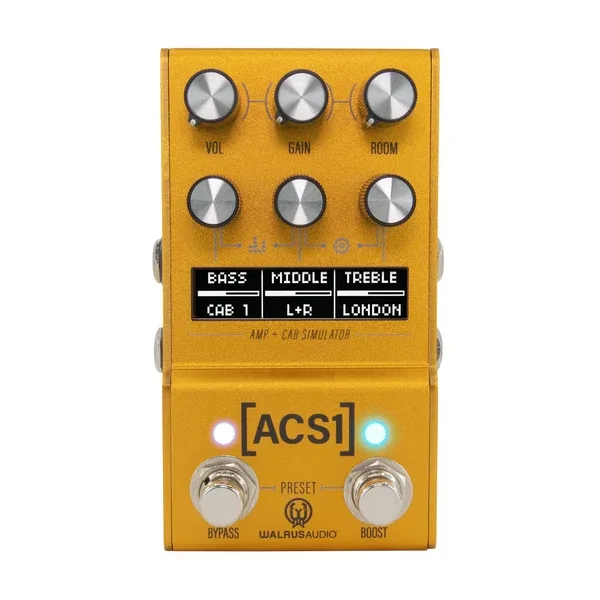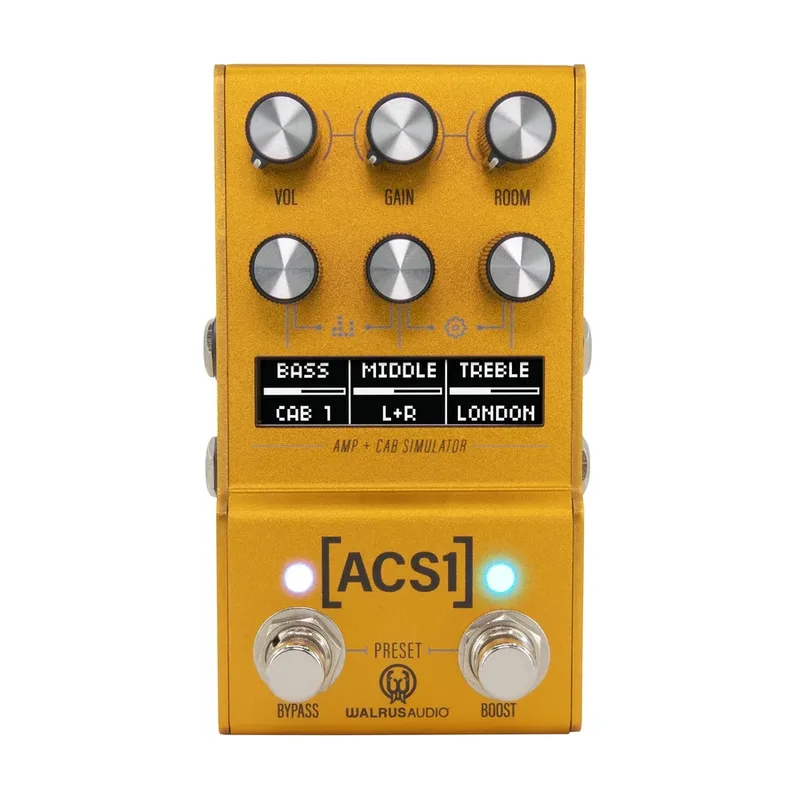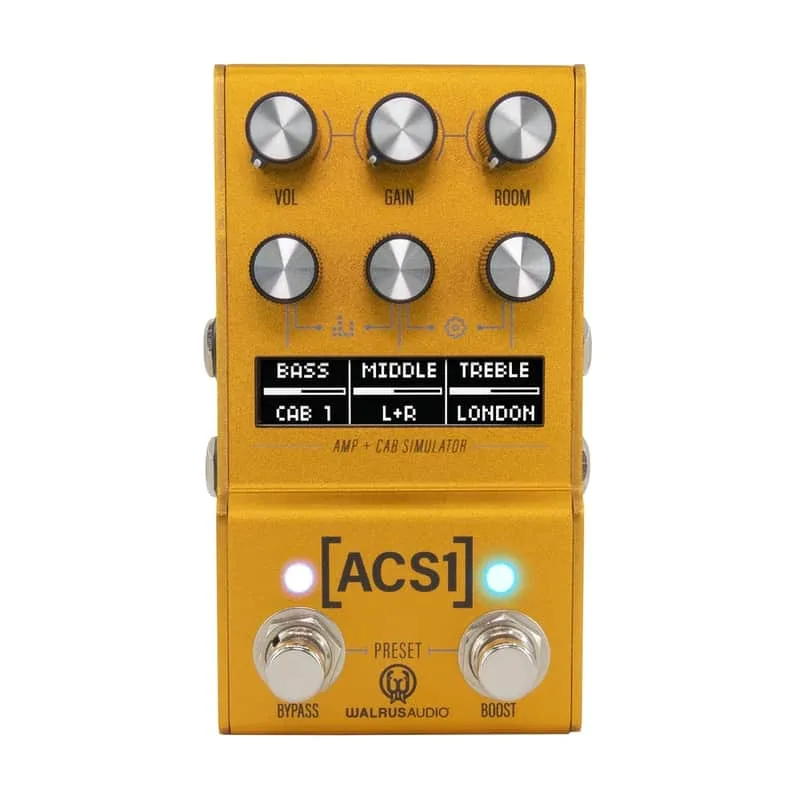


The Walrus Audio Mako ACS1 Amp + Cab Simulator is a pedal that puts a full amp and speaker cabinet rig on your pedalboard, and it can be run in stereo or mono1. It arrived in a handsome anodized gold enclosure with an amp-like layout, built on the Mako platform with an Analog Devices SHARC processor inside1. It was available to preorder priced £365 / $3991, and it gives players three amp modes to choose from: the Fullerton, which models the Fender Deluxe Reverb, the London, which puts the raw heat of a 1962 Marshall Bluesbreaker at your feet, and the Dartford, which brings a 60s VOX AC30 to life23.
The idea is simple: instead of carrying an amp, you plug into the ACS1 and it delivers what MusicRadar called "premium grade tube amp tones for your pedalboard"3. It models three vintage amplifiers, pairs them with six cabinet impulse responses (IRs, digital captures of real speaker cabinets), and outputs the result to a PA, an interface, or a pair of headphones. It runs in mono or stereo, is made in the USA, and carries a true bypass switch so it drops cleanly out of your signal chain2.
What it does: three amp models and six swappable cab IRs
The ACS1 gives you three amp models, each named for the town its reference amp came from3:
| Amp model | What it is based on |
|---|---|
| Fullerton | Fender Deluxe Reverb |
| London | 1962 Marshall Bluesbreaker |
| Dartford | 60s VOX AC30 |
MusicRadar described the London model as putting "the raw heat of a 1962 Marshall Bluesbreaker at your feet," with the Dartford mode bringing "a 60s VOX AC30 to life"3. An Amp switch on the face of the pedal moves between the three2.
On the cabinet side, the pedal ships with six custom cabinet impulse responses, and players can upload their own to the pedal via USB using Walrus Audio's dedicated web app3. A Cab switch (A/B/C) selects the speaker pairing2. When the pedal launched, a Walrus Audio commenter clarified that all six cab slots are user-swappable, not just three, so none of the stock cabinets is locked in place.
The ACS1 also carries onboard reverb, with a Room control and three reverb types: Room, Hall and Spring5. MusicRadar's review noted the stereo inputs and outputs give you the choice of running it in mono or stereo2.
The ACS1 was superseded by the Walrus Audio Mako Series MKII ACS1 in 2024, which added three more amp models (six total), six more cab IRs (twelve total), an OLED display, a boost footswitch and a noise gate67.
The controls
The control layout is deliberately amp-like, set in what MusicRadar's Jonathan Horsley called a "handsome anodized gold enclosure"1. The full control set, as listed in MusicRadar's review2:
| Control | What it does |
|---|---|
| Volume | Sets the output level |
| Gain | Sets the amount of drive from the amp model |
| Bass, Mid, Treble | Three-band tone shaping |
| Room | Sets the amount of onboard reverb |
| Cab switch (A/B/C) | Selects the speaker pairing |
| Amp switch | Selects Fullerton, London or Dartford |
| L+R switch | Sets mono or stereo operation |
| Bypass and Boost footswitches | Engages the pedal and the boost |
GuitarPlayer's coverage noted the boost switch and the adjustable room size alongside the Volume, Gain and three-band EQ controls8. Saving presets is done from the footswitches: dial in your sound, then press and hold the bypass and boost switches simultaneously until both LEDs flash to confirm5.
Presets and MIDI
Three presets can be saved onboard and recalled through the two footswitches, and with MIDI connected the count rises to 12825. MusicRadar's review listed MIDI controllability among its reasons to buy, with MIDI in and MIDI out connections at the top of the unit2. GuitarPlayer confirmed full MIDI support when the pedal launched8.
Power and connections
The ACS1 runs on a 9V DC power supply drawing a minimum of 300mA, and the adaptor is not supplied2. That current draw is well above what a standard 9V battery or a low-current daisy chain output can deliver, so it needs a proper pedalboard power supply.
At 300mA minimum, the ACS1 should be run from an isolated power supply output rated for that draw, not shared with low-current analog pedals on a daisy chain.
Connections are standard inputs (Left/Mono, Right), standard outputs (Left/Mono, Right), a mini-jack headphone output for silent practice, USB for loading IRs, and MIDI in and out2. The headphone output means the pedal works as a complete silent practice rig on its own. The unit can be run in stereo or mono4.
Where it came from
Walrus Audio made the ACS1 available to preorder at £365 / $39912. The pedal sits in the company's Mako series, and underneath its anodized gold enclosure there is a Mako platform with an Analog Devices SHARC processor doing the processing1. The enclosure follows an amp-like layout, and the unit can be run in stereo or mono1. A later blemished listing for the Mako Series MKII ACS1 shows a SOLD OUT status5.
The core of the ACS1's sound is its three amp modes. There is the Fullerton, which models the Fender Deluxe Reverb, the London, which puts the raw heat of a 1962 Marshall Bluesbreaker at your feet, while a 60s VOX AC30 is brought to life on the Dartford mode23. Each mode is paired with the pedal's speaker cabinet simulation, so a player switching between the three is moving between complete amp and cab voices rather than preamp flavors alone2.
What reviewers said
Coverage of the ACS1 pointed to what sits under the hood: underneath that handsome anodized gold enclosure there is a Mako platform with an Analog Devices SHARC processor doing the processing, and the enclosure itself follows an amp-like layout1. The same coverage noted that the unit can be run in stereo or mono1. The pedal has since become hard to find new, with a blemished listing for the Mako Series MKII ACS1 showing SOLD OUT status3.
Videos
walrusaudioeffects
walrusaudioeffects
walrusaudioeffects
Questions
What amps does the Walrus ACS1 model?
The original ACS1 has three amp models. Fullerton models the Fender Deluxe Reverb, London puts the raw heat of a 1962 Marshall Bluesbreaker at your feet, and Dartford brings a 60s VOX AC30 to life. The MkII version added three more amp simulations, taking the total to six.
Can you load your own IRs into the Walrus ACS1?
Yes. The ACS1 ships with six custom cabinet impulse responses, and all six cab slots are user-swappable. Players can upload their own IRs to the pedal via USB using Walrus Audio's dedicated web app, so the stock cabinets can be replaced entirely.
Does the Walrus ACS1 have a headphone output?
Yes. There is a mini-jack headphone output for silent practice, alongside standard stereo inputs and outputs, USB and MIDI connections. That makes it usable as a practice rig straight into headphones with no amp or speakers needed.
How many presets does the ACS1 hold with MIDI?
Three presets can be saved onboard, accessed through the two footswitches, and up to 128 presets can be saved and recalled when you bring in MIDI. Onboard presets are stored by holding the bypass and boost switches together until both LEDs flash.
What changed in ACS1 firmware 2.0?
Firmware 2.0, made public in August 2023, improved the gain knob's dynamic range and replaced the version 1 cabinet IRs with new ones by David Hislop and Kenyon Reed at Tone Factor. It was a free update for existing ACS1 owners.
Sources (8)
- Walrus Audio's Mako ACS1 Amp + Cab Simulator will let you nail that vintage amp tone without the vintage amp, MusicRadar, 2021-01-25
- Walrus Audio Mako Series ACS1 Amp + Cab Simulator review, MusicRadar, 2021-09-25
- 13 must-have stompboxes for 2021, MusicRadar, 2021-01-29
- Walrus Audio unveils its third Mako Series pedal, the ACS1 Amp + Cab Simulator, Guitar World, 2021-01-22
- Voyager Preamp/Overdrive, Walrus Audio
- “Dialling in these inspiring studio grade tones has never been easier and has never sounded better”: Walrus Audio adds OLED display, more controls, features and sounds on its new and improved flagship Mako MkII series pedals, MusicRadar, 2024-09-25
- Walrus Audio Mako Series MkII ACS1 review, Guitar.com, 2025-08-18
- Walrus Audio Announces New ACS1 Amp & Cab Simulator, GuitarPlayer (www.guitarplayer.com), 2021-02-09