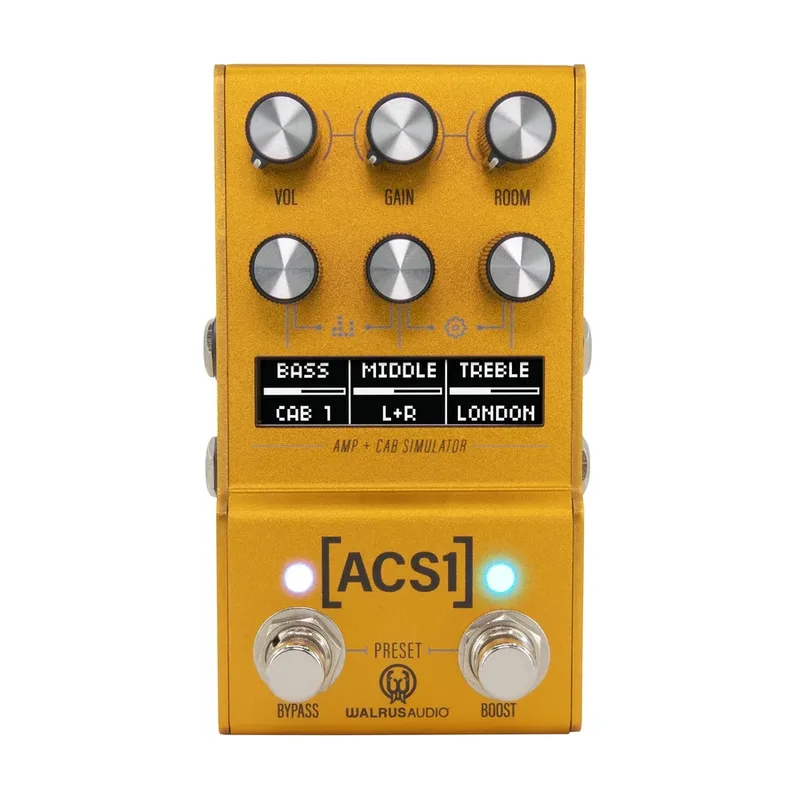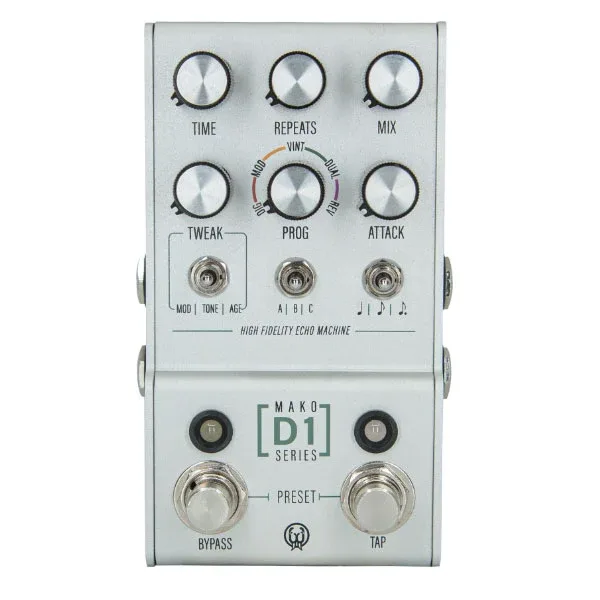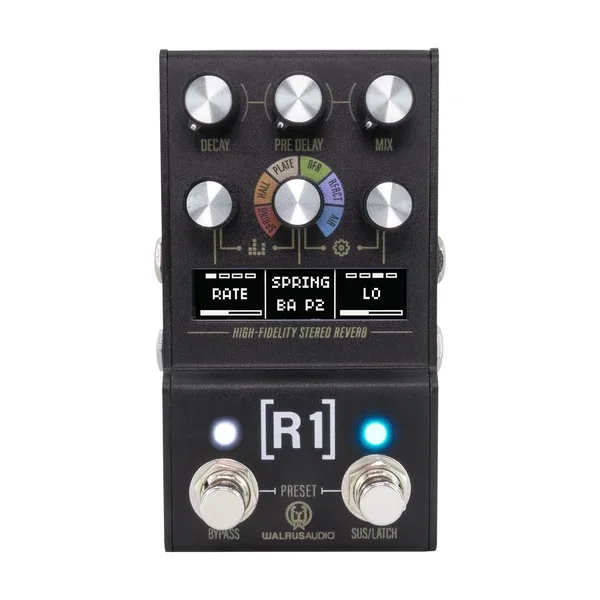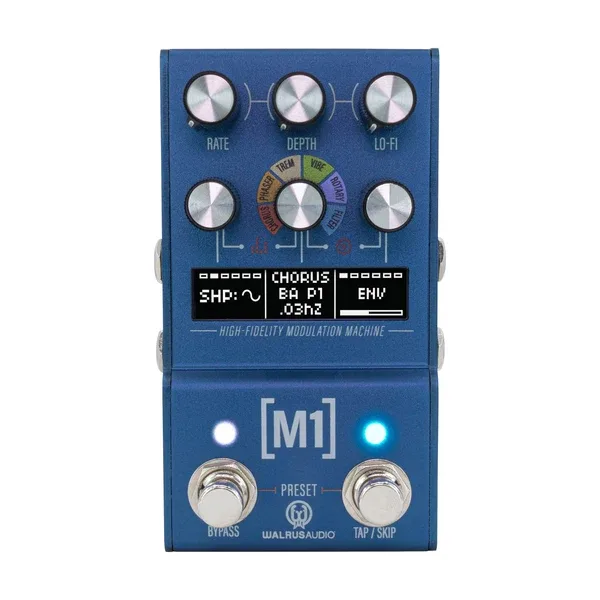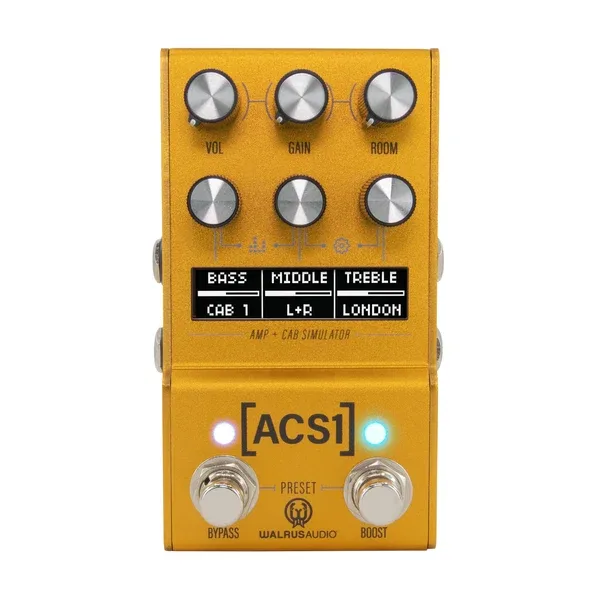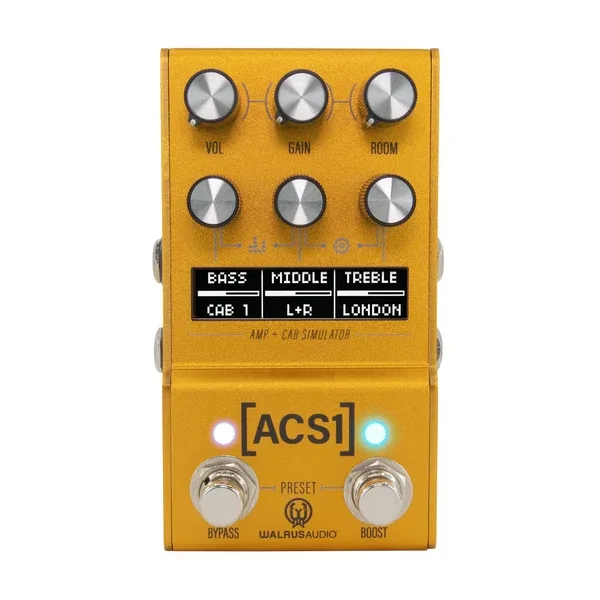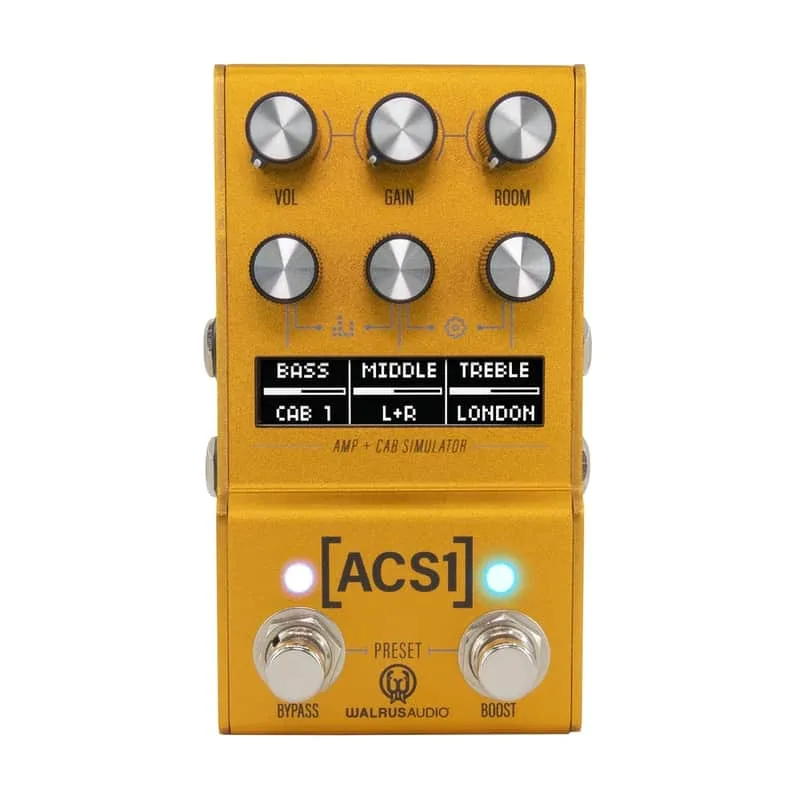


The Walrus Audio Mako Series MKII ACS1 is an amplifier and speaker cabinet simulator pedal, a speaker simulation unit that replaces an amp and cab with a stompbox. It delivers the sound and feel of world-class amplifiers through digital amp modeling and IR-based cabinet simulation, with stereo inputs and outputs, onboard presets, and MIDI support12. It is part of Walrus Audio's Mako Series MKII line, which also includes revised versions of the D1 delay, R1 reverb, and M1 modulation pedals3.
The MKII ACS1 carries six amp models: the three from the original 2021 ACS1 (Fender Deluxe Reverb, Marshall Bluesbreaker, and Vox AC30 inspired) in revised form, plus three new high-gain models based on the Peavey 5150, Orange Rockerverb, and Mesa Boogie Dual Rectifier45. The cabinet offering expands to 12 IRs4. Note that Walrus Audio's product page lists the pedal as sold out as of October 20261.
The amp models and cabinet IRs
The six amp models each take a specific vintage or modern amp as their reference, and Walrus describes what each is for43:
| Model | Inspired by | Walrus Audio's description |
|---|---|---|
| Fullerton | Fender Deluxe Reverb | Crisp clean tones with loads of headroom1 |
| London | 1962 Marshall Bluesbreaker | Harmonically rich, valve-driven breakup; articulate and sensitive response1 |
| Dartford | 1960s Vox AC30 | Jangly high-end tones with bite and chime1 |
| Red | Peavey 5150 | Heavy, aggressive modern metal and hard rock; tight low end, strong midrange, bright cutting high end1 |
| Citrus | Orange Rockerverb | Classic British gain with creamy midrange and punchy lows1 |
| Tread | Mesa Boogie Dual Rectifier | Massive amounts of in-your-face gain1 |
Guitar World's reviewer found the three new models to be where the pedal really starts to shine3. The stock cabinet IRs were built by two well-known IR houses: the IRs for the Fullerton, London, and Dartford models were custom-engineered by David Hislop and Kenyon Reed at Tone Factor, while the IRs for the Red, Citrus, and Tread models were designed by Justin York at York Audio1. Guitar.com's review counts 12 cab IRs in total4.
Specific cab pairings get named in reviews. Guitar World's reviewer favored the second cab option on the Fullerton model, a vintage '66 Fender Deluxe replication captured with a Royer 121 ribbon microphone, and liked the London model paired with the JTM50 cabinet mic'd with a Shure SM573.
The pedal also holds onboard reverb with three types: Room, Hall, and Spring834. Guitar World's reviewer called the reverb settings somewhat limited but enough for most uses3.
The controls
The MKII interface replaces the three toggle switches of the original ACS1 with a 2-inch OLED screen measuring 128 x 32 pixels, with secondary push controls on the bottom three dials36. Guitar.com's review describes this as part of a whole Mako Series MkII interface revamp4.
| Control | What it does |
|---|---|
| Volume (top knob) | Sets output level; turn down as gain goes up to compensate1 |
| Gain (top knob) | Sets the amp model's drive level1 |
| Room (top knob) | Sets room size or reverb amount; further clockwise is a bigger room1 |
| Bass (bottom knob) | Low EQ, adjustable on the home screen for L, R, and L+R channels1 |
| Mids (bottom knob) | Mid EQ, same per-channel adjustment1 |
| Treble (bottom knob) | High EQ, same per-channel adjustment1 |
| Middle encoder (push) | Choose individual settings for L, R, or L+R combined1 |
Deeper editing lives in the menu: presence and resonance controls are available within Amp EQ Settings, and the room decay is adjustable in the Global Sound menu1. A noise gate was added for the MKII, one of the new program controls Premier Guitar highlighted at launch2. There is also a built-in boost on a second footswitch that grants an additional +4dB of gain and plenty of volume, according to Guitar World's review3.
Presets work from the footswitches: dial in a sound, then press and hold the bypass and boost switches simultaneously to save; press and release both simultaneously to cycle through the three onboard presets, labeled red, green, and blue1.
Power and connections
Power requirements are 9VDC at 300mA minimum1. Walrus Audio recommends an isolated power supply for all of its pedals1, so a shared daisy chain is not the intended way to run it. The pedal runs on a 9V DC adapter, which is not supplied9.
Connectivity is stereo throughout: left and right inputs, left and right outputs, a mini-jack headphone output for silent practice, USB C, and five-pin MIDI IN and MIDI Thru310. Using MIDI, up to 128 presets can be saved and recalled6. Bypass is selectable between True Bypass and Buffered Bypass1.
The enclosure measures 4.9" x 2.52" x 2.64" with knobs, in an anodized gold finish with black and green ink1, and weighs 0.79lbs (0.36 kg)3. Audio passes through 24-bit 48kHz A/D and D/A converters8.
What changed from the original ACS1
The original ACS1 offered three amp types and six cabinet IRs, with full stereo capability, onboard room reverb and three presets, or 128 with MIDI4. The MKII follows it with new versions alongside the D1 Delay, R1 Reverb, and M1 Modulation, ditching toggle switches in favor of an OLED menu screen with secondary push controls on the bottom three dials6.
The MKII, introduced in late 2024, adds the Red, Citrus, and Tread high-gain models, expands the cab offering to 12 IRs, and swaps the toggle switches for the OLED screen42. Walrus also increased the pedal's headroom and lowered the noise floor, according to Guitar World's review3.
What reviewers said
The review praised the MKII's build quality, calling it a rugged metal chassis that feels robust and bomb-proof in construction3. On gain, the reviewer still found himself looking for a little more despite a firmware update that added gain to the three original models, a common complaint with the previous version of the ACS13. He favored the Fullerton's second cab option, a vintage '66 Fender Deluxe replication captured with a Royer 121 ribbon microphone, and was a big fan of the London model paired with the JTM50 cabinet mic'd with a Shure SM573.
Guitar World's review praised the build quality, calling the rugged metal chassis robust and bomb-proof in construction3. On the critical side, the reviewer still found himself looking for a little more gain on the London model, even after a firmware update that added gain to the three original models3.
"surely makes the most persuasive case yet for using a digital pedal to replace real amps and cabs"
Videos
walrusaudioeffects
walrusaudioeffects
The Studio Rats
News
Questions
Can you load your own IRs into the Walrus ACS1 MKII?
Yes. The pedal ships with 12 stock cabinet IRs, and you can load your own IRs or update the firmware by plugging into a laptop over USB C and using the web app at walrusaudio.io. The stock IRs for the Fullerton, London, and Dartford amp models were custom-engineered by David Hislop and Kenyon Reed at Tone Factor, and the IRs for the Red, Citrus, and Tread models were designed by Justin York at York Audio.
Is the ACS1 MKII true bypass?
It offers both True Bypass and Buffered Bypass, so you can choose which mode suits your signal chain. True bypass leaves the pedal out of the path entirely when disengaged, while buffered bypass keeps a buffer in line, which can help long cable runs. The original ACS1 also offered selectable bypass modes, including a DSP trails option.
Does the ACS1 MKII have MIDI?
Yes. It has five-pin MIDI IN and MIDI Thru connections. Three presets can be saved and recalled from the pedal itself, and using MIDI, up to 128 presets can be saved and recalled, which makes it practical on larger boards and in switching systems.
What changed from the original ACS1 to the MKII?
The MKII keeps the original's Fender Deluxe Reverb, Marshall Bluesbreaker, and Vox AC30 models in revised form and adds three new high-gain models based on the Peavey 5150, Orange Rockerverb, and Mesa Boogie Dual Rectifier. The cab offering expands to 12 IRs, and the three toggle switches of the original are replaced by a 2-inch OLED screen with push-function encoders. A noise gate and a boost footswitch were also added.
Does the ACS1 MKII have a headphone output?
Yes. It has a mini-jack headphone output for silent practice, alongside stereo left and right inputs and outputs. That makes it usable as a complete practice rig straight from the pedal, with the amp modeling, cab IRs, and onboard reverb all available in headphones.
Sources (10)
- Mako Series MKII: ACS1 Amp + Cab Simulator, Walrus Audio
- Discover the Latest Walrus Audio Mako Series MKII, Premier Guitar, 2024-09-25
- Walrus Audio Mako Series MKII ACS1 review, Guitar World, 2025-01-25
- Walrus Audio Mako Series MkII ACS1 review, Guitar.com, 2025-08-18
- Review: Walrus Audio Mako Series ACS1, Guitar.com, 2021-02-10
- Mako Series MKII: ACS1 Amp + Cab Simulator, Walrus Audio
- Walrus Audio ACS1 MkII Amp & Cab Simulator, Delicious Audio, 2024-12-03
- Voyager Preamp/Overdrive, Walrus Audio
- Walrus Audio Mako Series ACS1 Amp + Cab Simulator review, MusicRadar, 2021-09-25
- “Dialling in these inspiring studio grade tones has never been easier and has never sounded better”: Walrus Audio adds OLED display, more controls, features and sounds on its new and improved flagship Mako MkII series pedals, MusicRadar, 2024-09-25