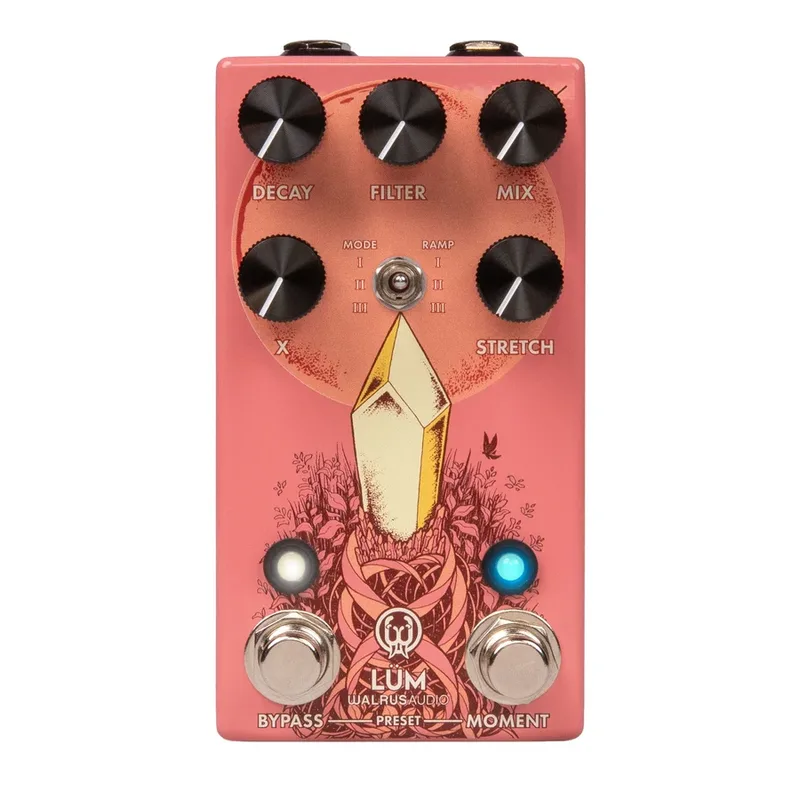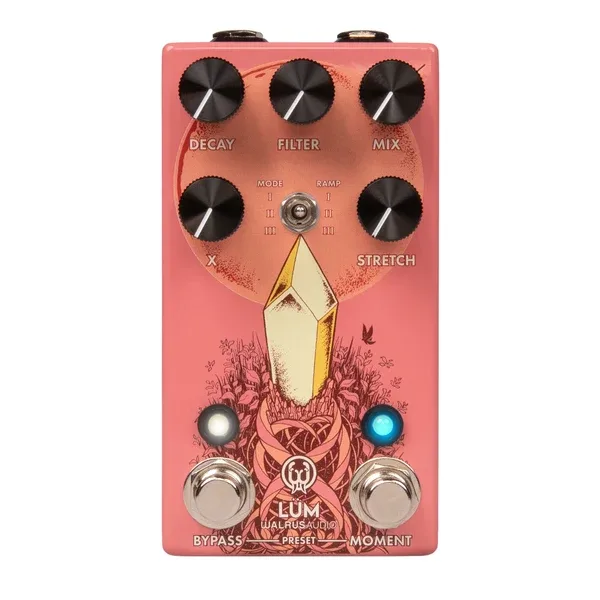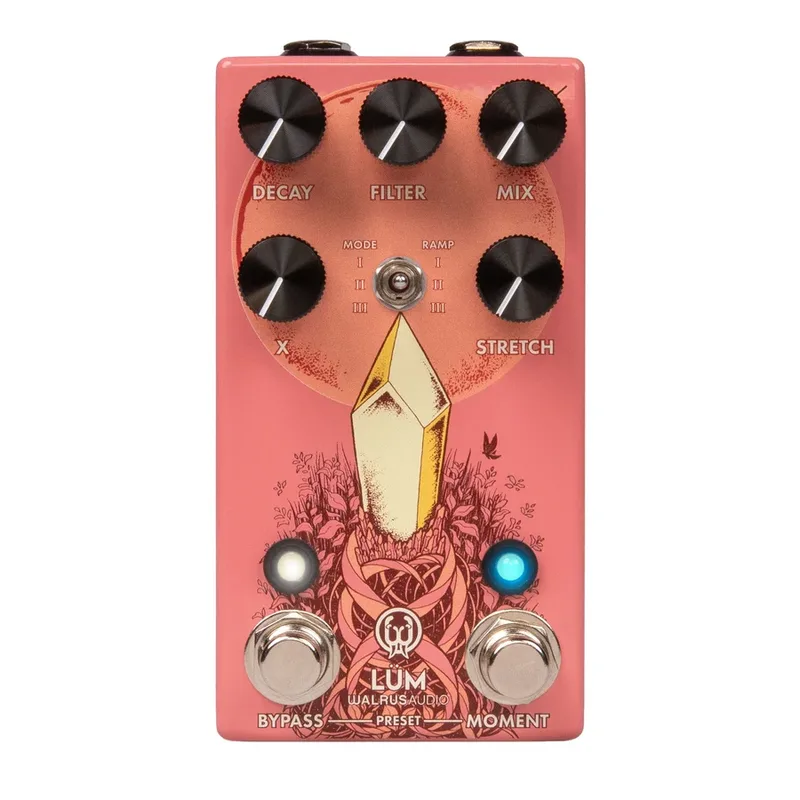


The Walrus Audio Lüm Texture Engine is a digital granular and textural reverb pedal. In the maker's words, it "takes your audio signal and fractures it into tiny 'grains' wrapped in different washes of reverb to create sporadic and atmospheric textures"1. Where a conventional reverb smooths your sound into a wash, granular processing chops it into short fragments and reassembles them, which is what gives the Lüm its glitchy, evolving, ambient character.
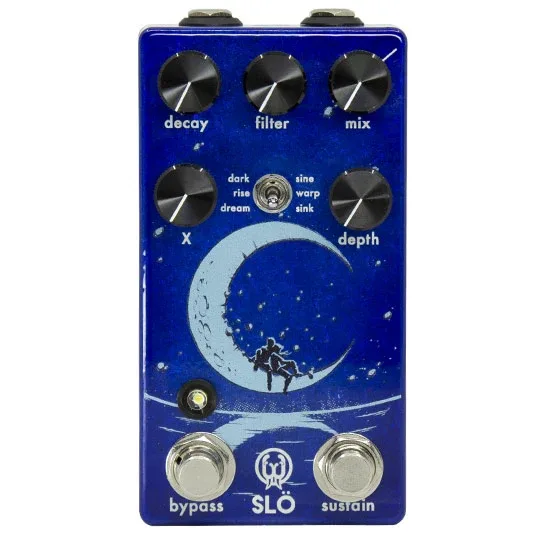
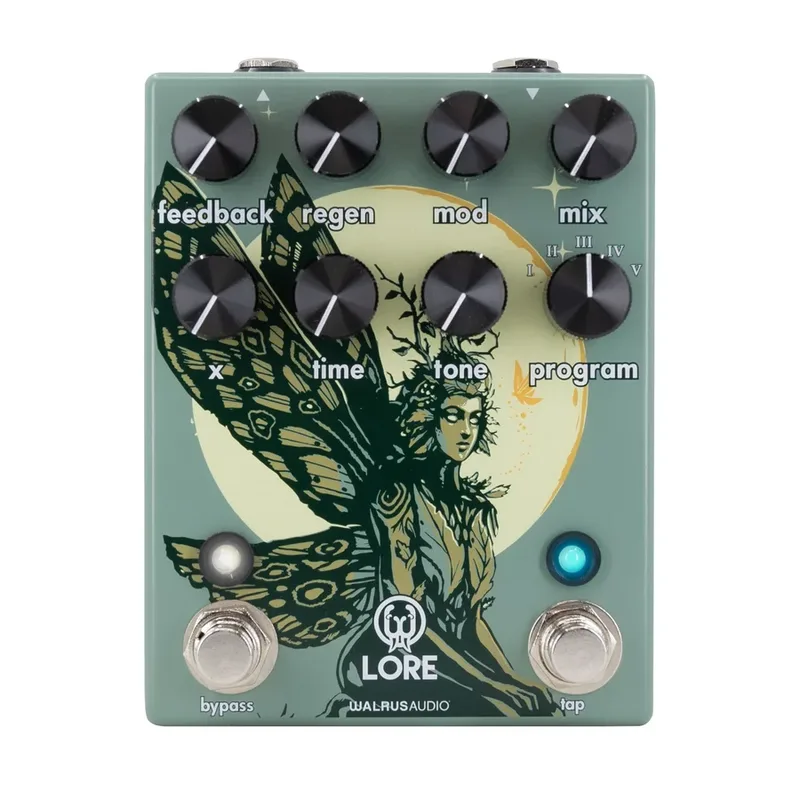
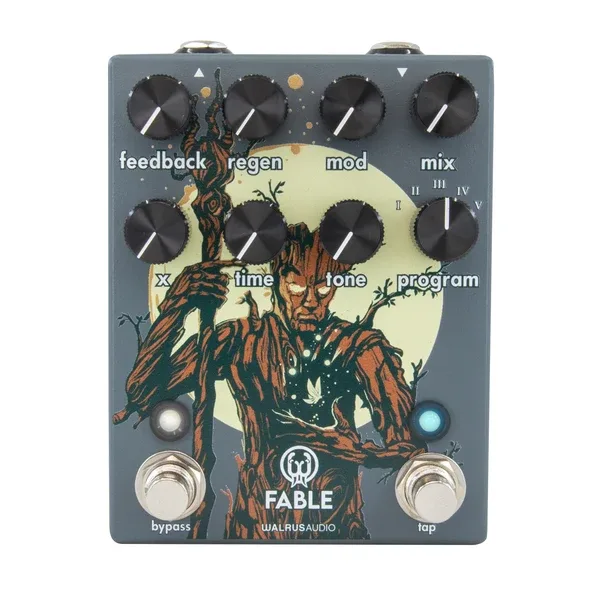
The pedal draws its circuitry from three earlier Walrus Audio designs: the Slö Reverb, the Lore Reverse Reverb and the Fable Granular Generator1. It is a mono pedal with one input and one output, three modes, three presets and a momentary automation system. It launched in September 2025 as a 600-unit limited edition, sold out, and returned in July 2026 as a permanent product in two new colorways2.
What the Lüm Texture Engine does
Granular reverb works by slicing the incoming signal into very short pieces, called grains, and playing those pieces back in varying patterns inside a reverb wash. On the Lüm, that happens across three modes selected with a three-way toggle, and the character of the grains changes from mode to mode. MusicRadar's reviewer described the Grain Cloud mode as "a granular texture built from dual taps reading off a feedback delay line"5.
The pedal is built for players who want texture and atmosphere rather than a traditional room or hall sound. Walrus Audio suggests experimenting with stacking it with other modulated or wet effects on your board to create new sounds, and notes that in its second mode the Lüm "is a treat to put before high-gain pedals"1.
Three modes: Grain Cloud, Grain Verb and Forward/Reverse Verb
A three-way toggle on the pedal selects between the modes, and the X knob takes on a different job in each one514.
| Mode | What it is | What the X knob does |
|---|---|---|
| I. Grain Cloud | A granular texture built from dual taps reading from a feedback delay line | Controls grain size, that is, how frequently the "glitches" happen1 |
| II. Grain Verb | A granular reverb built from dual taps reading from the delay memory of a reverb algorithm tank | Controls grain size, how frequently the "glitches" happen1 |
| III. Forward / Reverse Verb | A forward reverb algorithm running into a reverse reverb algorithm | Controls the reverse reverb decay14 |
MusicRadar's review noted that Forward/Reverse Verb "combines forward and reverse reverb algorithms for rhythmic, evolving reflections from the Lore pedal", and that the three modes together give the pedal "a whole lot of range for you to experiment with"5. In Mode III, the Stretch knob changes how fast or slow the interaction between the forward and reverse reverbs is1.
The controls
The control surface is five knobs, a mode toggle and two footswitches5.
| Control | What it does |
|---|---|
| Mix | Sets the balance of dry and effected signal5 |
| Decay | Sets the reverb decay5 |
| Filter | Shapes the tone of the effect5 |
| X | Changes job by mode: grain size in Modes I and II, reverse reverb decay in Mode III1 |
| Stretch | Part of the Stretch Engine; in Mode III it sets how fast or slow the forward/reverse interaction is15 |
| Mode toggle | Three-way switch selecting Grain Cloud, Grain Verb or Forward/Reverse Verb5 |
| Bypass footswitch | Engages and bypasses the pedal2 |
| Momentary footswitch | Triggers the Moment automation2 |
Pressing the Bypass and Momentary footswitches together scrolls through the three onboard presets2.
Moment switch, Ramp and the Stretch Engine
The Lüm's most distinctive feature is its momentary automation. Walrus Audio describes it this way: the pedal "allows you to automate any one of the five knobs by holding the Moment switch to glide to a defined target, adding dynamic, expressive motion in real time"1. Gearnews explained the same system as automating each of the five controls between two settings, shifting from a start value to an end value when the footswitch is pressed3.
The Ramp setting controls how fast that glide happens. Holding Bypass and adjusting the Mode toggle sets the glide time to one of three values1:
The Stretch Engine is a global control that shifts the pedal's sample rate from 0.5x to 2x speed, stretching time, and it interacts with grain size, reverb decay and filter tone in different ways depending on the mode1. In practice it lets you slow the whole texture down or speed it up without simply changing a decay knob.
Presets
The pedal stores three onboard presets, labeled Red, Green and Blue, and sounds fade seamlessly between them for smooth transitions live1. MusicRadar's review confirmed the three presets with crossfade, each denoted by a red, green or blue light5. You move between them by pressing both footswitches together2.
Power and connections
The Lüm runs on 9V DC center-negative power at 100 mA minimum, and no power supply is included with the pedal14. Walrus Audio recommends an isolated power supply and advises against daisy chain supplies for its pedals1.
No power supply is included. Walrus Audio recommends an isolated supply and does not recommend daisy chain power for its pedals, so plan on a dedicated output on your power brick1.
Connectivity is minimal: one 1/4" TS input and one 1/4" TS output1. Input impedance is 1M Ohms and output impedance is 100 Ohms1. There is no MIDI and no expression input, and the pedal is mono only5. Guitar Pedal X's Stefan Karlsson wished the ports had been built for TRS stereo, but concluded it is "an interesting Textural Reverb for sure - and perfect for mono rigs"2. On the power side, MusicRadar noted the Lüm needs only a 100 mA feed, compared with the 300 mA requirements of the Lore and Fable pedals it draws inspiration from5.
History and versions
The Lüm Texture Engine launched in September 2025 as a limited edition of 600 units worldwide236. It sold out fast: Delicious Audio reported it as "their limited-edition (and sadly, already sold-out) Walrus Audio Lüm" by the end of that month7. The original run carried artwork by Emily Ursä1.
In July 2026, Walrus Audio brought the pedal back as a permanent addition to the lineup due to popular demand, in two colorways: Minimal Black Edition and Guava Edition52. MusicRadar's Phil Barker described the return: "The Lüm Texture Engine originally launched as a 600-unit limited run, returning as a permanent addition to Walrus's lineup"5. The reissue is priced at $279.99 on the maker's page as of 25 October 20264, while the original 2025 run had been listed at $2933. The maker's blemished listing, which notes blemishes are cosmetic only such as scratches or dents in the finish, shows sold out as of 25 October 20261. The pedal carries Walrus Audio's limited lifetime warranty1.
What reviewers said
MusicRadar's review rated the Lüm's sounds at five stars out of five5. The same review flagged the mono-only design and the absence of MIDI and expression as the trade-offs in what is otherwise a compact, low-current textural reverb5. Guitar Pedal X called it a decent mono textural reverb, perfect for mono rigs, while wishing for full stereo2. Pedal of the Day's 2025 coverage highlighted the three granular and reverb textural pad programs, the three onboard presets, and the Momentary Glide Parameter Automation as the pedal's headline features6.
Videos
walrusaudioeffects
walrusaudioeffects
TheGuitarGeek
News
Questions
Is the Walrus Audio Lüm stereo?
No. The Lüm is mono only, with a single 1/4 inch TS input and a single 1/4 inch TS output. There is no stereo output, and reviewers noted there is no MIDI or expression input either. Guitar Pedal X wished the ports supported TRS stereo, but as built the pedal is aimed at mono rigs.
Is the Lüm Texture Engine true bypass?
No, it uses buffered bypass. You can choose between two bypass modes: Trails, which lets the reverb decay naturally when you switch off, or Instant Cut, which stops it abruptly for rhythmic effects. Both the maker and MusicRadar's review confirm the buffered bypass with selectable Trails or Instant Cut behavior.
Is the Lüm still a limited edition?
No. It launched in September 2025 as a 600-unit limited run and sold out quickly. In July 2026 Walrus Audio brought it back as a permanent addition to the lineup in Minimal Black and Guava Edition colorways. The maker's own product page currently shows the blemished listing as sold out.
How do you save presets on the Lüm?
The pedal holds three onboard presets, labeled Red, Green and Blue. You scroll through them by pressing the Bypass and Momentary footswitches together. Sounds fade seamlessly between presets, which makes for smooth transitions when switching live.
Does the Lüm come with a power supply?
No, a power supply is not included. The pedal runs on 9V DC center-negative at 100 mA minimum. Walrus Audio recommends an isolated power supply and advises against daisy chain supplies for its pedals.
Sources (7)
- Lüm Texture Engine, Walrus Audio
- Guitar Pedal X, Guitar Pedal X, 2026-07-09
- Walrus Audio Lüm Texture Engine: The ambient treasure trove is back!, gearnews.com, 2026-07-07
- Lüm Texture Engine, Walrus Audio
- Walrus Audio Lüm Texture Engine review, MusicRadar, 2026-09-05
- Walrus Audio Lüm Texture Engine Granular Reverb, Pedal of the Day, 2025-09-16
- New Pedal: Walrus Audio Lüm Texture Engine, Delicious Audio, 2025-09-30