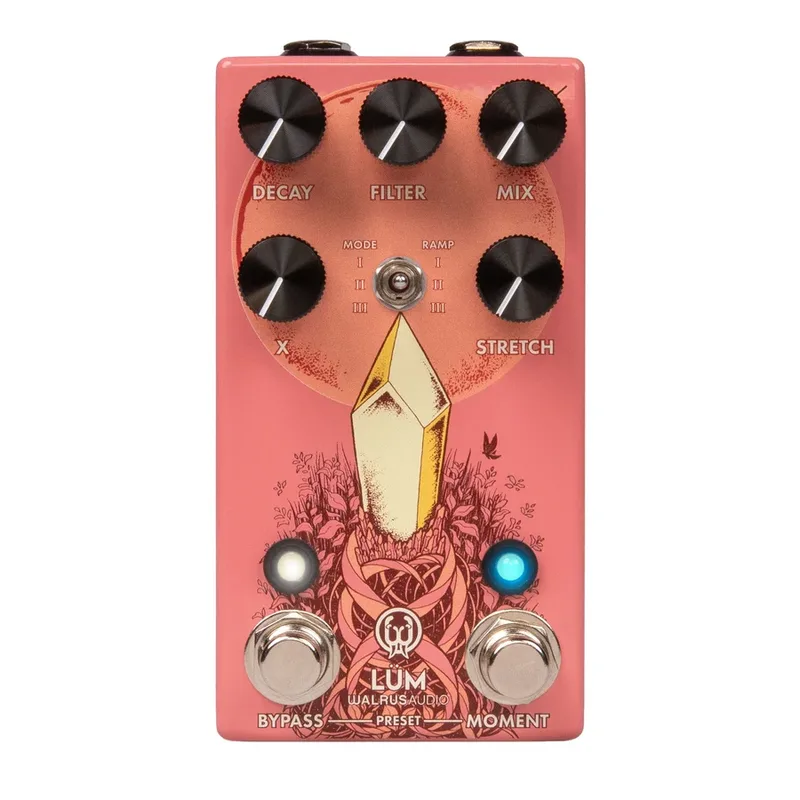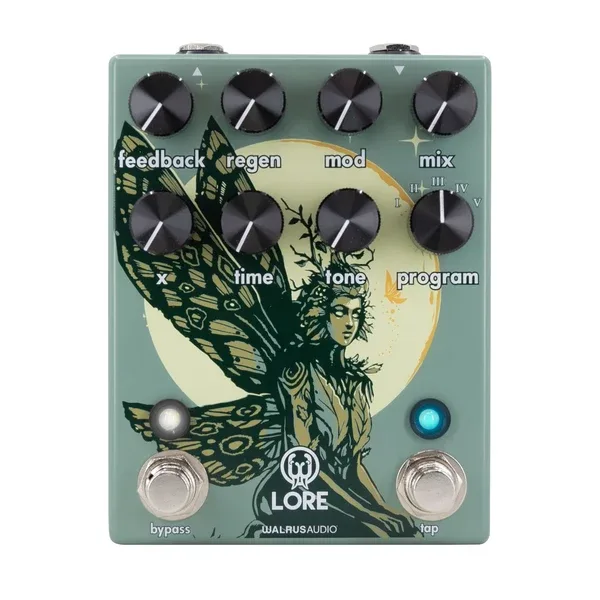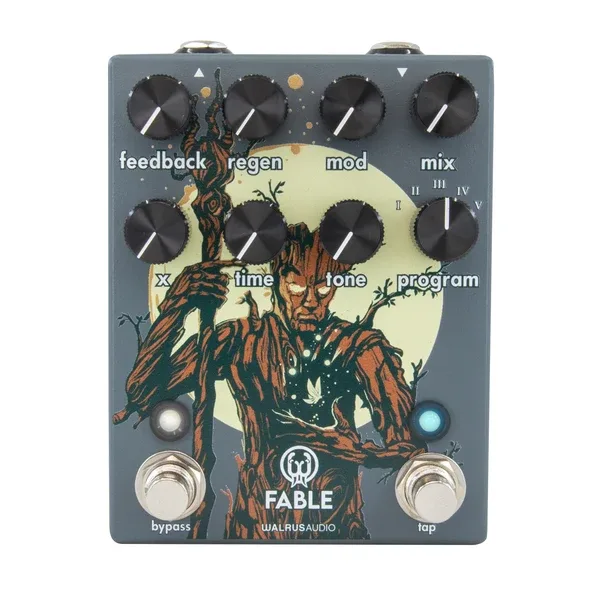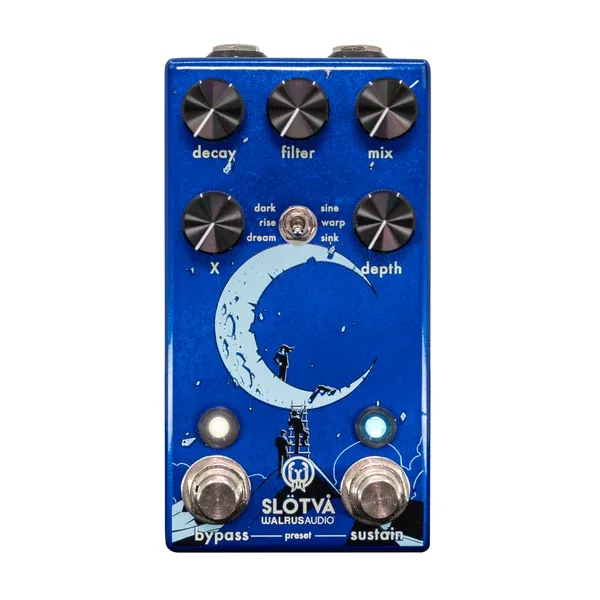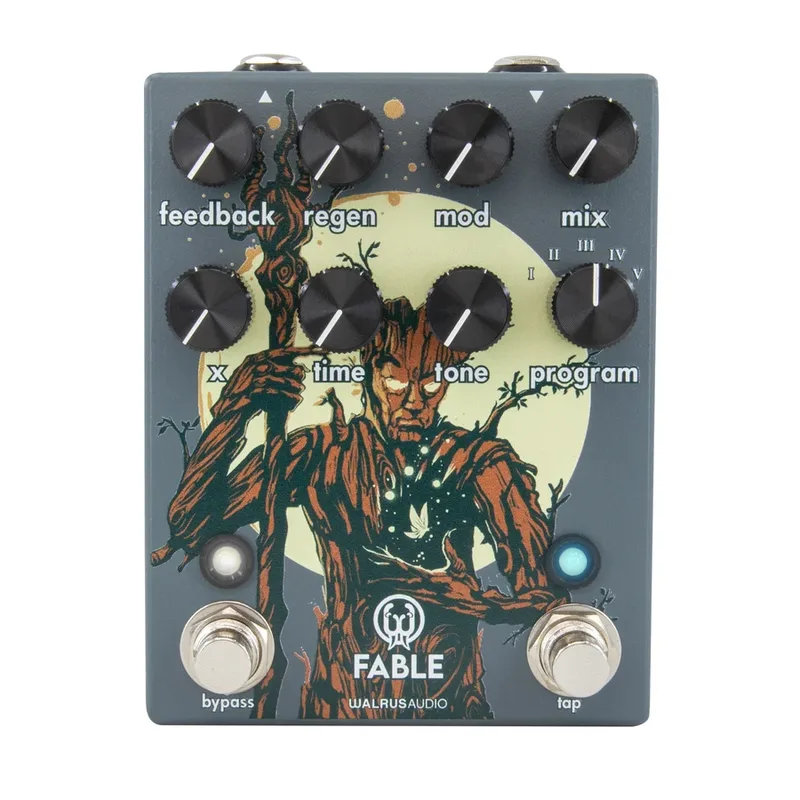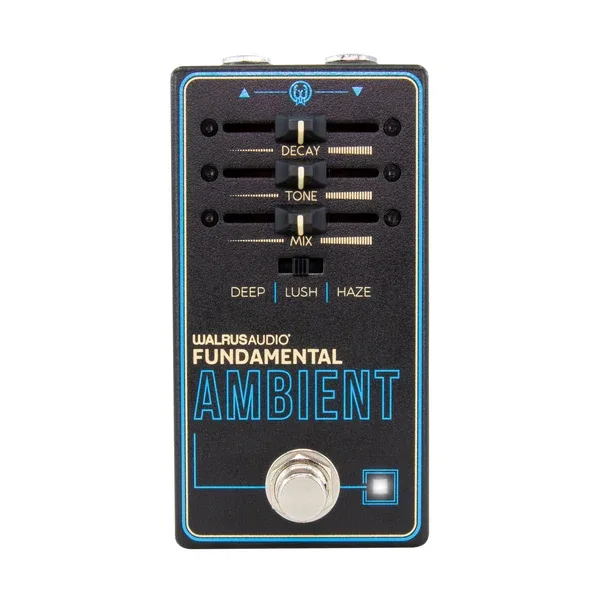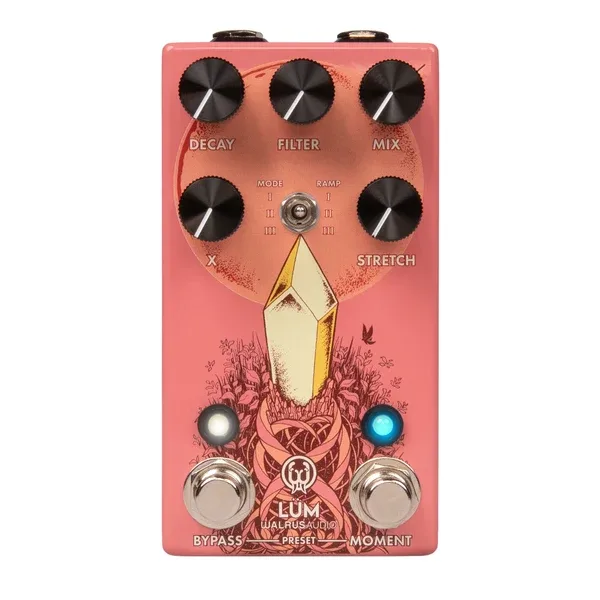


The Walrus Audio Lüm, sold in full as the Lüm Texture Engine, is a compact multi-mode granular and textural reverb pedal. Walrus describes it as taking your audio signal and fracturing it into tiny "grains" wrapped in different washes of reverb to create sporadic and atmospheric textures1. It draws on elements of three earlier Walrus pedals: the Slö Reverb, the Lore Reverse Reverb and the Fable Granular Generator2.
What the Lüm does
Granular reverb works by chopping your signal into short fragments, or grains, and scattering them through reverb washes. On the Lüm, that produces sounds ranging from big, dreamy ambience to glitchy, rhythmic textures, depending on the mode and the grain size. Guitar.com's reviewer found mode 1 "a big and dreamy reverb, with a nice bit of grainy fluttering," mode 2 smoother, and mode 3 a regular reverb combined with one that swooshes in rhythmic waves3.
Walrus also suggests a practical placement tip: the pedal is "a treat to put before high-gain pedals in mode two"2. Guitar.com's reviewer went further, reporting that it "sounds incredible running into a fuzz box"3.
The pedal is mono. It has a single 1/4 inch TS input and a mono TS output, with no MIDI or expression input14. MusicRadar's review lists this plainly among its limitations: "Mono only, no MIDI or expression input"5.
The three modes
A three-way toggle in the middle of the pedal selects the mode, and the five knobs adjust the detailed settings6. Each mode has a distinct character:
| Mode | Name | What it does | What the X knob does |
|---|---|---|---|
| I | Grain Cloud | Dual granular taps reading from a feedback delay line | Controls grain size, from bouncy to jittery |
| II | Grain Verb | Grains pulled from the delay memory of a reverb algorithm; denser and more washed out | Controls grain size |
| III | Forward/Reverse Verb | A forward reverb feeding into a reverse reverb, creating a playful ping-pong interaction | Controls the reverse reverb's decay |
Mode descriptions from Delicious Audio's review7 and Walrus's product page73; X knob behavior in mode 1 from Guitar.com3.
Guitar Pedal X described Mode II as sounding "like the grains took a bath in reverb," and noted that in Mode III "you'll hear a playful rhythmic interaction between the forward and reverse reverbs"8.
The controls
The Lüm has five knobs, a three-way mode toggle, two footswitches and a Moment switch359.
| Control | What it does |
|---|---|
| Mix | Sets the reverb level |
| Decay | Sets the reverb decay |
| Filter | A low-pass filter, from full-frequency shimmeriness to a moodier, darker tone3 |
| X | Changes function by mode: grain size in Modes I and II, reverse reverb decay in Mode III21 |
| Stretch | Changes how fast or slow the forward and reverse reverb interaction is in Mode III2 |
| Mode toggle | Three-way switch to select a mode6 |
| Moment switch | Automates any one of the five knobs21 |
The Moment Control is the pedal's expressive trick. Walrus describes it this way: "Lüm allows you to automate any one of the five knobs by holding the Moment switch to glide to a defined target, adding dynamic, expressive motion in real time"1. A hidden Ramp switch, accessed through the bypass plus mode toggle combination, lets you choose the glide time between 10ms, 1000ms or 5000ms7.
Guitar.com's reviewer found the Moment effects "hit and miss" overall3.
The Stretch Engine
The Stretch Engine is a global control that shifts the pedal's sample rate from 0.5x to 2x speed, stretching time. Walrus says it interacts uniquely with grain size, reverb decay and filter tone21. Delicious Audio's reviewer put it in plainer terms: the Stretch Engine "shifts the global sample rate from half-speed to double, which changes how everything interacts," including grain size, reverb decay and filter tone7.
Presets
The Lüm saves and recalls up to three onboard presets, marked Red, Green and Blue, and sounds fade seamlessly between presets for smooth live transitions1. There are three editable factory presets, one per mode, and you hit both footswitches to scroll through them3. MusicRadar's reviewer confirmed the crossfade behavior, with presets "denoted by a red, green or blue light"5.
Built from the Slötvå: history and versions
The Lüm's circuit has a specific origin story. Guitar.com reports that Walrus, "finding itself with a bunch of leftover PCB assemblies for Slötvas that nobody wanted, it did a bit of firmware tweakage"3. The result reuses the Slötvå format, combining algorithms from the Fable, Lore and Slö/Slötvå pedals4. Guitar Pedal X called it "essentially a rebooted and updated version of the 3-Presets Walrus Audio Slötvå pedal," with different parameters and algorithms8. The Slö, Slöer, Lore, Fable and Melee all fed into its character3.
The timeline of its releases:
- September 2025: Released as a limited edition at $279.99 (£259)83. It has since sold out, with the maker's page marked SOLD OUT1.
- July 2026: Returned as a permanent product, no longer a limited edition, at the same $279.99 price43.
What reviewers said
Reviews of the Lüm have been positive about its sounds, with the mono I/O as the main recurring criticism54.
- MusicRadar rated its sounds five out of five, and listed its controls as "Mix, Decay, Filter, X, Stretch, 3-way Mode toggle, Moment switch"5.
- Guitar.com called it "multiple dreamscape sounds in one compact pedal," praising how easy it is to adjust texture and tonality, while noting the Moment effects are hit and miss3.
- Guitar Pedal X called it "an interesting Textural Reverb for sure, and perfect for mono rigs," while wishing the ports had been enabled for TRS stereo action4.
"It would have been cooler if they had enabled those ports for TRS Action, and we could have had full stereo."
For players who need stereo ambient processing, Walrus has since released other pedals that sit above the Lüm in the range.
Videos
walrusaudioeffects
walrusaudioeffects
TheGuitarGeek
Questions
Is the Walrus Audio Lüm stereo?
No. The Lüm is mono only, with a single 1/4 inch TS input and a mono TS output. There is no MIDI or expression input either. Reviewers noted it would have been useful if the ports supported TRS stereo operation, but as built it suits mono rigs.
What colors does the Walrus Audio Lüm come in?
The current permanent version comes in two colorways: Guava Gloss (a pink finish) and Matte Black. The original September 2025 limited edition of 600 units was blue. Both current colors are sold at the same price.
How many presets does the Lüm have?
Three. You can save and recall three onboard presets, marked by a red, green or blue light, with one editable factory preset per mode. Sounds fade seamlessly between presets for smooth transitions when switching live, using the two footswitches to scroll through them.
What is the Stretch Engine on the Lüm?
The Stretch Engine globally shifts the pedal's sample rate from 0.5x to 2x speed, stretching time. It interacts with grain size, reverb decay and filter tone, so everything changes character together rather than just speeding up or slowing down.
Sources (9)
- Lüm Texture Engine, Walrus Audio
- Lüm Texture Engine, Walrus Audio
- Walrus Audio Lüm review, Guitar.com
- Guitar Pedal X, Guitar Pedal X, 2026-07-09
- Walrus Audio Lüm Texture Engine review, MusicRadar, 2026-09-05
- Walrus Audio Lüm Texture Engine: The ambient treasure trove is back!, gearnews.com, 2026-07-07
- Walrus Audio Lüm Granular Reverb, Delicious Audio, 2026-08-03
- Guitar Pedal X, Guitar Pedal X, 2025-09-18
- Walrus Audio launches the Lüm Texture Engine, MusicRadar, 2026-07-07