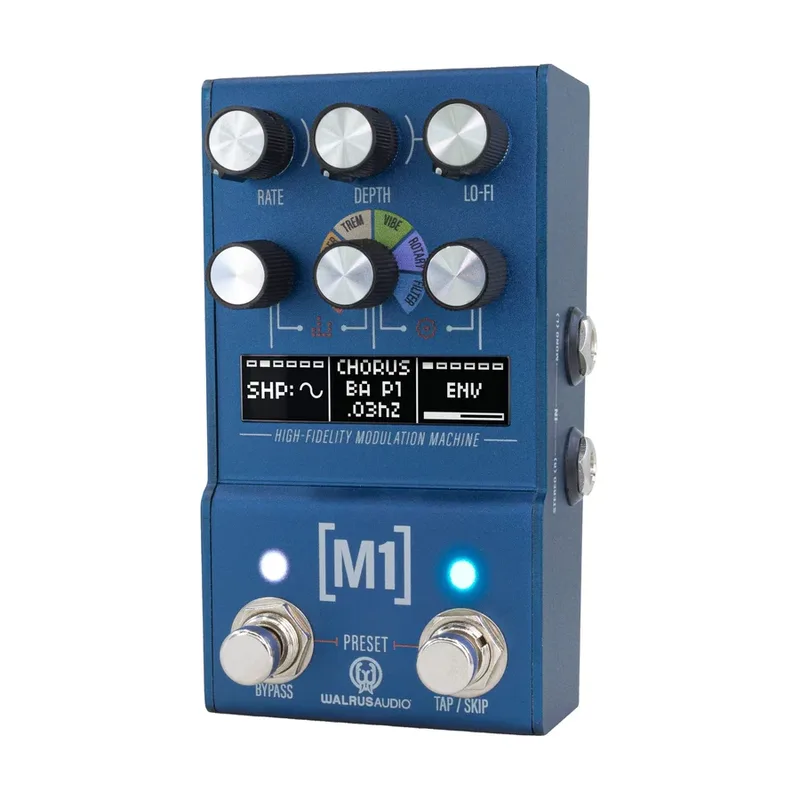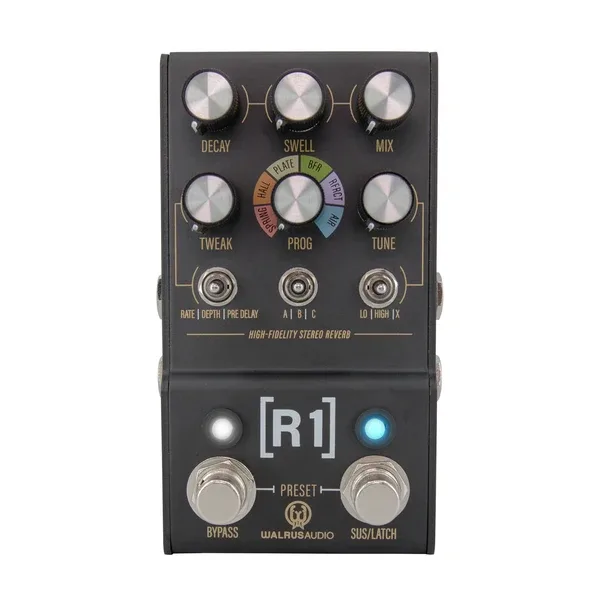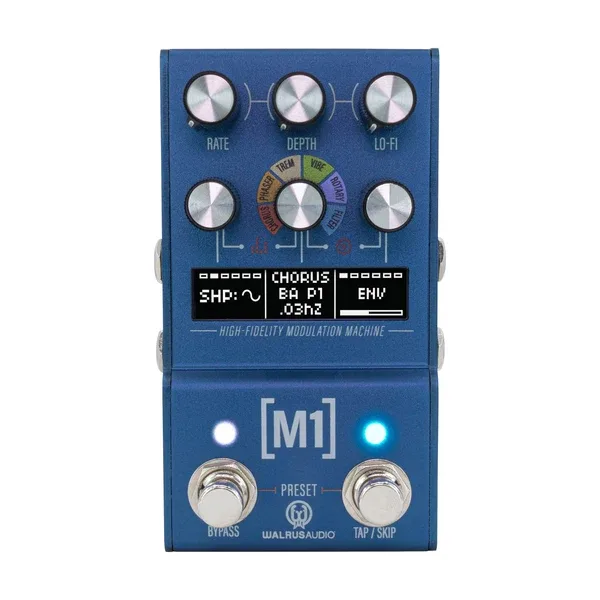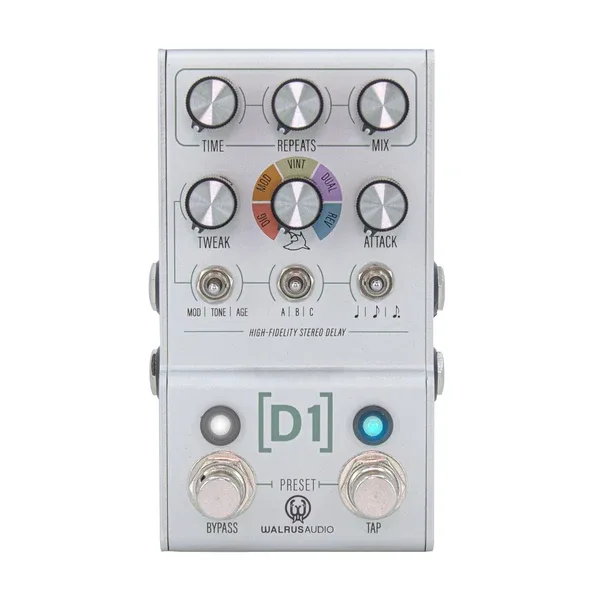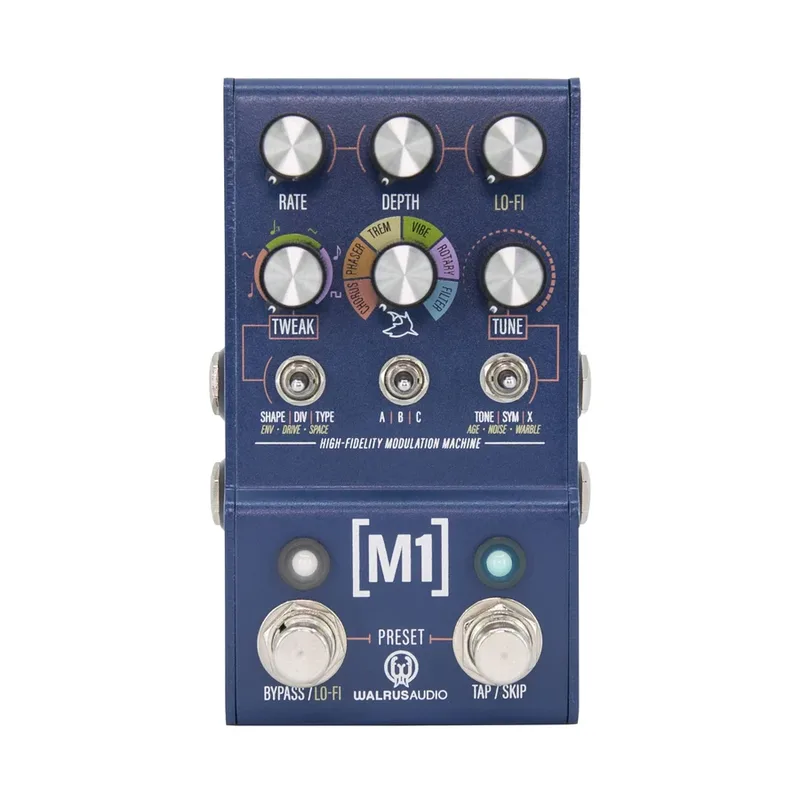


The Walrus Audio Mako Series M1 is a stereo digital multi-mode modulation pedal: one stompbox holding six customized, studio-quality programs, Chorus, Phaser, Tremolo, Vibrato, Rotary, and Filter, each with three program types inside it1. It arrived in 2022 as the modulation entry in Walrus Audio's Mako Series of high-end digital effects, which also includes the D1 delay and the R1 reverb23. For a player, it means covering most of the modulation ground a pedalboard would normally need several pedals for, with presets, stereo ins and outs, and MIDI.
The M1 is digital, emulating analog-style modulation effects, and reviewers found those emulations convincing: Premier Guitar wrote that "the digital emulations of analog effects are beautifully accurate and replete with rich overtone detail"4. A second version, the M1 MKII, followed in 2024 with a screen-based interface, more presets, and a flanger added to the Chorus algorithm25.
Six modulation voices in one stompbox
At the M1's core are six modulation voices, and each program carries three types, giving eighteen algorithms in total on the MKII42. The Filter program, for example, offers a lowpass, a highpass, and a bandpass filter1. The full MKII algorithm list:
| Program | Types / algorithms |
|---|---|
| Chorus | Vintage Chorus, Tri-Chorus, Flanger (MKII; dual chorus on Series I)5139 |
| Phaser | 2-Stage Phaser, 4-Stage Phaser, Uni-Vibe21 |
| Tremolo | Bias Tremolo, Harmonic Tremolo, Pattern Tremolo2 |
| Vibrato | Vintage Vibrato, Warped Vinyl, Tape-Vibrato2 |
| Rotary | Full Rotary Leslie, Moving Horn Only, Moving Drum Only2 |
| Filter | Lowpass, Highpass, Bandpass12 |
The original Series I M1 had no flanger, and Guitar World's modulation buying guide listed that absence plainly as a con11. The MKII closes the gap: Walrus added "all new flanger sound added to the Chorus algorithm," and Guitar World's Jonathan Horsley noted that "the dual chorus algorithm from the MKI unit has been swapped out for a flanger"59. Guitar.com's Josh Gardner did not mourn the change, writing "I certainly didn't miss the replaced dual-chorus mode as a result"13.
The controls: Tweak, Tune and the A/B/C presets
The original M1's face holds two footswitches, three toggle switches and six control knobs14, and Premier Guitar counted 11 switches, knobs, and toggles governing primary and secondary functions4. The core knobs are Rate, Depth, Lo-Fi, Tweak and Tune, plus a six-way mode dial8.
| Control | What it does |
|---|---|
| Rate, Depth | Set the speed and intensity of the modulation2 |
| Lo-Fi | Degrades the sound; on the MKII its variables are adjusted with the right encoder2 |
| Tweak | Chooses sine, triangle, or square waveshapes; quarter-note, triplet, or eighth-note tap divisions; or one of three modes per program4 |
| Tune | With its 3-way switch: tone, wave symmetry, or "X" functions such as stereo phase effects, phaser feedback, and tape flutter4 |
| A/B/C toggle | Preset bank switch, used with the two footswitches to reach nine presets4 |
The Tune knob's X setting "controls different parameters depending on the selected Program and Type," so the same knob becomes a different tool in each algorithm110. Premier Guitar cautioned that the face "is packed with knobs, switches, graphics and text, which can look intimidating," but praised the downloadable manual on the Walrus site as "a well-written map" worth reading even before buying4.
The MKII replaces much of this with a screen and three clickable encoders: left for parameters, center for modes, right for Lo-Fi variables, with Rate, Depth and Lo-Fi knobs alongside2. Guitar Pedal X's Stefan Karlsson found the screen "easily visible and legible from a standing position"2. Presets on the MKII live in three banks (BA/BB/BC, P0 to P8), reached by pressing the middle rotary controller, with a dual press on both footswitches scrolling presets within a bank2.
Power and connections: stereo, MIDI and USB
The M1 runs three input/output configurations: Mono In / Mono Out, Mono In / Stereo Out, and Stereo In / Stereo Out110. Connections include 1/4-inch mono and stereo I/O, MIDI in and thru, and a mini USB jack used for firmware updates46. MIDI allows control over most of the M1's parameters and preset selection, which is how the 128 MIDI presets of the Series I are reached62.
There is no battery option: the M1 runs on a 9V power supply only, drawing 300mA minimum118. The MKII specifies isolated 9VDC, center negative, 300mA minimum2, so plan an isolated output on your power supply rather than a daisy chain.
The MKII also adds selectable bypass, relay or buffered2. Its enclosure measures 2.48 by 2.9 by 4.89 inches including knobs and jacks and weighs .8 lbs (363g)2.
History and versions: Series I and the MKII
The original Mako Series I M1 emerged in 2022 as Walrus Audio's modulation machine, the latest in the Mako series of pedals alongside the D1 delay and, later, the R1 reverb and ACS11573. It launched at $3494.
What reviewers said
Reviewers were broadly positive about both versions, with reservations about complexity.
- Guitar.com rated the original 9/10, calling it "a stunning collection of modulation effects in one user-friendly stomper"81.
- Premier Guitar found it "fun, lots of fun," with sounds and smart design making "a cornucopia of easy-to-source, immersive modulations," and called the $349 price "a relative bargain" given the engineering4. The same review warned that many lo-fi functions "tend toward the noisy, junky, and weird side of the sound spectrum" and will not suit every player4.
- MusicRadar singled out the rotary program, writing "the Rotary sounds in particular are so good they win a lot of favour with us"6.
- Guitar Pedal X called the MKII M1 "pretty perfect now" and said it was entering his reference collection12.
- Guitar.com's MKII review rated it 8, finding top-class sounds and deep tweakability but reduced intuitiveness, noting that players who valued the original's ease of use and simple operation might prefer to "stand firm" with the MKI13.
"If the thing you liked about the original was its ease of use and simple operation, I would stand firm where you are."
Videos
Sweetwater
walrusaudioeffects
walrusaudioeffects
Questions
Does the Walrus Mako M1 have a flanger?
The original Series I M1 did not, and reviewers listed the missing flanger as a drawback. The M1 MKII adds a flanger sound to the Chorus algorithm, replacing the dual-chorus mode of the first version. So flanger is available on the MKII but not on the original.
Is the Walrus Mako M1 analog or digital?
It is digital. The M1 uses DSP to emulate analog-style modulation effects, and reviewers found the emulations accurate with rich overtone detail. Walrus Audio describes its six programs as studio-quality, and the MKII is described as studio-grade digital chorus in a compact chassis.
How many presets does the Walrus Mako M1 hold?
The original M1 saves up to nine onboard presets, reached with the A/B/C bank switch and the two footswitches, with 128 more accessible via MIDI. The MKII raises onboard storage to 128 presets held in a preset bank, reached by tapping down on two knobs simultaneously.
What is the difference between the Mako M1 and the M1 MKII?
The MKII, announced in September 2024, adds a screen-based interface with clickable knobs, a flanger in the Chorus algorithm, updated rotary and filter algorithms, and 128 onboard presets instead of nine. The original had no screen and was seen as simpler and more WYSIWYG to operate.
Can you control the Walrus M1 with MIDI?
Yes. Both versions have MIDI in and thru jacks, and MIDI allows control over most of the M1's parameters as well as preset selection. The original exposes 128 presets via MIDI, and the USB jack handles firmware updates.
How much power does the Walrus Audio M1 MKII need?
The MKII requires 9VDC at 300mA minimum, center negative, from an isolated supply. There is no battery option; the pedal runs on a 9V power supply only, which is sold separately.
Sources (15)
- MAKO Series: M1 High-Fidelity Modulation Machine, Walrus Audio
- Guitar Pedal X, Guitar Pedal X, 2024-11-19
- Review: Walrus Audio Mako Series R1, Guitar.com, 2021-03-15
- Walrus Audio Mako Series M1 Modulation Pedal Review, Premier Guitar, 2022-05-03
- Walrus Audio Mako M1 MKII High-Fidelity Modulation Machine review, Guitar World, 2025-01-10
- Walrus Audio Mako Series M1 High-Fidelity Modulation Machine pedal review, MusicRadar, 2022-06-09
- Is the new Walrus Audio MAKO M1 the only modulation pedal you'll ever need?, MusicRadar, 2022-01-20
- Walrus Audio Mako M1 review, guitar.com, 2022-03-29
- 385 Overdrive, Walrus Audio
- Walrus Audio Mako M1 MkII, Delicious Audio, 2026-10-06
- Best modulation pedals: our pick of the best mod effects, Guitar World, 2023-06-02
- Guitar Pedal X, Guitar Pedal X, 2024-09-27
- Walrus Mako M1 MKII review, guitar.com, 2025-09-22
- Walrus Audio launches its latest Mako pedal, the M1 High-Fidelity Modulation Machine, Guitar.com, 2022-01-20
- Walrus Audio Unveils M1 Modulation Machine, Premier Guitar, 2022-01-20