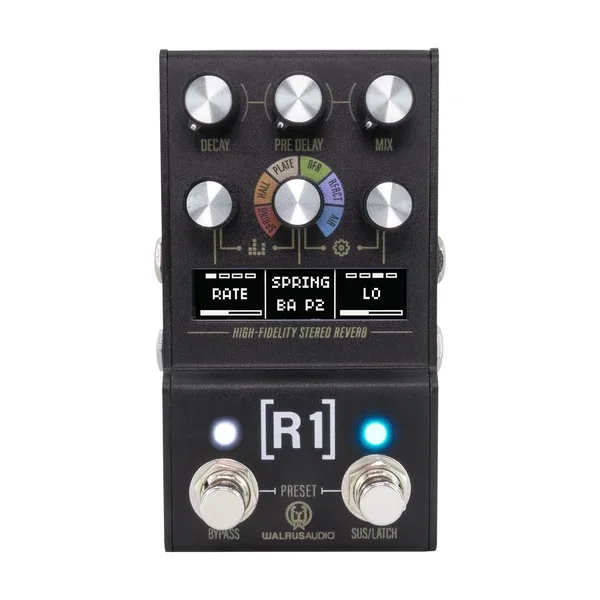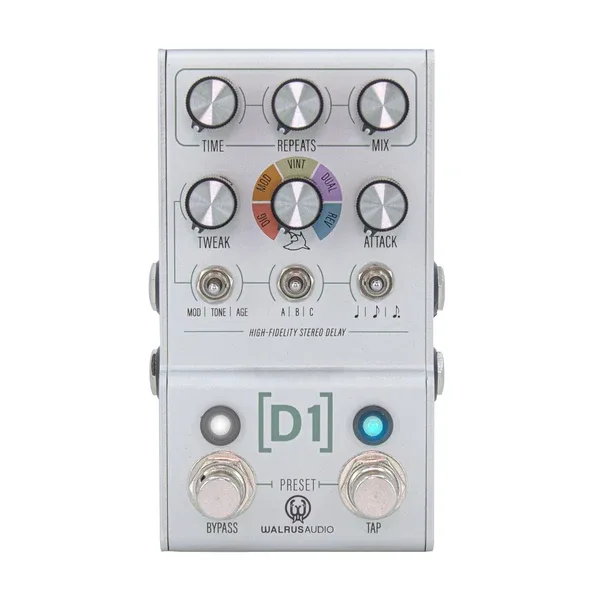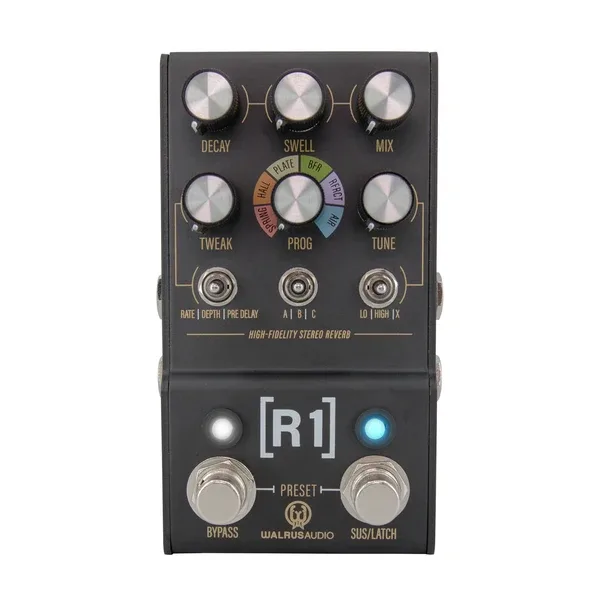


The Walrus Audio R1 is a digital stereo reverb pedal from Walrus Audio's Mako Series, released in early 2021 as the second pedal in the line after the Mako D1 delay12. It packs six reverb programs, Spring, Hall, Plate, BFR, RFRCT (Refract) and Air, into a compact enclosure, with stereo inputs and outputs, MIDI control and preset storage3. The original R1 is now discontinued and no longer available from Walrus Audio3, and its place in the range is taken by the R1 MkII, released in 2024.
The R1 is built on the Analog Devices Sharc processor, the same DSP platform Walrus used across the Mako Series4. Premier Guitar described it at launch as "an extremely powerful and versatile multi-function reverb"4, and Guitar.com's Richard Purvis called it "a stereo reverb with six modes" in the same stepped enclosure as the D11.
What the R1 does
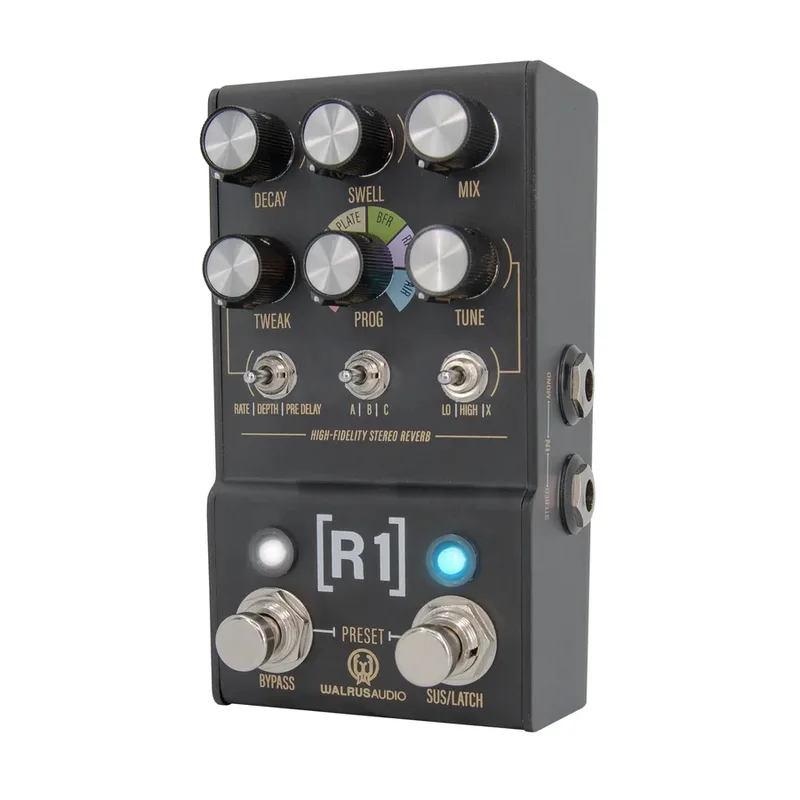
The R1 runs six reverb algorithms simultaneously selectable from one pedal, with stereo in and out so a two-amp rig gets the full picture31. Each program can be tuned and saved to one of nine onboard presets, with up to 128 slots reachable over MIDI6. A volume swell effect can be applied to any program2, and a secondary sustain/latch footswitch opens up ambient playing tricks: hold it to sustain the current reverb and play over it with no dry signal, or tap it to latch the decay indefinitely82.
The enclosure is matte black anodized aluminum, 4.9 by 2.52 by 2.64 inches, in the same stepped shape as the Mako D142. Firmware updates come over microUSB through Walrus Audio's update site13.
The six programs
A six-way rotary program selector in the middle of the faceplate chooses the algorithm91. Walrus describes each program in its own words8:
| Program | What it does | What the X knob adds |
|---|---|---|
| Spring | Emulates an excited spring reverb from a tube amp, with "loads of transducing drip" | Warm grit in the reverb decay |
| Hall | The acoustics of large live spaces, from concert halls to arenas | Room size, from small to large |
| Plate | A smooth analog plate reverb with even diffusion, inspired by plates like the EMT 140 | Gentle warm grit on the front end, like driving a hot signal into the plate |
| BFR | A "no holds barred" big hall-esque reverb with rich, lush decay | (program-specific) |
| RFRCT | Glitch-like textures hovering over a largely diffused reverb | Tones the glitch effect, from lo-fi and tape-like at zero to brighter |
| Air | A larger diffused reverb with subtle shimmer and a crisper decay | Amount of wind and shimmer elements, off at zero |
MusicRadar's review found the range genuinely versatile: "All of this offers real versatility whether you're adding space around the guitar (the Spring, Hall and Plate programs are up to the task) or diving into otherworldly ambient washes with the BFR program"9.
The controls
The top row holds single-function knobs for decay, swell and mix2. Below them sit the Tweak and Tune knobs, each a three-mode control: Tweak handles modulation and pre-delay, while Tune shapes the low and high frequencies of the reverb signal810. The X knob is the wildcard, giving a different parameter depending on the active program, from glitch tone to shimmer amount to grit11.
"A couple things that really stand out here for us are the 'X' knob and the 'Tweak' knob"
Onboard presets are reached with the bank switch, cycling between presets in a bank by pressing bypass and tap together; any edit turns the tap LED purple to show the preset has changed8. The sustain/latch footswitch doubles as a preset selector8.
History and versions
Walrus Audio announced the R1 in January 2021, with shipping expected that February, at a retail price of $34942. It was the second entry in the Mako Series after the D1 delay112, and Guitar.com's Richard Purvis noted it arrived in "a world overflowing with expensive high-end reverb pedals"12.
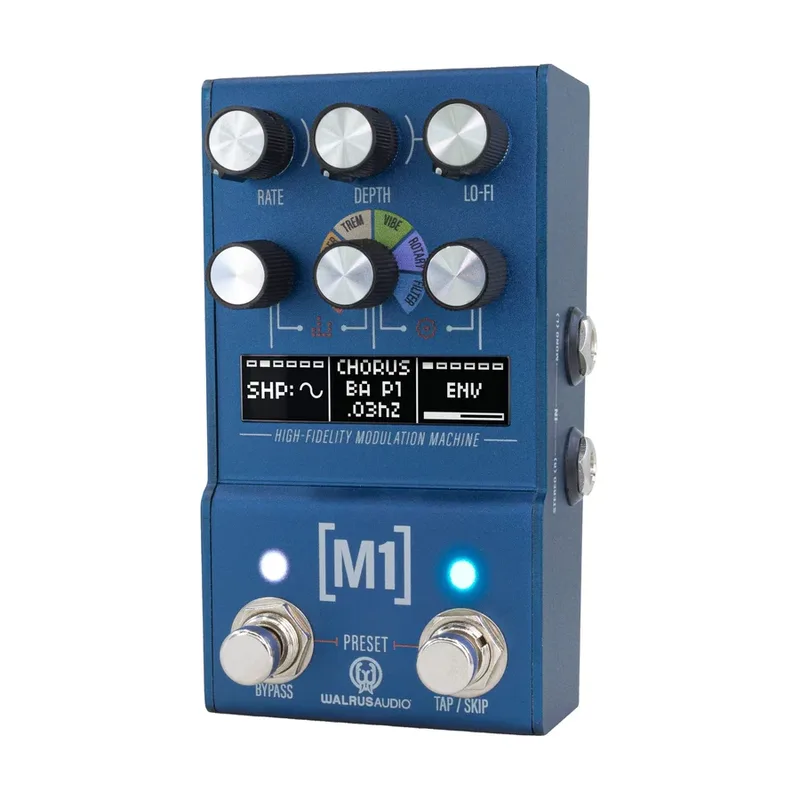
In September 2024 Walrus unveiled the MkII versions of the R1, D1 and M1 at $399.99 each5. The R1 MkII keeps the same six programs but, per Walrus, they are "rebuilt and revamped for vast tonal improvement"12. It replaces the original's bank of mini-toggles with an OLED menu screen, moves MIDI to mini-TRS connectors, and expands storage to 128 onboard presets12. New controls include a size control, a diffusion control, an expanded swell control that can duck the reverb, and a bipolar EQ filter that shifts decay darker or brighter1213.
Guitar.com's Josh Gardner rated the MkII 9 out of 10, finding "much improved basic reverb sounds" and spring depth "more impressive than the original's", though he noted the extra editing "comes at the cost of some ease of use"12. He was harder on the original, calling it "perhaps the least impressive" of the first four Mako pedals, with core sounds that were good but not great12.
The original Mako Series R1 is discontinued and no longer available from Walrus Audio3. The R1 MkII carries the line forward at $399.995.
Videos
Premier Guitar
walrusaudioeffects
walrusaudioeffects
Questions
Is the Walrus Audio R1 true bypass with trails?
Yes, trails are available. The R1 offers switchable bypass modes: true bypass, DSP bypass, and a true plus DSP mode that lets the reverb decay naturally when you switch the pedal off. The MkII keeps the same three bypass options.
How many presets can the Walrus R1 store?
The original R1 saves up to nine presets on board, with up to 128 slots accessible via MIDI. The R1 MkII expands this to 128 onboard presets, reachable through the pedal's menu rather than just the nine footswitch slots of the original.
Is the Walrus Audio R1 analog or digital?
It is digital. The original R1 is built on the Analog Devices Sharc processor, the same platform Walrus Audio used across the Mako Series, and runs six reverb algorithms in a compact pedal enclosure.
Does the Walrus R1 work in stereo?
Yes. The R1 has stereo inputs and outputs on the sides of the enclosure and can run in either stereo or mono. All six reverb programs are stereo, so a two-amp or stereo rig gets the full effect.
How do I update the Walrus R1 firmware?
The R1 has a microUSB port for firmware updates, which are done through Walrus Audio's update site at www.walrusaudio.io. Connect the pedal by USB and follow the instructions there to load new firmware.
Where is the Walrus Audio R1 made?
The original Mako Series R1 is made in the USA. Reviews list its origin as USA, and it shares the same stepped aluminum enclosure and build as the rest of the American-built Mako Series line.
Sources (13)
- Review: Walrus Audio Mako Series R1, Guitar.com, 2021-03-15
- Walrus Audio announces the Mako R1, a high-fidelity stereo reverb, Guitar.com, 2021-01-20
- MAKO Series: R1 High-Fidelity Stereo Reverb, Walrus Audio
- Walrus Audio Releases the R1 Reverb, Premier Guitar, 2021-01-20
- Discover the Latest Walrus Audio Mako Series MKII, Premier Guitar, 2024-09-25
- MAKO Series: R1 High-Fidelity Stereo Reverb, www.walrusaudio.com
- Walrus Audio Mako Series R1 High-Fidelity Stereo Reverb review, Guitar World, 2021-05-07
- Walrus Audio R1 MkII Multi-Mode Stereo Reverb, Delicious Audio, 2025-01-14
- Walrus Audio Mako Series R1 High-Fidelity Stereo Reverb review, MusicRadar, 2021-09-24
- Guitar Pedal X, Guitar Pedal X, 2021-08-16
- Walrus Audio R1 High-Fidelity Stereo Reverb, Pedal of the Day, 2021-05-08
- Walrus Audio Mako Mk II R1 review, Guitar.com, 2025-10-22
- Walrus Audio Releases Mako Series MKII Pedals, Bass Magazine, 2024-09-25