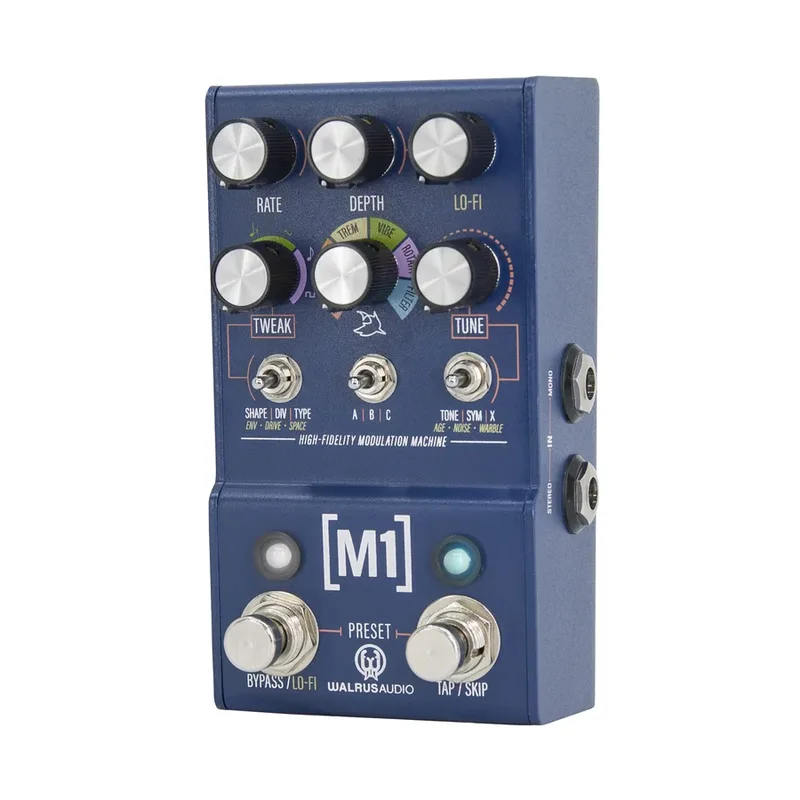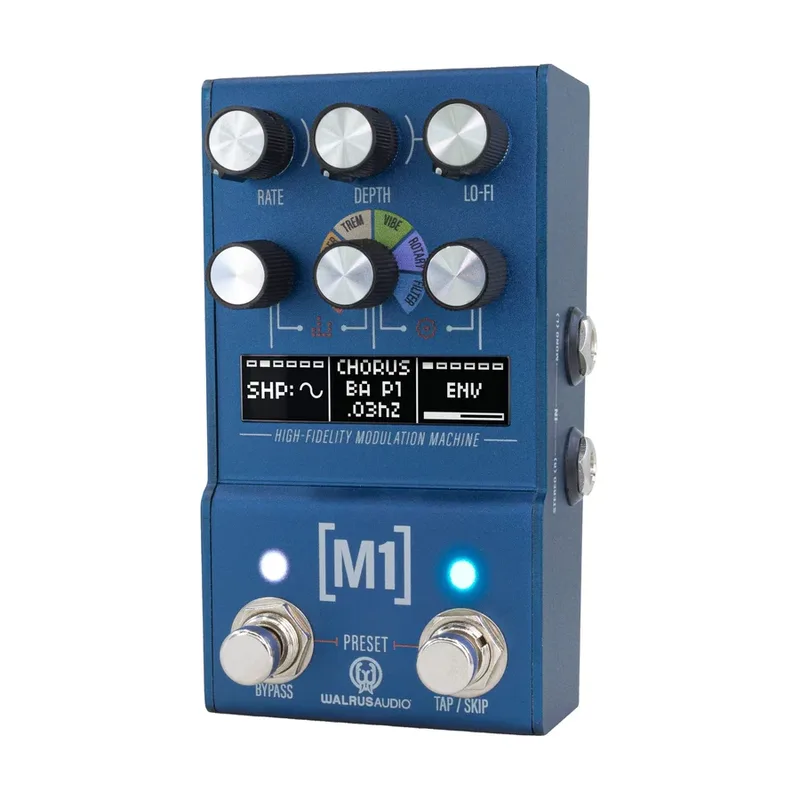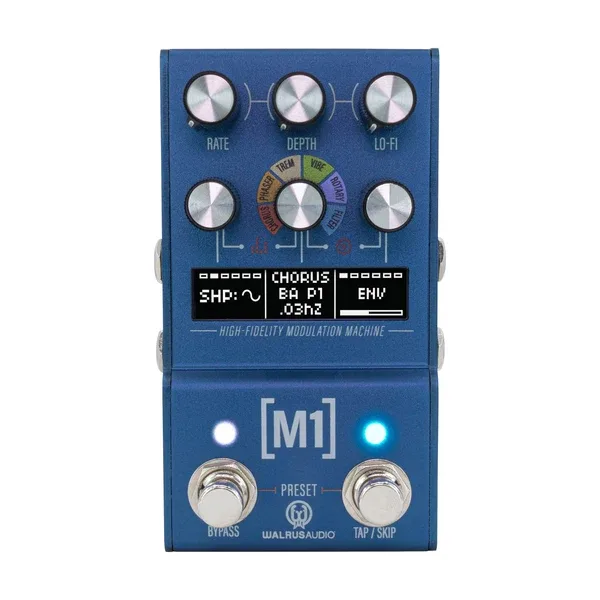


The Walrus Audio M1 MkII is a stereo, all-in-one digital modulation pedal featuring six studio-grade programs: Chorus, Phaser, Tremolo, Vibrato, Rotary, and Filter1. It sits in Walrus Audio's Mako series of stereo, multi-algorithm pedals, and the MkII update brings a 2-inch OLED screen, a flanger sound added to the Chorus algorithm, updated Rotary and Filter algorithms, total BPM control, an internal wet/dry mix, and 128 onboard presets23. For a player, it means covering nearly every modulation effect on one pedalboard slot, with deep editing when you want it.
The M1 MkII lists at $399.99 on Walrus Audio's product page as of October 20261. It is a digital pedal, with a dark blue finish featuring red, orange, cream, gold, green, purple and blue ink, in an enclosure measuring 4.9" x 2.52" x 2.64" with knobs1. All Walrus Audio products are covered by a limited lifetime warranty1.
Six modulation modes in one stereo pedal
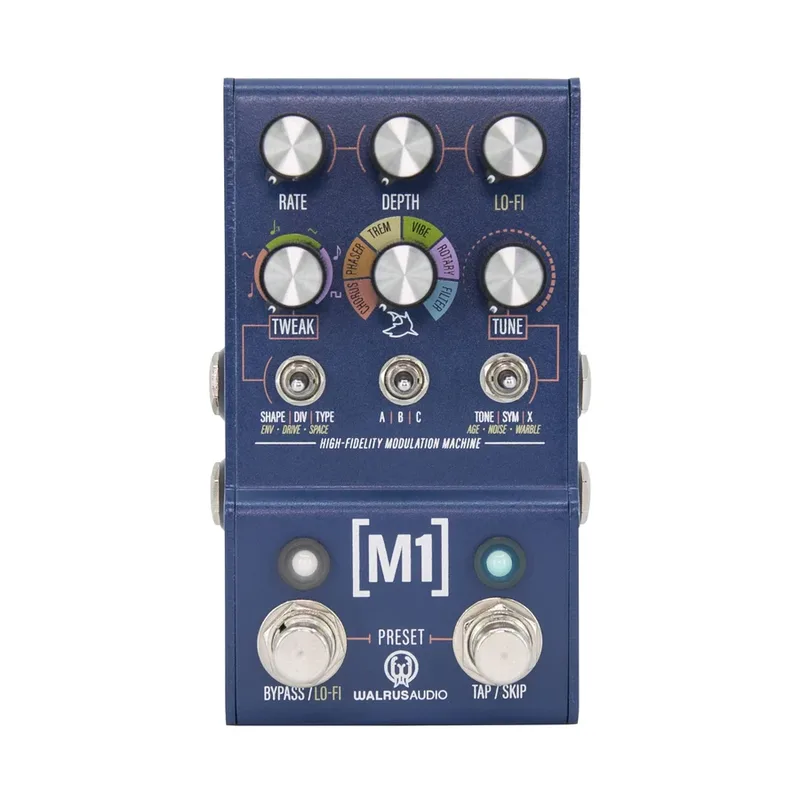
The M1's six programs each offer three different types, selected by the Type control, giving eighteen algorithms in total24. MusicRadar summarized the range: "On the M1 you have chorus, phaser, tremolo, vibrato, rotary and filter, with the chorus algorithm also handling flanger"5.
| Program | What it covers |
|---|---|
| Chorus | Three voicing options, now including a flanger8 |
| Phaser | Three types2 |
| Tremolo | Three types2 |
| Vibrato | Three types2 |
| Rotary | Three types, updated algorithm in MkII2 |
| Filter | Three types, updated algorithm in MkII2 |
Walrus Audio describes the Chorus program as running "from subtle chorus to vibrant and lush tri-chorus that will instantly teleport you to the 80s"1. In the Rotary program, the X knob controls the drive of the horn2.
The flanger is new to the MkII. Guitar Pedal X welcomed it: "Within the 3 formerly Chorus voicing options we now have a Flanger at last - great news for me!"8. It replaced the original M1's dual-chorus mode, and guitar.com's Josh Gardner wrote, "I certainly didn't miss the replaced dual-chorus mode as a result"9. The original M1 had been flagged in buying guides for having no flanger10, so the addition closes a real gap for players who want that effect alongside chorus.
The controls
The MkII keeps the Mako series knob layout and adds screen-based editing. Guitar World lists the controls as Rate, Depth, Lo-fi, Mode, and 2 parameter controls7, with each program further customized through the left encoder knob for features like effect type, BPM, wave shape, and more program controls1.
| Control | What it does |
|---|---|
| Rate | Sets the modulation speed, scaled to 104 |
| Depth | Sets the modulation depth, scaled to 104 |
| Lo-fi | Scales to 10; Guitar Pedal X calls the Lo-Fi section a standout4 |
| Mode | Selects the program7 |
| Type | Selects one of three different types for each program2 |
| Tone | Controls the overall tone of your signal passing through the M12 |
| X | Controls different parameters depending on the selected Program and Type, such as horn drive in Rotary2 |
| Left encoder | Effect type, BPM, wave shape and more program controls1 |
Guitar Pedal X's Stefan Karlsson was enthusiastic about the Lo-Fi variables, writing:
"The whole 'Lo-Fi' section is wholly genius - and is one of the elements that really makes this pedal a standout Multi-Modulator."4
Guitar Pedal X, November 20244
The two footswitches offer tap tempo, preset navigation and a series of momentary effects2. The MkII adds total BPM control, allowing you to select a specific tempo and read it out on the menu screen for the Chorus, Phaser, Tremolo, and Vibrato programs1. The original M1's tap tempo footswitch could also be used for a Skip performance effect11.
Presets, MIDI and connections
The maker's page says the M1 MkII holds 128 onboard presets, held in a preset bank made accessible by tapping down on the bottom left and bottom middle knobs simultaneously, with presets 10 through 128 accessible through manual selection or MIDI112. Delicious Audio and Guitar World describe it differently, as 9 onboard presets with 128 accessible via MIDI23.
Press sources describe the MkII as having 9 onboard presets with 128 available via MIDI23, while Walrus Audio's own page says 128 onboard presets1. Whichever figure applies to your unit, the full 128 are reachable, and presets 10 to 128 can be accessed through manual selection or MIDI1.
MIDI control is extensive. The pedal has mini-jack MIDI In and Thru plus USB-C7, and MIDI allows control over most of the M1's parameters11. Guitar Pedal X notes MIDI compatibility for external control and preset selection4. Connections are stereo in and out, so the pedal works in mono or stereo rigs613.
Power and bypass
Power requirements are 9V DC at 300mA minimum1. Guitar Pedal X specifies an isolated 9V DC center-negative supply at 300mA minimum4, and the original M1 ran on a 9V power supply only, with no battery option6. A 300mA draw rules out a standard 9V battery and means the pedal needs a supply or an isolated output capable of that current.
The bypass is switchable: Walrus Audio lists both True Bypass and Buffered Bypass1, and Guitar World describes it as a switchable relay or buffered bypass7. That lets you keep the pedal's DSP out of the chain when off, or leave a buffer in place to drive long cable runs. The original M1 used a DSP bypass7, so the MkII's relay true bypass is a change players with strict bypass preferences will notice.
What reviewers said
Guitar World's Jonathan Horsley reviewed the MkII and listed among its reasons to buy "top-shelf sounds and creative ways to manipulate them," a super compact size, a very welcome display screen, and the new flanger3. His spec summary noted 9 onboard presets, 128 when connected via MIDI, and 9V, 300mA power3.
Guitar.com's Josh Gardner reviewed the MkII in September 20259. Guitar Pedal X's first impressions of the Mako Series II called it a high-fidelity stereo modulation pedal, with the Lo-Fi section standing out4. Walrus Audio itself describes the M1's six programs as fine-tuned modulation algorithms: Chorus, Phaser, Tremolo, Vibrato, Rotary, and Filter1.
For context, the original Mako M1 carried the same six programs the MkII builds on: Chorus, Phaser, Tremolo, Vibrato, Rotary, and Filter1. The MkII adds a 2in OLED screen measuring 128x32 pixels and a left encoder knob for features like effect type, BPM, wave shape, and more program controls1. It lists at $399.991, and the Mako Series MKII M1 is currently sold out112.
Videos
walrusaudioeffects
walrusaudioeffects
Eirik Stordrange
Questions
Is the Walrus Audio M1 MkII true bypass?
Yes, and it can also run buffered bypass. The maker lists both True Bypass and Buffered Bypass, and Guitar World describes the bypass as switchable between relay and buffered, so you can choose which suits your signal chain.
Can the M1 MkII do flanger sounds?
Yes. The MkII adds a flanger sound to the Chorus algorithm, replacing the original M1's dual-chorus voicing. Guitar.com's reviewer did not miss the replaced dual-chorus mode as a result, so the flanger effectively takes its slot among the chorus types.
How many presets does the Walrus M1 MkII hold?
Walrus Audio's product page says the M1 MkII holds 128 onboard presets, accessed by tapping down on the bottom left and bottom middle knobs simultaneously. Delicious Audio and Guitar World describe it as 9 onboard presets with 128 accessible via MIDI, so the two figures are given side by side.
Does the M1 MkII have tap tempo or BPM sync?
Yes. The MkII adds total BPM control, letting you select a specific tempo and read it on the menu screen for the Chorus, Phaser, Tremolo and Vibrato programs. The two footswitches also offer tap tempo, preset navigation and a series of momentary effects.
Can you control the Walrus M1 MkII with MIDI?
Yes. The pedal has mini-jack MIDI In and Thru plus USB-C, and presets 10 through 128 can be accessed through manual selection or MIDI. MIDI allows control over most of the M1's parameters, including external control and preset selection.
Sources (13)
- Mako Series MKII: M1 High-Fidelity Modulation Machine, Walrus Audio
- Walrus Audio Mako M1 MkII, Delicious Audio, 2026-10-06
- Walrus Audio Mako M1 MKII High-Fidelity Modulation Machine review, Guitar World, 2025-01-10
- Guitar Pedal X, Guitar Pedal X, 2024-11-19
- “Dialling in these inspiring studio grade tones has never been easier and has never sounded better”: Walrus Audio adds OLED display, more controls, features and sounds on its new and improved flagship Mako MkII series pedals, MusicRadar, 2024-09-25
- Walrus Audio Mako M1 review, guitar.com, 2022-03-29
- Best chorus pedals 2026: My pick of choices for your 'board at every price point, Guitar World, 2022-06-09
- Guitar Pedal X, Guitar Pedal X, 2024-09-27
- Walrus Mako M1 MKII review, guitar.com, 2025-09-22
- Best modulation pedals: our pick of the best mod effects, Guitar World, 2023-06-02
- Walrus Audio Mako M1 High-Fidelity Modulation Machine review, Guitar World, 2022-07-28
- 385 Overdrive, Walrus Audio
- Walrus Audio Mako Series M1 High-Fidelity Modulation Machine pedal review, MusicRadar, 2022-06-09