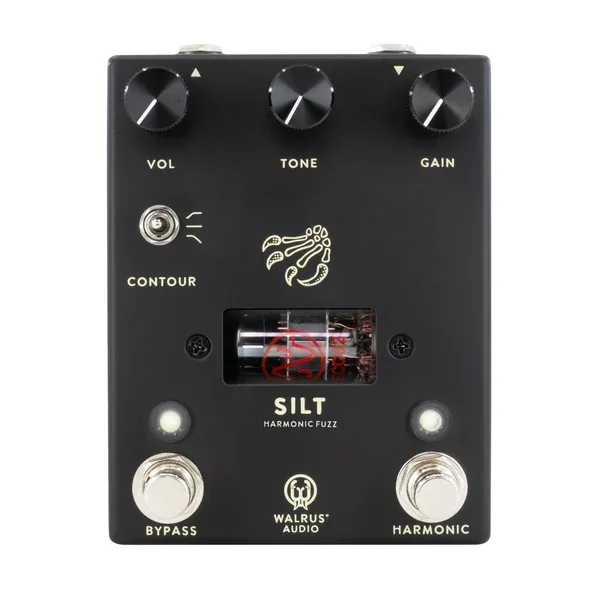


The Walrus Audio Silt is a fuzz pedal built around a real 12AU7 preamp tube. Walrus Audio describes it as a two-in-one fuzz: an analog circuit with the warmth of a 12AU7 tube as its drive section, plus a Harmonic mode that adds an octave-up before the fuzz1. It was announced on 16 January 2024, ahead of NAMM, and designed in collaboration with tube expert Jim Hagerman of Hagerman Amplification2.
A fuzz driven by a 12AU7 tube
Most fuzz pedals get their sound from transistors or clipping diodes. The Silt instead uses an internal 12AU7 preamp tube as its drive section, and the fuzz comes from pushing that tube hard. Guitar.com's reviewer, Cillian Breathnach, found no clipping diodes in the circuit, so the fuzz comes mainly from driving the 12AU7 far beyond its headroom5. Delicious Audio notes that pedals with tubes in them are quite rare, and normally confined to the overdrive niche, which makes a tube-based fuzz an unusual design8.
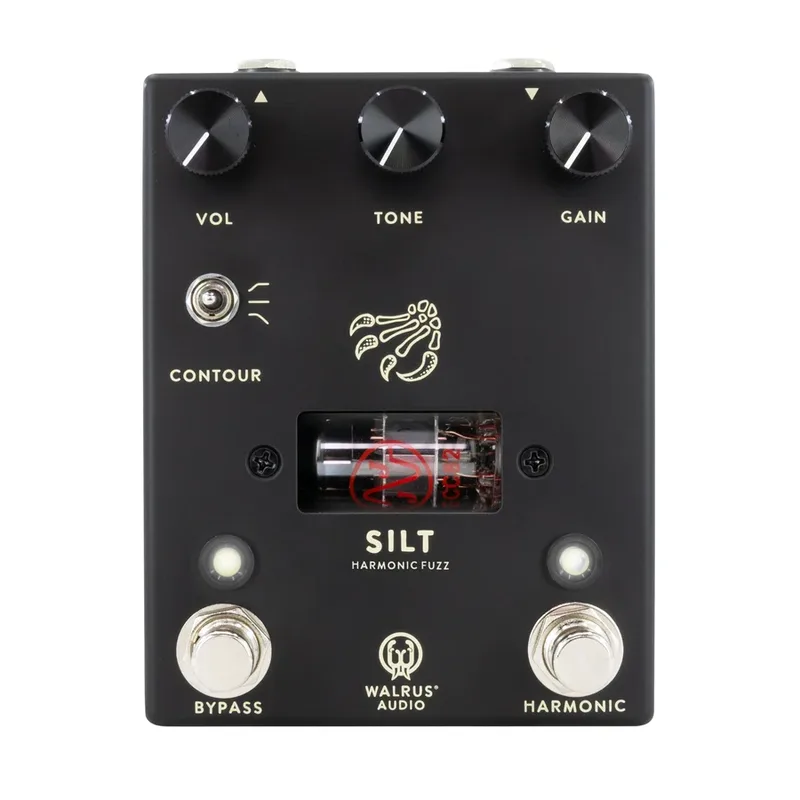
The tube is fully enclosed within the pedal but visible through a transparent window, so it is protected while still on display5. In the worst case of a failed tube, the manual outlines the simple steps needed to replace it5.
As for how it sounds, Guitar.com's reviewer described the base fuzz as:
"a thick, smooth distortion that's quite compressed, very loud, and very midrange-heavy"5
That is not a low-gain, dynamic fuzz. It is a loud, compressed, midrange-forward sound, which the reviewer found works well for chords and rhythmic parts54.
The controls and the three-way filter
The Silt keeps its control set simple: Volume, Tone and Gain knobs, a Contour toggle, and two footswitches, one for bypass and one for Harmonic mode9.
| Control | What it does |
|---|---|
| Volume | Sets the output level10 |
| Tone | An active tilt EQ that boosts and cuts highs and lows rather than passively filtering5 |
| Gain | Sets the amount of fuzz9 |
| Contour | Three-way toggle: highpass, flat, or lowpass curves in the pre-tube EQ stage1 |
| Bypass footswitch | Engages and bypasses the pedal9 |
| Harmonic footswitch | Engages Harmonic mode9 |
The Contour toggle is the most useful control for fitting the pedal into a rig. Delicious Audio describes the three positions as delivering full response (flat), tight and sparkly (low-pass), or warm and bassy (high-pass) tones8. Guitar.com's reviewer found the three filter modes help the Silt sit well in a full signal chain5. Walrus also suggests the pre-tube EQ stage is helpful when switching between different styles of pickups2.
The Tone control is worth noting for experienced players: it is an active tilt EQ, boosting and cutting highs and lows rather than just passively filtering the whole signal5.
Harmonic mode: an octave-up before the tube
The second footswitch engages Harmonic mode, the "harmonic" part of "harmonic fuzz". Walrus Audio describes it as a frequency doubler placed before the drive section of the pedal, producing crispy, octave-like sounds1. Guitar.com's reviewer calls it an analog octave-up before the main fuzz circuit, in the tradition of the Dan Armstrong Green Ringer or the Univox Superfuzz5.
A few things a player should know about Harmonic mode:
- There is no blend control for it. Guitar.com's review notes there is no blend control for Harmonic mode, "nor does there need to be"5.
- Walrus Audio recommends rolling back the guitar's Tone knob when engaging the mode9.
- The frequency doubler circuit adds a uniquely crisp quality to the signal, reminiscent of upper octaves8.
Power: 9V or 12V, 300mA
The Silt runs on 9V DC, center negative, with a 300mA minimum current draw1. It can also be powered at 12V, which delivers extra gain and a little more volume output, though Guitar.com's reviewer found it plenty loud at 9V58.
The 300mA draw is substantial. Guitar.com's reviewer notes it approaches what big-box digital delays and reverbs need, so a standard low-current 9V supply or a shared daisy chain may not be up to the job5.
Designer, colorways and editions
The Silt was created in collaboration with tube expert Jim Hagerman of Hagerman Amplification8. Walrus Audio calls it a collaborative creation with Hagerman, who is known for his tube amp work468.
It launched in two colorways at the same price of $299 in the US and £289 in the UK6:
- Red: a full dinosaur skeleton design, with artwork from Adam Forster610
- Matte black: a more minimalist single dinosaur claw design5
Guitar.com's reviewer found the build quality solid and feeling very premium, though the matte-black finish is an absolute fingerprint magnet5.
There was also a limited Black Friday 2024 Floral Series edition of the Silt, sold as a blemished unit, which is now sold out4.
What reviewers said
Guitar.com's review found the Silt's base fuzz mode is not a low-gain dynamic preamp fuzz: it is a thick, smooth distortion that's quite compressed, very loud, and very midrange-heavy5. The same reviewer found the build quality solid, though the matte-black finish is a fingerprint magnet5.
"a RAT and an EQD Tentacle will set you back a lot less, and get you pretty close to the Silt's functionality."5
Guitar World's review listed the Silt's flexible EQ among its strengths7. The pedal was created in collaboration with tube expert Jim Hagerman of Hagerman Amplification, and Walrus Audio notes that pedals with tubes in them are quite rare, and normally confined to the overdrive niche8.
Videos
Sweetwater
walrusaudioeffects
walrusaudioeffects
Questions
Does the Walrus Audio Silt have a real tube?
Yes. The Silt uses a real 12AU7 preamp tube as its drive section, fully enclosed inside the pedal and visible through a transparent window. The fuzz comes mainly from driving that tube beyond its headroom rather than from clipping diodes.
Can you replace the tube in the Walrus Silt?
Yes. In the worst case of a failed tube, the manual outlines the simple steps needed to replace it, according to Guitar.com's review. The tube sits inside the enclosure behind a transparent window, so it is not exposed to damage in normal use.
Does the Walrus Silt have clipping diodes?
No. Guitar.com's reviewer found no clipping diodes in the circuit, so the fuzz comes mainly from driving the 12AU7 tube far beyond its headroom. That makes it a genuinely tube-generated fuzz rather than a diode-clipped design.
Is there a blend control for Harmonic mode on the Silt?
No. Guitar.com's review notes there is no blend control for Harmonic mode, and adds that there does not need to be. The mode is simply switched on and off with the second footswitch, adding an octave-up before the fuzz.
Sources (10)
- Silt Harmonic Fuzz, Walrus Audio
- Walrus Audio Silt Harmonic Tube Fuzz, Pedal of the Day, 2024-01-16
- NAMM 2024: Walrus Audio unveils its two-in-one Silt harmonic fuzz pedal, designed in collaboration with tube maestro Jim Hagerman, Guitar.com, 2024-01-17
- Silt Harmonic Fuzz, Black Friday 2024 Floral Series, Walrus Audio
- Walrus Audio Silt review: the gnarliest Walrus fuzz pedal yet?, Guitar.com, 2024-03-11
- “Explore a unique and wild sonic landscape”: Walrus Audio recruits tube expert Jim Hagerman for the Silt, Guitar World, 2024-01-16
- Walrus Audio Silt Harmonic Fuzz review, Guitar World, 2024-05-10
- Walrus Audio Silt Fuzz, Delicious Audio, 2025-12-29
- Guitar Pedal X, Guitar Pedal X, 2024-01-18
- NAMM 2024: “Explore a unique and wild sonic landscape”: Walrus Audio teams up with Hagerman Amplification for the tube-equipped Silt Harmonic fuzz, MusicRadar, 2024-01-16