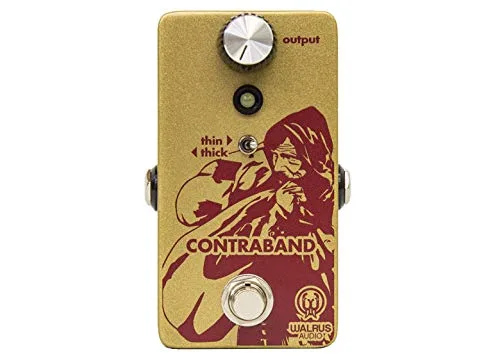


The Walrus Audio Contraband is a single-knob fuzz pedal that, in the maker's words, "ravages your guitar signal and generates a metallic wall of sound"1. Released by Walrus Audio on June 15, 2016, it strips the fuzz formula down to one control and a couple of switches, and adds a mild built-in gate that lets you pull choked-off, dying-battery sounds by rolling down your guitar's volume knob1. Because of how its circuit behaves, Walrus Audio says it also caters toward bass and analog synth players1.
What it does to your sound
The Contraband is built around one idea: a fuzz with a mild gate, and nothing else in the way3. Walrus Audio describes the result as a metallic wall of sound, and the gate is what gives the pedal its character. Rather than a separate noise-gate control, the gating is baked into the circuit, and it responds to your guitar's volume knob: roll the volume down and the signal chokes off in the manner of a dying battery, a sound many fuzz players chase with old pedals and half-dead cells1.
The maker also notes that the pedal's behavior suits instruments beyond guitar. "Because of that, it really caters toward bass and analog synth players as well"1. For bassists comparing fuzzes, that makes the Contraband one of the pedals explicitly voiced with low-end instruments in mind, and it belongs in any survey of bass pedals.
Controls and switching
The control set is deliberately minimal:
| Control or switch | What it does |
|---|---|
| Volume knob | Sets how loud your signal will be1 |
| Tone switch | Helps thin out humbuckers or beef up single-coils1 |
| Thick/Thin switch (bass version) | Voiced for bass frequencies3 |
| Footswitch | One footswitch engages the effect3 |
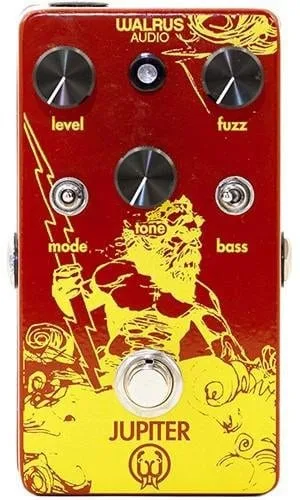
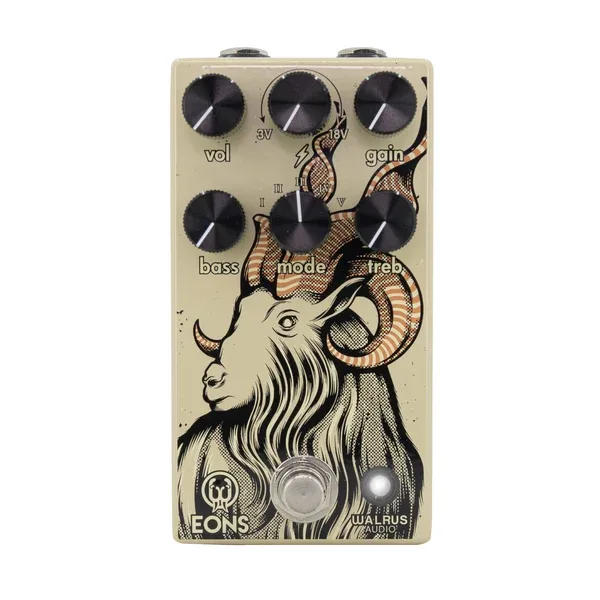
That is the whole interface. There is no fuzz amount knob, no bias control, no gate threshold: the gain structure is fixed, and the tone switch plus your guitar's volume knob are the shaping tools1. Players who want more dials from Walrus Audio have options like the Walrus Audio Jupiter or the five-mode Walrus Audio Eons, but the Contraband sits at the opposite end of that spectrum.
Power, size and enclosure
The Contraband runs on 9V DC and draws 20mA minimum1. It passes signal in mono in and mono out3, and it is true bypass, so the pedal stays out of the signal path when switched off3.
The enclosure is small. Walrus Audio calls it a petite enclosure that "packs a huge punch"4, and jokes that "because of its size, it's easy to smuggle into regions where fuzz is not welcome"1. The diecast enclosure measures 4.39" x 2.34" x 1.06"1, and the standard finish is a gold-sparkle, textured enclosure with navy ink, featuring original artwork of a smuggler delivering fuzz to the people1.
The Limited Edition version
Alongside the standard pedal, Walrus Audio produced a Limited Edition Contraband, restricted to 40 units. It comes in a lightly textured, matte enclosure with gold ink, and the color scheme was chosen by fan vote on the maker's social media. Walrus Audio stated that this version would not be run again4.
Price and availability
At launch, Walrus Audio offered the Contraband for a retail price of $149, first as a pre-order through its own store and then through authorized dealers1. In France, Audiofanzine lists a public price of 208 euros TTC, with a secondhand valuation of 100 euros2. The pedal was distributed in France by The Effect Factory2.
Where it sits among Walrus Audio fuzzes
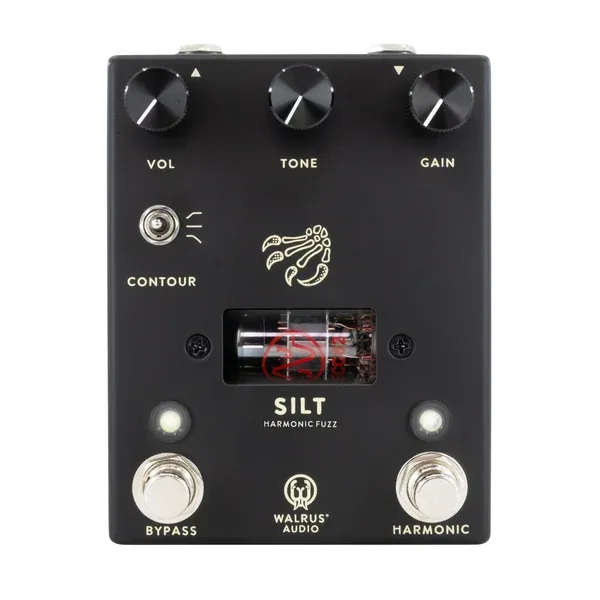
The Contraband is the maker's bare-bones fuzz: one knob, a fixed voice, and a gate. Later Walrus Audio fuzzes went the other direction. The Eons, released in late 2022, offers five clipping states and a voltage control, and the Silt, launched in January 2024 with Jim Hagerman, builds a 12AU7 preamp tube into a two-in-one harmonic fuzz at $299. Against those, the Contraband remains the simple, small-format option in the lineup, closer in spirit to a classic one-knob fuzz than to a multi-voice workstation.
Videos
walrusaudioeffects
Reverb
Brett Kingman
Questions
Does the Walrus Audio Contraband work on bass?
Yes. Walrus Audio says the Contraband caters toward bass and analog synth players as well as guitarists, so low-end instruments are part of its intended use rather than an afterthought. The bass version of the pedal also carries a Thick/Thin switch voiced for bass frequencies.
Is the Walrus Contraband true bypass?
Yes. The Contraband uses true bypass switching, so with the pedal off your signal passes through without buffering or coloration. It has a single footswitch for engaging the effect.
Where is the Walrus Audio Contraband made?
The Contraband is manufactured in the USA. Walrus Audio is the maker, and in France the pedal has been distributed by The Effect Factory.
Can the Contraband do dying-battery sounds?
Yes. The pedal has a mild built-in gate, and Walrus Audio says rolling down your guitar's volume knob produces choked-off, dying-battery sounds. That gate is part of the stock circuit, not a separate control.
Is the Walrus Contraband analog?
Yes. The Contraband's signal path is analog, built around a fuzz circuit with a mild gate. There is no digital processing in the effect itself.
How much does the Walrus Audio Contraband cost?
Walrus Audio set the Contraband's retail price at $149 at launch in 2016. In France, Audiofanzine lists a public price of 208 euros TTC and a secondhand valuation of 100 euros.
Sources (4)
- Contraband Fuzz, Walrus Audio
- Walrus Audio Contraband Fuzz, Audiofanzine (fr.audiofanzine.com), 2026
- Walrus Audio Contraband Fuzz, onethousandpedals.com
- Limited Edition Contraband Fuzz!, Walrus Audio