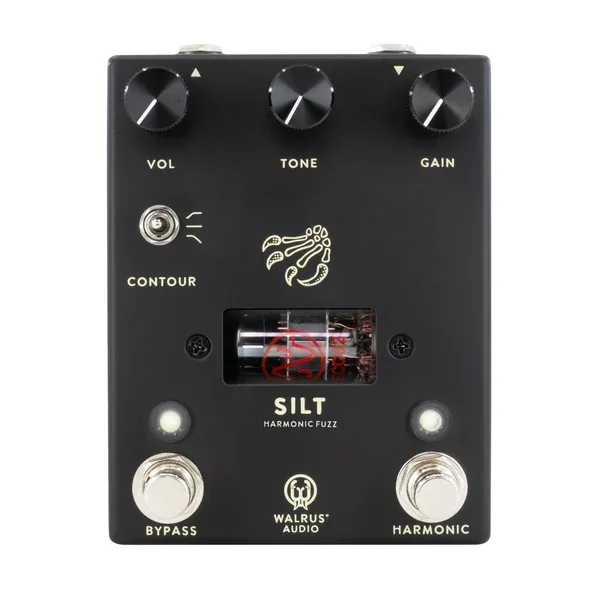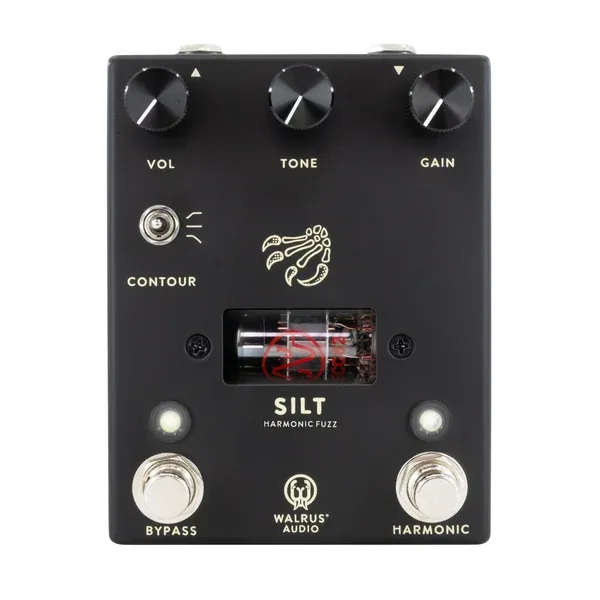


The Walrus Audio Silt Harmonic Fuzz is a two-in-one fuzz pedal that uses a real 12AU7 preamp tube as its drive section. Where most fuzz boxes clip the signal with diodes or transistors, the Silt pushes your guitar through an actual tube, which Walrus Audio says produces "warm, bone-rattling fuzz" with grit, growl, and harmonically complex textures1. The second half of the two-in-one design is Harmonic mode, a frequency doubler that sits before the drive section and produces octave-like sounds2.
The pedal was announced in January 2024, ahead of that year's NAMM show, as a collaborative creation between Walrus Audio and tube expert Jim Hagerman of Hagerman Amplification3. It launched in red and black colorways at $299.994.
What the Silt does: a tube-driven fuzz
The core of the Silt is its internal 12AU7 preamp tube, which Walrus Audio describes as the engine of the fuzz: "The Silt's 12AU7 tube section drives the warm, bone-rattling fuzz"1. The company positions it as a fuzz suited to more than single-note leads, calling it "a two-in-one fuzz that creates massively rich fuzz tones perfect for chords and rhythmic parts"5.
Guitar World's reviewer, Trevor Curwen, found the Gain knob covers a wide range rather than one flavor of fuzz: at zero it produces a crunchy drive tone, and turning it up moves through shades of distortion into fat fuzz7. That range is part of what makes the pedal a two-in-one: it can sit on a board as a drive, a distortion, or a full fuzz depending on where the Gain knob sits.
The controls, as laid out by Guitar World's review7:
| Control | What it does |
|---|---|
| Gain | From crunchy drive at zero, through shades of distortion, to fat fuzz at full |
| Volume | Output level; plenty of scope for a boost above unity |
| Tone | Post-fuzz tilt EQ: flat in the center, cuts highs and boosts lows to the left, boosts top and rolls off lows clockwise |
| Contour | Pre-tube EQ stage, toggling between highpass, flat, and lowpass curves2 |
| Bypass footswitch | Engages and disengages the pedal via relay bypass2 |
| Harmonic footswitch | Engages Harmonic mode7 |
The Contour control is worth noting for players comparing fuzzes: shaping the EQ before the tube changes how the drive section reacts, in the same way rolling off your guitar's tone before a fuzz changes its character21.
Harmonic mode: an octave-like frequency doubler
Harmonic mode is the Silt's distinguishing feature. Walrus Audio explains it plainly: "Harmonic Mode acts as a frequency doubler before the drive section of the pedal. This produces crispy, octave-like sound"2. Because it sits before the tube, the doubled signal then gets driven through the fuzz, which is what gives the mode its aggressive character.
Guitar.com's coverage described the mode as adding "uniquely harmonic overtones to the signal"8, and their writer Cillian Breathnach compared the result to a classic octave-up circuit: "from the demo, it sounds a little like the glitchy, awesome snarl of a boosted Green Ringer-style analogue octave-up"8. That comparison will mean something to players who know the octave-up fuzz tradition: the effect is not a clean, tracked octave like a digital pitch shifter, but a raw frequency-doubled signal that gets glitchy and ragged at the edges, which many players consider part of the appeal.
Walrus Audio offers one practical tip for using the mode: roll back your guitar's Tone knob when engaging it4. As with analog octave-up circuits, taming the top end of the guitar signal before the doubler helps the effect track and respond more predictably.
Power: 9V to 12V, 300mA
The Silt runs on 9V to 12V DC, center negative, with a 300mA minimum current draw1. The tube heater is the reason for the relatively high current: a 12AU7 needs real power to run, far more than a typical diode-clipping fuzz that might draw a few milliamps.
Running the pedal at 12V is not just about headroom. Walrus Audio says "Running the pedal at 12v will give you an extra gain boost"2, and Guitar World's reviewer confirmed it in practice, noting that "running the pedal at 12 volts squeezes out extra gain"7. A player who wants the Silt at its most aggressive can power it at 12V; at 9V it behaves with a bit less push.
Walrus Audio recommends an isolated power supply for the Silt and does not recommend daisy chain supplies. The pedal's 300mA minimum draw is beyond what most daisy chains can cleanly deliver, and a power supply is not included with the pedal1.
History and editions
The Silt is a collaborative creation with tube expert Jim Hagerman of Hagerman Amplification3. It launched in red and black colourway editions, each with cream and black ink and artwork of a fictional dinosaur fossil illustrated by Adam Forster2. A Black Friday 2024 Floral Series limited edition followed, and Walrus Audio also sold blemished units, where the blemish is cosmetic only, such as scratches or dents in the finish2.
The pedal launched in two finishes: red and black enclosures, both with cream and black ink, and artwork of a fictional dinosaur fossil illustrated by Adam Forster2. Both editions were available from the Walrus Audio webstore at $299.99, with international dealers expected imminently at launch4; Thomann listed the black finish at $261.00 and the red finish at $253.00 in January 20249.
Walrus Audio has also sold a Black Friday 2024 Floral Series edition of the Silt as a blemished unit, where the blemish was cosmetic only, such as scratches or dents in the finish; that edition is now sold out2.
What reviewers said
Guitar World's Trevor Curwen reviewed the Silt and summarized it as follows:
Guitar.com's reviewer's overall verdict was that the Silt is "another fuzz box, but it's one that is particularly inspired", calling it a great source for rich-sounding driven sounds with flexible EQ options, with the bonus of Harmonic mode that lets the sound really take off7.
The review's overall verdict was positive about the pedal's driven sounds and its EQ flexibility: "Yes, it's another fuzz box, but it's one that is particularly inspired, a great source for rich-sounding driven sounds with flexible EQ options, and the bonus of Harmonic mode that lets the sound really take off"7. The reviewer highlighted the same controls players find on the pedal itself, the post-fuzz Tone tilt EQ and the three-position Contour switch in the pre-tube EQ stage, as part of what makes it flexible7.
Videos
Sweetwater
walrusaudioeffects
walrusaudioeffects
Questions
What tube does the Walrus Audio Silt use?
The Silt uses a 12AU7 preamp tube (also designated ECC82) as its drive section. Walrus Audio describes the pedal as an analog circuit with the distinctive warmth of a 12AU7 tube doing the fuzz work, rather than clipping diodes or op-amps.
Who designed the Walrus Audio Silt?
The Silt is a collaborative creation between Walrus Audio and tube expert Jim Hagerman of Hagerman Amplification. Hagerman is credited as the designer on both Walrus Audio's own listings and press coverage of the pedal's announcement.
Can I power the Silt from a daisy chain?
No. Walrus Audio recommends an isolated power supply for all its pedals and specifically does not recommend daisy chain supplies for the Silt. The pedal draws 300mA minimum at 9V to 12V DC, center negative, which is well beyond what most daisy chains can cleanly deliver.
Is the Walrus Audio Silt true bypass?
Yes. The Silt uses a relay bypass circuit, which Walrus Audio describes as maintaining the integrity of your original tone when the pedal is off. It has two footswitches: one for bypass and one to engage Harmonic mode.
Sources (9)
- Silt Harmonic Fuzz, Walrus Audio
- Silt Harmonic Fuzz, Black Friday 2024 Floral Series, Walrus Audio
- Walrus Audio Silt Harmonic Tube Fuzz, Pedal of the Day, 2024-01-16
- Guitar Pedal X, Guitar Pedal X, 2024-01-18
- Overdrive, Fuzz, & Distortion, Walrus Audio
- Silt Harmonic Fuzz, Walrus Audio
- Walrus Audio Silt Harmonic Fuzz review, Guitar World, 2024-05-10
- What I’d Buy This Week: It’s a pre-NAMM fuzz overload!, Guitar.com, 2024-01-17
- Walrus Audio Silt Harmonic Fuzz, gearnews.com, 2024-01-16