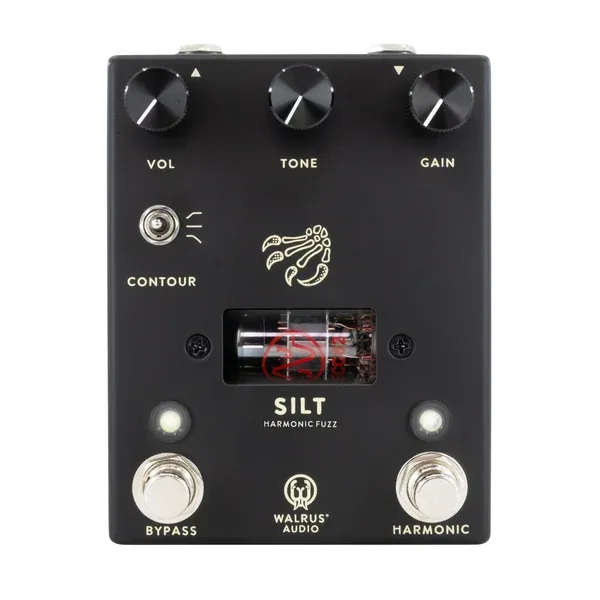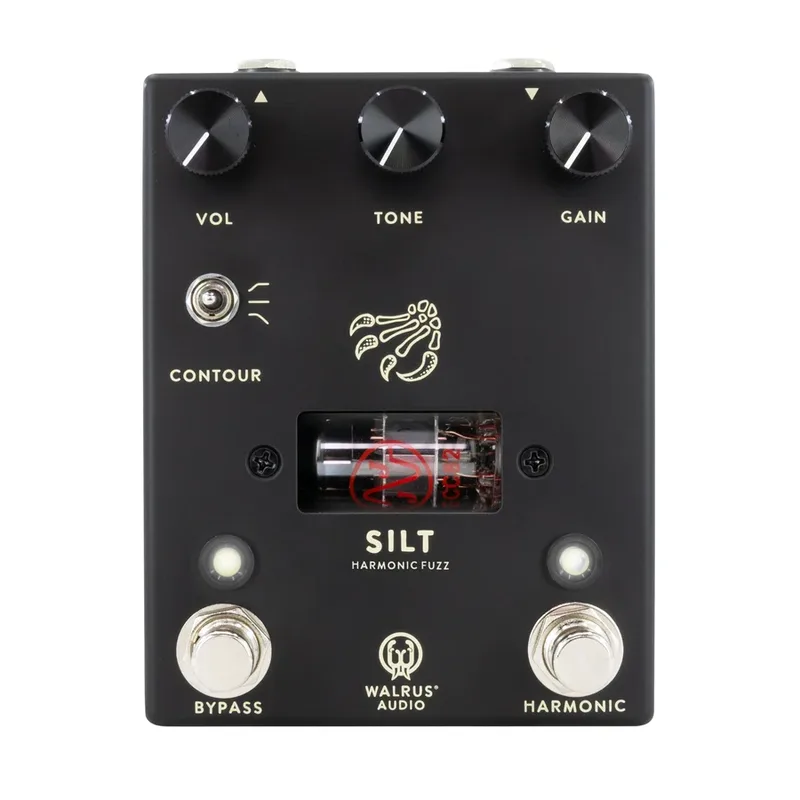


The Walrus Audio Silt Harmonic Fuzz is a fuzz pedal built around a real 12AU7 preamp tube. Walrus Audio describes it as a two-in-one fuzz: the tube drive section delivers what the maker calls "warm, bone-rattling fuzz" with grit, growl, and harmonically complex textures, while a second mode, Harmonic Mode, doubles your frequency before the drive section for octave-like fuzz12.
What sets the Silt apart from most fuzz boxes is that the tube does the work. Where a typical fuzz pedal clips the signal with transistors or diodes, the Silt's analog circuit uses the 12AU7 as its drive section, giving the fuzz a tube character rather than a solid-state one21. It was announced on 16 January 2024, ahead of that year's NAMM show, and was designed in collaboration with tube expert Jim Hagerman34.
A tube-driven fuzz with a Harmonic mode
The Silt's core is its 12AU7 tube drive section, which Walrus says produces warm, bone-rattling fuzz with grit, growl, and harmonically complex textures21. Pedal of the Day called it "a powerful pedal that utilizes a real tube to create some unique and punchy fuzz tones"3.
The second voice is Harmonic Mode, engaged by its own footswitch. Walrus Audio explains what it does721:
"Harmonic Mode acts as a frequency doubler before the drive section of the pedal. This produces crispy, octave-like"
Guitar.com described it as the pedal's special trick, with Walrus adding "uniquely harmonic overtones to the signal"8. Because the frequency doubling happens before the fuzz, the effect is an octave-up flavored fuzz rather than a clean octave effect, closer in spirit to the octave and pitch pedals family than to a standalone fuzz setting.
The controls
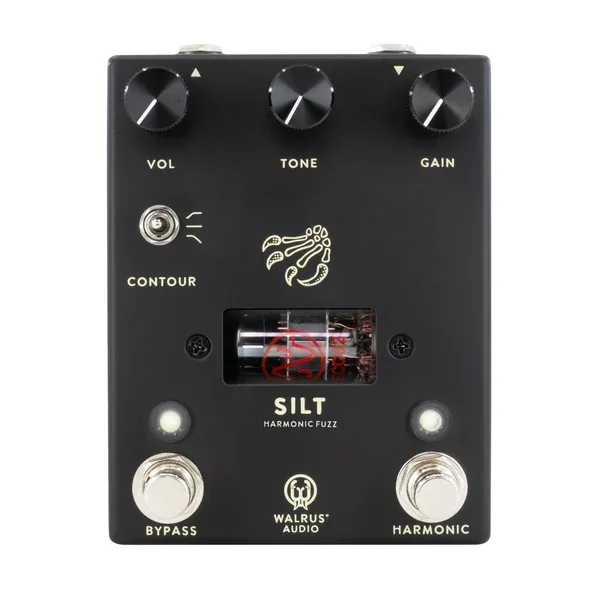
The Silt keeps its control set simple: Volume, Tone, Gain, and Contour, plus two footswitches67.
| Control | What it does |
|---|---|
| Volume | Sets output level; Guitar World's reviewer noted there's plenty of scope for delivering a boost with the Volume knob4 |
| Tone | Shapes the fuzz's brightness6 |
| Gain | Sets the amount of fuzz; Guitar World found unity gain sits around noon on the Gain knob4 |
| Contour | Three-way switch selecting a highpass, flat, or lowpass curve in the pre-tube EQ stage1 |
| Bypass footswitch | Engages and disengages the pedal7 |
| Harmonic footswitch | Engages Harmonic Mode7 |
The Contour switch is the EQ voice of the pedal. Guitar World's reviewer, Trevor Curwen, described it as "the three-way contour switch that, besides a flat setting, offers either a high-pass or a low-pass filter to tweak the t[one]" and listed "Flexible EQ" among the pedal's strengths4. Because the filter sits before the tube, it shapes what the fuzz reacts to as well as the final tone.
Power: 9V to 12V
The Silt runs on a standard pedalboard supply: 9V DC, center negative, with a 300mA minimum current draw1. It is designed for operation anywhere from 9V to 12V, and Walrus says running it at 12V gives an extra gain boost1. Guitar World's reviewer confirmed this in practice, finding that "running the pedal at 12 volts squeezes out extra gain"4.
Walrus Audio recommends an isolated power supply for all its pedals and does not recommend daisy chain supplies. No power supply is included with the Silt1.
The tube runs from this same supply, so there is no separate high-voltage wall connection to worry about. Guitar Pedal X noted the pedal is very user-friendly on the power supply side7.
Designed with Jim Hagerman
The Silt is a collaborative creation between Walrus Audio and Jim Hagerman, a tube expert best known in the pedal world through Hagerman Amplification37. It was announced on 16 January 2024, alongside NAMM that year, in two finishes: a textured red version with dinosaur artwork by Adam Forster, and a matte black version93. The pedal is made in the USA4.
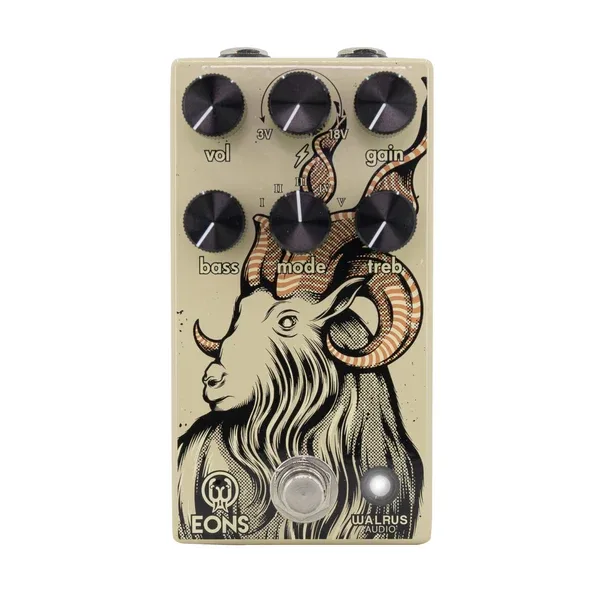
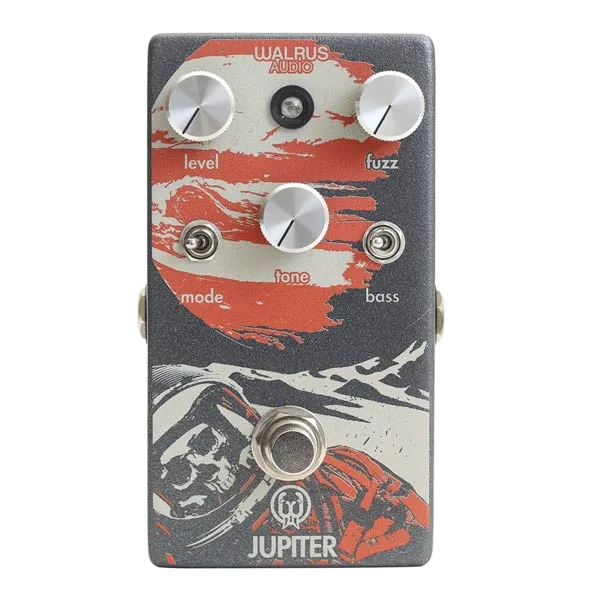
Walrus Audio's broader fuzz line includes the Eons Five-State Fuzz and the Jupiter Multi-Clip Fuzz V2, but the Silt is the company's only tube-driven fuzz, and its Hagerman collaboration is what distinguishes it from the rest of the range5103.
Videos
Sweetwater
walrusaudioeffects
walrusaudioeffects
Questions
What tube does the Walrus Audio Silt use?
The Silt uses a 12AU7 preamp tube as its drive section. Walrus Audio describes the pedal as a two-in-one fuzz wielding an internal preamp tube, with the 12AU7 giving the fuzz its distinctive warmth. The tube runs from the pedal's normal 9V to 12V power input, so no separate high-voltage supply is needed.
Does the Silt need a high-voltage power supply for its tube?
No. The Silt is designed for operation at 9V to 12V through a standard 9V DC center negative input rated at 300mA minimum. Running it at 12V gives an extra gain boost. Walrus Audio recommends an isolated power supply and advises against daisy chains, and no power supply is included with the pedal.
Is the Walrus Audio Silt an analog circuit?
Yes. Walrus Audio says the Silt boasts an analog circuit with the distinctive warmth of a 12AU7 tube as its drive section. There is no digital processing in the signal path.
What does the Harmonic mode on the Silt do?
Harmonic Mode acts as a frequency doubler before the drive section of the pedal, producing crispy, octave-like sounds. Walrus describes it as adding uniquely harmonic overtones to the signal. It is engaged by its own footswitch, separate from the bypass switch.
Does the Silt use relay bypass?
Yes. The Silt passes your signal through a relay bypass circuit, which Walrus Audio describes as maintaining the integrity of your original tone when the pedal is off.
Who designed the Walrus Audio Silt?
The Silt is a collaborative creation between Walrus Audio and tube expert Jim Hagerman, of Hagerman Amplification. It was announced on 16 January 2024, ahead of NAMM that year, in two finishes: textured red with dinosaur artwork by Adam Forster, and matte black.
Sources (10)
- Silt Harmonic Fuzz, Walrus Audio
- Silt Harmonic Fuzz, Walrus Audio
- Walrus Audio Silt Harmonic Tube Fuzz, Pedal of the Day, 2024-01-16
- Walrus Audio Silt Harmonic Fuzz review, Guitar World, 2024-05-10
- Silt Harmonic Fuzz, Black Friday 2024 Floral Series, Walrus Audio
- Walrus Audio Silt Harmonic Fuzz, gearnews.com, 2024-01-16
- Guitar Pedal X, Guitar Pedal X, 2024-01-18
- What I’d Buy This Week: It’s a pre-NAMM fuzz overload!, Guitar.com, 2024-01-17
- NAMM 2024: Walrus Audio unveils its two-in-one Silt harmonic fuzz pedal, designed in collaboration with tube maestro Jim Hagerman, Guitar.com, 2024-01-17
- Overdrive, Fuzz, & Distortion, Walrus Audio