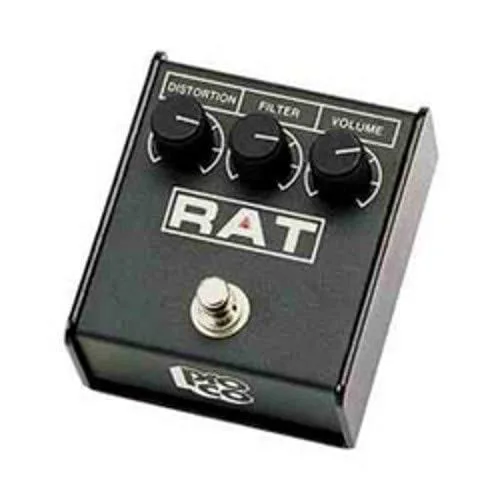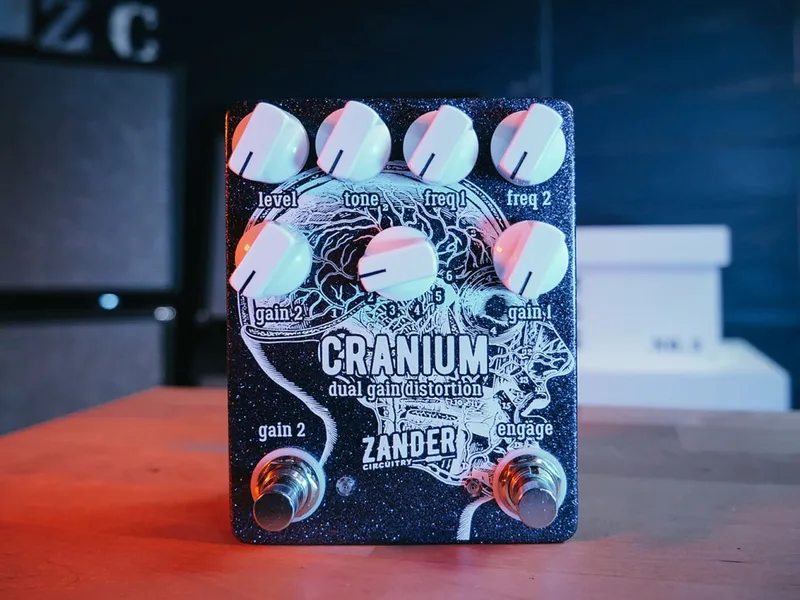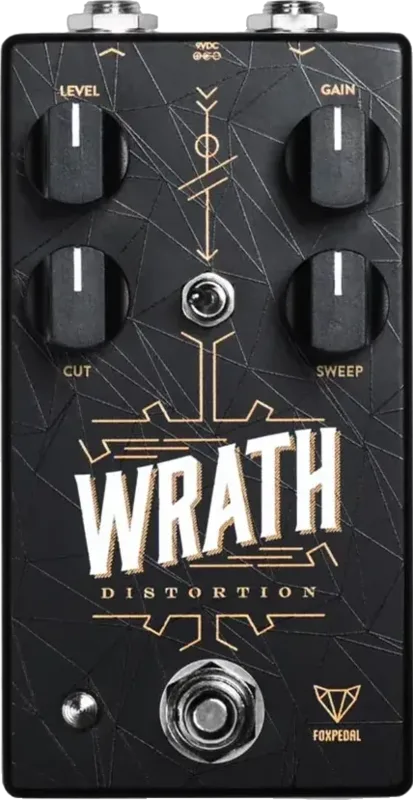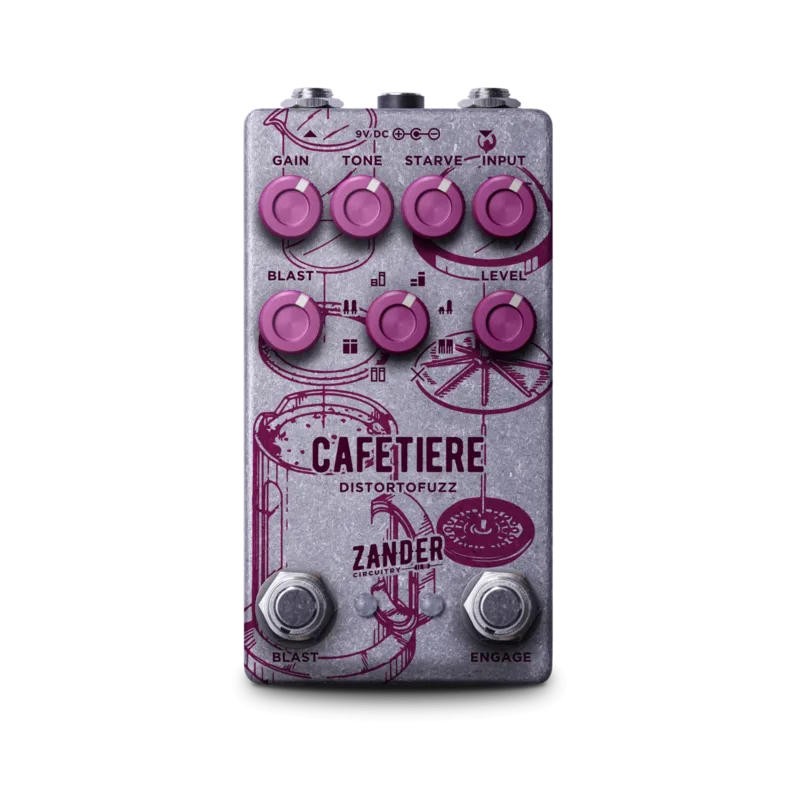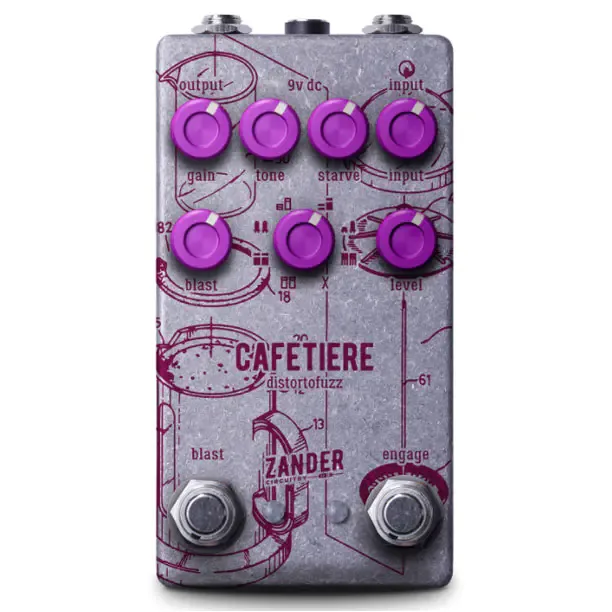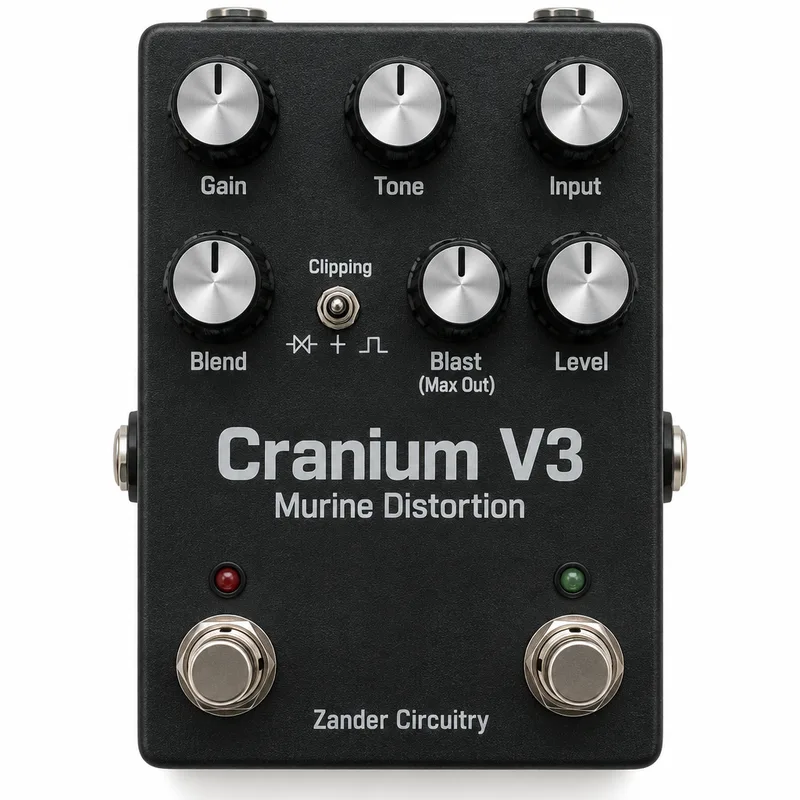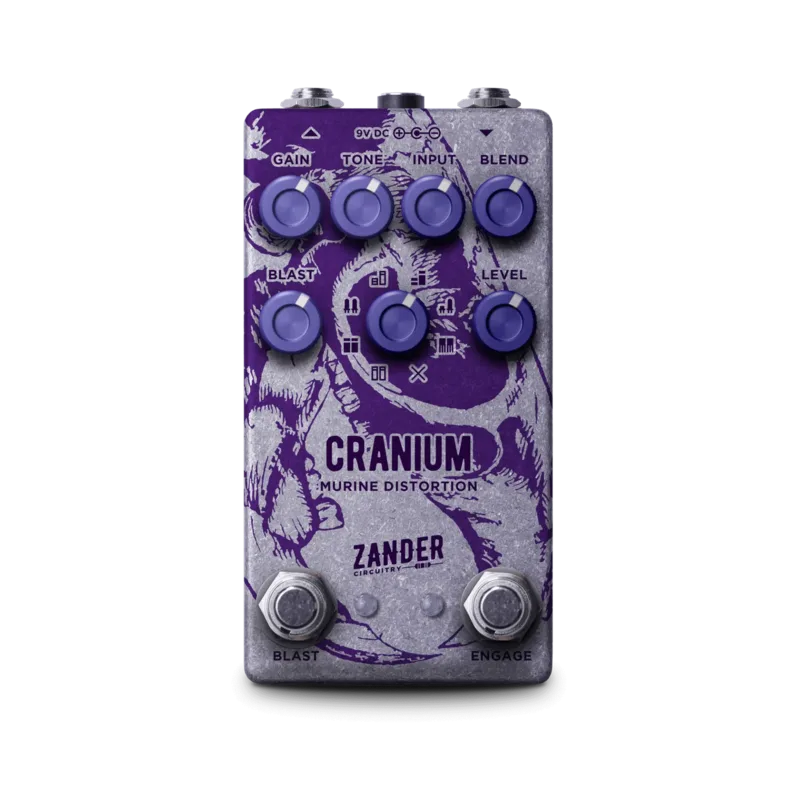


The Zander Circuitry Cranium is a distortion pedal built on the framework of the Pro Co RAT circuit, the "rodent" design heard on countless records. What sets it apart from a straight RAT clone is that it gathers the tones of the many rodent variants released over the years into one box, using a rotary switch to change the clipping diodes, and adds a clean Blend control plus a Blast footswitch for instant high gain12.
The pedal runs on a standard 9V DC center negative supply, draws 120 mA, and measures 67 mm wide by 122 mm long by 60 mm high, with top mounted input and output jacks. Zander lists it at $200.001.
A RAT-style distortion with a clean blend
The Cranium is based on the ProCo RAT pedal, as Zander explained in a Guitar.com interview about the original Cranium Dual Gain Distortion: "I wanted to create something that captured all of those tones in one box," since the RAT variants mostly differ in clipping diode type2. The rotary switch is how it does that, moving between silicon, germanium, asymmetrical and other clipping arrangements, each named after the rodent variant it echoes.
The Blend control mixes your clean signal back in with the distortion. Zander says this "works wonders on bass (even being included in the 'Juggernaut' bass variant of the original pedal) but also works for lower gain sounds that require more articulation"1. For bass players, that means the low end survives the distortion; for guitarists, it means you can keep note definition at gain settings that would otherwise turn to mush.
The controls
The current Cranium carries five knobs, a clipping rotary and two footswitches1.
| Control | What it does |
|---|---|
| Gain | Gain control |
| Tone | EQ for the output signal |
| Input | Low end/gain boost (Reutz mod) |
| Blend | Clean signal blend |
| Level | Output volume |
| Clipping rotary | Selects the clipping type |
| Engage footswitch | Turns it on and off |
| Blast footswitch | Activates Blast mode |
The clipping rotary is the heart of the pedal. Each position maps to a classic rodent variant1:
| Rotary position | Character | Rodent variant |
|---|---|---|
| Silicon | Louder, brighter, and a little bit brittle | Standard |
| Germanium | Smooth, sweet, and classically "amp-like" | You Dirty |
| Asymmetrical germanium | A more aggressive version of germanium | Zander |
| Asymmetrical silicon | A more aggressive version of silicon | Solo |
| Transistor/MOSFET | Similar to silicon, but sweeter and crunchier | FAT |
| No diodes | Loads of output and much less gain | Deucetone |
The Input knob is the odd one out. Rather than a tone control, it alters what would normally be a fixed resistor value in the circuit, similar to what is commonly called the "Reutz" mod, changing the low end and the overall gain response1. Where a stock RAT fixes that value, the Cranium makes it a knob.
The Blast footswitch
Blast mode ramps the drive all the way up and activates a second volume control, so you can set a low gain rhythm sound and a full gain lead sound and jump between them with one press1. It is a two preset arrangement built into the pedal rather than a separate boost, and it works alongside the Engage footswitch that simply turns the effect on and off1.
Versions and editions
Alongside the regular pedal there is the Custom Shop Cranium, a custom variant of what Zander calls its best selling distortion pedal. It offers a choice of powder coated enclosure colors (Blue/Teal, Pastel Blue, Pastel Green, Pastel Gray, Pastel Pink, Pastel Purple, Pastel Yellow), a choice of knob color, and a choice of op amp, listed at £149.003.
The Custom Shop Cranium is effectively a limited edition: Zander says it has "an incredibly limited number of powder-coated enclosures in various colours, most of which are a one off"3. Once a color is gone, it is gone.
The op amp question
The regular Cranium uses an OP07 op amp, which Zander describes as "the standard op-amp used in our regular Cranium pedal"3. The Custom Shop version lets you swap in a TL071 instead, which the maker says "offers a slightly brighter sound with a fizzier top end"3.
This matters because the original RAT used an LM308, and the op amp is part of that circuit's character. On the RAT 2, DIY builders note that the OP07 is not a pin to pin equivalent with the LM308 and the circuit needs tweaking to accept other single op amps4. General Guitar Gadgets' rodent project documentation lists the LM308 or OP07 as the IC, noting an LM208 or another op amp with a like slew rate spec can also be used5. Zander's choice of the OP07 puts the Cranium in the family of RAT derivatives built around that op amp rather than the original LM308.
Videos
Zander Circuitry
Zander Circuitry
Zander Circuitry
Questions
What op amp does the Zander Cranium use?
The regular Cranium uses an OP07 op amp, which Zander Circuitry describes as the standard op amp for the pedal. The Custom Shop version lets you choose a TL071 instead, which the maker says offers a slightly brighter sound with a fizzier top end.
Is the Zander Cranium good on bass?
Zander says the Blend control works wonders on bass, and notes it was even included in the Juggernaut bass variant of the original pedal. The clean blend also helps with lower gain sounds that need more articulation, keeping your low end intact under distortion.
What is the Reutz mod on the Cranium's Input knob?
The Input knob alters what would normally be a fixed resistor value in the circuit, similar to what is commonly called the Reutz mod. Turning it changes the low end and the overall gain response, so you can fatten up or tighten the distortion before the Gain control does its work.
What changed on the Cranium V2?
Released in March 2021, the Cranium V2 moved to a compact format and added a sculpting section of Tone, Frequency and Body controls for precise fine tuning. Its Blast footswitch, with its own knob, ramps the drive all the way up and activates a second volume control for quick switching between low and high gain sounds.
What is the difference between the OP07 and TL071 op-amp in the Cranium?
The OP07 is the standard op amp in the regular Cranium. The TL071, offered as an option on the Custom Shop version, gives a slightly brighter sound with a fizzier top end, in the maker's words. Note that on the original RAT circuit the OP07 is not a pin to pin equivalent of the LM308.
Is the Custom Shop Cranium a limited edition?
Yes, in effect. Zander Circuitry says it has an incredibly limited number of powder coated enclosures in various colours, most of which are one offs. You also choose the knob colour and the op amp, priced at 149.00 GBP on the maker's page.
Sources (5)
- Cranium - Zander Circuitry, Zander Circuitry, 2024-01-01
- How the Cranium Dual Gain Distortion put Zander Circuitry on the map, Guitar.com, 2020-08-26
- Custom Shop Cranium, Zander Circuitry, 2025-08-07
- Guitar FX Layouts: Proco Rat 2, tagboardeffects.blogspot.com (Guitar FX Layouts), 2015-01-27
- ProCo™ Rat™ Clone Kit: Build the Rodent Distortion Pedal, General Guitar Gadgets, 2014-05-12