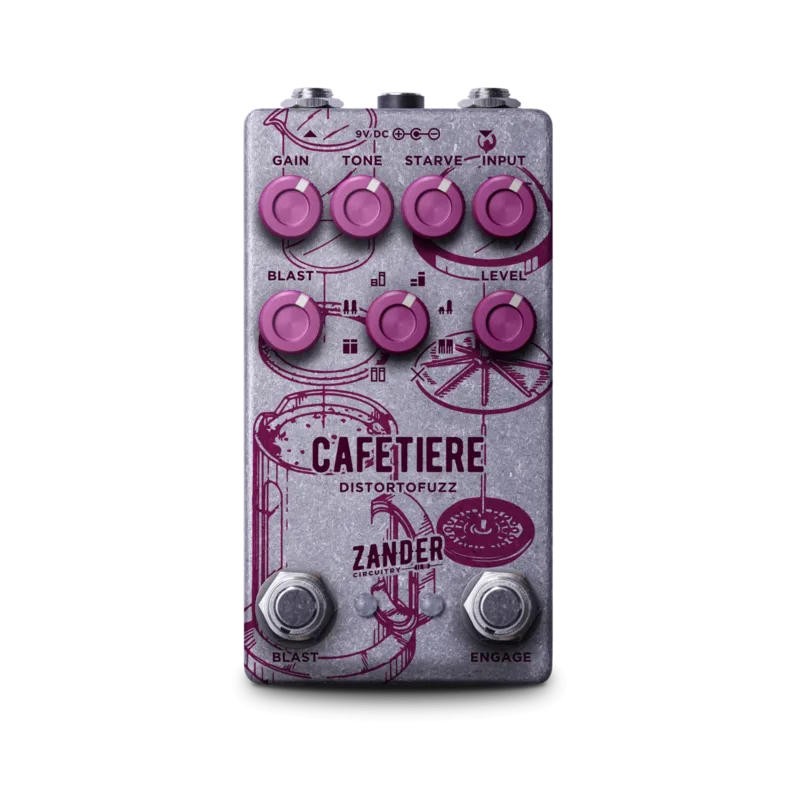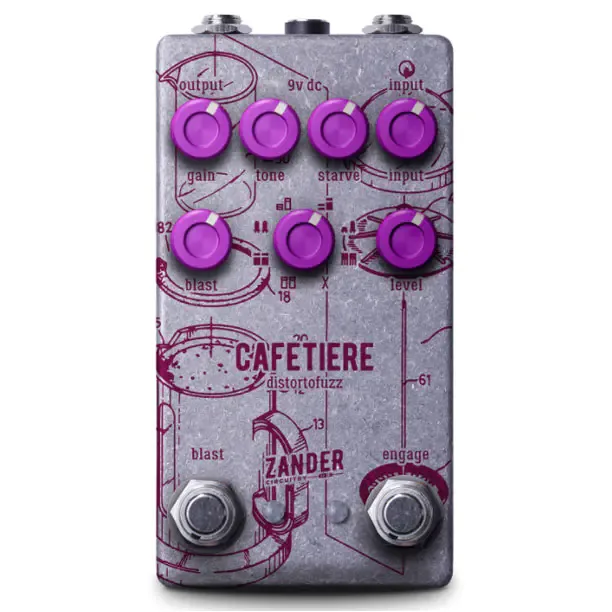
The Zander Circuitry Cafetiere V4 Distrofuzz is an analog fuzz/distortion pedal with tone and starve knobs and an extra boost footswitch with a separate level control1. Zander Circuitry describes it as their "torn-down, rebuilt and expanded take on the Interfax Harmonic Percolator (HP-1)"1, and as Delicious Audio put it when covering the launch: "Is it a distortion? Is it a fuzz? Who knows, but what we do know is that it's possibly one of the strangest beasts in the fuzz/distortion world"1. The pedal was born as a variant of the Harmonic Percolator and, in the words of the same coverage, "has evolved in this new version into something much more"1 than that original circuit.
From the Harmonic Percolator to V4
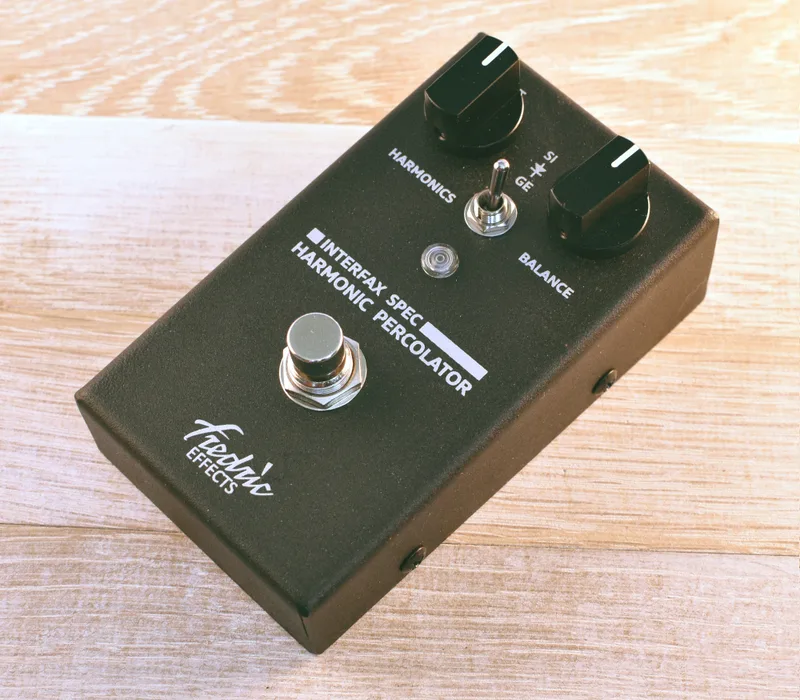
The circuit the Cafetiere builds on, the Interfax Harmonic Percolator HP-1, was a hybrid fuzz design. Guitar Pedal X notes that it "originally featured 2N404 Germanium, and 2N3565 Silicon Transistors"2, a mix that set it apart from both pure germanium and pure silicon fuzzes. Aion FX adds another point of difference: "The Harmonic Percolator uses clipping diodes (unlike most germanium fuzzes)"3, which is part of why the circuit lends itself to the kind of diode-switching palette the Cafetiere offers.
The Cafetiere was born as a variant of the Harmonic Percolator, and Zander Circuitry describes the V4 as a "torn-down, rebuilt and expanded take on the Interfax Harmonic Percolator (HP-1)"1. The Harmonic Percolator it builds on was itself a hybrid fuzz circuit, originally featuring 2N404 germanium and 2N3565 silicon transistors2, and used clipping diodes unlike most germanium fuzzes23.
The controls and footswitches
The V4's control panel pairs conventional knobs with two that come straight from the Percolator's spiky character1.
| Control | What it does |
|---|---|
| Clipping selector (1-8) | Chooses one of the 8 clipping modes |
| Input | Alters the input capacitance, affecting the low end and overall gain response |
| Starve | Drains the circuit of voltage when turned down, choking out note decay and compressing the attack |
| Tone | A simple low-pass filter to tame high end |
| Blast | Output volume in Blast mode |
The Starve control is the one players coming from standard distortion pedals will not have met before: because it starves the circuit of voltage rather than shaping the signal after it, turning it down changes how notes decay and how hard the attack hits, from gated and sputtery at low settings to full sustain when open1.
There are two footswitches. Engage turns the pedal on and off, and Blast activates Blast mode1.
Blast mode
The Blast footswitch turns the gain all the way up and activates a second volume control, set by the Blast knob, for seamless transitions between low and high gain sounds1. In practice this gives the pedal two personalities on one board: a set level and gain for rhythm, then a stomp for a boosted, full-gain lead sound without touching a knob.
The pedal also features both momentary and latching switching, which means you can hold down one of the footswitches to temporarily engage an effect and release it to return to normality1. That opens up stutter and swell effects: hold Blast for a burst of full gain only as long as you keep the switch down.
The eight clipping modes
The central rotary switch selects between eight clipping configurations, each with its own character as described at launch1:
| Mode | Character |
|---|---|
| Germanium | Smooth, sweet, and classically "amp-like" |
| Silicon | Louder, brighter, and a little bit brittle |
| LED | Louder again, with less saturation and more punch |
| Asymmetrical germanium | A more aggressive version of germanium |
| Transistor/MOSFET | Similar to silicon, but sweeter and crunchier |
| No diodes | Loads of output and much less gain |
The no-diodes setting is worth noting for players who want the circuit's character without heavy clipping: with no clipping diodes in the path, the transistors themselves do the work, giving high output at lower gain1. For players comparing fuzz circuits generally, the range here spans the two classic diode families plus LED and transistor clipping, which is a wider palette than most single-mode fuzz pedals offer.
Power and size
The Cafetiere V4 runs on a 9V DC center-negative supply and draws 126 mA1. That draw is high for a fuzz pedal, well past what a battery or a low-current daisy chain is meant to serve, so it belongs on a powered pedalboard with headroom to spare. The enclosure measures 67 mm wide by 122 mm long by 60 mm high1, roughly a standard compact-plus footprint.
What the press said
Delicious Audio's coverage of the launch was positive about both the builder and the pedal, calling Zander Circuitry "one of the few truly boutique builders who is churning out pedals that can compete in advanced functionality with more established builders like JHS or Walrus Audio" and describing the V4 as impressive1.
Questions
What pedal is the Cafetiere V4 based on?
It is Zander Circuitry's torn-down, rebuilt and expanded take on the Interfax Harmonic Percolator HP-1, a 1970s hybrid fuzz circuit that mixed germanium and silicon transistors and used clipping diodes, unlike most germanium fuzzes. The original Cafetiere appeared in 2018 and the V4 arrived in 2022.
How many clipping modes does the Cafetiere V4 have?
Eight, selected through a central rotary switch numbered 1 to 8. That is up from six modes on the V2. The options include germanium, silicon, LED, asymmetrical germanium, transistor/MOSFET and no-diodes settings.
What does the Blast footswitch do?
Blast turns the gain all the way up and activates a second volume control, set by the Blast knob, for seamless transitions between low and high gain sounds. Both footswitches also work momentarily: hold one down to temporarily engage the effect and release it to return to normal.
How much current does the Cafetiere V4 draw?
It draws 126 mA from a 9V DC center-negative supply. That is a fairly hungry draw for a fuzz pedal, so a dedicated spot on a powered pedalboard is more practical than a battery or a small daisy chain.
Is the Cafetiere V4 analog?
Yes. Delicious Audio describes it as an 8-mode analog fuzz/distortion pedal. All of its clipping options are set by analog components: germanium and silicon diodes, LEDs, transistors/MOSFETs, or no diodes at all.
Sources (3)
- New Pedal: Zander Circuitry Cafetiere V4 Distrofuzz, Delicious Audio, 2022-03-25
- Guitar Pedal X, Guitar Pedal X, 2024-05-13
- Particle Vintage Fuzz / Interfax Harmonic Percolator, Aion FX, 2021-02-19