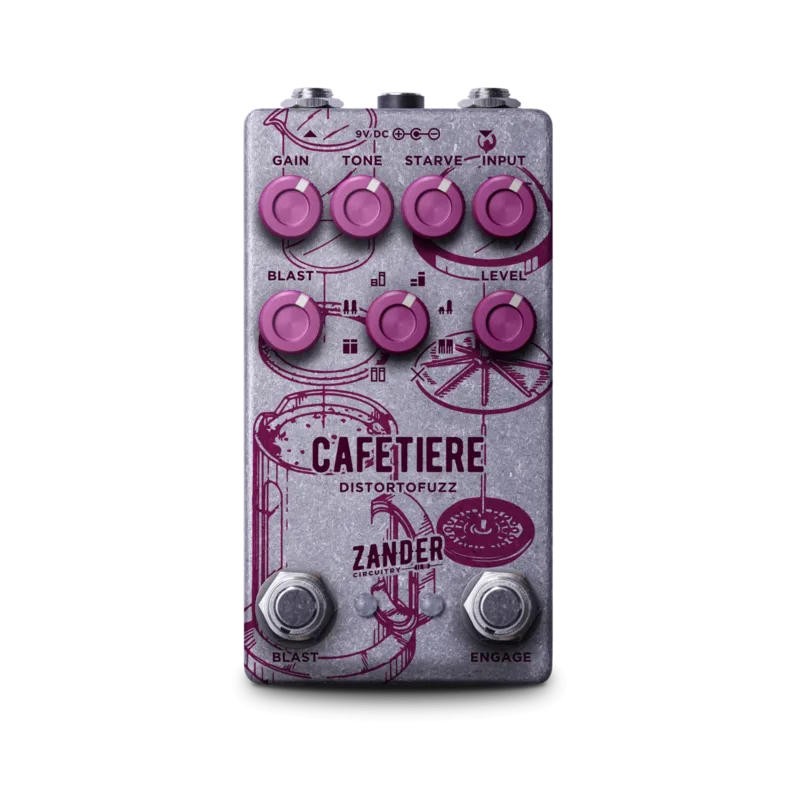


The Zander Circuitry Cafetiere is a distortion and fuzz pedal made in the UK by Zander Circuitry. Zander describes it as a "torn-down, rebuilt and expanded take on the Interfax Harmonic Percolator (HP-1)", a cult 1970s fuzz circuit, and says it will do "everything from a clean treble boost to a spitting/gated 'Jack White' style fuzz and everything in between"12. It sits between categories: as the maker's own page asks, "Is it a distortion? Is it a fuzz?"1.
The pedal first appeared in October 2018 as an evolution of the Harmonic Percolator with a second gain stage and a 6-way clipping selector3, and reached its V4 form, the Cafetiere V4 Distrofuzz, in March 2022 with 8 clipping modes3. The standard model is listed at $200.00 USD1.
The Harmonic Percolator lineage
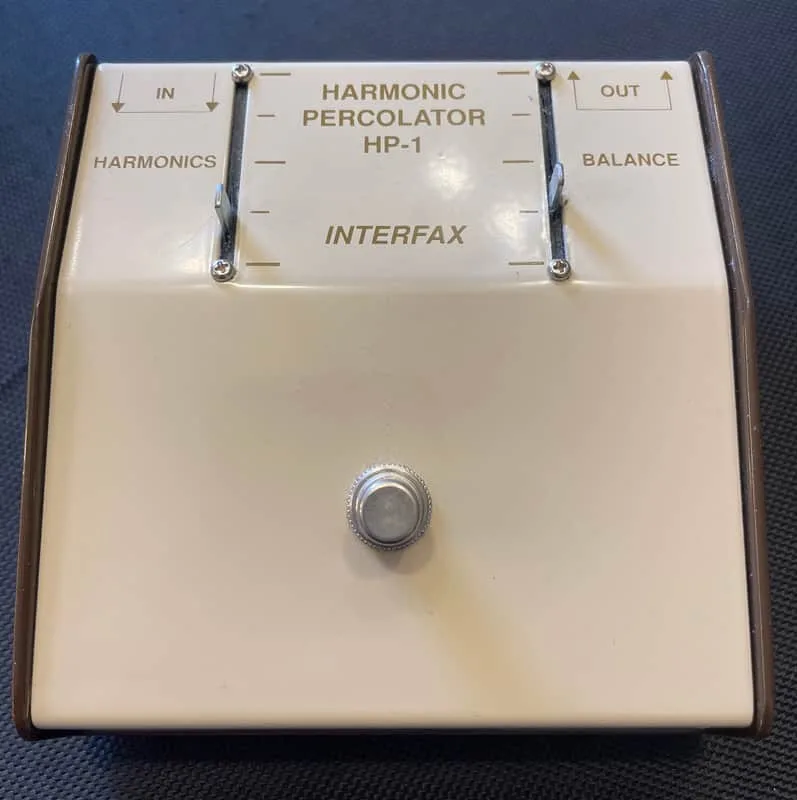
The original Interfax HP-1 Harmonic Percolator is a two-transistor fuzz that pairs a PNP germanium transistor with an NPN silicon one, letting it run in a standard negative-ground configuration5. Gearnews describes it as "a unique circuit using a rare mix of silicon and germanium transistors"6. The original 1970s units used 2N404 germanium and 2N3565 silicon transistors72, and the circuit is known for its "signature even-order harmonics saturation"8. Premier Guitar called it "a simple yet fascinating circuit which readily lends itself to tweaking and improvement"9.
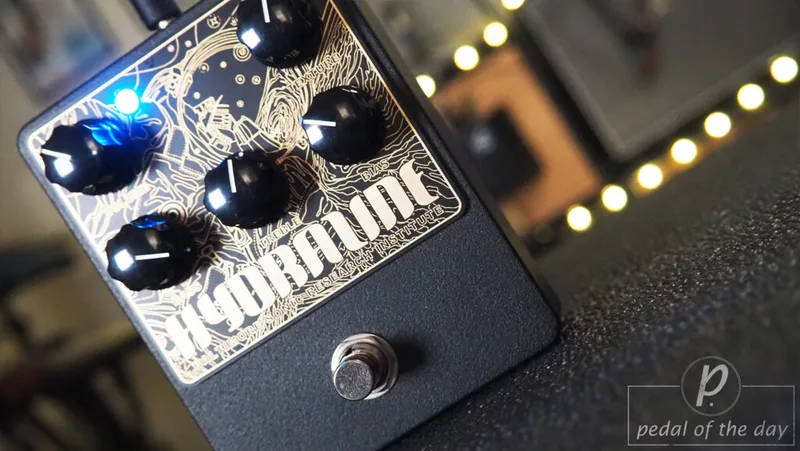
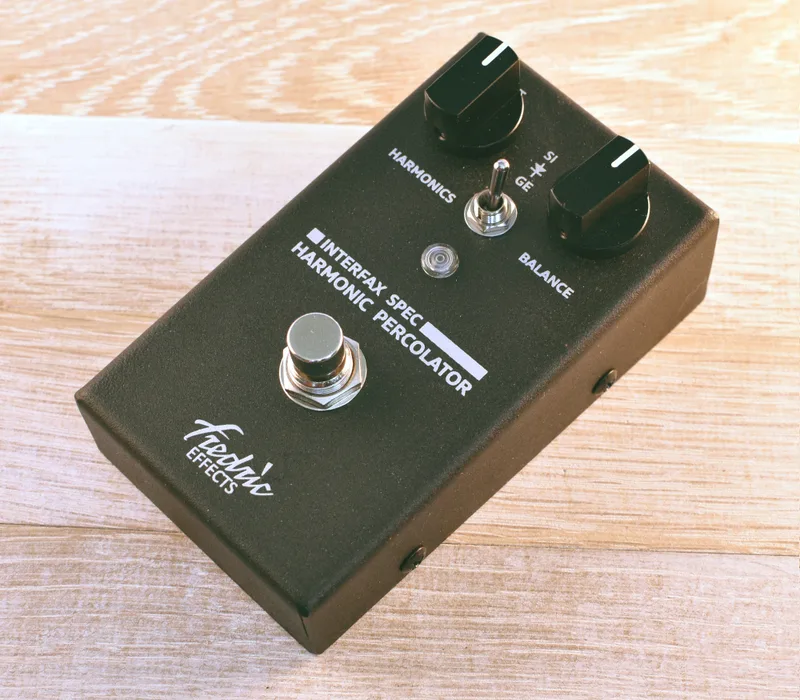
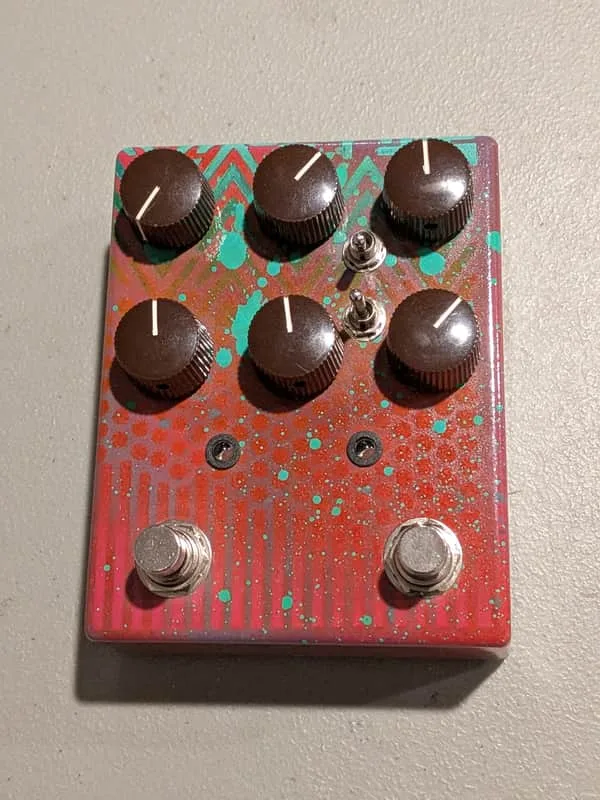
The originals are extremely rare and highly sought-after, with the transistors and some components gooped or obscured to hide the design5. That mystique has produced a steady stream of interpretations: Fredric Effects builds a silicon version of the hybrid circuit10, Pedal of the Day reviewed the BSRI Audio Hydrazine as "a modern interpretation of the Interfax Harmonic Percolator"11, and Cat Box Customs' Bean Machine is another variant of the circuit12.
Zander's take keeps the circuit's character but changes its heart: the rebuild swaps the original's one germanium transistor for a silicon one1. The circuit "has gained a bit of a cult following over the years", as Zander notes, "inspiring a number of clones from smaller builders"1.
The controls
The Cafetiere's five knobs go beyond the usual gain-and-volume setup. Two of them, Input and Starve, shape the circuit in ways most fuzz pedals do not offer1.
| Control | What it does |
|---|---|
| Input | Alters the input capacitance, affecting the low end and overall gain response1 |
| Starve | Drains the circuit of voltage when turned down, choking out the decay of notes and compressing the attack1 |
| Tone | A simple low-pass filter to tame high end1 |
| Gain | Gain control1 |
| Level | Output volume1 |
The Starve control is the inherited Percolator trick: starving a fuzz circuit of voltage makes the sound decay unevenly and compress the attack, which is where gated, spluttering fuzz textures come from. Delicious Audio noted the purple pedal "also sports a Starve knob" when it launched in 201813.
The eight-position clipping selector
An eight-way rotary switch selects the clipping diode configuration, a feature Guitar.com's reviewer noted is "common to most of Zander's current dirt devices", also appearing on the Zander Circuitry Cranium4. Zander describes each option1:
- Germanium: the baseline clipping character
- Asymmetrical germanium: "A more aggressive version of germanium."
- Silicon: "Louder, brighter, and a little bit brittle."
- Transistor/MOSFET: "Similar to silicon, but sweeter and crunchier."
- LED: "Louder again, with less saturation and more punch."
- Asymmetrical LED: "A more aggressive version of LED."
- No diodes: "Loads of output and much less gain."
- Eighth position: completes the 1 to 8 selector range1
The V4 Distrofuzz version carries the same 1-8 rotary clipping diode selector3.
Blast mode and the two footswitches
Two footswitches control the pedal: Engage turns it on and off, and Blast activates Blast mode1. Blast mode "turns the gain all the way up, and activates a second volume control for seamless transitions between low and high-gain sounds"1, so you can set a quiet rhythm sound and a full-gain lead sound and move between them with one press.
The switching is flexible in another way: both momentary and latching operation are available, so holding a footswitch down temporarily engages an effect and releasing it returns you to your previous sound3. Guitar.com's review confirms the latching and momentary switching, and that either channel can be engaged from bypass4.
Versions and editions
The Cafetiere has evolved across versions since 2018. The V4 Distrofuzz, launched in March 2022, brought the clipping selector from the 6 modes of V2 up to 8 modes313. See the Cafetiere V4 Distrofuzz page for that version's details.
Alongside the standard pedal, Zander offers the Custom Shop Cafetiere, a limited run built on the same circuit. It differs in finish and in transistor choice rather than in function14:
- Enclosures: powder-coated in Army Green, Blue, Gloss Black, Matte Black, Gold, Gun Metal Gray, Mid Gray, Pink or Purple, most as one-offs14
- Knob colors: Green, Blue, Purple, Pink, Red, Orange, Yellow, Gray or Black14
- Transistor pairings: Stock, High Gain or Low Gain14
- Price: $200.00 USD1
The Stock pairing is "the same as our standard Cafetiere model (somewhere in the middle)"14. Low Gain is "closer to the gain level of the original Harmonic Percolator circuit which offers a more open and overdriven fuzz sound", while High Gain gives "a heavier and more compressed sound that gets more spitty and gated at higher gain settings"14. For players chasing the original HP-1's feel, the Low Gain pairing is the closest of the three.
What reviewers said
Guitar.com reviewed the Cafetiere in June 2022 at £149 GBP, describing it as a fuzz/distortion pedal made in the UK with true bypass, powered by a nine-volt mains supply only4. Reviewer Richard Purvis's verdict:
"this is a twiddler's delight and an extremely likeable source of rich, thick-grained muck."
The review's control list matches the maker's: gain, tone, starve, input, blast output level, normal output level, the eight-way rotary clipping switch, and the normal and blast footswitches in latching and momentary forms4.
Power and practical notes
The Cafetiere draws 126 mA from a 9V DC center-negative supply1, far more than a typical three-transistor fuzz. It runs on a mains supply only, with no battery option4, so it needs a proper pedalboard power supply rather than a daisy chain shared with low-draw analog pedals.
Videos
Zander Circuitry
Zander Circuitry
Zander Circuitry
Questions
Is the Zander Cafetiere true bypass?
Yes. Guitar.com's review lists true bypass among the pedal's features, alongside latching and momentary switching. The pedal is powered by a nine-volt mains supply only, so there is no battery option.
How much current does the Cafetiere draw?
Zander Circuitry lists the current draw as 126 mA from a 9V DC center-negative supply. That is well above what a typical analog fuzz or overdrive draws, so it is worth planning for on a powered pedalboard.
Is the Cafetiere a germanium pedal?
No. The original Interfax Harmonic Percolator used one germanium and one silicon transistor, but Zander's rebuild swaps the germanium transistor for a silicon one. Germanium character is still available through the asymmetrical germanium clipping option on the eight-way selector.
What is the Interfax Harmonic Percolator?
A rare two-transistor fuzz from the 1970s that paired a PNP germanium transistor with an NPN silicon one in a negative-ground configuration. It is known for even-order harmonic saturation, and its transistors and some components were gooped or obscured in the original units. It has since inspired many clones from smaller builders.
What is the difference between the Custom Shop Cafetiere and the standard Cafetiere?
The Custom Shop version is a limited run in powder-coated enclosures, most of them one-offs, with a choice of knob colour and a choice of three transistor pairings: Stock, which matches the standard model, plus High Gain and Low Gain options. The standard model comes with the Stock pairing only.
Which transistor pairing is closest to the original Harmonic Percolator?
The Custom Shop's Low Gain pairing. Zander describes it as closer to the gain level of the original Harmonic Percolator circuit, giving a more open and overdriven fuzz sound. The original circuit used 2N404 germanium and 2N3565 silicon transistors.
Sources (14)
- Cafetiere, Zander Circuitry, 2024-01-01
- Guitar Pedal X, Guitar Pedal X, 2025-07-21
- New Pedal: Zander Circuitry Cafetiere V4 Distrofuzz, Delicious Audio, 2022-03-25
- Zander Circuitry Cafetiere review: A brilliantly tweakable take on the InterFax Harmonic Percolator, Guitar.com, 2022-06-14
- Particle Vintage Fuzz / Interfax Harmonic Percolator, Aion FX, 2021-02-19
- EHX Percolator: Based on '70s Harmonic Percolator, gearnews.com, 2026-06-17
- Guitar Pedal X, Guitar Pedal X, 2024-05-13
- Vaderin Pedals HP-X Harmonic Percolator, Pedal of the Day, 2021-10-21
- Fredric Effects Releases the Utility Perkolator, Premier Guitar, 2014-09-09
- Silicon Harmonic Percolator, fredric.co.uk
- BSRI Audio + PEDALXCHANGE.com Hydrazine Harmonic Percolator Fuzz, Pedal of the Day, 2026-04-25
- Cat Box Customs Bean Machine V2 Fuzz, Delicious Audio, 2022-10-05
- Zander Circuitry Cafetiere Distortion Fuzz, Delicious Audio, 2018-10-04
- Custom Shop Cafetiere, Zander Circuitry, 2024-11-22