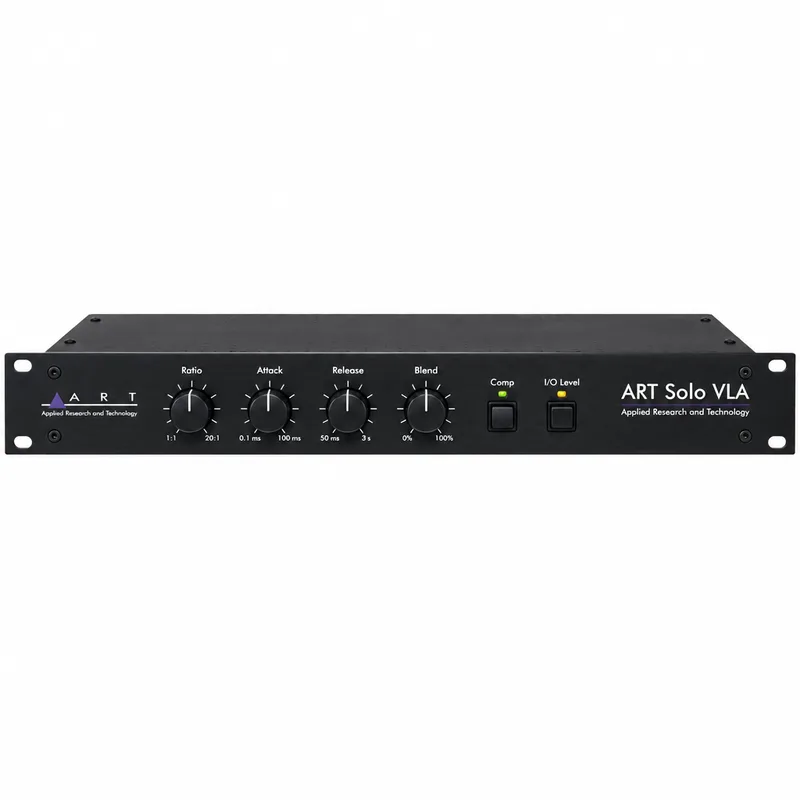


The ART Solo VLA is a single-channel rack compressor from Applied Research and Technology, sold as the "Multivoice Tube / Opto Compressor" and marked as model 1131. Its main application, as the maker describes it, is controlling the dynamic range of an audio signal, whether as a compressor or a limiter, and leveling vocals or instruments in a channel insert or after a preamplifier1. For a guitar or bass player, that means it sits in a rack rather than on a pedalboard, taking a line-level signal and smoothing its peaks.
What sets it apart from most compressor designs is its topology. ART describes it as a soft-knee leveling amplifier by design, with a non-VCA circuit the maker characterizes as producing a "transparent, classic sound"1. A soft-knee curve engages compression gradually as the signal approaches the threshold rather than clamping on at a single point, and the opto and tube elements do the gain reduction instead of a voltage-controlled amplifier. ART says the Solo VLA "was designed to excel in applications where transparent, expressively musical dynamics control is desired"2.
Controls and how it works
The front panel gives you the core compressor controls plus a blend, which mixes the dry and compressed signals2.
| Control | What it does |
|---|---|
| Ratio | Selects the amount of compression applied above the threshold, as an input/output ratio from 1.25:1 to 20:11 |
| Attack | Sets how fast the compressor responds to rising signal levels by reducing gain, shaping the front end of the dynamics envelope1 |
| Release | Sets the recovery time, variable from 150 msec. to 3 sec.1 |
| Blend | Mixes the dry and compressed signals for parallel compression2 |
| Comp switch | Bypasses all compressor controls and passes the input signal straight to the output; works only when the unit is powered on1 |
| I/O Level switch | Rear panel switch selecting +4dBu "professional" or -10dBV "consumer" levels; pressed in selects professional mode2 |
The ratio range of 1.25:1 to 20:1 covers gentle leveling through hard limiting. ART notes that compression ratios of 10:1 and greater are generally considered "limiting"1. Attack is variable from 0.25 msec. to 50 msec., so fast transients can either be caught or allowed through before gain reduction kicks in1. The Blend control is the parallel-compression feature: mixing the dry and compressed signals lets you keep the attack and dynamics of the untouched signal while the compressed path evens out the sustain, a technique borrowed from studio practice2.
The Comp switch deserves a note: because it is an active bypass, it only passes signal when the unit is powered on1.
Connections and levels: +4dBu or -10dBV
The Solo VLA provides both an XLR and a 1/4-inch input jack, both balanced, with the 1/4-inch jack usable with unbalanced signals1. The output is active balanced and available on both 1/4-inch TRS and XLR jacks1. The inputs are designed for line-level signals ranging from -30dBm to +20dBm1, which is worth knowing for guitarists: an instrument-level guitar signal straight out of the pickup is below that range, so the Solo VLA expects to be fed from a preamp, an effects loop or another line-level source rather than directly from a guitar.
The rear-panel I/O Level switch optimizes the unit for either "professional" (+4dBu) or "consumer" (-10dBV) I/O levels, with the switch pressed in selecting professional mode2. This matters for matching the rest of a rig: pro studio and live gear generally runs at +4dBu, while consumer and some instrument gear runs at -10dBV.
| Specification | Value |
|---|---|
| Maximum input level | +25dBu (+4dBu mode) / +16dBV (-10dBV mode)2 |
| Maximum output level | +25dBu2 |
| Output gain | +15dB Line In1 |
| Input impedance | 10K ohms1 |
| Output impedance | 47 ohms into a balanced or unbalanced load1 |
| Frequency response | 20Hz to 80KHz, +0dB/-1dB1 |
| Dynamic range | >100dB (20-20k Hz)1 |
| THD at 0dBm out | <0.02% (typical)1 |
| Equivalent input noise | -99dBu 'A' weighted (+4dBu mode) / -107dBu 'A' weighted (-10dBV mode)1 |
| Maximum attenuation | 30dB1 |
The VU meter reads against the selected output level: 0 VU corresponds to +4dBu (1.228V RMS) with the switch set to +4dBu, and -10dBV (0.316V RMS) when set to -10dBV2.
Power, rack mounting and tube warm-up
The Solo VLA has an internal power supply designed to operate from 100-120V/220-240V~, 50/60Hz at 25W, connected through a fused IEC connector with a removable fuse drawer for replacing the fuse1. There is no battery option and no external pedal-style adapter; it is mains-powered rack gear.
The tube circuitry needs about a minute to warm up and stabilize from a cold power up, and the 12AT7 tube reaches operating temperature within one to three minutes1. Let it settle before judging the compression.
For mounting, ART instructs you to use the supplied rackmount screw kit in a standard 19-inch rack, remove the feet, leave 1U of space above the unit and at least 10 cm (4 in) at the rear for ventilation1. The unit sits in a rack-mountable, all-steel enclosure with a 1U aluminum front plate, designed for continuous professional use1. It measures 1.75 x 19 x 6.0 inches (4.45 x 48.3 x 15.2 cm) and weighs 5.6 lb / 2.5 kg1.
Where it came from
The Solo VLA is marked "Designed by Yorkville Sound, Toronto, Canada" and made in China1. It carries a 3-year parts and labor warranty, which is void if the serial number is altered, defaced or removed, and does not cover misuse, abuse or unauthorized alterations or repairs1. The current owner's manual, version 1v8, is dated August 5, 20252.
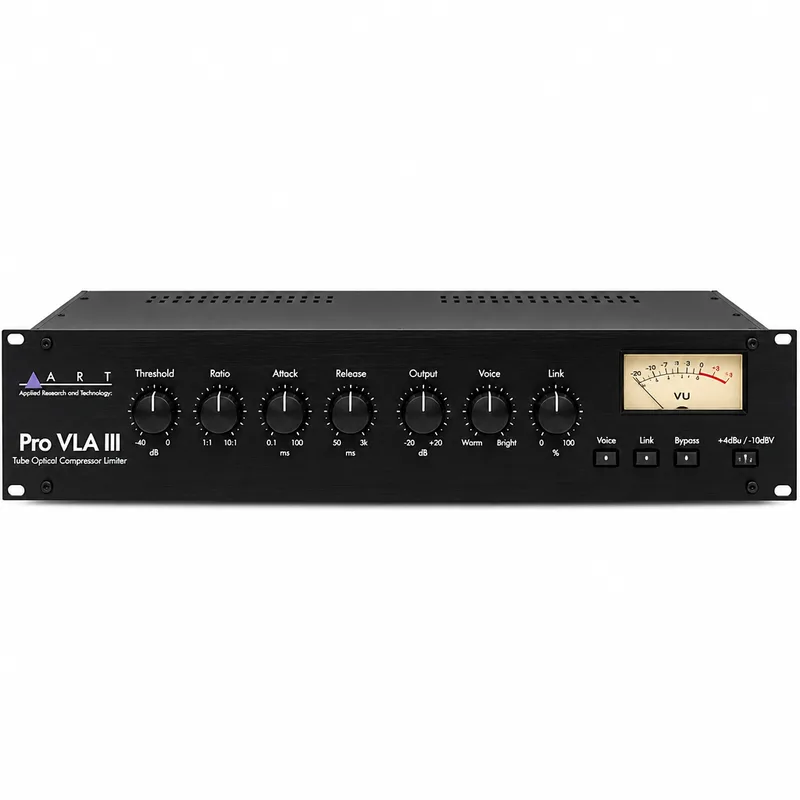
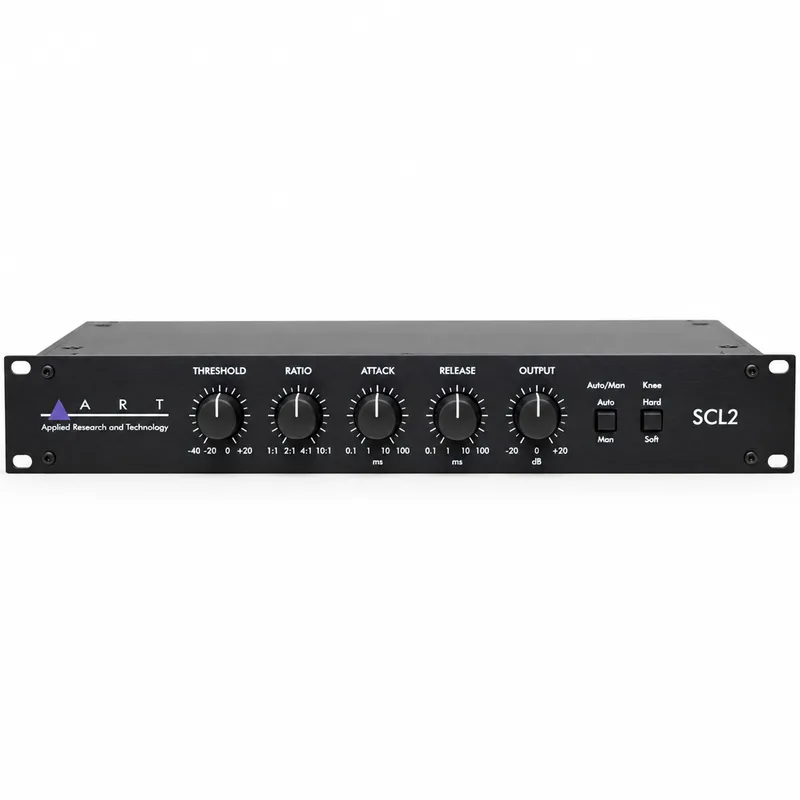
Within ART's compressor line, the Solo VLA is the single-channel member; players comparing rack compressors may also want to look at the ART Pro VLA III, the ART SCL2 and the ART Dual Limiter. For a wider view of the effect itself, see compressor pedals.
Videos
Rich Gear Shop
Inside The Music with Andy Tullis
Rich Gear Shop
Questions
What tube does the ART Solo VLA use?
It uses a single 12AT7 tube in its circuitry. ART says the tube reaches operating temperature within one to three minutes of powering on, and the tube circuitry needs about a minute to warm up and stabilize from a cold power up.
How long does the ART Solo VLA take to warm up?
The tube circuitry needs about a minute to warm up and stabilize from a cold power up, and the 12AT7 tube reaches operating temperature within one to three minutes. Give it that time before judging its sound.
Does the ART Solo VLA have a blend control?
Yes. The Blend control mixes the dry and compressed signals, which lets you run parallel compression and keep some of the untouched dynamics of the original signal alongside the compressed path.
Who designed the ART Solo VLA?
The unit is marked as designed by Yorkville Sound in Toronto, Canada, and made in China. It is sold under the Applied Research and Technology brand as model 113.
Sources (2)
- Manual-Owners-ART-SOLOVLA-00-1v3.pdf, Applied Research and Technology, 2025
- om-ART-SOLOVLA-00-1v8.pdf, Applied Research and Technology, 2025