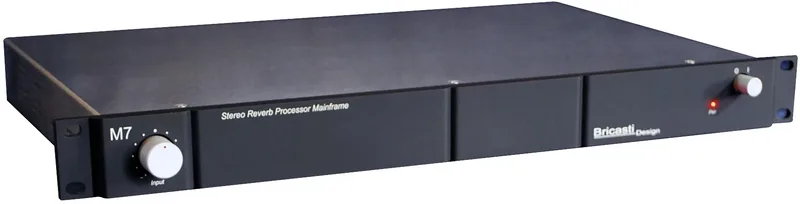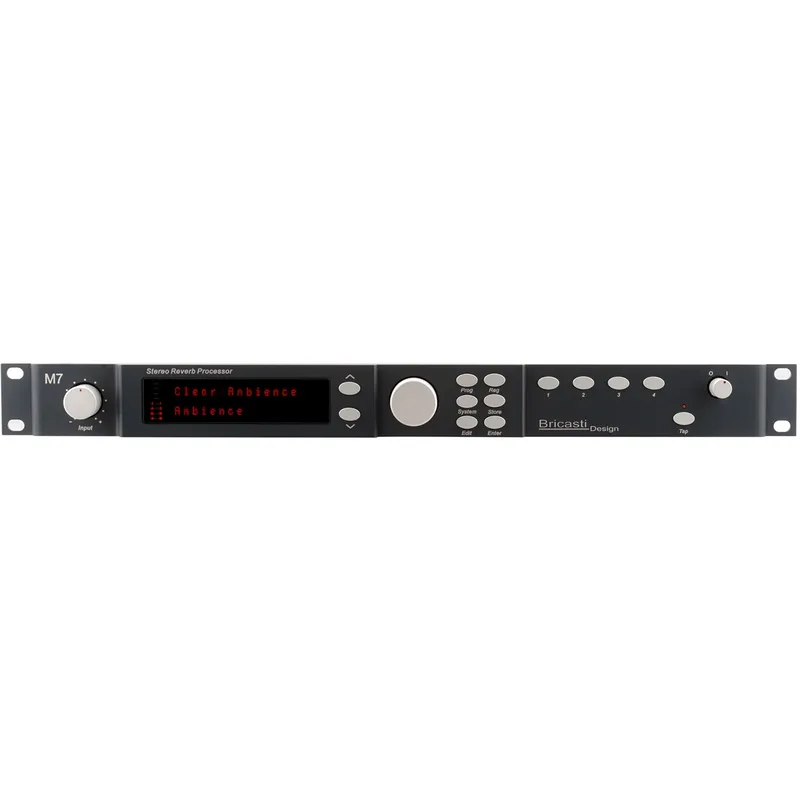

The Bricasti Design Model 7, usually just called the M7, is a rackmount stereo reverb processor dedicated entirely to reverberation1. Released in 2007, it is a 24-bit/192 kHz algorithmic stereo reverb with both analog and digital connectivity, built around six dual-core Analog Devices DSPs, all of which are dedicated to a single stereo signal23. Bricasti describes it as providing "a palette of sounds that encompass the familiar as well as new expressions in the art"1.
For a player used to reverb pedals, the M7 is a different animal: a 1U studio processor with balanced XLR and AES connections, more than 200 presets, and deep parameter control. It is hand crafted in the USA2.
What it is and what it does
The M7 is a real-time synthesized algorithmic reverb processor: rather than convolution, it generates reverb with algorithms running on its DSP array4. Its presets are organized into banks of Halls, Plates, Rooms, Chambers, Ambience and Spaces4. The unit comes with over 200 presets, and you can create and store 100 of your own2. Each bank has a distinct character, as the manual describes:
| Bank | What it emulates |
|---|---|
| Halls | Real concert halls and larger natural acoustical spaces, suited to orchestral music4 |
| Rooms | Rooms and smaller natural spaces, suited to post production and adding space to dialog and solo instruments4 |
| Plates | An analog metal plate reverb, suited to multi-track recording and live performance4 |
| Ambience | Adds space without necessarily adding reverb4 |
| Spaces | Outdoor sounds, non-real sounds, and very large or small acoustical spaces4 |
A third algorithm, Non Linear, is based on the classic AMS RMX 16 Non Linear algorithm. It is a very simple algorithm in which only the Rolloff, Size, Early Select, Early Balance and Early Rolloff parameters are used5. Recording Magazine's reviewer noted that Non-Linear offers four choices of slap-back for snares, drums and toms2.
Controls and parameters
The front panel centers on a 2-line red LED display, a stepped input knob, and a set of keys2. The main editable reverb parameters and their ranges:
| Parameter | Range | What it does |
|---|---|---|
| Reverb Time | 0.1 to 30 sec | Mid-frequency reverb time4 |
| Reverb Size | Small 1 to 24 Large | Apparent size of the late reverberant field4 |
| Pre Delay | 0 to 500 ms | Time between input signal and onset of reverberation4 |
| Diffusion | Low 1 to 9 High | Initial diffusion of the reverb4 |
| Modulation | Off, Low 1 to 9 High | Modulation and pitch variation in the later reverberant field4 |
| Roll Off | 80 Hz to 28 kHz | Low pass filter on the overall reverb output4 |
Front panel keys handle navigation and storage4:
- Enter Key: confirms operations like loading a selected program4
- Store Key: stores an edited program in a register4
- Reg Key: takes you to the user register bank where edited presets are stored and labeled4
- Favorite Keys 1-4: press and hold to store the current running program; press once quickly to recall it4
- Input Level knob: re-settable stepped control in 2 dB steps from +8 dbm to +24 dbu4
- Level Meters: display current input or output level, software selectable4
Registers are labeled using a 14-character location display4. System parameters include analog output level (HIGH +24 dB, MED +16 dB, LOW +8 dB), wet gain from 0 to -60 dB in 1/2 dB steps or Off, and display brightness in five levels4.
Power and connections
Around the back are stereo balanced XLR ins and outs, AES digital I/O on XLR, 5-pin MIDI I/O, and a 9-pin serial port for connection to the M10 remote2. The serial connection is an RS 422 port for the dedicated M10 Remote Console, which provides control data and power for the remote; a loop through connector allows up to 4 M7 mainframes on one remote4.
The analog section is fully differential with its own transformer-based linear power supply, separate from the digital section's supply14. Analog performance figures from the maker's spec sheet3:
- Dynamic range: >116 dB, A-weighted (input and output sections)
- THD+N: <0.001%
- Frequency response: 10 Hz to 20 kHz, within 0.05 dB
- Maximum input and output level: +24 dBu
- Jitter: <20 picoseconds
The M7 uses a three pin IEC connector and detachable power cord, running on 100-240 VAC at 50 to 60 Hz, selectable, with power consumption under 40W4. The AC inlet fuse is a T1A, 1A 250V slow blow for all voltages and frequencies4.
The M7 and M7M can only use analog or digital I/O, not both in parallel2. Pick one path when you wire it up.
MIDI program changes
Early M7 units shipped with MIDI in and out that had no function in V1 and were reserved for future enhancement4. Bricasti's 2008 application note explains how program changes work once the firmware supports them.
To set up MIDI program changes6:
- Check the system page for MIDI channel select; if it is not there, contact Bricasti at info@bricasti.com to have a newer version sent6.
- Set the MIDI channel you want on the system page6.
- Store the programs you want in the desired user registers6.
- Place the M7 in Register mode by manually loading a program from a user register; it is then ready to receive program changes6.
Program changes recall programs from the user registers only, mapped one to one: MIDI program change 0 equals Register Bank 0 program 0, and so on6. The application will not load from the preset programs or the 1-4 keys on the front panel, so any preset you want under MIDI control must first be stored in the corresponding user register6. To turn MIDI control off, manually load a preset program; in PROG mode the M7 ignores MIDI commands6.
The M7M also carries MIDI I/O7. A separate option, the Exponential Audio M7 Control plug-in, requires MIDI cables run to the Bricasti from a MIDI interface2.
Versions: V1, V2 and the M7M
The M7's algorithms come in two flavors. The original Version 1 software offers more than 200 unique reverb presets with 12 parametric program parameters2. The V2 late reverb algorithm takes a different approach to the sound. Bricasti's V2 addendum describes it as "a very different kind of sound, with more coloration, being more effect like than natural sounding, but keeping the kind of clear density found in the original V1 sounds"5. A version 3 of the algorithms was reported to be in development, but still a year out2.
"It is a very different kind of sound, with more coloration, being more effect like than natural sounding, but keeping the kind of clear density found in the original V1 sounds."
The M7M Mainframe is an exact duplicate of the M7 Stereo Reverb Processor with reduced front panel controls, intended to be used in conjunction with the M10 Remote Console8. The M7M's front panel carries only the stepped input knob and power switch2. It is available bundled with the M10 in several configurations, with one or more M7Ms, and as a stand alone product for customers adding more channels of Bricasti processing to an M10-based setup without duplicating interface controls8. In 2016 the M7M listed at $3200 against the M7's $36952.
What reviewers said
Recording Magazine's Paul Vnuk Jr., reviewing the Bricasti system in September 2016, noted that the M7 "dedicates six dual-core Blackfins to one stereo signal" and that since 2007 it "has ascended to the rarefied heights of world-class reverbs"2. He also reported that Bricasti was working on version 3 of the algorithms at the time, still a year out2.
Engineer and producer Chris Spilfogel, in a 2008 Bricasti press release describing his use of the Model 7 on pop, R&B and film soundtrack mixes, said:
"I like the fact that the M7 is a true stereo, reverb with stereo in and stereo out."
The press release from that period listed more than 100 reverb presets with 15 parametric program parameters and 50 user registers9; the current product page lists more than 200 unique presets, 12 parametric program parameters and 100 user registers104, reflecting how the product grew with the V2 release.
Build and reliability
The chassis is stainless steel with an anodized aluminum front panel, knobs and buttons410. Recording Magazine described the chassis as thick black aluminum with textured matte silver knobs2. The manual calls it a rugged device with extensive electrical protection4, and recommends a minimum of half a rack space above and below plus ventilated rack fillers, making the installation a minimum 2U4. Warranty is 1 year parts and labor4.
Videos
RealHomeRecording.com
Questions
Is the Bricasti M7 a true stereo reverb?
Yes. The M7 maintains a true stereo path through its reverb processing, with stereo in and stereo out. Engineer Chris Spilfogel, in a Bricasti press release, singled out exactly that: the M7 is a true stereo reverb with stereo in and stereo out. Input routing is set from the front panel, including a stereo option that keeps the two channels separate through the processing.
Can the Bricasti M7 be controlled by MIDI?
Yes, with conditions. Units that have MIDI channel select in the system menu can receive MIDI program changes on a chosen channel. Program changes recall programs from the user registers only, mapped one to one, so a preset you want recalled has to be stored in the corresponding register first. Units without the MIDI channel select item can have a newer version sent by contacting Bricasti.
How many rack spaces does the Bricasti M7 take?
The M7 is a 1U high product, 19 inches wide by 1.75 inches tall by 11 inches deep, weighing 9 lbs. Bricasti recommends allowing a minimum of half a rack space above and below it and using ventilated rack fillers, which makes the installation a minimum of 2U in practice.
What is the difference between the Bricasti M7 and M7M?
The M7M Mainframe is an exact duplicate of the M7 Stereo Reverb Processor with reduced front panel controls, intended to be used with the M10 Remote Console. Its front panel carries only a stepped input knob and a power switch. It is sold bundled with the M10 in several configurations and as a stand alone product for adding more channels of Bricasti processing.
What sample rates does the Bricasti M7 support?
The digital I/O is AES/EBU 24 bit single wire, self-clocking to incoming sample rates from 44.1k to 192k. The supported rates are 44.1 kHz, 48 kHz, 88 kHz, 96 kHz and 192 kHz. Digital frequency response is DC to 24 kHz at 48 kHz and DC to 96 kHz at 192 kHz.
Can the Bricasti Model 7 use analog and digital inputs at the same time?
No. The M7 and M7M can only use analog or digital I/O, not both in parallel. You choose one path: the balanced XLR analog connections, with 24-bit conversion at each end, or the AES digital I/O on XLR.
Sources (10)
- Bricasti Design, Bricasti Design
- BricastiDesign_rec_0916.pdf, Recording Magazine, 2016-09
- Bricasti Design, Bricasti Design
- Owner’s Manual, Bricasti Design, 2019
- M7 V2 manual, bricasti.com, 2010-07-23
- M7 Midi App Note, bricasti.com, 2008-05-07
- Bricasti Design, Bricasti Design
- Bricasti Design, Bricasti Design
- BricastiDesign11_Model7_for_Chris_Spilfogel.doc, Bricasti Design, 2008-12-01
- Bricasti Design, Bricasti Design