News
6 Blues-Approved Effects Pedals
Sultry melodies and steeped in lyrical emotion, it is no surprise why blues music has had such a significant and lasting impact on the music of the UK, the United States, and beyond. It is capable of invoking a variety of emotions, from joy to triumph to anguish to plain old sadness. The instrumentation of blues music is as diverse as its lyrical content, its influence is immensely widespread, and the genre lives on in chart-topping contemporary music styles. Similar to most genres, blues has evolved throughout the years and adapted to players’ changing needs. It is regarded as the “rawest American art form,” making it challenging to find technology the fits its primal origins. Blues guitarists often use pedals that are free of delay or modulation. They prefer saturation, gain, or occasional filtering. The aim is to make the guitar sound more vocal, yield the purest sound possible, and complement the player, amp, and guitar itself. This article looks into a handful of stompboxes that play a significant part in shaping the sound of the blues. From units that emulate the fabulous tones of yesteryear to the original tools utilized to convey blues playing into the stratosphere, here are some of the modern blues staples.
Overdrive
An excellent, low-gain overdrive may be the most apparent option for blues aficionados. Nothing beats the legendary Ibanez Tube Screamers, which Stevie Ray Vaughan utilized to craft his signature tone. This classic green beast is a modern pedalboard staple. Original TS808 Tube Screamers carries a hefty price tag on the collector’s market. Fortunately, individuals can now snag this icon at a reasonable price. The Ibanez TS808 Tube Screamer reissue lets users capture the same raved-about tones without breaking the bank. It features chip and analog circuitry identical to the original.
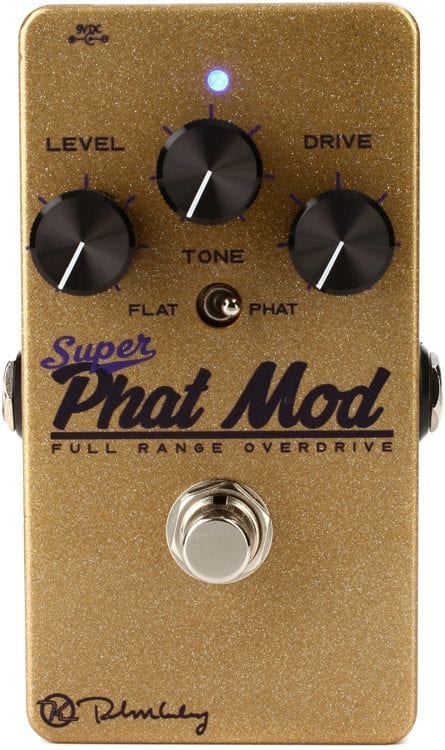
However, achieving SRV’s tone is not the sole reason to add an OD to a pedalboard. For those who cannot quite get their amp cooking to its sweet spot, a low-gain drive is a key to tonal nirvana. The Keeley Super Phat Mod stompbox breaks up sweetly like a tube amp. It is more responsive and dynamic than ever, thanks to its revamped JFET gain circuit. The core tone stays intact as the user set the breakup amount using their volume control and pick attack. Phat and Flat modes provide two low-end response choices. The Super Phat Mod Full Range Overdrive features a tube-esque response that does not color tone. The BD-2W Blues Driver from Boss’ Waza Craft line boasts incredible tube amp overdrive with two different voices. Way more than a merely customized BD-2, Boss redesigned the BD-2W entirely, leveraging top-grade discrete analog components and incorporating a modified signal path accessible with a flip of the mini-toggle. The custom mode adds a healthy dose of sustain and beefs up the low end, while Standard gives the smoky and gritty Blues Driver tone.
Wah
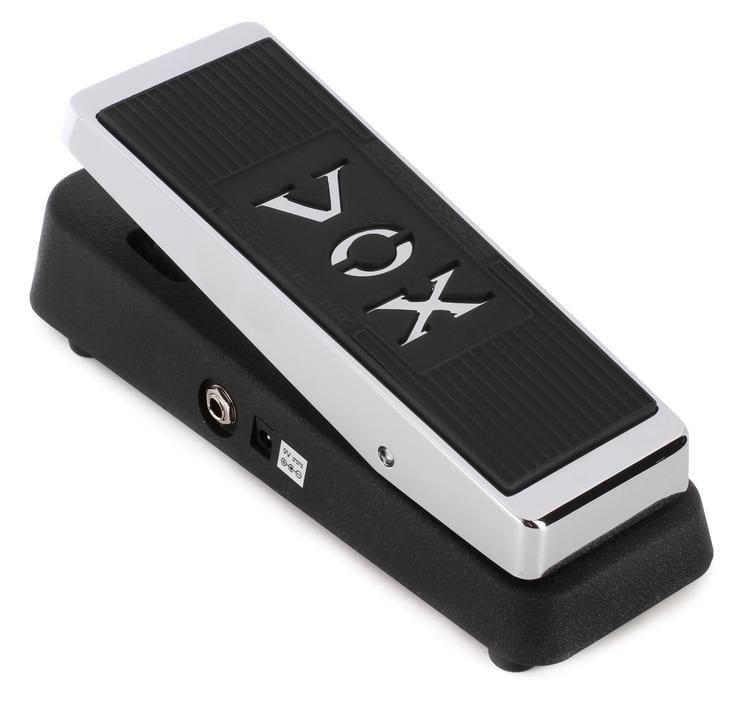
As soon as Eric Clapton stepped on his Vox wah for the Tales of Brave Ulysses by Cream, guitar immediately had a new language. Now, a wah pedal is present on the boards of many blues players. Blues icons Joe Bonamassa and Buddy Guy even have their signature Cry Baby.
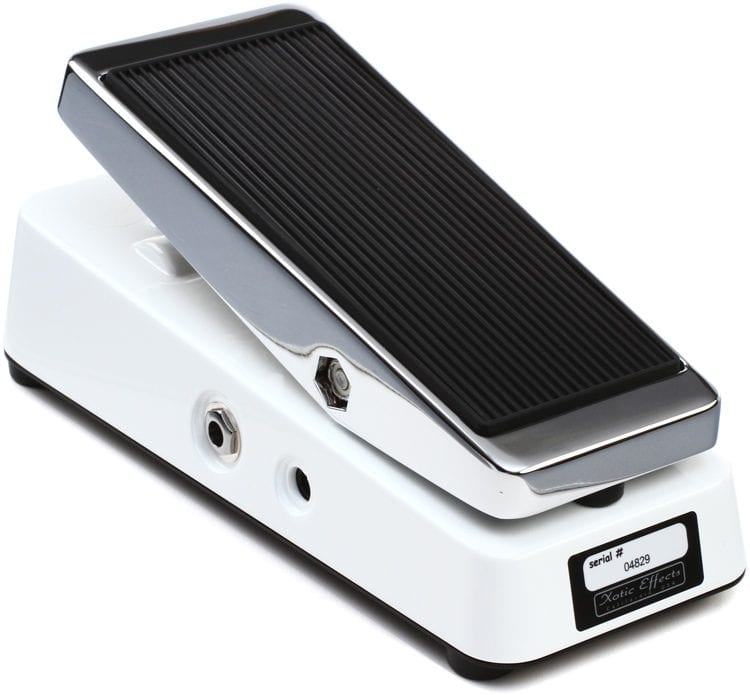
The ultra-versatile Xotic Wah effects pedal’s circuit is closely based on the famed Italian-made Clyde McCoy wahs from the 1960s. Onboard controls for resonance, bias, Q, and frequency range enable dialing in any wah shade. The Xotic Wah also features a true bypass to work perfectly with fuzz pedals and avoid coloring the tone. The pedal is already beautiful-sounding in its factory setting, but added controls help users capture their signature sound. The custom-modified Joe Bonamassa Signature Cry Baby boasts some unusual circuitry tweaks. It has a modified vintage circuit featuring a tremendous vocal sweep range. An output buffer prevents impedance mismatch when using vintage stompboxes, while a vintage-esque Halo inductor gives more harmonic content to the signal. The Joe Bonamassa Signature Cry Baby is among the most expressive wahs ever, with vintage appointments and customized circuitry. It comes in a classy, lightweight aluminum chassis sporting a gloss black finish and shiny copper treadle. Improving on the V847’s brilliant design, Vox’s V847-A wah pedal boasts increased functionality and dynamics courtesy of some design changes. Per Vox, the V847-A “offers guitarists the same legendary tone with the addition of AC power capability and a buffered input jack for preserving the unprocessed guitar tone when the pedal is not engaged. The pedal’s inductor has undergone a redesign to be closer in specification to the original VOX wah inductors, for improved dynamics and tone. These additions will benefit players of all genres who use a wah pedal as an integral part of their sound.”
Rotary effect
Fuzz, amp overdrive, and flanging are only some of the effects that originated when players utilized their gear improperly. Another common effect that follows that lineage started when young Buddy Guy connected his guitar to an organist’s Leslie rotating speaker and then sliced the blues staple Hoodoo Man Blues for Junior Wells. Since then, the watery, proto-psychedelic sound has been as synonymous with electric guitar as it is with its real application. However, guitarists usually hate bringing bulky rotating cabinets, causing several pedal creators to build units that emulate the sound. Numerous guitar heroes have embraced the rotary speaker sound in the studio and onstage. The RT-20 Rotary Sound Processor is part of Boss’ Twin Pedal series. Leveraging COSM modeling technology, the RT-20 faithfully simulates classic rotary-speaker sounds. It provides tweakable Horn and Bass seed, Overdrive, Rise Time, and more. The RT-20 can be utilized to craft pulsating effects and distinctive overdrive. This awesome-sounding pedal gives a graphical view of the virtual rotors on its inbuilt display.
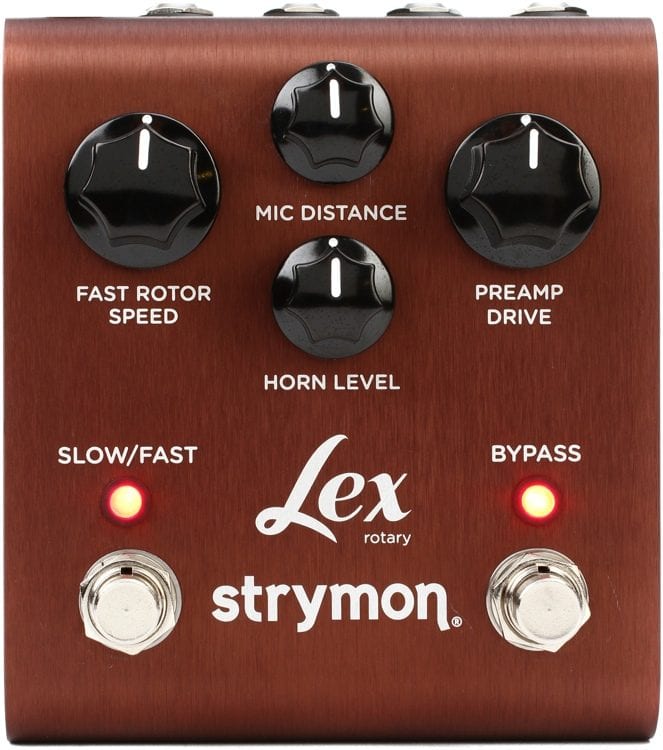
Keyboardists and guitarists know that a Leslie rotary speaker delivers unrivaled smooth, swirling stereo chorus. Electro-Harmonix wanted to reproduce that iconic Leslie sound in pedal form, introducing the Lester K stompbox. The pedal has two adjustable speeds controllable using a footswitch to transition between slow and fast textures conveniently. It also carries a Drive knob that gives B-3 guts and grit to the sound, while the Balance control helps smooth out the tone. A stage-ready metal enclosure and true stereo ins/outs make the Lester K an ideal choice for keyboardists wishing to add ear-to-ear effects to recordings and stereo textures to live work. The Strymon Lex Rotary packs the enchanting sound of a rotating Leslie speaker into a pedalboard-friendly stompbox. It lets users enjoy a high-quality tone without needing to carry a rotary speaker cab. Two independently selectable speeds are foot-switchable, while the four-knob interface, extensive I/O, and deep-editing secondary features enable setting the pedal’s sound to taste. The Strymon Lex Rotary is a way easier means to capture those classic swirling sounds.
Fuzz
Utilizing a singing and spitting fuzz stompbox is typical for the blues, but modern players are taking the sonic devastation given by an abundance of fuzz pedals to bluesier heights. The likes of Doyle Bramhall II, Gary Clark Jr., as well as Jack White are demonstrating what can happen when one places the vocabulary of Muddy Waters, John Lee Hooker, and Albert King through gated nastiness. The Hoof V2 fuzz pedal from EarthQuaker Devices soaks a guitar tone in a beautifully dirty natural fuzz, credits to its hybrid of silicon and germanium transistors. It merges the best of a fuzz effect and overdriven amp by dishing out a nice amount of smooth, harmonically-lush sustain, together with its unique, vintage-esque fuzz. Shift and Tone knobs offer a massive helping of tone-sculpting options, serving up anything from classic scooped to contemporary boosted mids. Equipped with a true bypass for pure tone, the Hoof V2 adds a classic fuzz character to the tone.

Ever since its introduction in the 1960s, the iconic Fuzz Face has been stepped on by the likes of David Gilmour, Jimi Hendrix, and blues guitarists Joe Bonamassa and Philip Sayce. The pedal is legendary for its thick, warm tones. Dunlop’s JDF2 Fuzz Face is a reissue built to the exact specs of an authentic Dallas Arbiter Fuzz Face. Solidly constructed to vintage specs and the classic germanium PNP transistor design, this Fuzz Face was utilized by Hendrix and other prominent rockers of the 1960s and 1970s. It carries Fuzz and Volume controls for capturing the ideal sound. It is the perfect choice for those who are big on the beautiful guitar tones of yesteryear. The Way Huge Swollen Pickle MkIIS squeezes all the features and fuzz of the MkII model into a pedalboard-friendlier package. It covers an extensive range of tonal territory from laser-y shoegaze to classic rock crunch to complete sputtery destruction. The Filter control allows users to reign in the treble content from fizzy and bright to woolly and dark, while the Sustain knob enables adjustment for different playing styles and pickup outputs. The Swollen Pickle MkIIS also carries Crunch and Scoop dials for setting midrange and compression characteristics.
Amp-in-a-box
Many blues players have injected harder rock ‘n’ roll sounds into their tone. They often achieve that sound through cranked tube amps. Dropping an amp-in-a-box-esque distortion or overdrive onto a board delivers the cranked blues tones of the Allman Brothers, Gary Moore, and Billy Gibbons at band-friendly volumes.
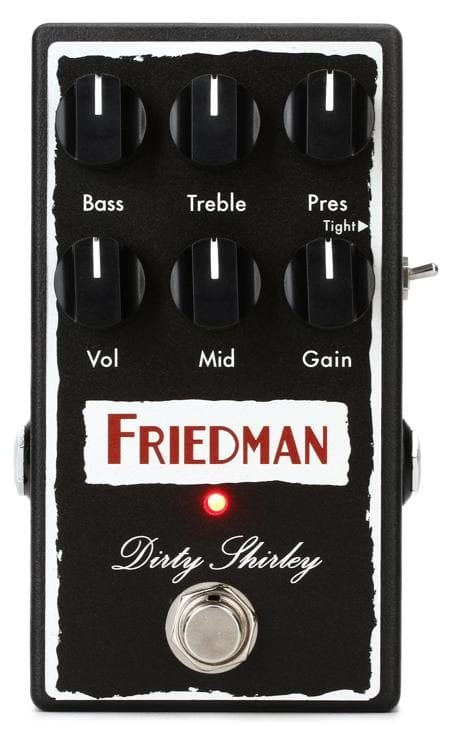
The Friedman Dirty Shirley overdrive stompbox packs all the British-esque grit, tonal flexibility, and supple touch sensitivity of its namesake all-tube amp head into a pedalboard-friendly chassis. It serves up the same sweetened tone regardless of what amp the user runs it through, props to six dials mirroring the amp’s controls. The Dirty Shirley also carries a Tight switch to rule in the amp’s low end when being driven. Xotic’s little SL Drive amp-in-a-box pedal loads a cranked British stack’s soul into any amp. Configured to sound like a late 60s Super Lead, the SL Drive provides the same singing and cutting tone, and it responds to playing and volume changes just as well as those iconic amps. It also features internal voicing dip switches for adjusting the pedal’s character as well as true bypass switching for keeping the tone pure. The SuperBolt V2 by JHS emulates the sound of the combo amps heard on epic recordings by Brian Setzer and Jimmy Page, among others. It offers the power amp sag and touch sensitivity that made the original amps enjoyable. The SuperBolt V2 becomes mean and nasty when cranked up. At lower settings, it dishes out a milder, darker tone. This revamped version boasts a better taper on the volume control for a broader sweet spot. For those who are seeking an amazingly dynamic, sensitive stompbox that shines at anything from barking overdrive to fat jazzy woodiness, the Catalinbread Formula No. 55 is a great option. It is capable of serving as a reliable source for Tweed Deluxe tone stack circuitry in a portable design. This JFET-driven stompbox is flexible enough for any music genre and playing style, and it is created to unleash the best of any pedal stacked with it—pretty much like an exceptional Tweed Deluxe amp. The Formula No. 55 consists of helpful Volume, Master, Tone, and Presence knobs as well as a Hi/Lo button.
Tuner
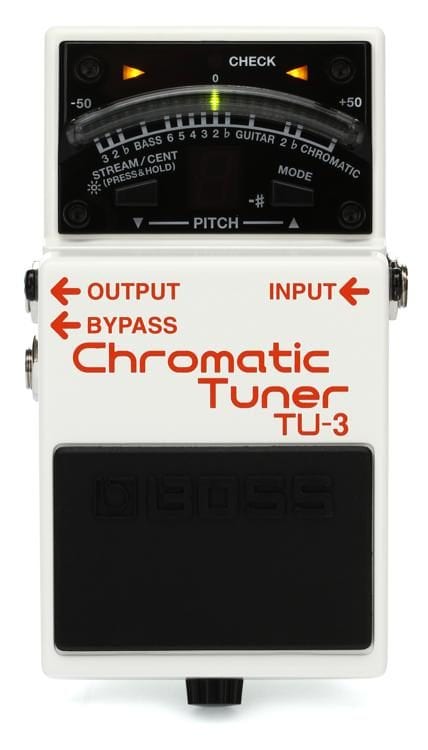
Ultimately, a tuner is a must-have for all guitarists to guarantee that all strings are set to the correct pitch. More than merely a rock-solid tuner, the Boss TU-3 Chromatic Tuner is practically a contemporary legend. It is ruggedly constructed to work stomp after stomp and night after night. Moreover, the TU-3 Chromatic Tuner comes with a high-brightness mode so it can work day after day as well. Korg’s Pitchblack Mini boasts the same incredibly fast and dead-on tuning of the original Pitchblack tuners but in a pedalboard-friendlier size that sits nicely even on a crowded rig. The easily readable display is configurable into three different display modes—Strobe, Hybrid Strobe, and Standard. The Pitchblack Mini also includes true bypass and inbuilt stabilizers to keep the stompbox from tipping. Lightning-fast, more intuitive, and more dependable than ever, the TC Electronic PolyTune 3 boasts precision within 0.1 cents and a no-frills approach to guitar and instrument tuning. Credits to an inbuilt BonaFide Buffer circuitry, the PolyTune 3 is capable of enhancing the tone for lengthy cable runs. “Whether you’re a mega-super rock star, a seasoned pro or a passionate bedroom shredder, PolyTune 3 gets you in tune quickly and accurately,” TC Electronic exclaims.