News
Guitar Pedals 101: A Quick and Dirty Guide to Delay Pedals
When you’re just getting into guitar effects pedals (or, sometimes, even when you’re already an old hand), the sheer number of different effects types can drown you in a sea of confusion. Our Guitar Pedals 101 series is here to help you navigate through the storm and reach your own personal pedal nirvana. Today we’re looking at a very versatile tool for adding layers of complexity to your sound: the delay pedal. What do Fall of Troy’s “F.C.P.R.E.M.I.X.”, Flock of Seagulls’s “I Run to You,” and a very large—almost disproportionate, really—number of songs in U2’s entire catalog have in common? They all use a delay guitar effect to great, well, effect. The concept behind the delay effect is very simple: take a note then play it back exactly as it sounds, albeit at a slightly later time, usually in milliseconds. It’s very similar to an echo, but the reverberations aren’t affected by surface or atmospheric characteristics; the delayed sound is exactly the same as the original sound. Musicians typically use delay pedals to create everything from fast and subtle “slapback” echoes to cascading washes of highly atmospheric sound. On a more technical level, the tie-based delay effect is also the main building block for modulation-type guitar effects such as the chorus, flanger, and phaser effects. You can even stretch out the definition a bit to encompass modern looper pedals.
History of the Delay Pedal
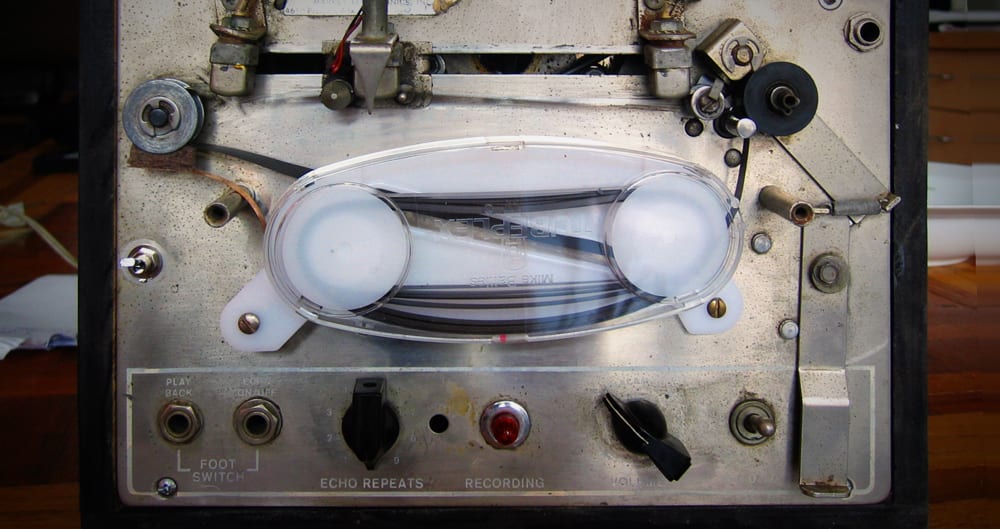
Although artificial delay effects have been used in sound recordings since the ‘20s, when it comes to guitar delays, the first stop in our history lesson is in the 1950s. Back then, tape delay units were considered top of the line in delay technology. Sound engineers cobbled together tape delay units that featured two tape heads: a recording head and a playback head. The original guitar sound would first be recorded by the recording head and then played back milliseconds later by the playback head. The length of the delay was dependent on the distance between these two heads. Early tape delay units were technically portable in the sense that one could transport them to another site, but they were still too large and unwieldy to use onstage during live performances. Thanks to the efforts of people like Charlie Watkins, who invented the Copicat, and Ray Butts, the man responsible for the EchoSonic tape delay-enabled amp, the tape delay effect became increasingly portable. Later innovations upped the number of repetitions, introduced tape speed controls, and even the ability to change the delay speed on the fly. The invention of the Binson Echorec, which used a magnetic disk instead of magnetic tape, was another hallmark in the development of delay effects. The next big step in the evolution of the delay effect happened in the 1970s, when F. Sangster and K. Teer of the Philips Research Labs invented the Bucket-Brigade Device (BBD). While BBDs are usually considered part of the analog approach to delay effects, it’s actually more of a hybrid of both analog and digital. It works by splitting the original signal into two; one would go directly to the output while the other would pass through the BBD. The signal that passes through the BBD is then slightly delayed before being mixed back with the first signal, thus creating the delay effect. The invention of the BBD led directly to a spike in the number of consumer-level compact delay pedals available on the market. Among these early delay pedals was the venerable Memory Man from Electro-Harmonix. These pedals had a few shortcomings, though. They often suffered from high frequency loss caused by the low-pass filtering used to remove clock noise. They also had delay times that were limited to around 300ms. The advent of digital delay technology in rectified these issues, but the first digital delay units were quite expensive and were initially available only as rack-mounted units. It wasn’t until 1984 when Boss released the world’s first compact digital delay pedal, the Boss DD-2. The DD-2 was a big step up from early solid-state delay pedals in terms of features. Not only did it sound much clearer, but it was capable of up to 800ms delay time. Later digital delay pedals took things even further by bringing the delay time to up to 16 seconds long.
Common Types of Delay Effects
**Tape Echo** - This type is basically a recreation of the granddaddy of delay effects. Modern delay pedals typically add some slight warping to the delayed sound to more closely emulate the pure analog nature of the classic tape echo-style delay unit. **Slapback** - Slapback delay is a super fast and super short delay that consists of a single repeat. It adds a sense of space and dimensionality to your sound and is very popular with country and rockabilly musicians. Settings-wise, a slapback delay usually have a delay time within the 40ms to 120ms range and the mix knob set to noon. You can also create a faux reverb effect by increasing the delay time to around 100ms to 200ms and the feedback to around five repeats. **Doubling** - Doubling is similar to a slapback delay in that both are super fast delays with minimal repeats. The delay time for a doubling effect usually falls within the 50ms and 100ms range. This results in the illusion of your guitar signal being doubled instead of the more distinct echo effect that longer delay times can cause. Set the signal mix to max for maximum effect. If you make the delay time shorter, say around 20ms to 50ms, you can create a pseudo-chorus effect. **Looping** - Think of looping as a delay effect pushed to its logical extremes. A delay pedal with a looping function lets you record short phrases and play them back ad infinitum so you can play over them. It may take a little practice, but with the correct timing, these work particularly well for creating harmonically complex guitar parts even when you’re the only one onstage with a six-string.Parameters to Play With
While a lot of delay pedals are intuitive, easy to use affairs with only three to four control pots, some of the high-end monsters can be hard to come to grips with even if you’re an experienced stompbox user. Here are a few of the most common parameters that let you control the delay effect to suit your taste. Time / Delay Time - As its name suggests, this parameter controls how long the pedal “waits” before it plays your original signal again. This is one of the two most important parameters in delay pedals, as it lets you create everything from the super fast “slapback” echoes made popular by rockabilly groups and old Sun Records releases to the super precise dotted eighth approach like what The Edge does in U2’s “Where the Streets Have No Name.” Feedback / Repeats - This parameter controls how many times the delayed signal is fed back into the signal chain and played again and again… and again (or more, depending on what you set it to). Setting the feedback parameter to the minimum will result in one repetition, while the upper limit generally differs from pedal to pedal. Turning it up will help you create more lush ambient sounds, but don’t go overboard if you want your audience to hear the rest of your band clearly. Mix / Blend / Effect Level - This parameter controls the volume ratio of the original “dry” signal and the delayed “wet” signal. You can usually make even the most feedback-heavy delay effect more subtle simply by dialing back on the Mix knob. Crank it back up to equal volume settings when you’re in the mood for some sonic chaos.
Analog or Digital?
There’s one big question that every musician must ask themselves when shopping around for a delay pedal: Should I go analog or digital? Analog delay pedals generally use a BBD chip to create the delay effect. As with the old solid-state analog delay pedals we mentioned before, this approach comes with its own limitations, most notably the shorter delay times. Analog delays do have their own unique charm, though. They tend to lean towards the warmer and darker side of the sonic spectrum, plus the inherent shortcomings of the analog approach make them sound more organic, natural, and nuanced. And then there’s the “authentically vintage” street cred, of course. Digital delays, meanwhile, offer not only longer delay times, but a much wider range of flexibility as well. Modern digital delay pedals are now also able to closely emulate the sound of old analog units, including tape echo delays from the ‘50s. Some analog purists, however, might not appreciate how digital delays convert their analog signal to digital and then back to analog. Fortunately, neither side has been left wanting in terms of currently available options. Whether you’re living the full starving artist lifestyle or you’ve got way too much money to burn, you can easily find a delay pedal, analog or digital, that fits your needs and price range nowadays. See below for a quick look at some of our recommendations.Recommended Delay Pedals
MXR M169 Carbon Copy
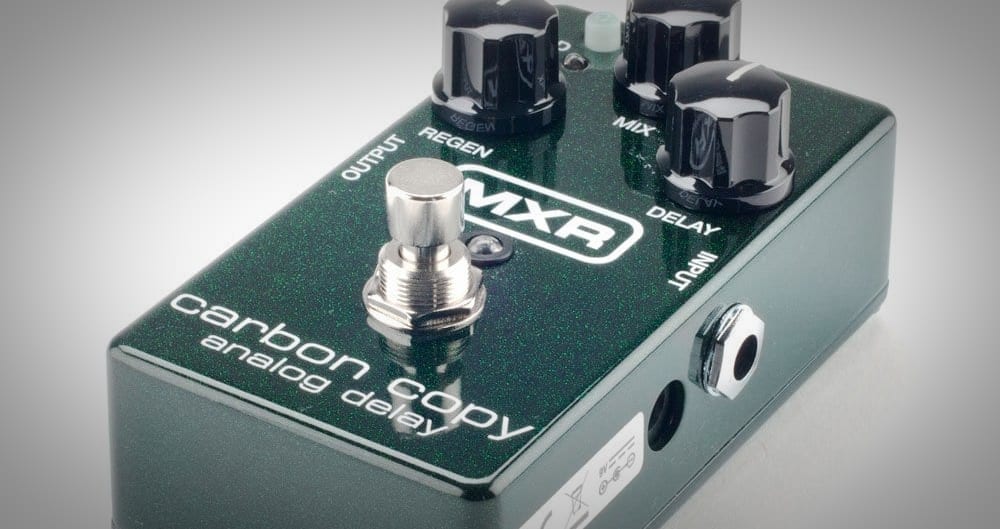
The all-analog Carbon Copy delay guitar effects pedal from MXR is, without a doubt, one of the best delay pedals you can get within its price range. This BBD-powered stomp features up to 600ms of delay time and comes with a top-mounted modulation switch for creating even more lush delay effects. The three-knob Delay, Mix, and Regen control scheme gives you a lot of room for playing around with the delay effect, plus it has internal trim pots for adjusting the width and rate. The Carbon Copy can easily serve up everything from crisp slapback echoes to long, epic delays. MXR has also made a larger version called the Carbon Copy Deluxe, which features double the maximum delay time, tap tempo, tap division, and dedicated controls for the modulation effect.
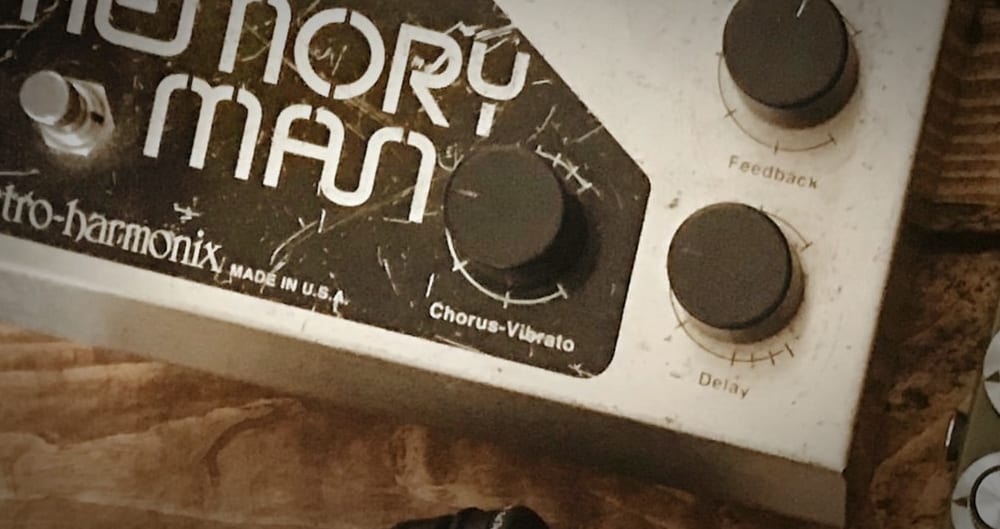
Electro-Harmonix Deluxe Memory Man
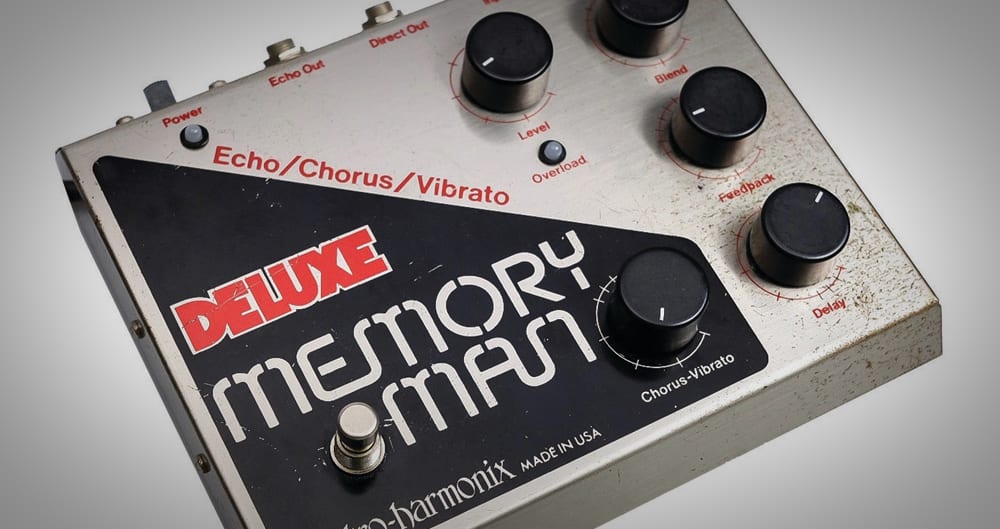
It can be argued that U2’s whole legacy is built on the back of the Deluxe Memory Man. With a pedigree that reaches all the way back to the introduction of solid-state compact analog delay pedals, this delay stomp from Electro-Harmonix is a true modern classic. It’s way bigger than the average compact pedal, but Electro-Harmonix has made good use of the Deluxe Memory Man’s size. It features a six-knob control layout that lets you harness is full potential in unlocking new sonic dimensions, plus it has a built in chorus and vibrato effects. The maximum delay time of 550ms is nothing to scoff at, either. While it’s not exactly an entry-level analog delay pedal, you simply can’t go wrong with a stomp that’s been churning out highly organic, hypnotic delays for over four decades.
Boss DM-2W Waza Craft
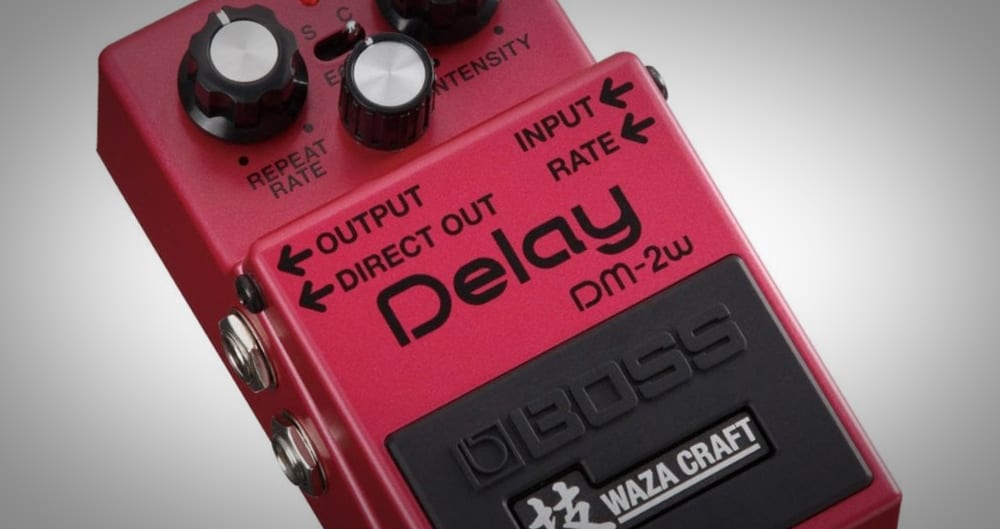
The Boss DM-2W Waza Craft has a deep pedigree comparable to the Deluxe Memory Man. Based on the DM-2, which was released the year after the Deluxe Memory Man hit the market, the DM-2W faithfully recreates the original’s dark and brooding BBD-powered delay sound while giving it the versatility of a modern pedal. Its main feature is a two-way selector toggle that lets you switch between the original DM-2’s moody delay sound and a more modern Custom mode that brings the maximum delay time up to 800ms and makes the repeats warmer and more clear. The DM-2W Waza Craft sticks to Boss’s “simpler is better” dogma in terms of controls, with a three-knob Repeat Rate, Echo, and Intensity scheme providing a wide enough range of versatility that should satisfy most modern players. It also features optional dedicated wet and dry signal output jacks as well as support for an external expression pedal for controlling the repeat rate.
Eventide TimeFactor
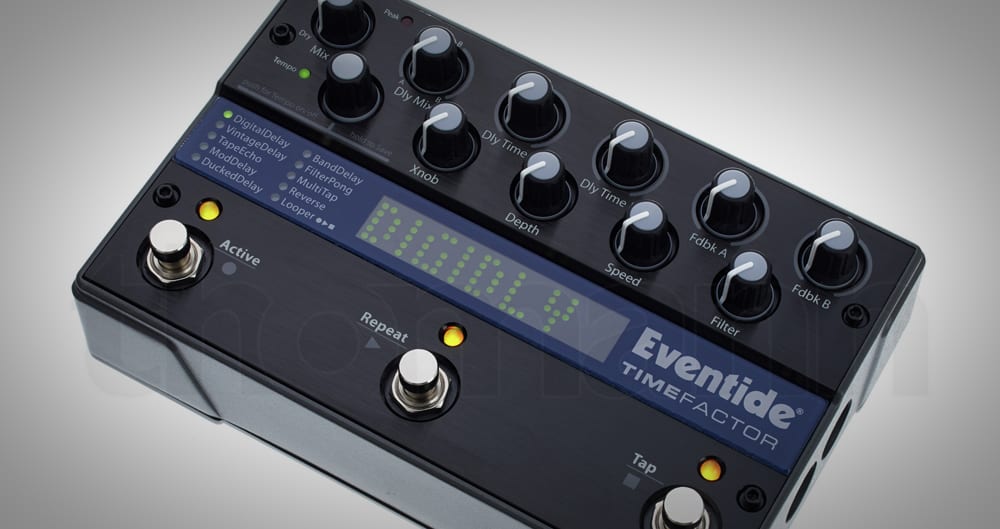
Eventide doesn’t have a big lineup of guitar effects pedals, but the ones that they’ve made have consistently been top-notch. The TimeFactor twin delay pedal is no different. Packed with nine different delay effects—Digital Delay, Vintage Delay, Tape Echo, Mod Delay, Ducked Delay, Band Delay, Filter Pong, Multi Tap, and Reverse—plus a built-in Looper function, the TimeFactor is a delay maniac’s wet dream. Each delay even has its own independent delay times (up to 3 seconds max each) and feedback controls for maximum versatility. The TimeFactor puts the advantages of a digital delay—power, clarity, and versatility—on full display, but there’s nothing unnatural or mechanical about its sound at all. If you love the analog sound but need the sheer power and flexibility of a digital delay, then the TimeFactor should be a no-brainer.
Joyo D-Seed Dual Channel Digital Delay
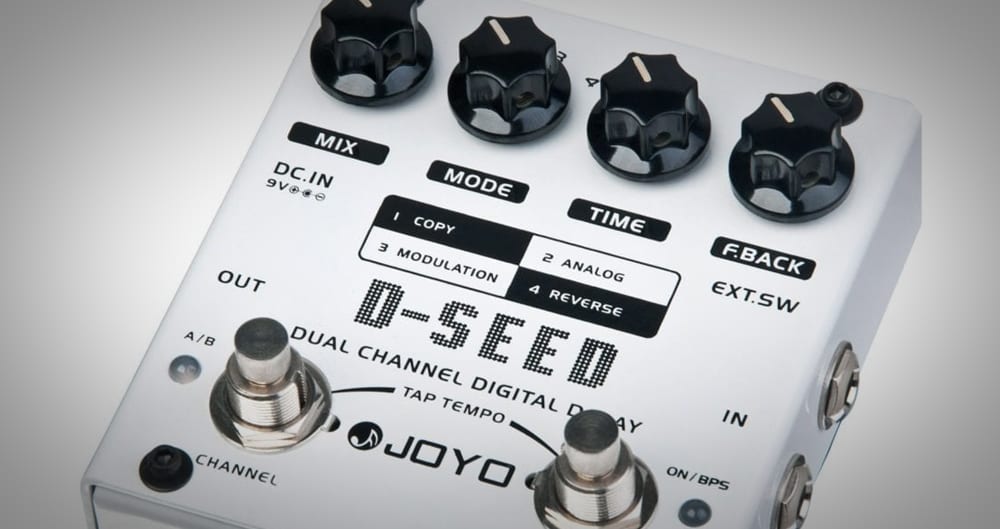
One of the things we love most about the current guitar effects pedal landscape is that even the most budget-conscious musicians have a wealth of versatile but low-priced digital delay pedals to choose from. The D-Seed dual channel delay pedal from budget guitar effects pedal maker Joyo is one of the standouts in the under-$100 price range. With four different delay modes and built-in tap tempo controls, the D-Seed is a bit more advanced but still cheaper than your regular entry-level delay pedals. The control scheme is dead simple: you get dedicated Mix, Time, and Feedback controls, plus a four-way rotary Mode knob that lets you switch between the Copy, Analog, Modulation, and Reverse modes. Joyo somehow packed a lot of high-quality delay bang into a pedal that sells for just around $70, but we’re not about to question how they did it. We’re just gonna go ahead and recommend this affordable stomp to anyone who wants to start playing around with a digital delay.
Strymon TimeLine
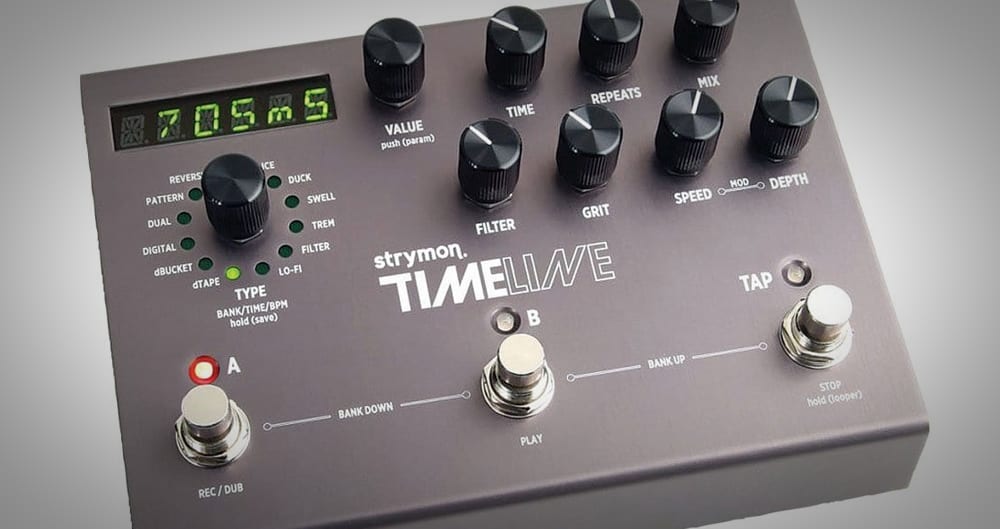
In stark contrast to the D-Seed, at least price-wise, is the TimeLine digital delay pedal from Strymon. It’s big and it’s expensive, yes, but it also packs enough power and versatility to justify its price tag. Like Eventide’s TimeFactor, the TimeLine features a built-in looper, plus an onboard memory chip that can hold up to 200 rewritable effects presets. The TimeLine goes beyond the TImeFactor in terms of the number of delay types, however, coming with a full dozen compared to the latter’s nine, two of which can be run simultaneously in series or parallel. The TimeLine also feature support for both an expression pedal and a MIDI controller, while the dedicated control knobs lets you create as clean or as gritty a delay you want. You want antiseptic digital delay? You got it. Organic old-school analog tape echo more your thing? Yeah, the TimeLine has that too. If you’ve got the money to spring for a high-end digital delay pedal, the TimeLine is definitely one of your best choices available.