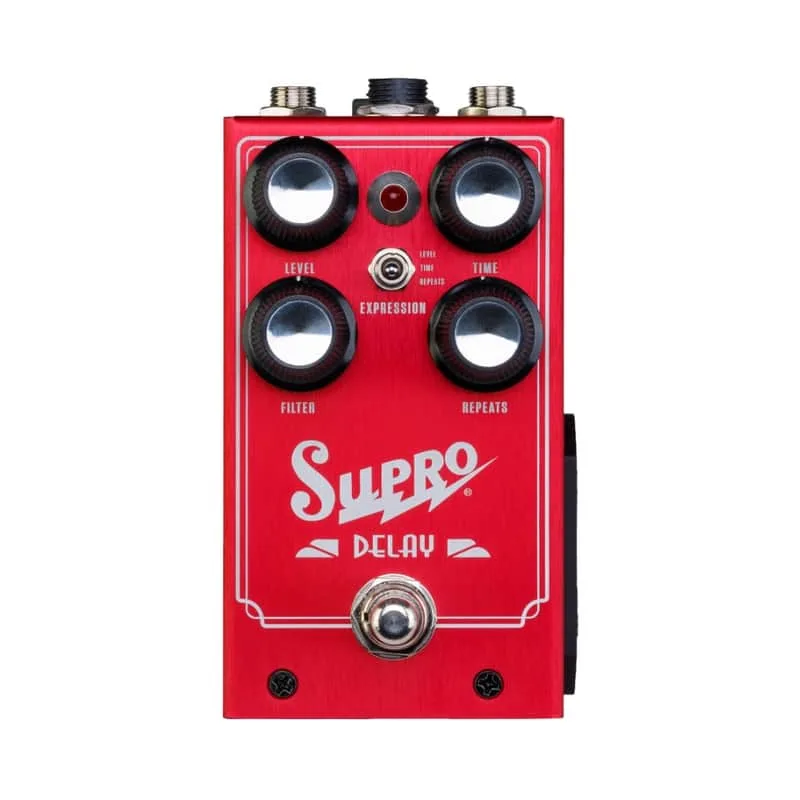
Among the delay pedals announced for 2019, the one covered here in depth is the Supro 1313 Analog Delay, which Supro unveiled at the Winter NAMM show in January 2019 as a premium, all-analog delay pedal1. It sits in a year that also saw new drives and modulations from many makers, and players comparing 2019 releases may want to read it alongside the overdrive pedals released in 2019, the distortion and fuzz pedals released in 2019, the modulation pedals released in 2019 and the reverb pedals released in 2019.
The delay pedals side by side
The Supro 1313 Delay is a delay pedal built by Supro and announced at NAMM 2019 as a premium all-analog design1. That analog construction is the main thing that separates it from the digital delays that dominate the modern market, and it is worth understanding what the difference means for your sound before comparing any 2019 releases.
A digital delay samples your guitar signal, stores it as numbers, and plays it back. Because the stored copy is exact, the repeats stay clean and clear for as long as the feedback holds them up, and a digital circuit can offer long delay times, presets and tempo features without the signal degrading.
An analog delay works differently. It passes your signal through a bucket-brigade circuit, a chain of tiny capacitors that hand the signal along step by step, one small piece at a time. That handing-off process is not perfectly clean: each pass through the circuit rolls off some high end and adds a little of its own character. The practical result is that the repeats get progressively darker and softer as they fade, which many players hear as warmer and more organic than the identical copies a digital delay produces. It is the same family of behavior that made the analog delays of earlier decades sought-after on the secondhand market, and it is the reason a maker like Supro would build a new all-analog pedal in 2019 and position it as premium1.
For players weighing analog against digital options more broadly, the site's general guide to delay pedals compares the two approaches, and a dedicated comparison of analog delay and tape echo units covers nine vintage-minded choices.
Controls, presets and tap tempo
The 1313 has no tap tempo switch. Instead, delay time is set with an expression pedal2. That is a real difference in how you use the pedal on a gig, and it changes what the pedal is good for.
A tap tempo switch lets you punch in the tempo of the song with your foot, usually by tapping quarter notes, so the repeats land in time with the band. It is the standard way to sync a delay to a beat on the fly, and most delay pedals released in recent years include it. A pedal without it asks you to set delay time another way.
An expression pedal gives you continuous control of the delay time under your foot. Rather than locking a tempo, you can sweep the delay time back and forth while you play. That opens up effects a tap tempo pedal does not give you as directly: slowing the repeats down while a note rings out produces a pitch-dropping swell, speeding them up bends the pitch upward, and rocking the pedal gently adds a moving, seasick character to the repeats. Players who use delay as an ambient texture rather than a rhythmic tool often prefer this kind of control.
MusicRadar's reviewer, Trevor Curwen, put the tradeoff plainly:
"Setting delay time by foot pedal might be less precise than a tap tempo switch, but it's smoother"2
For a player who wants repeats locked to a beat, that precision matters, and a pedal without tap tempo will feel like a step backward at a gig where the tempos shift. For a player who sweeps delay time for ambient swells and pitch-bending effects, the smoother continuous control is the point, and a tap tempo switch would sit unused.
Where it came from
Supro unveiled the 1313 at the Winter NAMM show in January 2019, the annual trade show in Anaheim where makers introduce their new gear for the year, and MusicRadar reported it at the time as a premium all-analog delay pedal1. The announcement placed Supro, a maker better known for amplifiers, among the pedal makers showing new delay designs that year, and it is the 2019 delay release this comparison covers in depth.
What the reviewer made of it
MusicRadar reviewed the 1313 and found the expression-pedal approach to setting delay time workable, describing it as less precise than a tap tempo switch but smoother2. That verdict tells you who the pedal suits as the reviewer framed it: players drawn to analog repeats and continuous control rather than tempo-synced presets. The reviewer's wording is worth sitting with, because it names the exact trade a player makes with this pedal. You give up the ability to tap in a tempo and get repeats that sit exactly on the beat, and in exchange you get a delay time that moves fluidly under your foot with no stepping between settings.
Read alongside the announcement coverage, the review rounds out the picture of what Supro brought to the 2019 delay market: an all-analog circuit in a premium positioning, with a control scheme aimed at players who treat delay time as something to play rather than something to program12.
Questions
Do delay pedals need tap tempo?
No. The Supro 1313 Analog Delay ships without a tap tempo switch and sets its delay time with an expression pedal instead. MusicRadar's reviewer found that approach less precise than tapping a tempo but smoother, which suits players who bend delay time for ambient swells rather than locking repeats to a beat2.
Sources (2)
- NAMM 2019: Supro unveils “premium, all-analogue” Delay pedal, MusicRadar, 2019-01-15
- Supro 1313 Analog Delay review, MusicRadar, 2019-04-03