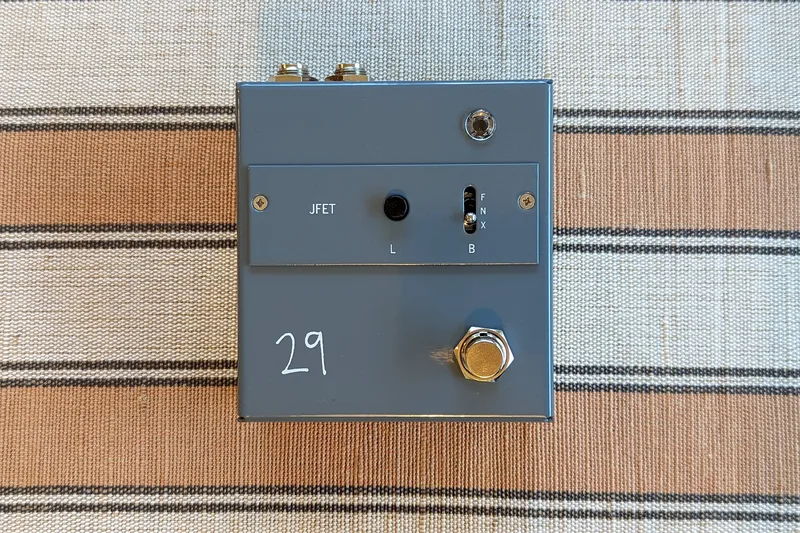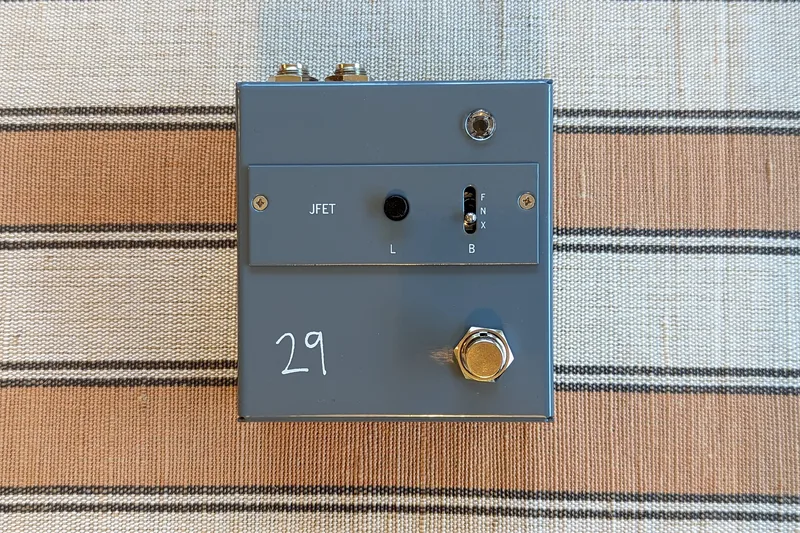


The 29 Pedals JFET is an analog clean boost and preamp pedal from 29 Pedals. It makes about 18dB of gain, and the maker describes its character as "just enough hair to be tube-y but still very clean by most standards": a JFET stage biased for a specific THD ratio, followed by a dual-stage IC output driver1. It sits in the broad family of boost pedals, but with a little more shaping on board than a one-knob unit.
What it does to your sound
The core of the pedal is a JFET transistor stage. FETs are very early solid-state devices that were designed to emulate vacuum tubes as closely as possible, and they have a corresponding place in the hearts of many pieces of classic gear, as RockBoard's PedalPedia puts it2. 29 Pedals biases the stage for a specific THD ratio, so the boost stays clean by most standards while carrying a small amount of tube-style saturation1.
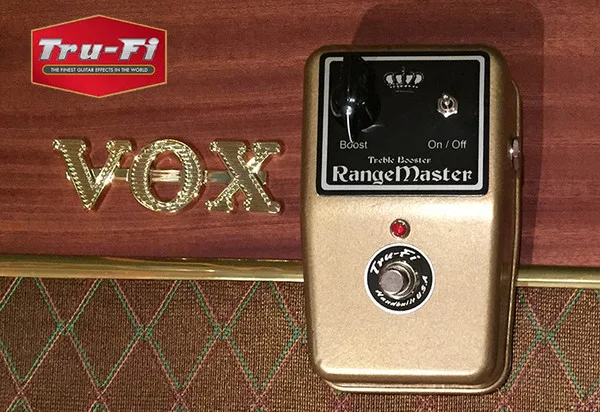
The pedal offers three modes that tailor the low end in a gentle way for fine-tuning the boost sound with your guitar1. Delicious Audio's Paolo De Gregorio describes the N (Normal) mode as emulating a treble booster, reminiscent of the classic vintage RangeMaster design, that adds high-end sparkle3.
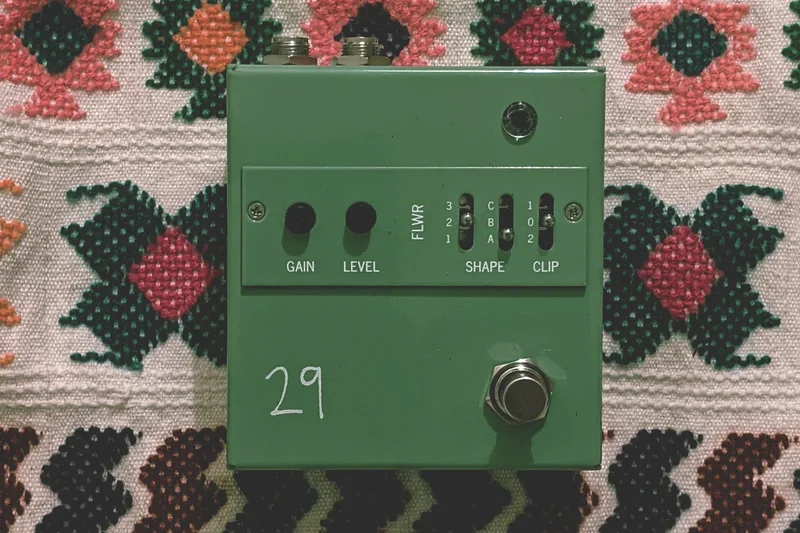
29 Pedals suggests using it after its EUNA input stage, or as an alternate front-end to a board, and says it loves to be stacked with the company's FLWR and other drives. It also happily drives cables, meaning it can push long cable runs from the end of a chain13.
Is it a copy of a classic circuit?
No, according to the maker. FET-based designs are behind a sizeable number of classic pieces of gear2, but 29 Pedals states: "As usual for 29 we don't copy or emulate any of those, but start from a ground-up design."1
Delicious Audio's reviewer framed the pedal the same way, writing that it "is presented as a reimagining of the most humble of stompboxes, by a company that has proven uber-competent" in tone preservation and enhancement3.
Power and size
The JFET carries 29 Pedals' WHATEVER internal power supply and draws about 150mA13. That current draw is high for a boost pedal, so it is worth matching it to a supply output that can deliver it.
The JFET draws about 150mA13, which rules out the low-current outputs found on some daisy-chain supplies.
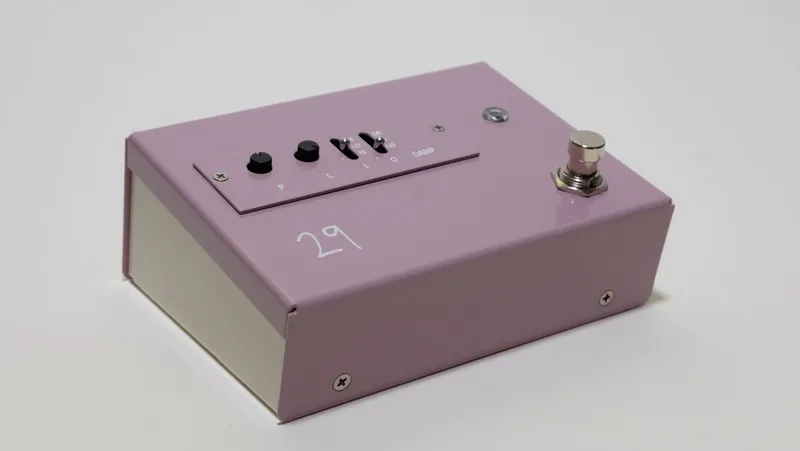
The enclosure is the same depth and height as the company's EUNA and OAMP pedals1, and its dimensions are:
Availability and versions
The maker's support pages list the JFET as sold out and available to backorder, with a one month delivery lead time4. The product page lists three variants: JFET Rev C, JFET Rev B, and JFET SE/R Rev C, each shown as sold out or unavailable1.
As of the last check, all three listed variants, Rev C, Rev B and SE/R Rev C, were shown as sold out or unavailable, with backorders quoted at one month delivery14.
Videos
Mark Johnston
ambienttrash
Sasha Ivantic
Questions
How much gain does the 29 Pedals JFET make?
29 Pedals says the JFET makes about 18dB of gain. The company positions it as a pedal that sounds great after its EUNA input stage or as an alternate front-end to a board, and notes that it loves to be stacked with the FLWR and other drives. It also happily drives long cables, so it can sit at the end of a chain as well as the front.
Is the 29 Pedals JFET analog?
Yes. The JFET is an analog pedal. Its circuit uses a JFET transistor stage biased for a specific total harmonic distortion ratio, followed by a dual-stage IC output driver. There is no digital processing in the signal path.
How much current does the 29 Pedals JFET draw?
29 Pedals says the JFET draws about 150mA, and Delicious Audio's product page repeats the same figure. That is well above what many small pedals need, so a low-current output of a daisy-chain supply may not run it; a dedicated supply output is the safer choice.
Is the 29 Pedals JFET a copy of a classic FET circuit?
No. FETs appear in a sizeable number of classic pieces of gear, but 29 Pedals says that, as usual for the company, it does not copy or emulate any of them and instead starts from a ground-up design. In Normal mode it does emulate a treble booster reminiscent of the vintage RangeMaster design, adding high-end sparkle.
What is the difference between the JFET Rev B and Rev C?
The maker's product page lists three variants of the pedal: JFET Rev C, JFET Rev B, and JFET SE/R Rev C, each shown as sold out or unavailable at the time of the last check. The newest named revision is Rev C, and Rev B is the earlier one.
Sources (4)
- 29 Pedals JFET, 29 Pedals (29pedals.com)
- JFET by 29 Pedals, RockBoard PedalPedia, 2026
- 29 Pedal JFET Boost, Delicious Audio, 2023-09-20
- OAMP Quickstart, 29 Pedals (Believable Audio)