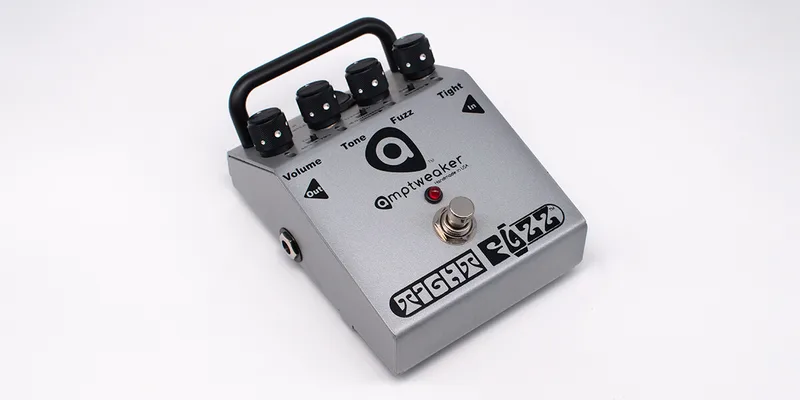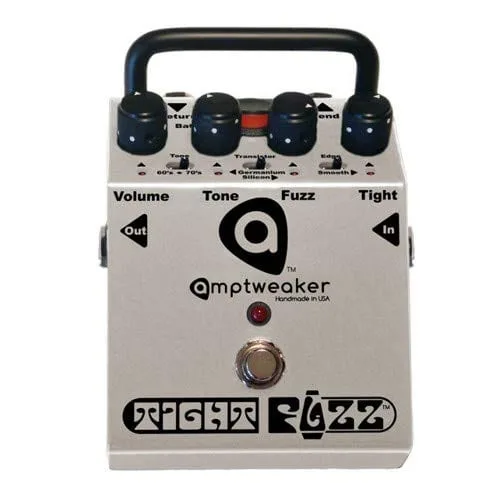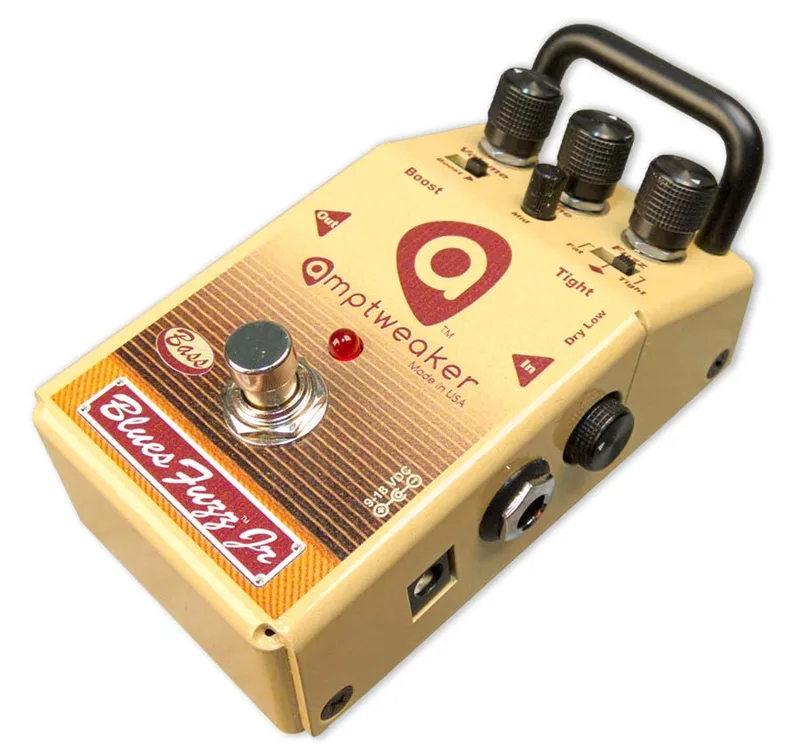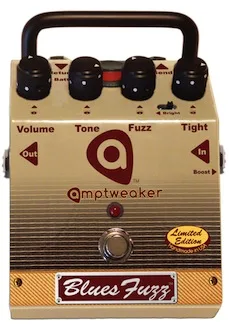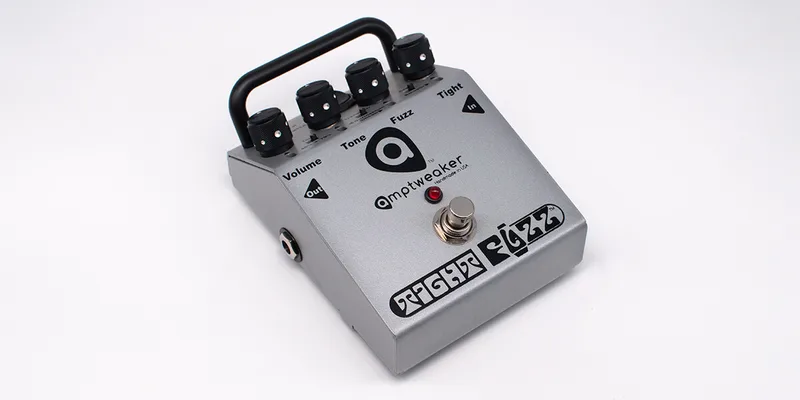


The Amptweaker Bass TightFuzz is a fuzz pedal built specifically for bass, an evolution of the company's original TightFuzz for guitar, which designer James Brown released in 2012 as a combination silicon and germanium fuzz12. Where most fuzz circuits thin out the low end, the Bass TightFuzz adds a Dry Low knob that blends clean low end back under the fuzz, and Premier Guitar's reviewer called it "a fuzz pedal that's truly tuned for bass"1.
The pedal sits in a silver enclosure with black knobs and a settings-saver bar that holds the knob positions, and it carries its own effects loop: a pair of 1/4" send and return jacks that create a series loop for adding other pedals1. Vintage Guitar reviewed it in February 2014 alongside the guitar TightFuzz, testing it with a G&L JB played through an Ampeg B200R combo3.
A bass fuzz with a clean low-end blend
The core idea of the Bass TightFuzz is that the fuzzed signal and the clean low end travel on separate paths. The Dry Low knob adds clean low end to the signal, which helps prevent the typical loss of low end that happens with most distortion pedals1. Amptweaker later described the dry low blend knob as "a very popular feature from the Bass TightFuzz" and carried it into its other bass pedals, including the Bass TightFuzz Jr and the limited-edition Lefebvre TightFuzz6.
Premier Guitar's reviewer found the pedal kept its character across the range of settings1:
"Keeps the bottom end big with lots of usable tones."
Premier Guitar, 20211
The circuit itself traces back to the guitar TightFuzz, which Aion FX traced in 2023. That circuit wraps a vintage-inspired fuzz with James Brown's signature pre-gain bass cut control and a heavily modified Big Muff-style tone control2. Aion FX's tracing journal also noted that the fuzz goes all the way down to a very-nearly-clean sound at zero, usable as a vintage-flavored boost, with heavier fuzz starting around 2 to 3:00 on the Fuzz control7.
The controls
The control panel covers Volume, Fuzz, Tone, Tight, Dry Low, and a '60s/'70s voicing switch13. Premier Guitar's reviewer found the volume and fuzz knobs intuitive, and the tight knob central to the pedal's character1.
| Control | What it does |
|---|---|
| Volume | Typical bass distortion volume control; sets the effected output level1 |
| Fuzz | Sets the amount of distortion, from a slight dusting of dirt to a full, Entwistle-esque solo tone1 |
| Tone | Opens up the distortion spectrum; a high-roll-off-style knob13 |
| Tight | Tames and slightly squashes the signal; rolled all the way up gives an SVT-like driven sound, off gives a wide-open, harmonics-ringing fuzz1 |
| Dry Low | Adds clean low end to the signal1 |
| '60s/'70s switch | Toggles the fuzz between a bright tone and a fuller, beefier tone1 |
The '60s/'70s switch is where much of the voicing happens. The '60s position has more bite, while the '70s position is fuller and beefier1. Vintage Guitar's reviewer found both the TightFuzz and Bass TightFuzz "offered great interaction with the well-voiced, high-roll-off-style Tone knob, while the '60s/'70s voicing switch did the bulk of the work shaping the tone of the fuzz sounds"3.
The Fuzz control also adjusts bias automatically as you turn it, in what Bass Gear Magazine's Tom Bowlus called "typical Amptweaker fashion" in his review of the Jr. series pedals5.
Power: 9V to 18V, with an effects loop
The Bass TightFuzz runs with either a 9V or 18V power supply, or any voltage between, with different performance at each end1. Premier Guitar's reviewer described the difference plainly: "When powering with a 9V supply, the signal is the most distorted, and with an 18V, the tone is cleaner and louder"1. A player can therefore pick a voltage that trades distortion for headroom.
Power options include a 9V battery, housed in a slide-out compartment held in place by magnets, with no screws to drop or plastic tabs to break1. Vintage Guitar confirmed both the TightFuzz and Bass TightFuzz operate on a 9-volt battery or a DC power supply3.
The effects loop deserves a note of its own:
The loop is engaged only when the fuzz effect is on, so the fuzz and whatever pedals sit in the loop can both be turned on with one stomp3.
This means a player can park, say, an octave or filter pedal in the loop and have it appear only when the fuzz does, without a separate switch. The loop is engaged only when the fuzz effect is, so both can be turned on with one stomp3.
Where it came from and where it went
Amptweaker introduced the Bass TightFuzz in December 2012, shortly after the original guitar TightFuzz48. The family grew in several directions:
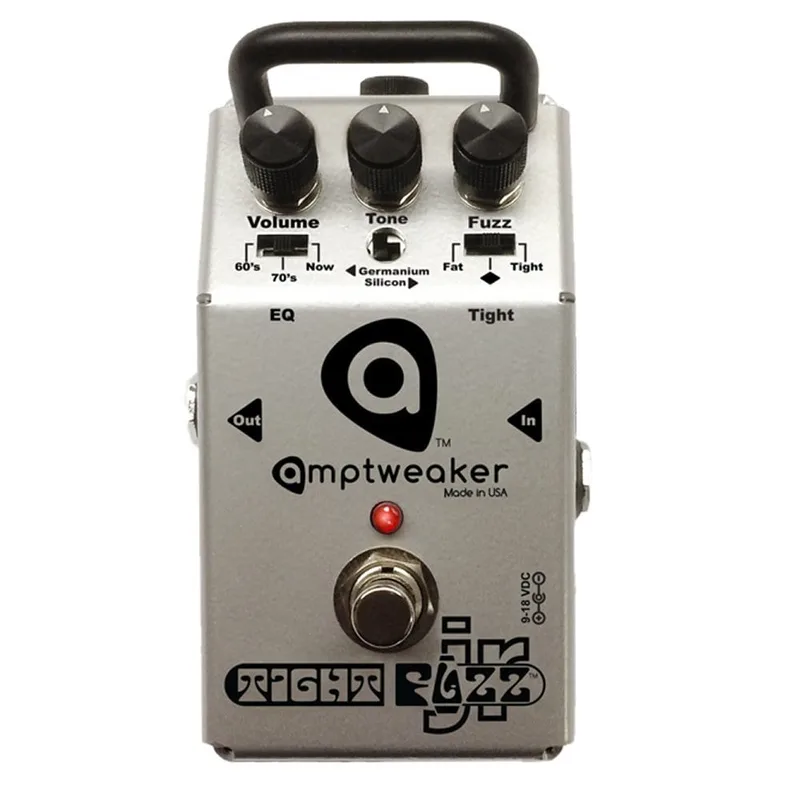
The Jr. versions make a few practical trade-offs against the full-size pedal. The slide-out magnetic battery door is not an option on the smaller enclosure; battery access on the Jr. pedals is through a single thumb screw and case/plate design5. The Jr. pedals also replace the '60s/'70s switch with a three-position 60's/70's/Now Tone switch, where 60's is tight and bright, 70's is a fatter full-range fuzz, and Now is aimed at more modern fuzz tones5.
What reviewers made of it
Premier Guitar's 2021 review summed up the Bass TightFuzz as "an extremely versatile bass distortion that's packed with smart features and great tone," with the bottom end staying big across its range of usable tones1. Vintage Guitar's 2014 review covered both the TightFuzz and Bass TightFuzz together, noting the well-voiced Tone knob and the voicing switch as the main tone-shaping tools3.
Bass Gear Magazine's Tom Bowlus, reviewing the Jr. series in 2019, noted the family's practical design details, including the automatic bias adjustment on the Fuzz control and the Dry Low control placed on the right-hand side of the Jr. enclosure for dialing in clean low end under the effected tone5.
Videos
Amptweaker
Amptweaker
MrExcane
Questions
Does the Bass TightFuzz take a battery?
Yes. It runs on a 9V battery housed in a slide-out compartment held in place by magnets, with no screws to drop or plastic tabs to break. It also runs on a DC power supply, and accepts anything from 9V to 18V.
What does the Dry Low knob do?
It blends clean low end back into the effected signal. Because most distortion and fuzz pedals thin out a bass's low end, the Dry Low control lets you dial in as much clean fundamental as you want under the fuzz tone. Amptweaker carried this feature over to its later bass pedals.
What changes when you run the Bass TightFuzz at 18V?
At 9V the signal is at its most distorted, and at 18V the tone is cleaner and louder. The pedal accepts 9V, 18V, or any voltage between, so you can pick a point on that scale to trade distortion for headroom.
What is the difference between the '60s and '70s settings?
The '60s/'70s switch toggles the fuzz between a bright tone and a fuller, beefier tone. The '60s position has more bite, while the '70s position is fatter and more full-range. Vintage Guitar's reviewer found this voicing switch did the bulk of the work shaping the fuzz sounds.
Does the Bass TightFuzz work with active basses?
The related Lefebvre TightFuzz, which is based on the Bass TightFuzz circuit, added special input circuitry to accommodate basses with active pickups, and Amptweaker's TightFuzz Jr. works fine with low-impedance active pickups. The Bass TightFuzz itself was reviewed with a passive G&L JB.
Sources (8)
- Amptweaker Bass TightFuzz Pedal Review, Premier Guitar, 2013-04-30
- Cinder Hybrid Fuzz / Amptweaker Tight Fuzz, Aion FX, 2023-11-24
- Amptweaker’s TightFuzz and Bass TightFuzz, Vintage Guitar magazine, 2015-10-23
- Amptweaker Offers Bass TightFuzz Pedal, Vintage Guitar magazine, 2012-12-04
- Bassic Review, Bass Gear Magazine, 2019-12-05
- Amptweaker Launches New Bass Jr. Pedal Series, Premier Guitar, 2016-07-01
- Tracing Journal: Amptweaker Tight Fuzz, Aion FX, 2023-11-24
- Amptweaker releases the Lefebvre TightFuzz, Guitar.com, 2019-12-09
 Tim Lefebvre