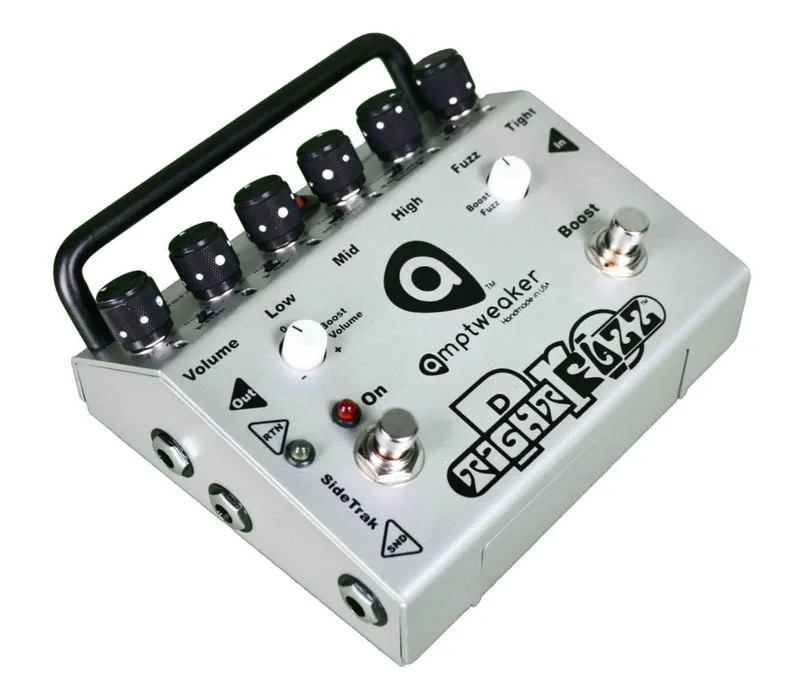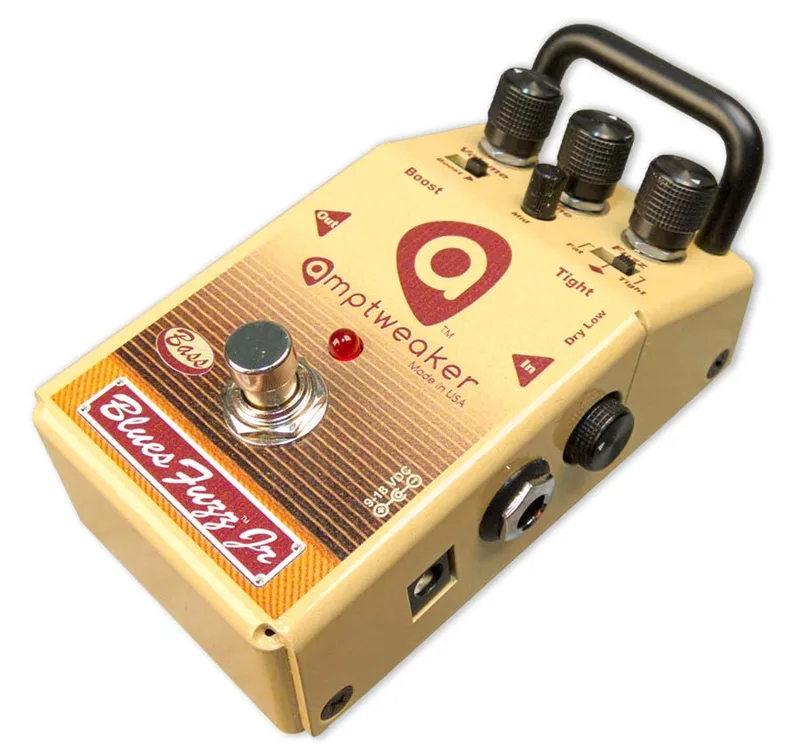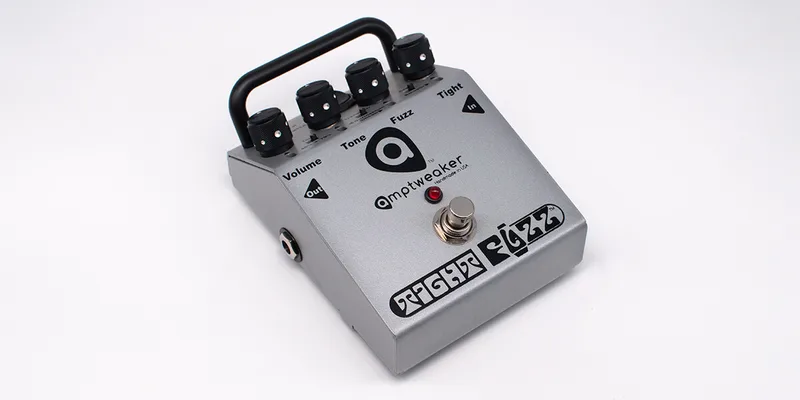

The Amptweaker Bass TightFuzz Jr is a compact fuzz pedal for bass, part of Amptweaker's smaller-footprint Jr. Series. It was unveiled in July 2017 alongside Jr. versions of the TightFuzz and BluesFuzz in both guitar and bass incarnations, with the bass versions adding a Dry Low knob to blend clean tone with distortion1. It is derived from Amptweaker's Pro series, with the larger pedals' Tight control and Fat switches reconfigured into a single 3-position Fat/Normal/Tight switch2.
What makes it a bass fuzz rather than a guitar fuzz is that Dry Low control: it lets you dial in clean low end to sit under the fuzzed signal, so your low notes keep their foundation while the top of the signal gets saturated. Bass Gear Magazine's reviewer Tom Bowlus covered the pedal in December 2019, when it listed at $180.00 in the US3.
The controls and switches
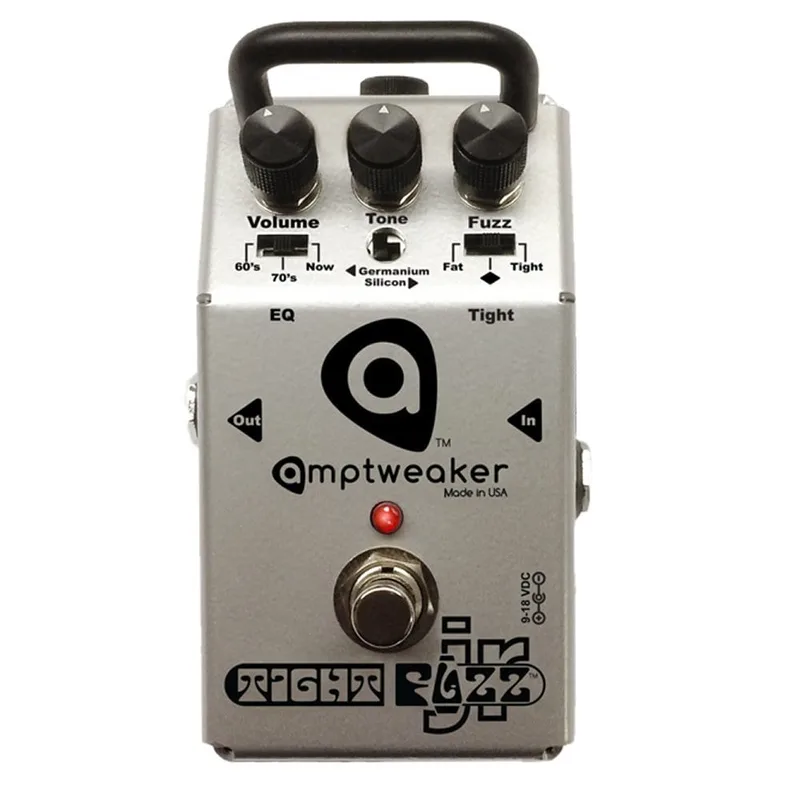
The pedal's knobs and switches cover saturation, level, tone, and two character choices: how the fuzz attacks and which transistor type shapes it31.
| Control | What it does |
|---|---|
| Fuzz | Adjusts the level of fuzz saturation, and automatically adjusts bias3 |
| Volume | Controls the level of the effected output, so you can match your fuzz volume to the bypassed level or get a boosted fuzz tone3 |
| Tone | Dials in your high end, mostly a roll-off but with some boost possible3 |
| Dry Low | Blends clean low end in with the effected tone, on the right-hand side of the enclosure3 |
| Fat/Normal/Tight switch | 3-position attack switch; Fat yields a thicker, "buzzier" distortion tone, Tight allows a more aggressive, "chunkier" attack3 |
| Germanium/Silicon switch | Selects between germanium or silicon output stage transistors3 |
| 60's/70's/Now Tone switch | Fixed EQ settings; 60's is more tight-n-bright, 70's is a fatter, full-range fuzz tone, Now is aimed at more modern fuzz tones3 |
The Fuzz control's automatic bias adjustment is worth noting for anyone who has used vintage-style fuzzes: where an old germanium pedal's bias drifts with temperature and needs manual tweaking, here the bias tracks the fuzz setting itself, in what Bowlus called "typical Amptweaker fashion"3.
The two character switches do different jobs. The Germanium/Silicon switch changes the output transistor: germanium gives a warmer, lower-gain tone, while silicon is brighter with higher gain3. Delicious Audio described the same switch as a way "to change the output transistor for warmer or brighter/high gain distortion"2. The 60's/70's/Now switch sets fixed EQ curves, with the 60's and 70's positions mimicking the fuzz sound of those decades and the Now option aiming at a more current sound2.
The Fat/Normal/Tight switch replaces the Tight knob found on the larger Amptweaker pedals. As Bowlus put it32:
"the Jr. pedal has a 3-position switch for Fat/Normal/Tight. The Fat setting yields a thicker, 'buzzier' distortion tone,"3
Tom Bowlus, Bass Gear Magazine
The TightFuzz Jr. and the Jr. Series
The Jr. Series is Amptweaker's smaller-footprint line, and the company added bass and guitar versions of its fuzz pedals to it: as Amptweaker described it, "With the popularity of Amptweaker's smaller footprint JR series, we've added bass and guitar versions of our Fuzz pedals"2. The TightFuzz Jr. is derived from the TightFuzz Pro series, with the Tight control and Fat switches reconfigured into a 3-position Fat/Normal/Tight switch2.
The circuit is derived from the Pro series, specifically the TightFuzz Pro, with the Pro pedals' Tight control and Fat switches condensed into the 3-position attack switch2. The family it sits in includes:
- The guitar version, the TightFuzz Jr, a fuzz pedal unveiled alongside the bass version2
- The Bass BluesFuzz Jr, its companion bass fuzz, also $1801
Delicious Audio called the TightFuzz Jr "a very flexible fuzz pedal, with a Silicon/Germanium transistor switch and Tight attack switch"2, and that flexibility is the practical pitch of the Jr. format: fewer knobs than the Pro, but the two switches that matter most for shaping the fuzz character are both still there.
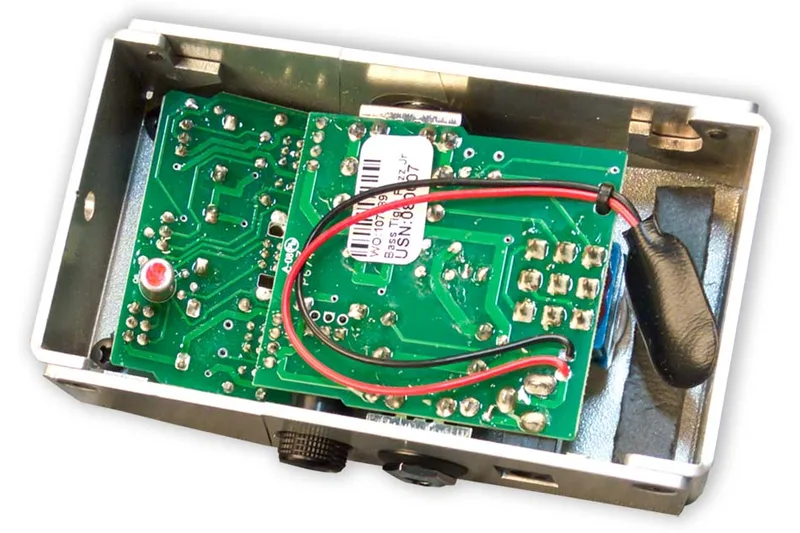
One practical difference from the larger Amptweaker pedals: the slide-out magnetic battery door on the full-size enclosures is not an option on the smaller Jr. case. Battery access instead works through a plate held by a single thumb screw3. Power otherwise comes through the 9-18 VDC jack on the right side of the enclosure, just in front of the input jack3.
Videos
MrExcane
Questions
Is the Amptweaker Bass TightFuzz Jr true bypass?
Yes. The pedal uses true bypass switching, with an indicator LED on the footswitch so you can see at a glance whether the fuzz is engaged. When bypassed, your signal passes through without the circuit coloring it.
Can the Bass TightFuzz Jr run on a battery?
Yes. The Jr. pedals run on 9V to 18V batteries or supplies. On the smaller Jr. enclosure there is no slide-out magnetic battery door like the larger Amptweaker pedals have; instead the battery is reached through a plate held by a single thumb screw.
What does the Dry Low knob do?
The Dry Low control blends clean, unprocessed low end back in with the fuzzed signal. This lets you keep a solid bass foundation under the distortion, so your low notes stay present instead of disappearing under the fuzz.
What voltage does the Bass TightFuzz Jr take?
It runs on 9 to 18 VDC, through a jack on the right side of the enclosure just in front of the input jack. It also accepts 9V to 18V batteries, so you can power it either way.
What does the Germanium/Silicon switch do?
It selects between germanium and silicon output stage transistors. Germanium gives a warmer, lower-gain tone, while silicon is brighter with higher gain, so the switch moves the pedal between vintage and more aggressive fuzz characters.
How big is the Bass TightFuzz Jr?
The enclosure measures 2.7 inches wide by 4.65 inches deep by 2 inches high, and it weighs 9 ounces. It is a metal enclosure, built to the smaller Jr. Series footprint rather than the full-size Amptweaker format.
Sources (3)
- Amptweaker reveals TightFuzz and BluesFuzz Jr guitar and bass pedals, MusicRadar, 2017-07-20
- Amptweaker TightFuzz Jr., Delicious Audio, 2019-03-31
- Bassic Review, Bass Gear Magazine, 2019-12-05