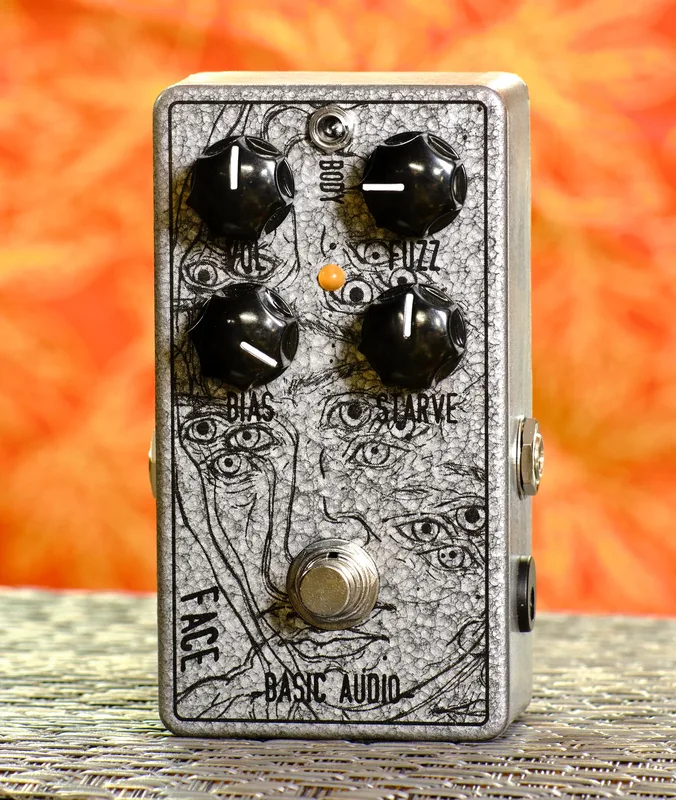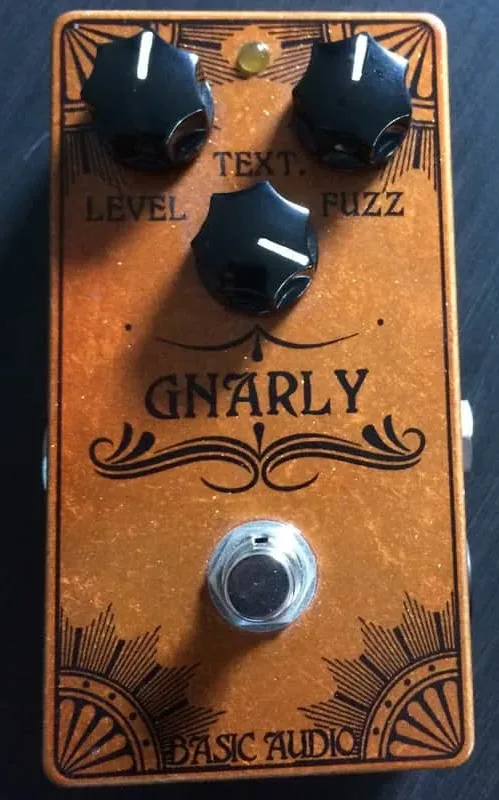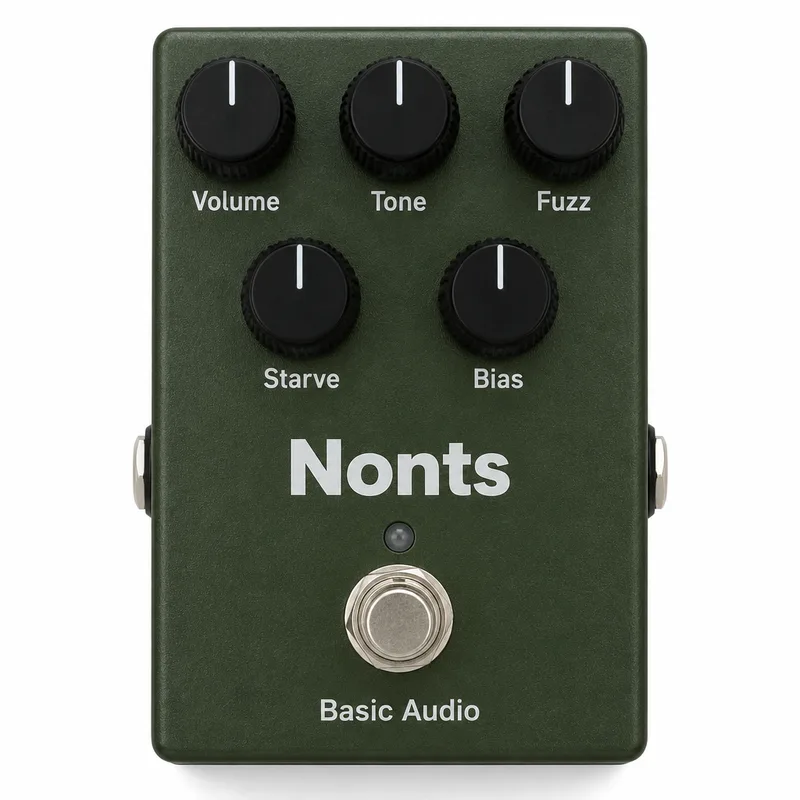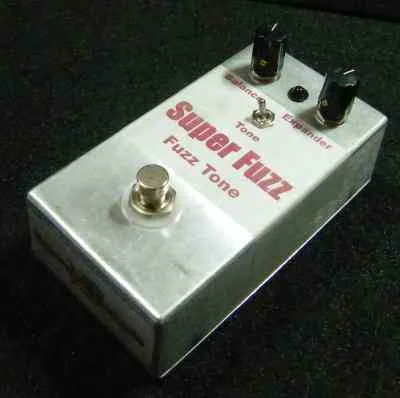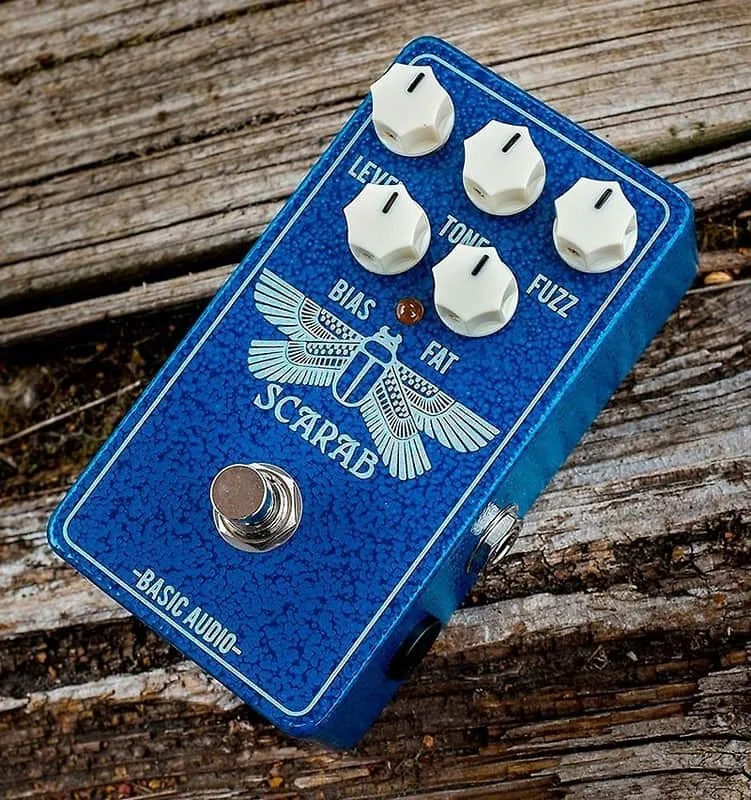


The Basic Audio Scarab Deluxe is a silicon fuzz pedal designed by John Lyons of Basic Audio, first released in 2010 as the successor to the original Scarab1. Guitar World's reviewer described it as "a straight-ahead refined vintage-era fuzz along the lines of the Tonebender with lots of sustain and gain"2. What sets it apart from a straight clone is its Bias and Fat controls, which, in the reviewer's words, help "fine tune your fuzz's tone to perfection"2.
The circuit is a four-transistor design (Q1 to Q4) in the Tonebender tradition, where the bias of the third transistor shapes the whole character of the fuzz3. Coda Effects lists the Scarab Deluxe among the many builders who have cloned, modified and reproduced the Sola Sound Tonebender Mk1, Mk1.5 and Mk2 circuits4.
What the controls do
The Scarab Deluxe's two signature knobs are what distinguish it from the three-knob original. This version "adds in a couple knobs over the 3 knob version"3.
| Control | What it does |
|---|---|
| Bias | Adjusts the bias of the 3rd transistor, affecting tone and gain: gritty gated tones at one end of the dial, sustaining lead tones in the middle, sweet lower gain tones at the other end3 |
| Fat | Adjusts the low end at the input of the circuit, affecting fuzz amount and saturation: from a saturated, slower-responding fat fuzz to a snappy, fast-responding, slightly less gain fuzz3 |
| Tone | Around 7dB of attenuation in the far counter-clockwise position3 |
The Bias control is the heart of the pedal. Tonebender-type circuits vary depending on the bias of the third transistor, and bringing that adjustment to the outside lets a player move between completely different fuzz characters without opening the box3.
The Fat control works differently: it blends the input capacitor, changing how much low end feeds the circuit. More bass at the input means more saturation and a slower, fatter feel; less bass means a snappier response with slightly less gain3.
History and versions: from the Hot Silicon to the Scarab Deluxe
The lineage runs from the Hot Silicon, described by Aion FX as "a classic circuit in the DIY community," to the original Scarab, and then to the Scarab Deluxe in 20101. The Deluxe "added an input capacitor blend as well as an external bias control for the third transistor," after which the original Scarab was discontinued1.
The Tonebender line itself goes back to the Sola Sound originals, whose early Wooden Case models already featured "level and bias control which enables the user to tune in their perfect fuzz tone"5. The Scarab Deluxe carries that bias-adjustment idea forward in a modern silicon build.
The original Basic Audio Scarab is discontinued. It was dropped from the lineup after the Scarab Deluxe was released in 20101.
What reviewers said
Guitar World's Brett Kingman reviewed the pedal in May 2011 and was positive on both sound and build. On the sound:
"The Scarab Deluxe rips with the best Tonebenders out there but doesn't suffer from the lack of volume or mid punch that many of the old-school MK1's and II's do"2
He also noted the maker's own description of the pedal as having a "full fuzz sound with the clarity of an overdrive," with all gain and tone settings remaining "articulate and sweet throughout their range"2. On build quality, he found "hand-wired attention to detail and top-shelf components" inside, in "a gray hammered case with brass-colored plating and etched fascia" that he called "a cool but industrial-looking box"2.
The DIY community and the Scarab Deluxe
The circuit has a strong second life among home builders. IvIark of Guitar FX Layouts published a vero (stripboard) layout in June 2014, with circuit information shared by designer John Lyons himself3. Builders in the comments verified the layout working, and their verdicts were enthusiastic:
"One of the best Si Tonebender pedals out there!"3
"I've done a few fuzzes by now, and this is possibly the nicest one so far."3
"Holy crap this thing is awesome. Move over Big Muff - this fuzz is seriously worth building even if you have a (few)..."3
For anyone building the stripboard version, two practical notes came out of the comments thread:
- Fat pot wiring: the FAT control is wired in reverse in the original layout; swapping connections 1 and 3, so the input cap value grows when turning the pot clockwise, corrects reported hiss and oscillation problems3.
- Bias pot value: a 25k pot is specified, but IvIark recommends 10K or less, since larger values (20k or 50k work) give "a lot of wasted rotation"3.
- Radio interference: soldering a small cap of around 47pF to 150pF from the input (fat2) to ground cures radio pickup3.
On transistor choice, builders verified the layout with 2N5088, 2N5089, BC109, BC549, BC182L, BC108 and 2N4123 transistors, plus an NPN germanium transistor in the Q2 position. IvIark ended up with 5088s for Q1 and Q2 and BC109s for Q3 and Q4, and recommends socketing the transistors to experiment3.
The circuit's DIY reach extends to printed circuit boards too: PedalPCB offers its Dung Beetle project as a comparison to the Scarab Deluxe6.
Videos
Prymaxe
Brett Kingman
gearmanndude
Questions
What is the difference between the Scarab and the Scarab Deluxe?
The Scarab Deluxe, released in 2010, succeeded the original three-knob Scarab and added a couple of knobs over that version. Specifically, it added an input capacitor blend (the Fat control) and an external bias control for the third transistor, giving five-way control over the fuzz's gain, low end and character. The original Scarab was discontinued after the Deluxe came out.
What does the Fat knob do on the Scarab Deluxe?
The Fat control adjusts the low end at the input of the circuit, which affects fuzz amount and saturation. Turning it takes the pedal from a saturated, slower-responding fat fuzz to a snappy, fast-responding fuzz with slightly less gain. It works by blending the input capacitor value, changing how much bass feeds the circuit.
Who designed the Basic Audio Scarab Deluxe?
The Scarab Deluxe was designed by John Lyons of Basic Audio. The circuit is a silicon fuzz in the lineage of the Tonebender, with four transistors and the bias of the third transistor made adjustable from the outside.
Can you build a Scarab Deluxe on stripboard?
Yes. IvIark of Guitar FX Layouts published a vero (stripboard) layout of the Scarab Deluxe in June 2014, with circuit information shared by designer John Lyons. Builders in the comments verified the layout working, and one later correction to the Fat pot wiring was published to fix reported hiss and oscillation.
Which transistors work in a Scarab Deluxe build?
Builders verified the stripboard layout with 2N5088, 2N5089, BC109, BC549, BC182L, BC108 and 2N4123 transistors, plus an NPN germanium transistor in the Q2 position. IvIark ended up with 5088s for Q1 and Q2 and BC109s for Q3 and Q4, and recommends socketing the transistors to try different combinations.
Is the original Basic Audio Scarab still made?
No. The original Scarab was discontinued after the Scarab Deluxe was released in 2010. The Deluxe replaced it in the Basic Audio lineup, adding the input capacitor blend and the external bias control for the third transistor.
Sources (6)
- Anubis Silicon Fuzz / Basic Audio Scarab Deluxe, Aion FX, 2021-02-19
- Trampled Underfoot: Basic Audio is the Lyon's Den o' Fuzz, Guitar World, 2011-05-26
- Guitar FX Layouts: Basic Audio Scarab Deluxe, Guitar FX Layouts (tagboardeffects.blogspot.com), 2021-04
- Coda Effects, Coda Effects, 2015-08
- Tone Bender History, britishpedalcompany.com
- Dung Beetle, PedalPCB.com