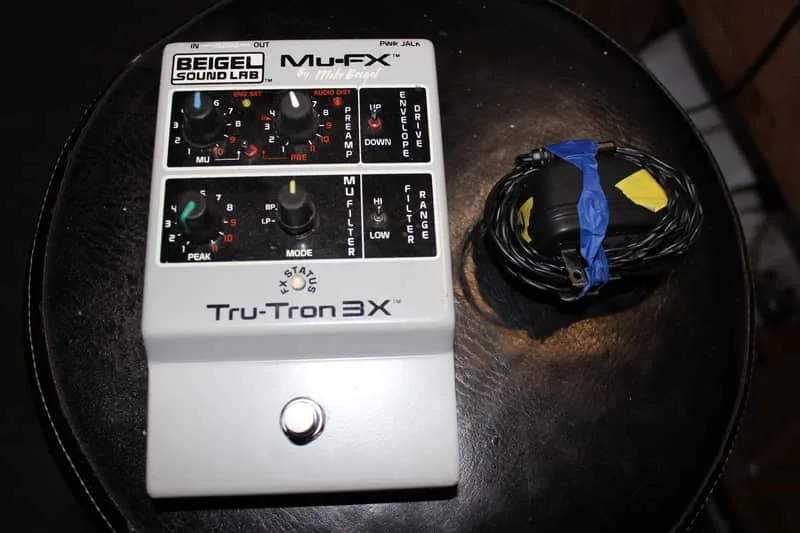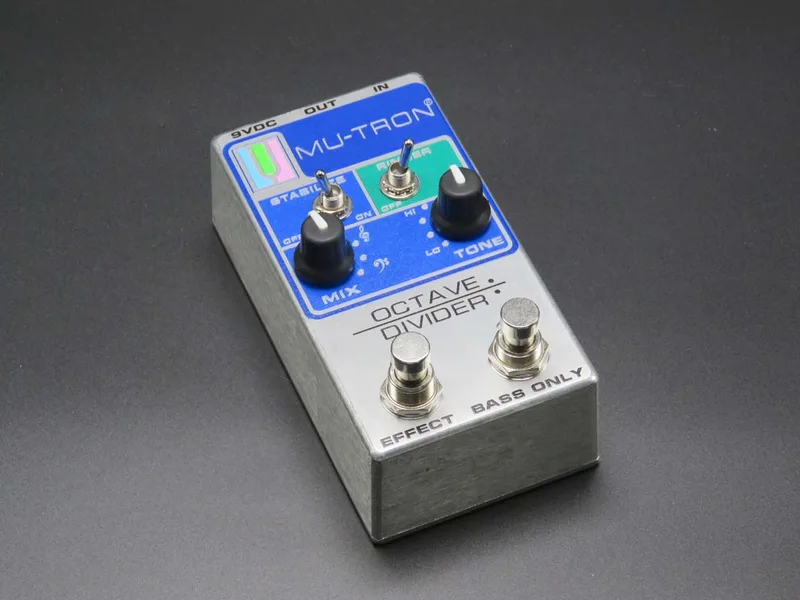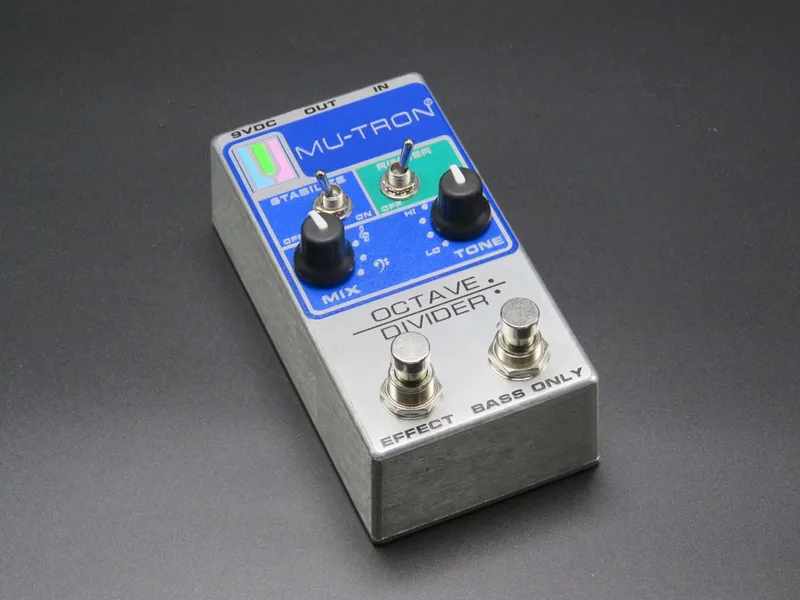


The Mu-FX Octave Divider is an analog octave divider pedal that combines two effects from the classic 1970s Mu-Tron Octave Divider: a thick analog octave-down and a fuzzy, ring-modulated octave-up tone from the Green Ringer circuit123. It is a reissue in the true sense: designed by Mike Beigel, whose latest venture Mu-FX has been reissuing classic Mu-Tron effects with modern updates, and built in the USA to ISO 9001 standard1. Premier Guitar reviewed it in 2021 at a street price of $359.972.
Mu-FX describes it as an enhanced reissue that offers more versatility of operating modes and features than the original, now in a "mini-Mu" housing that keeps the authenticity of the original in a pedalboard-friendly size1. It includes the same Octave Down effect and Green Ringer that made the original Octave Divider so popular1.
What it does: octave down and Green Ringer
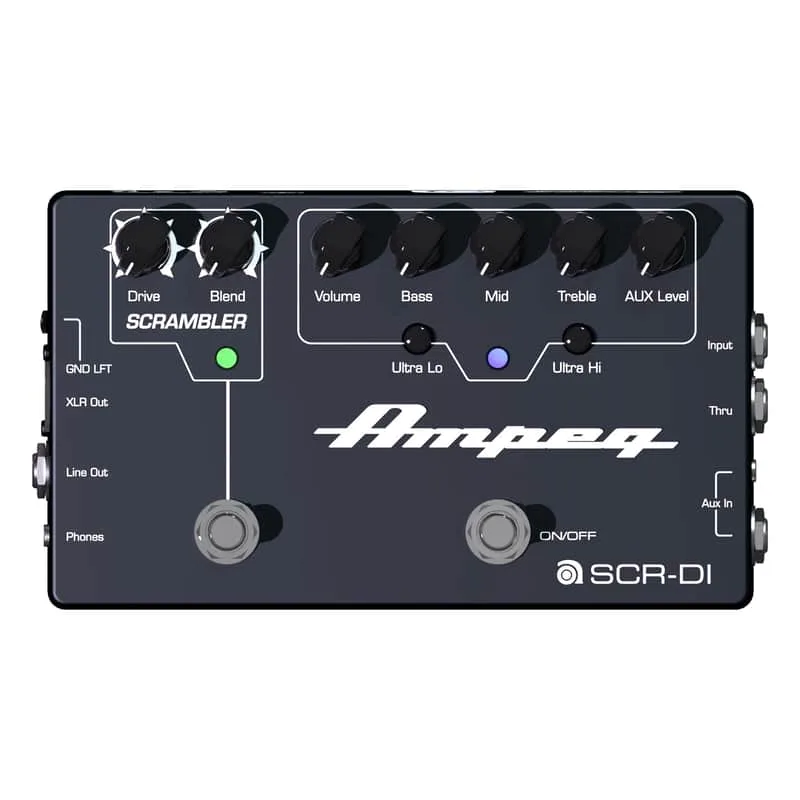
The pedal produces two voices at once. The octave-down (BASS) circuit drops your note one octave for a thick, sub-bass layer, while the Green Ringer adds a fuzzy, ring-modulated octave-up tone. Premier Guitar notes the Green Ringer circuit was itself "inspired" by the earlier Ampeg Scrambler2. Coda Effects describes the Green Ringer as a small but efficient analog octaver circuit4.
The original Mu-Tron Octave Divider used its ringer circuit for harmonic emphasis of upper tones and special multi-note effects, and Musitronics advertised that, used with other sound modifiers, it enabled a whole new range of synthesizer-related sounds35. Premier Guitar's reviewer found the reissue's tone warm, fat, and a bit synth-like2.
The controls and footswitches
The Mu-FX version keeps the two-footswitch layout that made the original notable. Premier Guitar notes the original Octave Divider was the first stompbox with two footswitches, letting you toggle between the dual effect and the octaver alone2.
| Control | What it does |
|---|---|
| TONE | Varies the tonal "brightness" of the octave-down effect1 |
| BASS | Adjusts the volume of the octave-down (BASS) circuit in Effect mode; unity gain is at approximately 8 on the dial1 |
| SOLO SEL switch | Selects whether BASS (octave-down only) or RING (RINGER only) will be activated by the SOLO footswitch1 |
| STABILIZE switch | Improves the reliability of the octave-down effect's tracking for guitar and other plucked instruments1 |
| SOLO footswitch | Activates the effect selected with the SOLO SEL switch (Effect Off, Red LED / BASS, Blue LED / RINGER, Green LED)1 |
| EFFECT footswitch | Switches between EFFECT (Purple LED) and BYPASS (Red LED) output1 |
Premier Guitar's reviewer confirmed the tone knob does indeed affect the tone, trimming highs from the bass effect, while the adjacent bass knob regulates level, not tone2. The review's pros list called out the "faithful '70s sound" and the dual and single effects via two footswitches; its cons list noted some confusing functionality, a bit of noise, the 12V power supply requirement, and the price2.
Power and connections
The Mu-FX Octave Divider runs on a 12VAC 200MA adapter, which is included. Premier Guitar notes the detachable 12V adapter replaces the original's built-in power supply21. This is not a standard 9V DC pedal supply, so it cannot share a typical daisy chain.
The pedal requires 12VAC power and ships with its own adapter. It will not run on the 9V DC center-negative supplies most pedalboards use.
Connections are straightforward: two 1/4" inputs (True Bypass Switching and Active Bypass Switching) and one 1/4" output jack1. The True Bypass input leaves your dry signal untouched when the effect is off; the Active input keeps the circuitry in the path, and Mu-FX's own demo examples use it, with the STABILIZE switch off and digital amp models in NI Guitar Rig 5, primarily the "Fender Clean" setting1.
Other measured specs from Mu-FX: nominal input and output levels of -10dBu, maximum output level of +16dBu, and a signal-to-noise ratio of 85dB or better1.
A reissue of the Mu-Tron Octave Divider by Mike Beigel
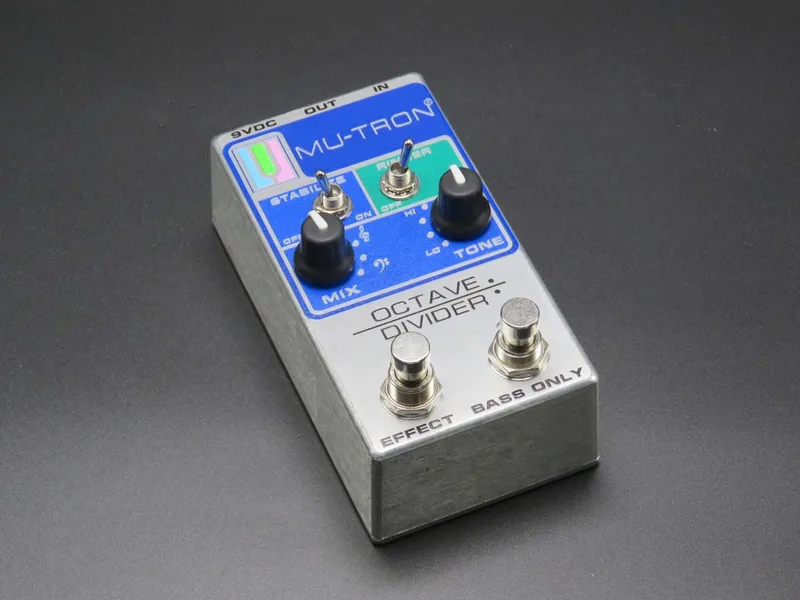
The Mu-FX Octave Divider is the newest reincarnation of the classic Mu-Tron Octave Divider, which Musitronics sold in the 1970s as a sophisticated accessory producing a sub-octave, in a rugged enclosure35. The current Mu-Tron lineup also includes the Mu-Tron Octave Divider and the Mu-Tron Octave Divider Vintage Silver, both 9V DC powered versions of the same design36. The Vintage Silver adds an auxiliary impedance-compensated output and a Stabilize switch for note tracking stability6.
Mu-FX says the reissue retains all the versatility and accurate tracking of the original while adding more operating modes and features1. The original had to be the first pedal to receive the instrument's signal, and Musitronics described it as especially effective followed by a Micro-Tron IV or Mu-Tron BI-PHASE6.
The design has also been cloned elsewhere: Behringer's Octave Divider is a clone of the classic 1970s Mu-Tron Octave Divider, rated at 9-12 V DC7. For players comparing analog options, the Foxrox Electronics Octron Octave Divider is another all-analog octave pedal, reviewed by Pedal of the Day as sounding "sick on bass as well"8.
Videos
gearmanndude
The Bass Hang
Dennis Kayzer
Questions
Is the Mu-FX Octave Divider analog?
Yes. Premier Guitar's reviewer describes it as an analog effect created via waveform modulation, not a digital transposition. It carries over the same Octave Down effect and Green Ringer circuit that made the original Mu-Tron Octave Divider popular, and Mu-FX says it retains the original's versatility and accurate tracking.
What does the Stabilize switch do?
The STABILIZE switch improves the reliability of the octave-down effect's tracking for guitar and other plucked instruments. Mu-FX's own demo clips were recorded with the switch turned off, so it is an option rather than a requirement, and players whose notes drop out can flip it on to help the divider follow the pitch.
What is the difference between the True Bypass and Active inputs?
The Mu-FX Octave Divider has two 1/4-inch inputs: a True Bypass Switching input and an Active Bypass Switching input. The True Bypass input passes your dry signal untouched when the effect is off; the Active input keeps the pedal's circuitry in the path. Mu-FX's demo examples use the Active input.
Does the Octave Divider work on bass?
The Mu-FX page does not restrict the pedal to guitar, and the Stabilize switch is described as helping guitar and other plucked instruments. The original Mu-Tron Octave Divider was advertised for use with other sound modifiers to create synthesizer-related sounds, and the related Foxrox Octron was reviewed as sounding sick on bass as well.
Sources (8)
- Mu-FX Octave Divider, Musitronics Mu-Tron (mu-tron.com)
- Mu-FX Octave Divider Review, Premier Guitar, 2015-06-09
- Octave Divider, Musitronics Mu-Tron
- Coda Effects, Coda Effects, 2017-01
- Mu-Tron Octave Divider, Musitronics Mu-Tron, 1970
- Octave Divider Vintage Silver, Musitronics Mu-Tron (mu-tron.com)
- Behringer Octave Divider: A clone of the classic 1970s Mu-Tron Octave Divider, gearnews.com, 2021-12-09
- Foxrox Electronics Octron Octave Divider, Pedal of the Day (www.pedal-of-the-day.com), 2017-02-08