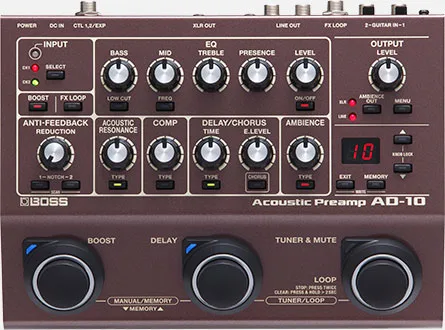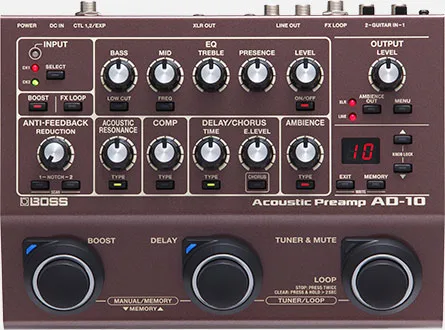


The Boss AD-10 is an acoustic preamp in a floor unit, built to take the signal from an acoustic guitar pickup and turn it into something that sounds like the guitar itself. Its central feature, Acoustic Resonance, analyzes the pickup signal and recreates the missing body and string resonances that Boss says are essential for natural acoustic sound1. Around that core sit the tools a performing acoustic player needs on stage: EQ, compression, ambience reverb, delay, chorus, an 80-second looper and anti-feedback notch filters2.
What the AD-10 does for an acoustic pickup signal
A piezo or magnetic pickup on an acoustic guitar captures the strings but loses most of what makes the instrument sound like wood and air. The AD-10's answer is Acoustic Resonance, which Boss says analyzes the pickup signal and recreates the missing body and string resonances, restoring the elements essential for natural acoustic sound1. It offers three different resonance types, more powerful processing than earlier Boss acoustic preamps, and the ability to balance tonal characteristics3.
The AD-10 has two input channels, which Boss says can be set up for two different stage guitars, used to blend two pickup sources from a single instrument, or even used with two instruments at once1. That makes it a fit for players who switch between guitars mid-set, or who run a combined piezo and microphone rig on one guitar.
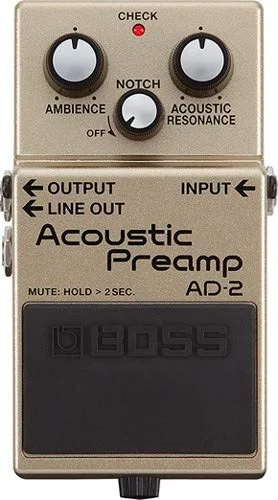
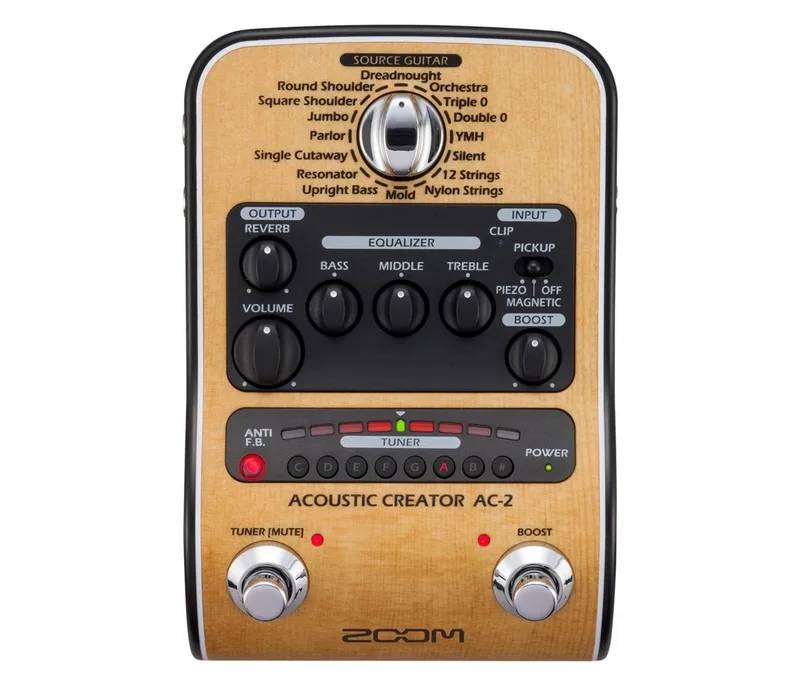
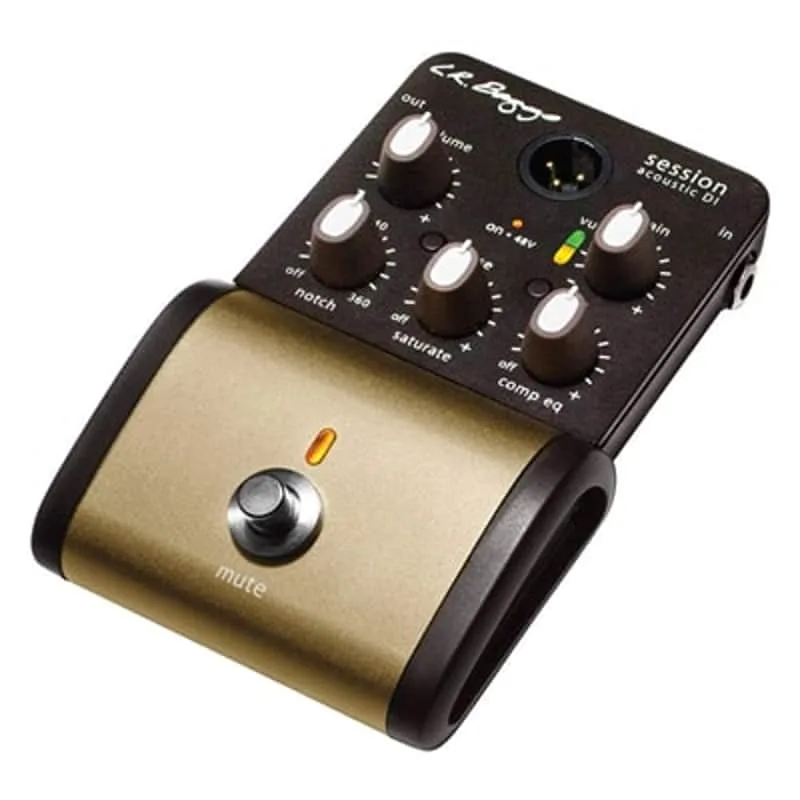
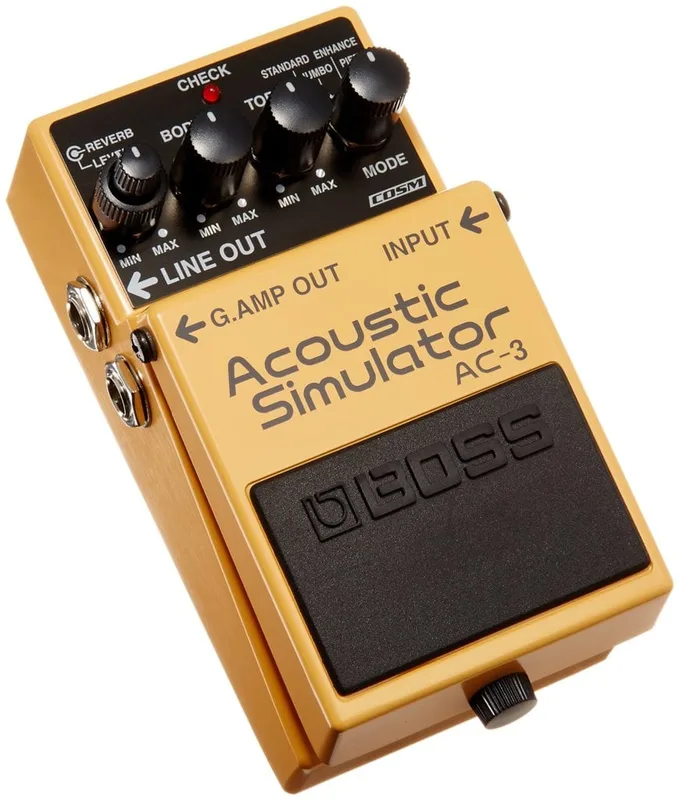
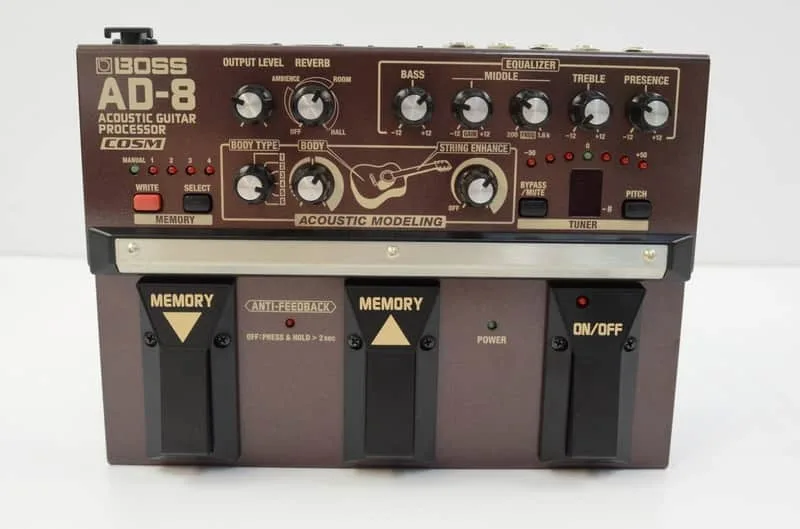
For players comparing acoustic preamps, the AD-10 sits alongside units like the Boss AD-2 Acoustic Preamp, the Zoom AC-2 Acoustic Creator and the LR Baggs Session DI in the acoustic pedals category.
The controls: EQ, compressor, effects and footswitches
Each channel gets its own EQ section with four bands, including a parametric midrange, plus a widely variable low-cut filter. The EQ can be defeated, and phase is adjustable per channel independently1. In his Acoustic Guitar review, Pete Madsen described the layout:
"The Boss' EQ section, occupying the top section of dials, has standard Bass, Mid, and Treble knobs, as well as Presence and EQ level output"
There is also a central Output Level control adjacent to the EQ knobs2.
The compressor is a single-knob design using Boss's MDP (Multi-Dimensional Processing) technology, which Boss says transparently controls dynamics3. The effects list from Madsen's review covers the full package: boost, chorus, delay, resonance, compression, 3-band EQ, reverb, an 80-second looper, and anti-feedback with notch settings and a reduction control2.
| Section | What it offers |
|---|---|
| EQ | Four bands per channel including parametric midrange, variable low-cut, defeatable; phase adjustable per channel1 |
| Compressor | Single knob, Boss MDP technology for transparent dynamics control3 |
| Chorus | Three variations of Boss's stereo sound-widening chorus3 |
| Delay | Standard, mod and reverse types3 |
| Ambience reverb | Three types of reverberation tuned for guitar3 |
| Looper | 80-second recording capability2 |
| Anti-feedback | Two notch selectors, scan mode, reduction control32 |
The soft-touch footswitches are designed for unobtrusive operation in quiet acoustic settings, and can be configured to select memories, turn effects on and off, access the onboard tuner and more1. A rear jack accepts up to two footswitches or an expression pedal for controlling looper functions, volume, tap tempo, anti-feedback scan and more1, something Madsen's review also confirmed with its input for an expression pedal2.
Anti-feedback
Feedback is the recurring problem for a plugged-in acoustic on a loud stage. The AD-10 gives you two individual notch selectors that dial out two different feedback-causing frequencies, and depressing both switches makes the unit scan for feedback-causing frequencies2. Each notch filter cuts out both the fundamental and the first overtone of the feedback frequency, and the depth of the filters is adjustable3.
Outputs and connections
On the rear panel, stereo XLR jacks provide a DI feed to the front of house, while stereo 1/4-inch jacks connect to a stage amp setup or headphones for monitoring1. Madsen's spec list adds the detail: two XLR main outs, two 1/4-inch line outs, one 1/4-inch send and one Type B USB port2. The USB port is where the computer drivers below come in.
Drivers for Mac and Windows
Boss provides USB drivers for the AD-10 for both platforms, with versions covering a wide span of operating systems456.
| Driver | Platform | Notes |
|---|---|---|
| Ver.1.0.4 | macOS Big Sur 11.x, Monterey 12.x, Ventura 13.x | Supports Apple silicon and Intel processor Macs6 |
| Ver.1.0.2 | macOS 10.13, macOS 10.14 | For Apple Mac series computers with on-board USB4 |
| Ver.1.0.1 | macOS / OS X | Released September 2017, minor bug fixes7 |
| Ver.1.0.2 | Windows 10/11 | Released May 2023, adds Windows 11 support8 |
| Ver.1.0.0 | Windows 8.1 (64-bit and 32-bit) | For Windows-compatible PCs with a USB port5 |
A few restrictions apply across the Windows drivers: ARM-based PCs are not supported, the driver cannot be used in a virtual Windows environment, and Windows running on a Mac is not supported8. The Windows 8.1-era driver also will not work on Windows RT5.
If you run Windows on a Mac, whether through Boot Camp or a virtual machine, Boss states that its AD-10 Windows drivers are not supported in that configuration68.
Videos
Andertons Music Co
BOSSchannel
BOSSchannel
Questions
Does the BOSS AD-10 run on batteries?
Yes. Boss says the AD-10 supports power via an included AC adapter or batteries, which gives performing players flexibility when mains power is not available at a venue or busking spot.
Does the BOSS AD-10 have an XLR output?
Yes. The rear panel carries stereo XLR jacks that provide a DI feed to the front of house, alongside stereo 1/4-inch jacks for a stage amp or headphones, a 1/4-inch send and a Type B USB port.
How many presets can the BOSS AD-10 store?
The AD-10 has 10 onboard memories, which Boss says lets you save favorite setups for different instruments and songs, so you can recall a ready-made tone for each guitar or arrangement.
Can I connect an expression pedal to the AD-10?
Yes. The AD-10 has a jack for connecting up to two footswitches or an expression pedal, for controlling looper functions, volume, tap tempo, anti-feedback scan and more.
Does the AD-10 work with two guitars at once?
Yes. The AD-10 has two input channels, which Boss says can be set up for two different stage guitars, used to blend two pickup sources from a single instrument, or used with two instruments at once.
Does the AD-10 have a feedback suppressor?
Yes. Two individual notch selectors dial out two different feedback-causing frequencies, and depressing both switches makes the unit scan for feedback-causing frequencies. Each notch filter cuts both the fundamental and first overtone, with adjustable depth.
Sources (8)
- BOSS - AD-10 | Acoustic Preamp, boss.info
- Gear Review: Boss AD-10 Acoustic Preamp, Acoustic Guitar (acousticguitar.com), 2017-11-13
- BOSS - AD-10 | Acoustic Preamp, BOSS (www.boss.info)
- BOSS - Support - AD-10 - Updates & Drivers, BOSS (boss.info)
- BOSS - Support - AD-10 - Updates & Drivers, BOSS (boss.info)
- BOSS - Support - AD-10 - Updates & Drivers, BOSS (boss.info)
- BOSS - Support - AD-10 - Updates & Drivers, BOSS (boss.info), 2017
- BOSS - Support - AD-10 - Updates & Drivers, BOSS (boss.info), 2023-05