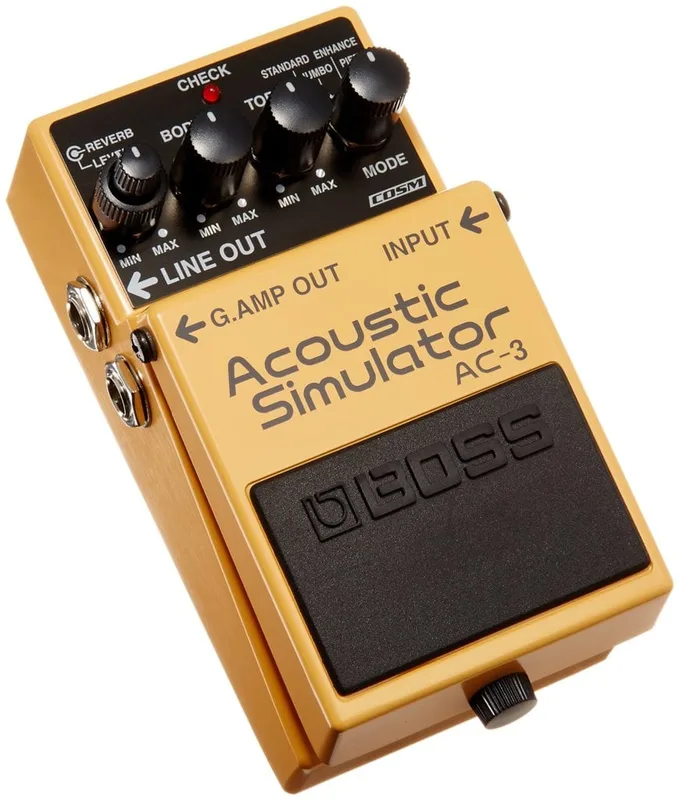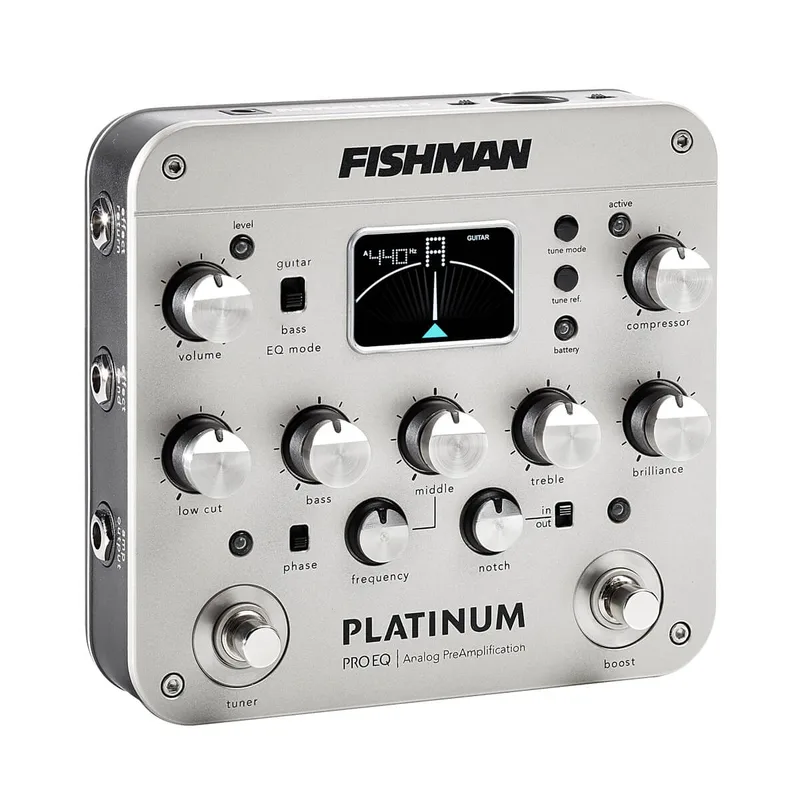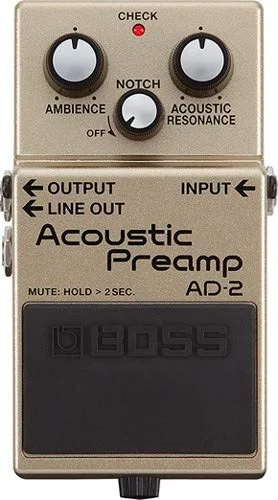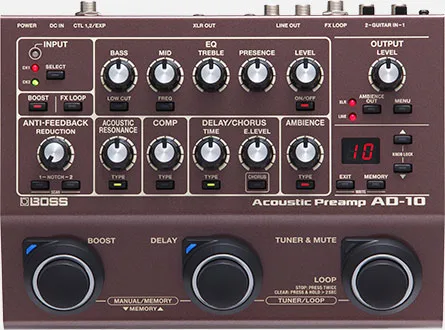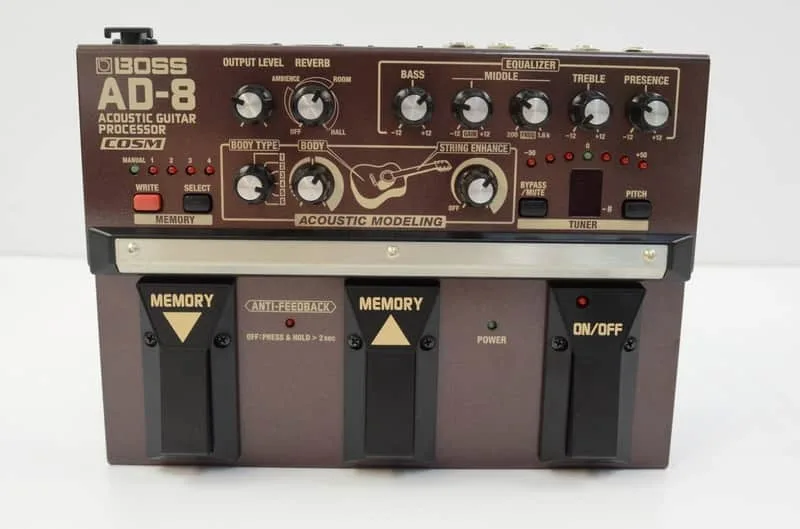


The Boss AD-8 Acoustic Guitar Processor is a floor pedal that uses Roland's COSM modeling technology to take the piezo pickup signal from an acoustic guitar and turn it into the full-bodied tone of a premium acoustic guitar miked in a recording studio. Boss describes it as its top-of-the-line acoustic modeling pedal, and the smaller Boss AC-3 Acoustic Simulator is derived from it12.
It is more than a simulator: the AD-8 packs a modeled acoustic preamp, EQ, anti-feedback, a DI output and a tuner into one box, which is why players have used it as an all-in-one acoustic stage solution. As of the review on which much of this page draws, it sold for approximately $400 street against an MSRP of $558.501.
What it does to your sound
The core of the AD-8 is its set of six acoustic guitar models, each blended with the tone of a specific studio microphone1:
| Guitar model | Paired microphone |
|---|---|
| Martin D-28 | Neumann U87 |
| Gibson B-25 | Neumann U87 |
| Martin 000-28 | Neumann U67 |
| Gibson J-45 | Neumann U67 |
| Guild D-40 | AKG C12 |
| Jose Ramirez classical | AKG C12 |
The idea is that you select the model closest to your guitar, then use the Body knob, which sits next to the model selector, to dial in how much of the modeled tone is applied to your instrument's signal1.
Around the modeling, the AD-8 carries a full EQ section with Bass, Treble, Presence and a sweepable midrange. One thing to know before you buy: the EQ is not bypassable, so it is always in the signal path1. For live use, the pedal can automatically detect and notch out a single problem feedback frequency, which the reviewer found useful in many live situations1.
Outputs, tuner and connections
The AD-8 has a DI built in, with both balanced XLR and unbalanced TRS output jacks, supporting mono and stereo operation, so it can feed a PA and an amp at the same time. There is also a dedicated output optimized for sending the signal to an electric guitar amp, and a headphone jack on the back panel1.
The input is strictly 1/4-inch TRS, meant for a guitar with a piezo or similar pickup. The pedal does not support phantom power, something the reviewer wished for so it could be powered directly from a mixing board1.
An onboard tuner is included. You can choose to have it enabled while you play, or have it mute the output when engaged, and the reference pitch is adjustable1.
Presets and footswitches
The AD-8 gives you five sounds at your feet: memory for four presets plus whatever the front panel knobs are set to. Two Up/Down footswitches scroll through these, and a third footswitch toggles the effect on and off1.
What reviewers said
His verdict was mixed, and worth reading in full before deciding whether the AD-8 suits your rig1:
Scott Kahn's verdict at MusicPlayers.com was that the results varied widely from one guitar to the next, and that depending on the style of play, the AD-8 worked better or worse than traditional acoustic DI boxes, so a player should try it with their own guitar before buying1.
He gave the pedal an overall rating of 3.0 on the site's scale, where 3 stars or better is worth considering1. His two main wishes were the absence of an effects loop for patching in other guitar effects like a compressor or delay, and the lack of phantom power support1.
Videos
lotoqui
Wanerz Vlogs
Questions
Does the Boss AD-8 have phantom power?
No. The AD-8 does not accept phantom power from a mixing board. MusicPlayers.com's reviewer wished Boss had added it so the pedal could be powered directly from a mixing board's phantom supply. For power, the pedal prefers a Boss PSA style adapter or another suitable pedalboard supply, and it can also run on six AA batteries, a set of which is included.
Can the Boss AD-8 run on batteries?
Yes. Alongside a mains adapter, the AD-8 runs off six AA batteries, and Boss includes a set in the box so the pedal works straight away. The reviewer notes the pedal prefers a Boss PSA style power supply, or you can connect it to other power supplies on your pedalboard.
Which acoustic guitar models are in the AD-8?
The AD-8 offers six acoustic guitar models: a Martin D-28, a Martin 000-28, a Gibson J-45, a Gibson B-25, a Guild D-40, and a Jose Ramirez classical guitar. Each is paired with a modeled studio microphone: the D-28 and B-25 with a Neumann U87, the 000-28 and J-45 with a Neumann U67, and the Guild and Ramirez with an AKG C12.
Does the AD-8 have an effects loop?
No. The AD-8 has no effects loop for patching in other pedals such as a compressor or delay, something the MusicPlayers.com reviewer said he would like to see added. Effects have to go before or after the pedal in the signal chain.
Does the AD-8 have a built-in tuner?
Yes. The AD-8 includes an onboard tuner. You can set it to stay enabled while you play, or to mute the pedal's output when engaged, and the reference pitch is adjustable.
Can I use the AD-8 with an electric guitar?
Not directly as an acoustic simulator for a standard electric output. The input is strictly quarter inch TRS, designed for a piezo pickup signal. However, MusicPlayers.com tested it with a Music Man JPXI electric guitar using its piezo acoustic output, which works because that guitar provides a piezo signal the modeling can process.
Sources (2)
- BOSS AD-8 Acoustic Guitar Processor, MusicPlayers.com, 2011-12-11
- BOSS - AC-3 | Acoustic Simulator, boss.info