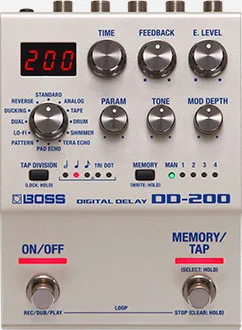


The Boss DD-200 Digital Delay is a digital delay pedal from Boss, part of the 200 series the company introduced in 2019. It brings together the sounds and features inherited from the flagship DD-500 into a much smaller box: Premier Guitar described it as "an enclosure that's little more than 50 percent bigger than a standard Boss pedal"12. Boss says the twelve modes provide "nearly any flavor of delay," from basic echoes to rich ambient pads3.
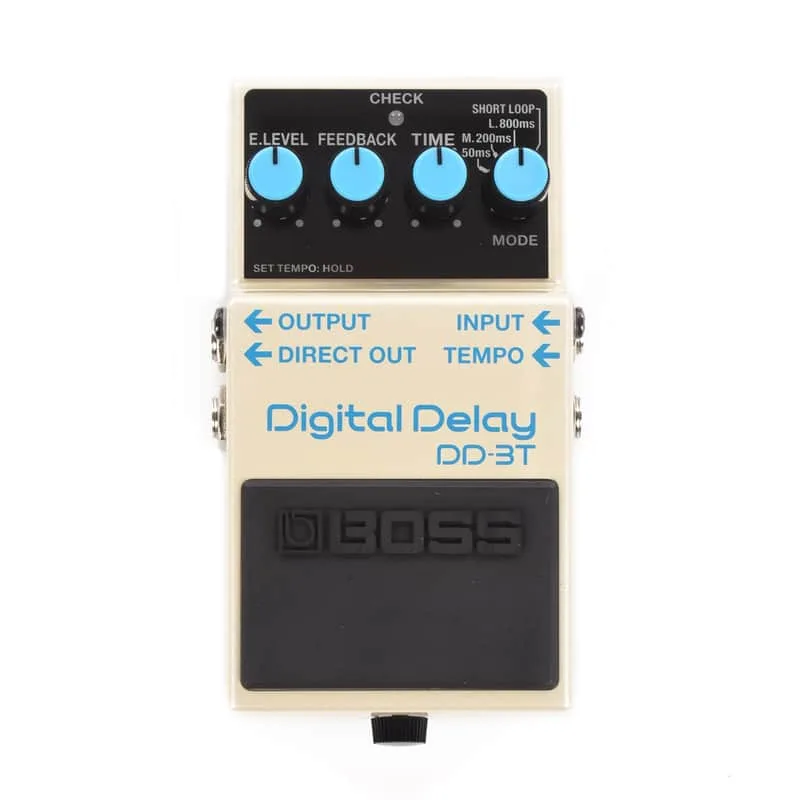
The pedal is also a looper, with up to 60 seconds of recording time always ready to use4, and it runs a full stereo rig with MIDI control, which puts it a step beyond Boss's compact single-function delays like the DD-3T.
Twelve delay modes from the DD-500
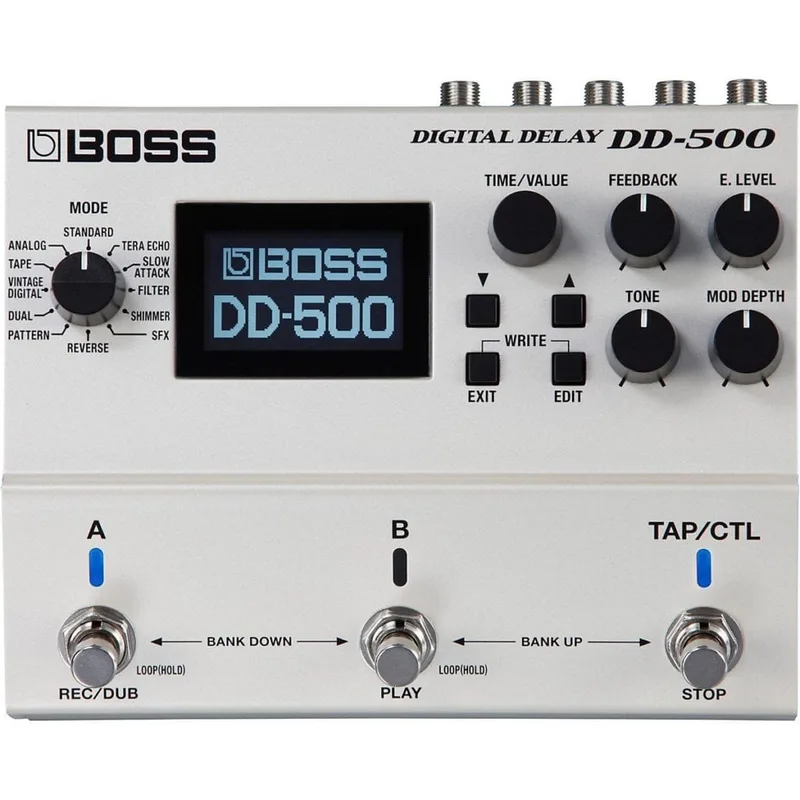
The DD-200's delay engines are drawn from the DD-500, Boss's flagship delay launched in 2015 with, as MusicRadar reported at the time, "12 delay modes, a graphic display and deep editing controls"783. The DD-200 keeps the twelve modes and drops most of the deep editing surface. On That Pedal Show, Mick Taylor and Daniel Steinhardt summed it up: the pedal has "at its heart twelve delay engines so everything from standard digital delays through analog everything you'd expect"9.
The twelve modes3:
| Group | Modes |
|---|---|
| Classic voices | Standard, Analog, Tape |
| Ambient and textured | Shimmer, Tera Echo, Pad Echo, Lo-Fi |
| Rhythmic | Drum, Pattern, Dual, Ducking |
| Special | Reverse |
RockBoard's PedalPedia describes the range as "delay colors from modern digital to classic analog"5, and the launch announcement promised "everything from basic echoes to rich ambient pads and everything in-between"10. The Reverse mode is more than a novelty: Premier Guitar found it "enables useful attack adjustments through the parameter knob, as well as the ability to remove the dry signal entirely, replicating real studio reverse-tape effects"1.
The controls
The front panel keeps Boss's knob-per-function layout rather than the menu diving of the DD-500. Two footswitches handle bypass and tap tempo, and both are customizable multi-function switches that can be reassigned to memory selection or looper control6. The rear panel has room for expansion footswitches and an expression pedal11.
What the main controls do:
| Control | What it does |
|---|---|
| Time | Click knob for precision settings down to the millisecond, up to three seconds, or in beats per minute1 |
| Parameter | Changes character per mode: number of virtual playback heads in Drum, attack in Pad and digital modes, distortion amount in Lo-Fi1 |
| Tone | High-boost/cut, "useful for recasting basic delay voices"1 |
| Modulation depth | Adds "a touch of wobble to any of the voices"1 |
| Tap division | Half, quarter and eighth note modes, each with dotted and triplet settings1 |
| Memory | Preset selection among the 128 total setups32 |
The click-detent time knob is worth noting for players who set delay by ear: Premier Guitar highlighted that it "enables precision settings down to the millisecond (up to three seconds)" rather than the sweep-and-hope feel of a plain rotary control1.
Power and connections
The DD-200 runs on 9V DC center negative and draws 225mA5, which is substantial for a single pedal and rules out sharing a low-current daisy chain output with several analog pedals. It also runs on a PSA-series AC adaptor or three AA-size batteries6, unusual for a pedal with this much processing on board.
At 225mA5, the DD-200 draws more current than most compact analog pedals. Check your power supply's per-output rating before plugging it in alongside a full board.
Connections are stereo: Pedal of the Day noted you can "run your entire Stereo rig right through this guy"12. Full MIDI I/O is provided with mini TRS jacks, with the BMIDI-5-35 adaptor cable available separately6, so the pedal can sit in a MIDI-switched rig or take program changes from a controller. External footswitches and an expression pedal are also supported6.
DD-200 versus DD-500
The core difference is size and editing depth. The DD-200 inherits the DD-500's twelve delay modes37 but drops the flagship's graphic display and deep editing controls3513. Guitar World's reviewer put the tradeoff plainly: "Hardcore delay fans might miss the DD-500's screen"4. For players who want the sounds without the menu system, the smaller box is the point; for players who tweak at the parameter level, the DD-500 remains the deeper tool.
What reviewers said
Published reception was positive. Delicious Audio reported in 2020 that "The first videos of the BOSS DD-200 Digital Delay are surfacing and the feedback is very positive"6. Premier Guitar's 2021 review found the tone control and the parameter knob gave the basic voices real range, and highlighted the reverse mode's studio-style dry-kill capability1. Guitar World reviewed it alongside the DD-3T and flagged the missing screen as the main thing a DD-500 owner would notice4.
On That Pedal Show's demo, the presenters walked through the twelve engines and the looper, treating the pedal as a compact way to get the DD-500's palette on a smaller board942.
Videos
Pete Thorn
BOSSchannel
Brett Kingman
Questions
Can the Boss DD-200 run on batteries?
Yes. It runs on three AA-size batteries or a PSA-series AC adaptor. Note that it also accepts 9V DC center negative power, and its 225mA current draw is high enough that a small daisy chain supply may struggle with it.
Is the Boss DD-200 true bypass?
No. The DD-200 uses analog dry through with a buffered bypass, meaning the dry signal stays in the analog domain while the effect is engaged, and the pedal is buffered when bypassed rather than fully disconnected.
How many presets does the DD-200 store?
Boss states the DD-200 holds 127 user memories plus a real-time panel setting, for 128 total setups. An earlier press description referred to four memories for favorite sounds, but the maker's current figure is 127 user memories.
What is the maximum delay time on the DD-200?
The time control allows precision settings down to the millisecond, up to three seconds, and can also be set in beats per minute using tap tempo. Tap division options include half, quarter and eighth notes, each with dotted and triplet settings.
What is the difference between the DD-200 and DD-500?
The DD-200 carries the twelve delay modes inherited from the flagship DD-500 into a much smaller enclosure, roughly 50 percent bigger than a standard Boss pedal. The DD-500 adds a graphic display and deeper editing controls, which Guitar World's reviewer noted hardcore delay fans might miss on the DD-200.
How long is the DD-200 looper?
The built-in looper offers up to 60 seconds of recording time and is always ready to use, so you can loop without switching the pedal out of delay mode.
Sources (13)
- Boss DD-200 Digital Delay Review, Premier Guitar, 2019-10-25
- BOSS Introduces 200 Series Effect Pedals, MusicPlayers.com, 2019-06-13
- BOSS - DD-200 | Digital Delay, boss.info
- Boss DD-3T and DD-200 Digital Delay review, Guitar World, 2020-05-28
- DD-200 Digital Delay by BOSS, RockBoard (rockboard.de PedalPedia), 2026
- BOSS DD-200 Digital Delay, Delicious Audio, 2020-07-08
- BOSS - DD-500 | Digital Delay, boss.info
- SUMMER NAMM 2015: Boss reveals DD-500 Digital Delay and RV-6 Reverb guitar pedals, MusicRadar, 2015-07-08
- Boss DD-200, Revival Drive Compact, Fender Bubbler, Spaceman Gemini IV, That Pedal Show (YouTube), 2019-09-24
- Boss Launches the 200 Pedal Series, Premier Guitar, 2019-06-13
- Boss DD-200 Digital Delay review, MusicRadar, 2019-11-21
- Boss DD-200 Digital Delay, Pedal of the Day, 2019-10-06
- Guitar Pedal X, Guitar Pedal X, 2020-07-26