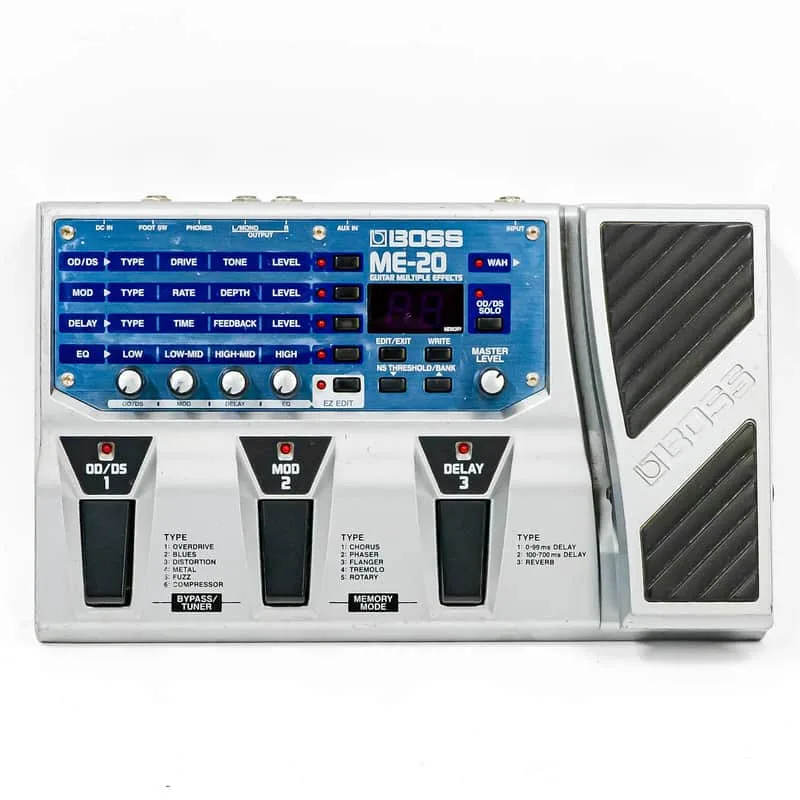


The Boss ME-20 is a compact guitar multi-effects floor unit aimed at players who want the essentials in one box rather than a deep modeling processor. It is built around a trio of basic effect types: overdrive/distortion, modulation and delay, each with its own section on the panel1. It sits in the multi-effects family, but its approach is deliberately simple, and it leans on individual knobs rather than menus.
The controls
The panel is laid out so each effect type has its own controls. A select button and four silver parameter controls alter the type, rate, depth and level of the selected effect, so changing a sound is a matter of pressing the relevant button and turning knobs rather than digging through displays1. The unit also includes a master volume, which is always useful for setting overall level1.
| Control | What it does |
|---|---|
| Select button | Chooses the effect section you want to adjust1 |
| Four parameter controls | Alter the type, rate, depth and level of the selected effect1 |
| Master volume | Sets the unit's overall output level1 |
| Expression pedal | Usable for either volume or wah1 |
| EZ Edit button | Calls up pre-programmed settings without touching a knob1 |
The EZ Edit function is a large part of the ME-20's ease of use. Boss has included an impressive number of settings that can be activated without even a single twist of a knob: pre-programmed sounds such as overdrives with different gains and delays with different time and feedback values1.
Effect types and extras
The three main sections cover the core of a gigging rig:
- Overdrive/distortion, with a Solo function described below
- Modulation, where the Modulation Type includes chorus, phaser, flanger, tremolo and rotary1
- Delay, where the Delay Type also includes a huge reverb1
Beyond those, other "hidden" features include an onboard noise suppressor, compressor and tuner1, covering the noise gate, compressor and tuner roles without extra pedals.
The reverb in the Delay Type section cannot be combined with the actual delays: the unit's structure does not allow the two to run together1.
The Solo function
The OD/DS Solo function provides a hike in output, allowing carefully built solos to be heard above the band. It is accessed via a small button and is best used in Memory mode1. Optional footswitches can trigger the Solo function remotely, but there is a catch: this turns on the OD/DS type whether you have chosen it or not. As the review puts it, "a clean boost this isn't"1.
Build and power
The ME-20 is heavier than it looks, and the metal chassis certainly seems robust enough to survive an onstage boot battering, according to MusicRadar's review1. Power comes from six AA batteries or an optional PSU1, so it can run without mains power at a rehearsal or small gig, though a power supply is the practical choice for regular use.
What reviewers said
MusicRadar's review, by Simon Bradley, positions the ME-20 as a unit for a wide range of players: "For first-time buyers to semi-pro gigging guitarists, this streamlined unit will appeal to many players." The review highlights its ease of use, the EZ Edit and Solo functions, and its great price as the reasons for that appeal1.
The same review names the single most obvious potential downside of the ME-20's non-modeling system: ears have been rather spoiled by modeling units, so players expecting amp models and deep editing should look elsewhere1. For a player who wants three core effect types, a built-in expression pedal and a short path from box to gig, that simplicity is the point.
Videos
Guitar World
BOSSchannel
nikmarkmedia
Questions
Does the Boss ME-20 have a tuner?
Yes. Alongside its three main effect types, the ME-20 includes what MusicRadar's review calls 'hidden' features: an onboard noise suppressor, a compressor and a tuner. These are not given their own front-panel effect sections, but they are built into the unit, so a player can keep their signal quiet, add light compression and tune up without carrying separate pedals.
Can you use reverb and delay at the same time on the Boss ME-20?
No. The Delay Type section includes a large reverb, but the unit's structure does not allow that reverb to be combined with the actual delays. You can have the reverb or a delay from that section, not both at once, which is one of the trade-offs of the ME-20's streamlined, non-modelling design.
Is the Boss ME-20 a modeling multi-effects?
No. The ME-20 is a non-modelling system. It is built around three basic effect types, overdrive/distortion, modulation and delay, each adjusted with its own knobs rather than by loading amp or pedal models. MusicRadar notes that the obvious potential downside of a non-modelling system is that ears have been rather spoiled by modelling units.
How does the Solo function on the Boss ME-20 work?
The OD/DS Solo function provides a hike in output so your solos can be heard above the band. It is accessed via a small button and works best in Memory mode. Optional footswitches can trigger the Solo function remotely, but doing so turns on the OD/DS type whether you have chosen it or not, so it is not a clean boost.
Can the Boss ME-20 expression pedal be used as a wah?
Yes. The built-in expression pedal can be set for either volume or wah, so you can sweep filter tones or control level with your foot without adding a separate expression pedal to your setup.
Sources (1)
- Boss ME-20 Guitar Multiple Effects review, MusicRadar, 2008-09-15