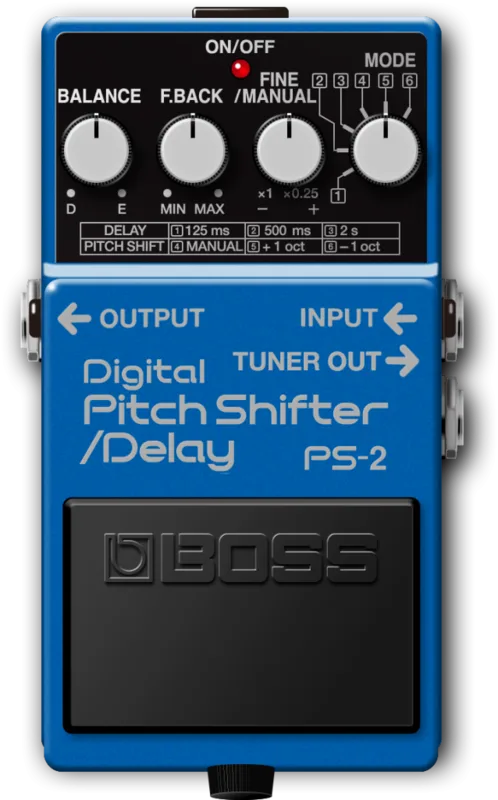


The BOSS PS-2 Digital Pitch Shifter/Delay is a compact effects pedal from Boss that combines two effects in one blue box: digital pitch shifting and digital delay. Pedal of the Day called it "basically two pedals in one, offering wild pitch shifting and pristine delay"1. Boss brought continuous pitch shifting to the compact pedal format in 19872, and the pedal was produced until 19943. It is discontinued and available only secondhand1.
The PS-2's appeal for players today is its character. Its 8-bit digital circuit gives the sound what Boss calls "an interesting low-res character"4, and Boss notes the effect remains popular for its retro 8-bit processing and vintage digital character5.
Pitch shifting and delay in one pedal
The PS-2's six-position Mode switch offers three pitch shift settings and three delay ranges, from thickening slapbacks to two-second echoes4. You pick the effect with the Mode control, then adjust it with the other knobs.
- +1 Octave: a preset shift one octave up
- -1 Octave: a preset shift one octave down
- Manual: fine-tuning the pitch over two octaves with the Fine-Manual knob
- Mode 1: maximum delay time of 125 ms
- Mode 2: maximum delay time of 500 ms
- Mode 3: maximum delay time of 2 seconds
The delay time ranges from 30 ms to two full seconds26, and in one of its modes the PS-2 offered up to two full seconds of delay time, another BOSS delay pedal first7. The three pitch modes include a manual option for fine-tuning the pitch over two octaves and presets for one octave up and one octave down5.
| Control | What it does |
|---|---|
| Mode | Selects the Delay or Pitch Shifting mode1 |
| Balance | Sets the mix of effect against dry signal, for creative layering4 |
| Feedback | Sets regeneration of the effect4 |
| Fine-Manual | Adjusts delay time in Delay modes and pitch amount in Manual pitch shift mode1 |
The Balance and Feedback controls allow creative layering and regeneration4. The PS-2 used the same analog compander found in the DD-2 Digital Delay, softening the attack of feedback and adding warmth4.
Pedal of the Day's reviewer found it works as a delay on its own, with pitch shifting adding live versatility1:
"This is a great little vintage delay in and of itself, but the ability to change to a nice pitch shifter with a turn of [a knob]"1
"the PS-2 Digital Pitch Shifter / Delay is basically two pedals in one, offering wild pitch shifting and pristine delay"1
The reviewer also noted the blue box can be used for practice, gigs, recording and more1.
Power and connections
The PS-2 runs on DC 9V with a 60 mA current draw, and the recommended AC adaptor is the Boss PSA Series1. Its connectors are Input, Output, Tuner Out (for plugging into a tuner) and AC Adaptor1. Input impedance is 1 Mohm1.
The Tuner Out jack is worth knowing about: a dedicated output jack provided a connection for an external tuner, like the era's Boss TU-12, allowing the player to keep a tuner connected without it interrupting the signal path7.
History: the third compact digital Boss pedal
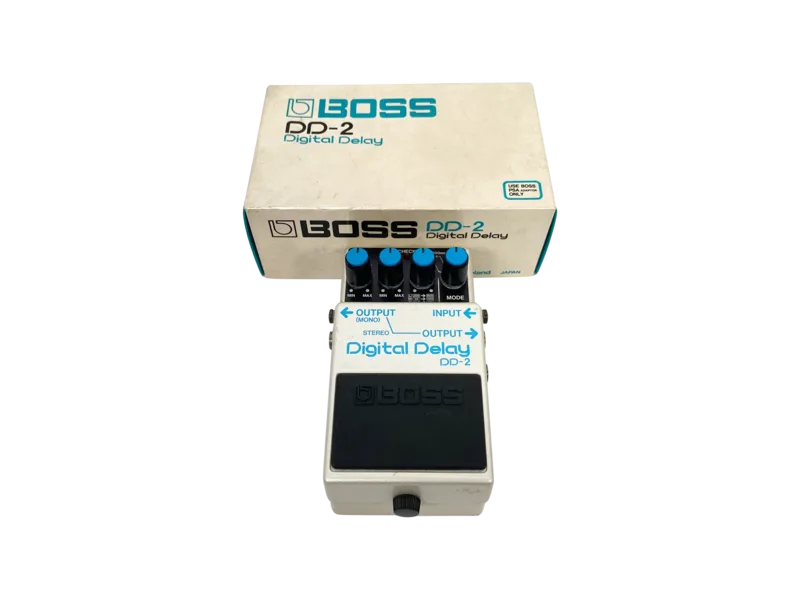
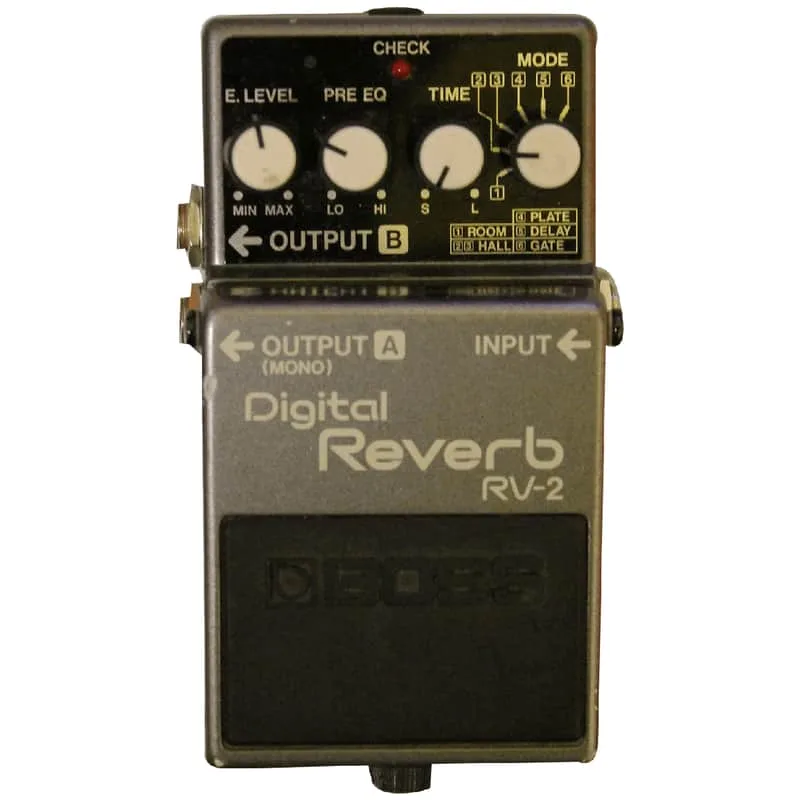
The PS-2 arrived as the third in a run of early compact digital pedals from Boss. Having broken new ground with two world firsts, the DD-2 Digital Delay and RV-2 Digital Reverb, guitarists were next treated to the PS-23. The DD-2, unveiled in 1983, was the world's first compact digital delay pedal4. The PS-2 brought continuous pitch shifting to the compact pedal format in 19872, and Boss produced it from 1987 to 19943.
Boss's own history of its delay pedals records the PS-2's place in the line3:
"In one of its modes, the PS-2 offered up to two full seconds of delay time, another BOSS delay pedal first."7
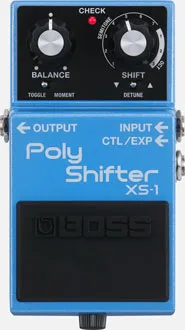
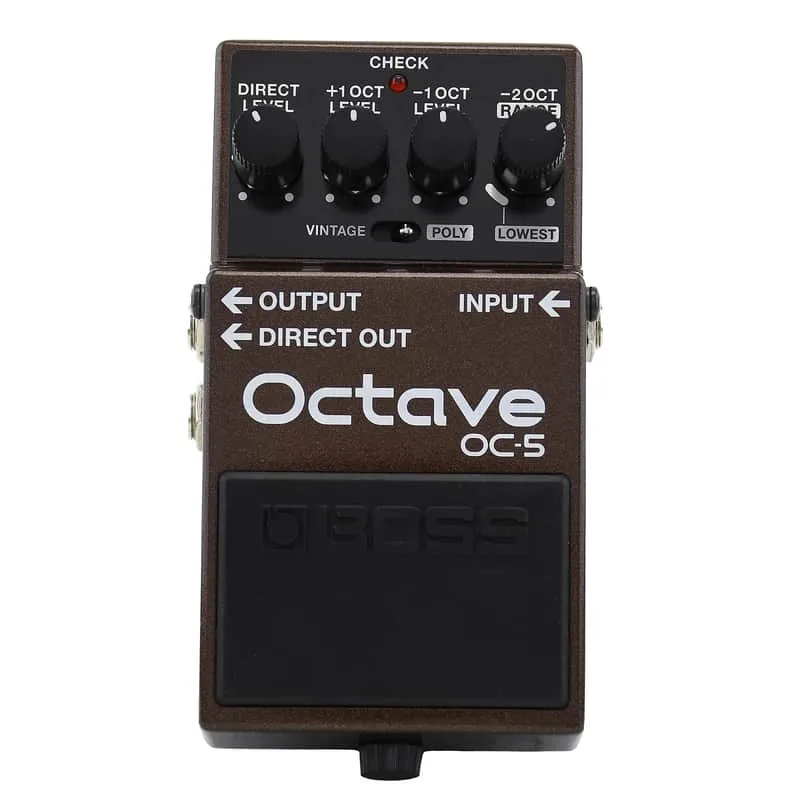
For players exploring pitch effects today, the PS-2's 8-bit character is part of the appeal, and it stands apart from modern polyphonic shifters like the Boss XS-100 Poly Shifter and Boss XS-1 Poly Shifter. Octave-style alternatives include the Boss OC-5 and the vintage Boss OC-2. For its delay side, see the wider world of delay pedals, and for pitch effects generally, octave and pitch pedals.
Videos
Pepe Music
pedal partners
intheblues
Questions
Is the BOSS PS-2 analog or digital?
It is digital. The PS-2 uses an 8-bit digital circuit, which Boss says gives the sound an interesting low-res character. It also uses the same analog compander found in the DD-2 Digital Delay, softening the attack of feedback and adding warmth.
How long is the delay time on the PS-2?
The delay time ranges from 30 ms to two full seconds. The three delay modes set maximum delay times of 125 ms, 500 ms and 2 seconds, covering everything from thickening slapbacks to two-second echoes. The two-second maximum was a first for a Boss delay pedal.
Is the BOSS PS-2 still made?
No. Boss produced the PS-2 from 1987 to 1994, and it is discontinued. It is available secondhand, and reviewers note that if you can find one, it will not break the bank.
Does the PS-2 have a tuner output?
Yes. The PS-2 has a dedicated output jack for an external tuner, such as the era's Boss TU-12, letting the player keep a tuner connected without it sitting in the signal chain. Its connectors are Input, Output, Tuner Out and AC Adaptor.
What is the difference between the PS-2 and the PS-3?
The PS-2 was the original 1987 compact digital pitch shifter and delay from Boss, running from 1987 to 1994. The PS-3 was its later successor in the same family. This page covers the PS-2; the PS-3 has its own page.
What does 8-bit mean for the PS-2's sound?
The PS-2 processes audio with an 8-bit digital circuit rather than the higher resolutions of later pedals. Boss describes this as giving the sound an interesting low-res character, and the effect remains popular for its retro 8-bit processing and vintage digital character.
Sources (7)
- Boss PS-2 Digital Pitch Shifter / Delay, Pedal of the Day, 2023-05-18
- BOSS - PX-1 | Plugout FX, BOSS (boss.info)
- BOSS - XS Series Pitch Pedals, BOSS (boss.info)
- The PX-1 Plugout FX: Timeless BOSS Pedals Reborn, BOSS (articles.boss.info), 2025-06-06
- BOSS - PX-1 | Plugout FX, BOSS (www.boss.info)
- BOSS - PX-1 | Plugout FX, BOSS (boss.info)
- Echoes in Time: The History of BOSS Delay Pedals, BOSS (articles.boss.info), 2024-01-10