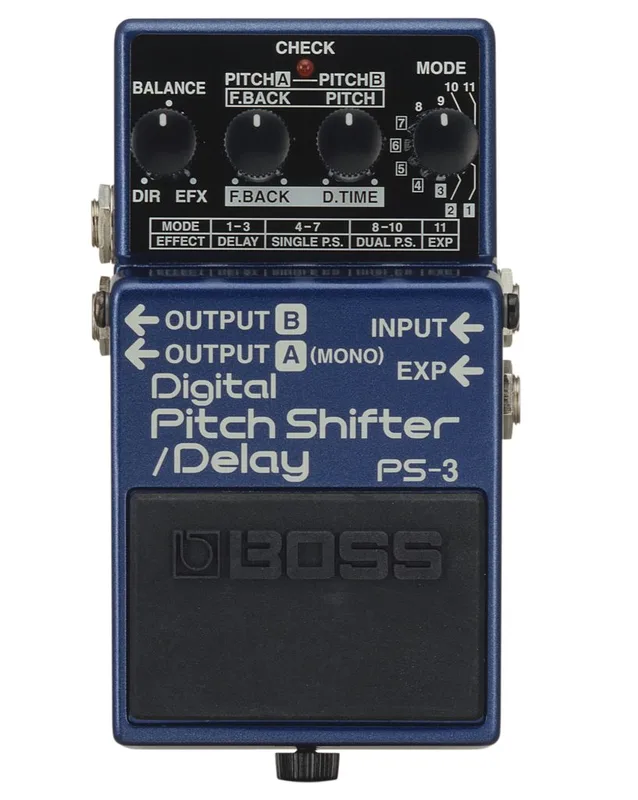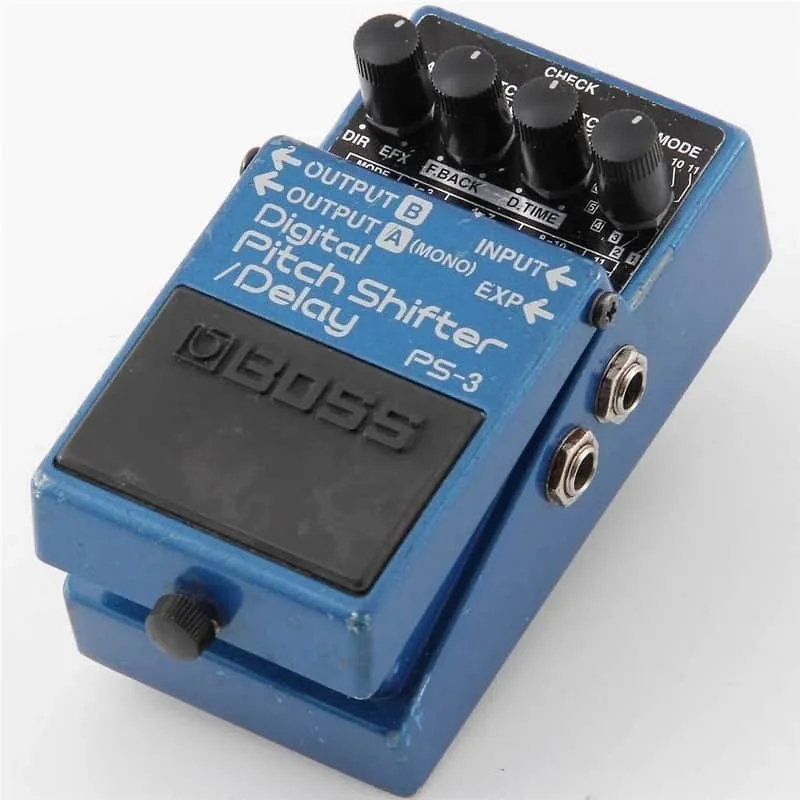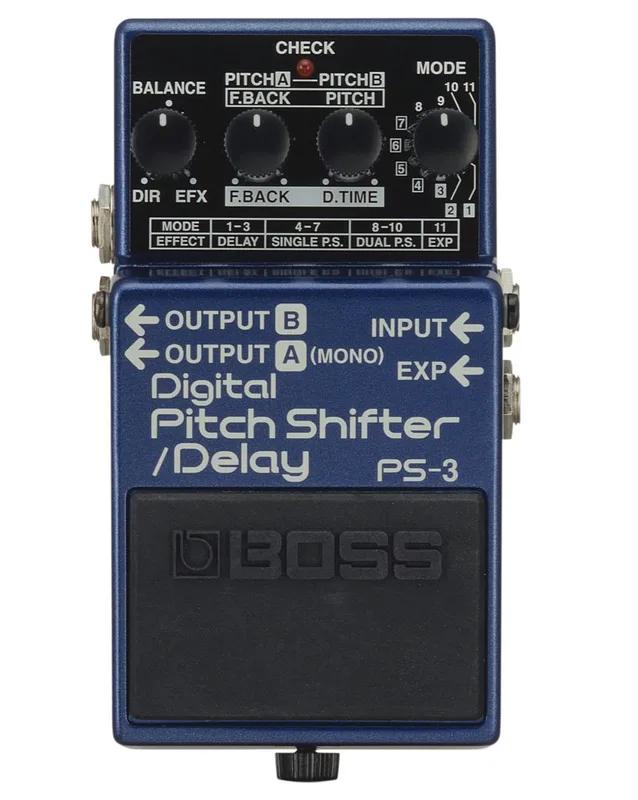


The Boss PS-3 Pitch Shifter / Delay is a compact one-stomp pedal that puts digital pitch shifting and digital delay in a single box. Made from 1994 to 1999, it is no longer in production12, but it remains a name players run into when hunting for early pitch-shifting pedals, and its mode layout still shapes how Boss approaches the combination of pitch and delay.
What it does
The PS-3 runs on 16-bit DSP, which Boss's own history article says delivered studio-grade clarity and considerably widened the sonic canvas for musicians1. Delicious Audio describes it as providing up to two seconds of delay time and allowing for a myriad of blended shift/delay effects, so the pitch and delay sides can be used together rather than as two separate pedals3.
The eleven modes
An eleven-way mode selector presents eight pitch-based and three delay effect choices, with delay up to two seconds1. Pedal of the Day's reviewer, Gabriel, breaks the same count down as seven pitch modes, three delay modes and one expression mode4.
| Mode group | What it covers |
|---|---|
| Pitch modes (eight choices) | Shifting up or down over two full octaves, a detune mode for chorus-like tones, and a dual mode creating two independent pitch shifts at once, each sendable to separate outputs for stereo operation6 |
| Delay modes (three choices) | Classic Boss digital delay settings, up to two seconds43 |
| Expression mode (one) | An expression-controlled patch, the eleventh position45 |
MusicRadar's Alex Lynham sums up the spread: three delays, choruses and single pitch modes, a straight-up pitch-shifter on mode 5, and a shimmer octave sound on mode 75.
Mode 7
Mode 7 is a pitch-shifting reversing delay4. Gabriel called it his personal favorite:
"Depending on where you place the settings it will give you a continuously reversed pitch-shifted delay. It sounds magical!"
That reversing, pitch-shifted character is the mode the PS-3 is most remembered for, and it is a large part of why players still look for the pedal secondhand4.
How it compares with the PS-2
The PS-3 followed the Boss PS-2. Boss's Jim Bybee notes that while the delay functionality is the same as the PS-2, the pitch-shifting abilities were greatly expanded16. On the PS-3 the pitch could be shifted up or down over two full octaves, a detune mode was available to create chorus-like tones, and a dual mode created two independent pitch shifts at once, each sendable to separate outputs for stereo operation6. In other words, the delay side carried over, and the pitch side is where the PS-3 grew.
Where it sits in Boss's history
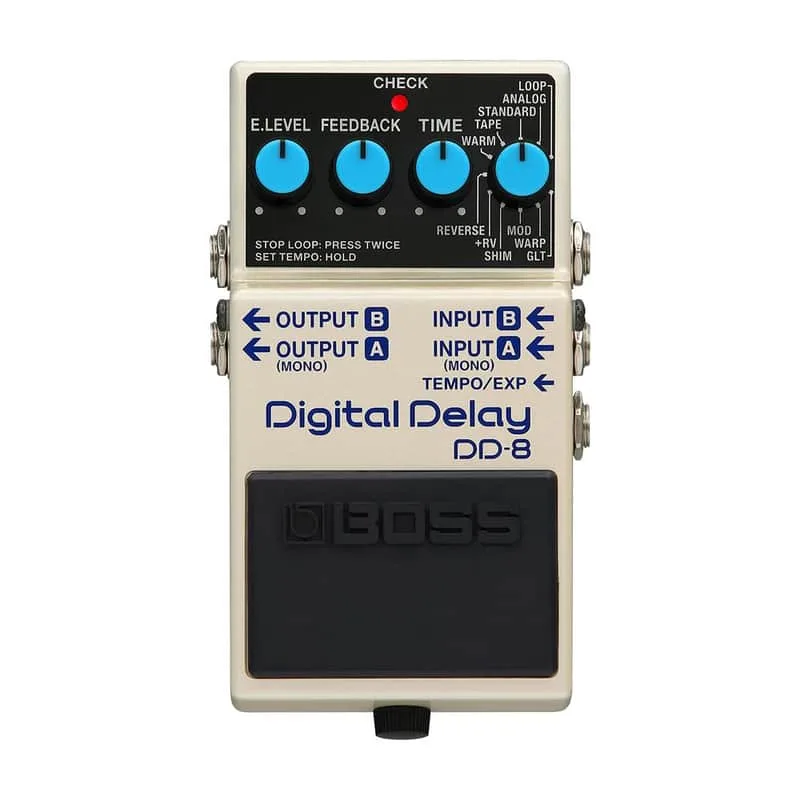
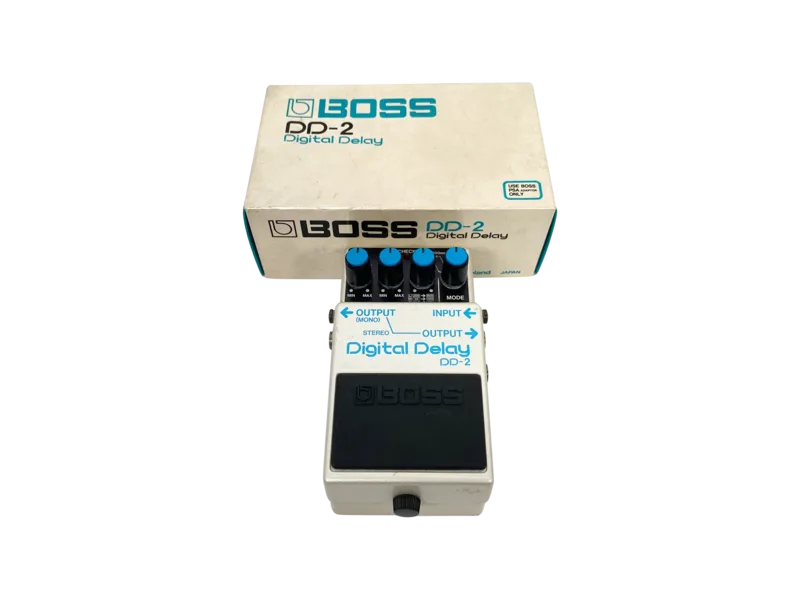
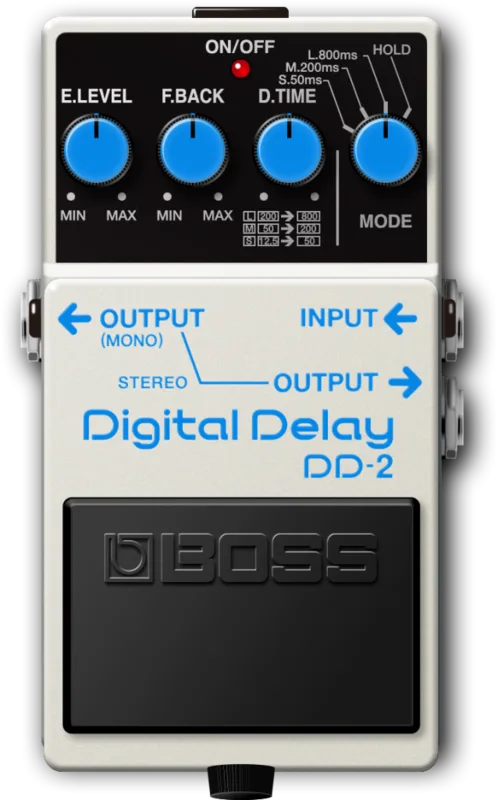
Boss lists the PS-3 Digital Pitch Shifter/Delay as part of its 1994 to 1999 lineup2, and its delay heritage sits within the company's longer line of digital delay pedals, from the Boss DD-2 through later models like the Boss DD-824. For players interested in the type, the PS-3 belongs to the wider family of octave and pitch pedals and delay pedals.
Gabriel's verdict on the whole package captures why it is still discussed:
"There's A LOT in this lil one-stomp pedal."
Videos
Gear Confessions
Dennis Kayzer
Brian Lynch
Questions
How long is the delay on the Boss PS-3?
The PS-3 offers up to two seconds of delay time across its three delay modes. Boss notes that the delay functionality was the same as on the earlier PS-2, while the pitch-shifting abilities were greatly expanded. The delay and pitch sides can also be blended together for combined shift and delay effects.
How many pitch modes does the Boss PS-3 have?
The PS-3 has eleven modes in total: an eleven-way mode selector presents eight pitch-based choices and three delay choices. The pitch modes cover shifting up or down over two full octaves, a detune mode for chorus-like tones, and a dual mode creating two independent pitch shifts at once, each sendable to separate outputs for stereo operation.
Is the Boss PS-3 still made?
No. Boss lists the PS-3 Digital Pitch Shifter/Delay as having been made from 1994 to 1999, and MusicRadar confirms it is not in production anymore. It remains available secondhand, and its modes have since appeared in other Boss pitch pedals.
What is Mode 7 on the Boss PS-3?
Mode 7 is a pitch-shifting reversing delay. Pedal of the Day's reviewer called it his personal favorite, noting that depending on where you place the settings it gives a continuously reversed pitch-shifted delay, and described the sound as magical. MusicRadar also points to a shimmer octave sound on mode 7.
How is the PS-3 different from the PS-2?
The delay functionality is the same as the PS-2, with up to two seconds of delay time, but Boss says the pitch-shifting abilities were greatly expanded on the PS-3. The pitch could be shifted up or down over two full octaves, with a detune mode for chorus-like tones and a dual mode creating two independent pitch shifts at once.
Can the PS-3 be used with an expression pedal?
Yes. Alongside its seven pitch modes and three delay modes, the PS-3 has one expression-controlled mode, the eleventh position on its mode selector. MusicRadar describes it as an expression-controlled patch, which lets a connected expression pedal control the effect in real time.
Sources (6)
- Shifting With the Times: The History of BOSS Pitch Pedals, articles.boss.info, 2025-12-17
- BOSS - XS Series Pitch Pedals, BOSS (boss.info)
- BOSS PS-3 Pitch Shifter/Delay, Delicious Audio, 2024-02-15
- Boss PS-3 Pitch Shifter / Delay, Pedal of the Day, 2014-05-13
- 5 great pitch shifting pedals guitarists need to try, MusicRadar, 2021-08-03
- Echoes in Time: The History of BOSS Delay Pedals, BOSS (articles.boss.info), 2024-01-10