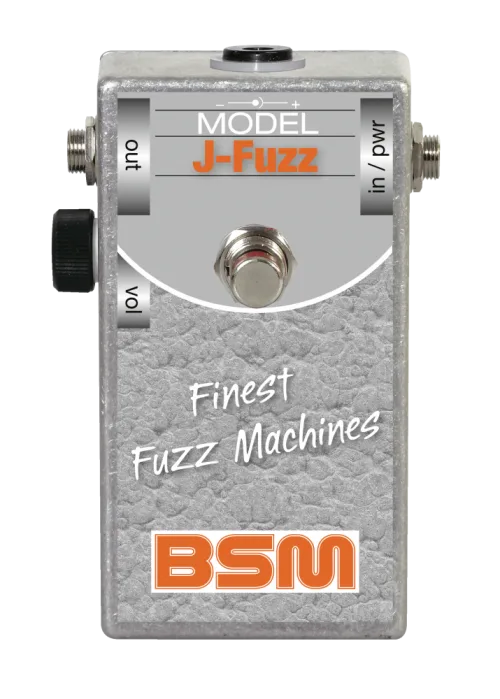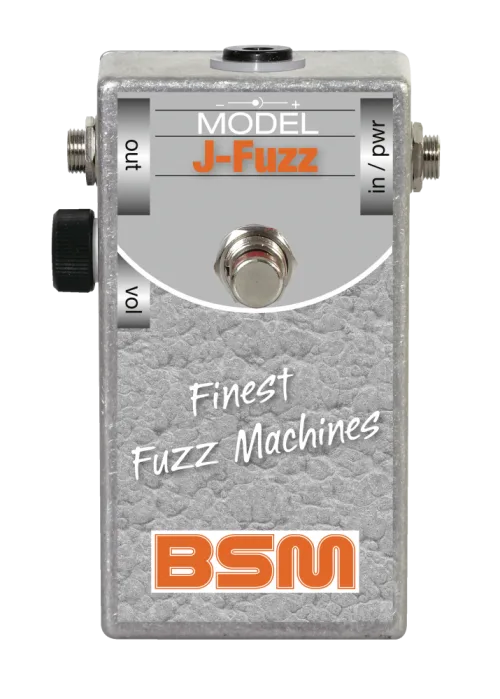


The BSM J-Fuzz Fuzz Machine is a stompbox fuzz pedal from BSM. BSM describes it as "a faithful recreation of the old original Jennings Fuzz from the late 60´s."1 The pedal was introduced as a new release from the maker, shown alongside the RPA Major as one of "two new pedals from BSM; the RPA Major and the J-Fuzz."2
For a player, the pitch is simple: a Jennings-style fuzz with very high gain and long sustain. BSM's own description of the pedal promises "Gain till the sun rises, violin sustain and really sick tones with the guitar volume turned down."3 With the volume control fully opened, the maker describes the sound as "warm, full and incredibly fat," and notes it is "milder and rounder than other silicone fuzzes, reminiscent of old germanium" fuzzes.4
What it does to your sound
The J-Fuzz is built for sustain and fatness rather than aggressive gating or splutter. BSM describes the tone with the volume wide open as warm, full and incredibly fat, and closer to old germanium fuzzes than to harder-edged silicon designs, even though the pedal uses silicon transistors.4 The maker also highlights the pedal's response at lower guitar volumes, describing violin sustain and usable tones with the guitar volume turned down.3
"Gain till the sun rises, violin sustain and really sick tones with the guitar volume turned down."
On the component side, BSM states the pedal uses:
- NOS transistors from the Japanese company "Micro Electronics," a batch the maker secured and is "using them exclusively for the BSM J-Fuzz"5
- polysterol caps among the parts35
Controls and power
The J-Fuzz runs on a 9V battery or an external 9V power supply, with a current consumption of approximately 2mA.4 That draw is low enough that the pedal sits easily on any board without stressing a supply.
| Specification | Value |
|---|---|
| Power | 9V battery or external 9V power supply4 |
| Current consumption | approximately 2mA4 |
| Battery polarity | negative pole is ground5 |
| Average output level | -5dBm5 |
| Maximum output voltage | 0.4V, when the strings are struck really hard5 |
| Made in | Germany5 |
BSM's documentation notes that the negative pole of the battery is ground.5 As with any center-negative pedal, that matters when daisy-chaining with other pedals or choosing an external supply.
Two output figures are worth knowing for gain-staging: BSM gives the average output level as -5dBm, and the maximum output voltage as 0.4V, reached when the strings are struck really hard.5 Those are modest levels, so the J-Fuzz is unlikely to slam a following pedal's input the way a hot overdrive can.
Where it came from
The circuit behind the J-Fuzz is the Jennings Fuzz. BSM calls the recreation faithful, describing it as "a faithful recreation of the old original Jennings Fuzz from the late 60´s."1 The maker also credits the pedal's sound to a batch of NOS transistors from the Japanese company Micro Electronics, which BSM says it uses exclusively in the J-Fuzz.1
Where it sits in a signal chain
BSM is explicit about placement: "the J-Fuzz should be connected in the signal path directly after the guitar."4 The maker's reasoning is that the pedal's characteristic tone is best achieved that way, which fits with the volume-knob response described above. Players who use fuzz pedals of this type typically put them ahead of overdrive pedals, distortion pedals, wahs and time-based effects for the same reason.
What reviewers said
The J-Fuzz was introduced as one of "two new pedals from BSM; the RPA Major and the J-Fuzz."2
Videos
Premier Guitar
Steves MusicCenter
Wall of Sound
Questions
Does the BSM J-Fuzz run on a battery?
Yes. BSM states the J-Fuzz is powered by a 9V battery or an external 9V power supply, with a current consumption of approximately 2mA. The maker also notes that the negative pole of the battery is ground, which matters when wiring the pedal or choosing a power supply.
What is the BSM J-Fuzz based on?
BSM describes the J-Fuzz as a faithful recreation of the original Jennings Fuzz. The maker's pages date that original to the late 1960s, and one page calls it a Jennings fuzz from 1969, while another describes an early 1970s Jennings Fuzz, so the maker's own pages differ on the exact era. The circuit was engineered by Dick Denney.
Where does the J-Fuzz go in a signal chain?
BSM recommends connecting the J-Fuzz directly after the guitar in the signal path. The maker says the pedal's characteristic tone is best achieved that way, which is a common arrangement for fuzz pedals that interact with the guitar's volume control.
Where is the BSM J-Fuzz made?
The J-Fuzz is made in Germany, according to BSM's product documentation.
Does the J-Fuzz clean up with the guitar volume?
BSM's product page describes violin sustain and usable tones with the guitar volume turned down, which points to the volume-control response players expect from a fuzz of this type. The maker's wording suggests the pedal responds to the guitar's volume knob rather than only working at full output.
Sources (5)
- J-Fuzz Fuzz Machine, BSM (treblebooster.net), 2025
- BSM Treble Boosters RPA Major & J-Fuzz Demos, Premier Guitar, 2009-05-07
- Special Units, BSM (treblebooster.net), 2025
- J-Fuzz Fuzz Machine, BSM (treblebooster.net), 2025
- untitled, BSM, 2025