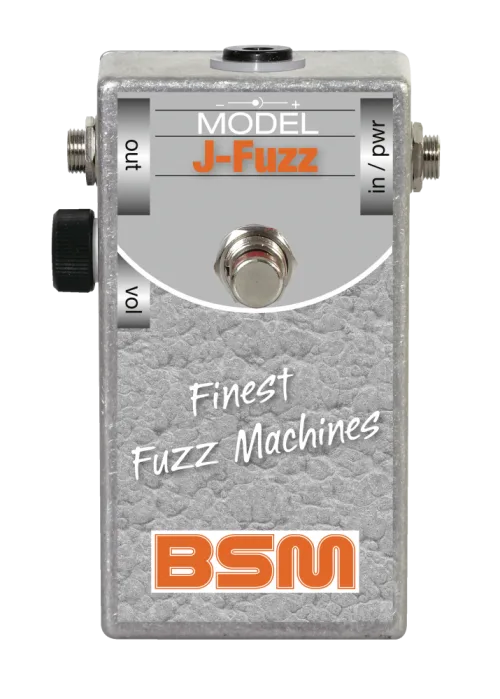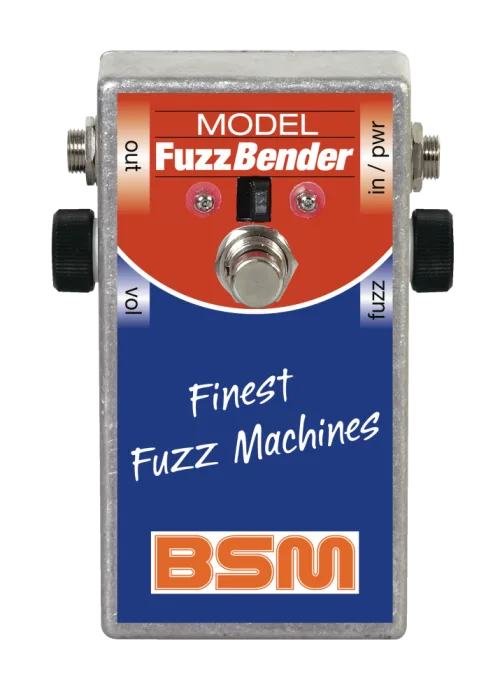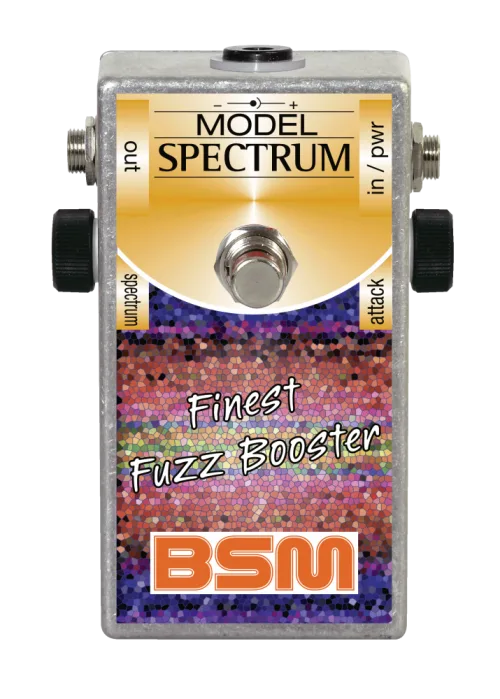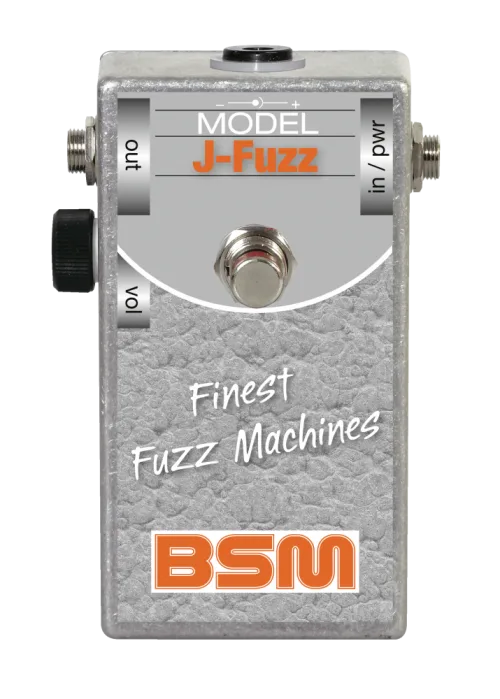

The BSM J-Fuzz Fuzz Machine is a stompbox fuzz pedal from BSM, a maker best known for its treble boosters. BSM describes it as "a faithful recreation of the old original Jennings Fuzz from the late 60's", the circuit that powered the early Vox-era fuzz sound. It is one of several fuzz machines in the BSM range, alongside the BSM FuzzBender Fuzz Machine and BSM Spectrum.1
What it does to your sound
BSM's own description of the J-Fuzz sets it apart from the harder-edged silicon fuzzes players may know. The maker says the original Jennings fuzz used two silicon transistors like most fuzz boxes of its time, "but had a much milder and rounder" character than its peers. Of the J-Fuzz itself, BSM reports: "With the volume control fully opened, the sound was warm, full and incredibly fat. A tone that reminds of old germanium" fuzzes.1
In other words, this is a fuzz for players chasing the rounder, vintage-flavored end of the fuzz pedal family rather than a splattery modern fuzz12.
Specifications
| Specification | Value |
|---|---|
| Type | Stompbox fuzz pedal1 |
| Circuit | Recreation of the Jennings Fuzz from the late 1960s1 |
| Transistors | Two silicon, NOS Japanese "Micro Electronics" types12 |
| Power | 9V battery or external 9V power supply1 |
| Current consumption | Approximately 2mA1 |
| Battery polarity | Negative pole is ground1 |
| Average output level | 5dBm1 |
| Maximum output voltage | 0.4V1 |
Power and output
The J-Fuzz runs on a 9V battery or an external 9V power supply, with a current consumption of approximately 2mA. That draw is low enough that it sits comfortably on any pedalboard supply. BSM adds one note for anyone powering it externally: "The negative pole of the battery is ground."1
BSM specifies that the negative pole of the battery is ground. Check the polarity of any supply you connect, as with most negative-tip pedals.1
On output, BSM gives an average output level of 5dBm and a maximum output voltage of 0.4V "when the strings are struck really hard".1
Placement in the signal chain
BSM's recommendation is simple: "the J-Fuzz should be connected in the signal path directly after the guitar."1 That is standard practice for fuzz circuits, which are sensitive to what feeds them, and it means the pedal goes ahead of buffers, wahs and time-based effects.
For a fuzz of this kind, that placement matters for a few practical reasons:
- The guitar's own signal shapes the fuzz response, so pickup strength and volume knob settings change what you hear.
- Buffers and wahs ahead of a fuzz can alter how the circuit clips.
- Time-based and modulation effects belong after the fuzz, not before it.
Where the circuit came from
The original circuit the J-Fuzz recreates has a named designer. BSM states: "This fuzz circuit was engineered by Dick Denney, and is one of his master pieces." Denney is the engineer associated with the Jennings organization, the company behind Vox, in the late 1960s.1
For questions about the pedal, BSM names its "tech-head and mastermind Mr. Bernd C. Meiser", who the maker says "would be happy to talk to you" by email or contact form.2
Videos
Wall of Sound
Questions
Does the BSM J-Fuzz run on a battery?
Yes. BSM states the J-Fuzz is powered by a 9V battery or an external 9V power supply, with a current consumption of approximately 2mA. The maker also notes that the negative pole of the battery is ground, which matters when connecting an external supply.
Where does the BSM J-Fuzz go in the signal chain?
BSM recommends connecting the J-Fuzz in the signal path directly after the guitar, before any other pedals. That placement is typical for fuzz circuits, which respond to the guitar's own signal.
Who designed the original Jennings fuzz circuit?
According to BSM, the fuzz circuit recreated in the J-Fuzz was engineered by Dick Denney, whom the maker describes as having made it one of his masterpieces.
What transistors does the BSM J-Fuzz use?
The J-Fuzz uses two silicon transistors. BSM says it acquired a supply of new old stock transistors from the Japanese company Micro Electronics and uses them exclusively in the J-Fuzz.
How loud is the BSM J-Fuzz output?
BSM gives the average output level as 5dBm, with a maximum output voltage of 0.4V when the strings are struck really hard.
Sources (2)
- J-Fuzz Fuzz Machine, BSM (treblebooster.net), 2025
- J-Fuzz Fuzz Machine, BSM (treblebooster.net), 2025